
KPMG Launches Bengaluru Sports Tech Hub as India’s Sports Industry Expands
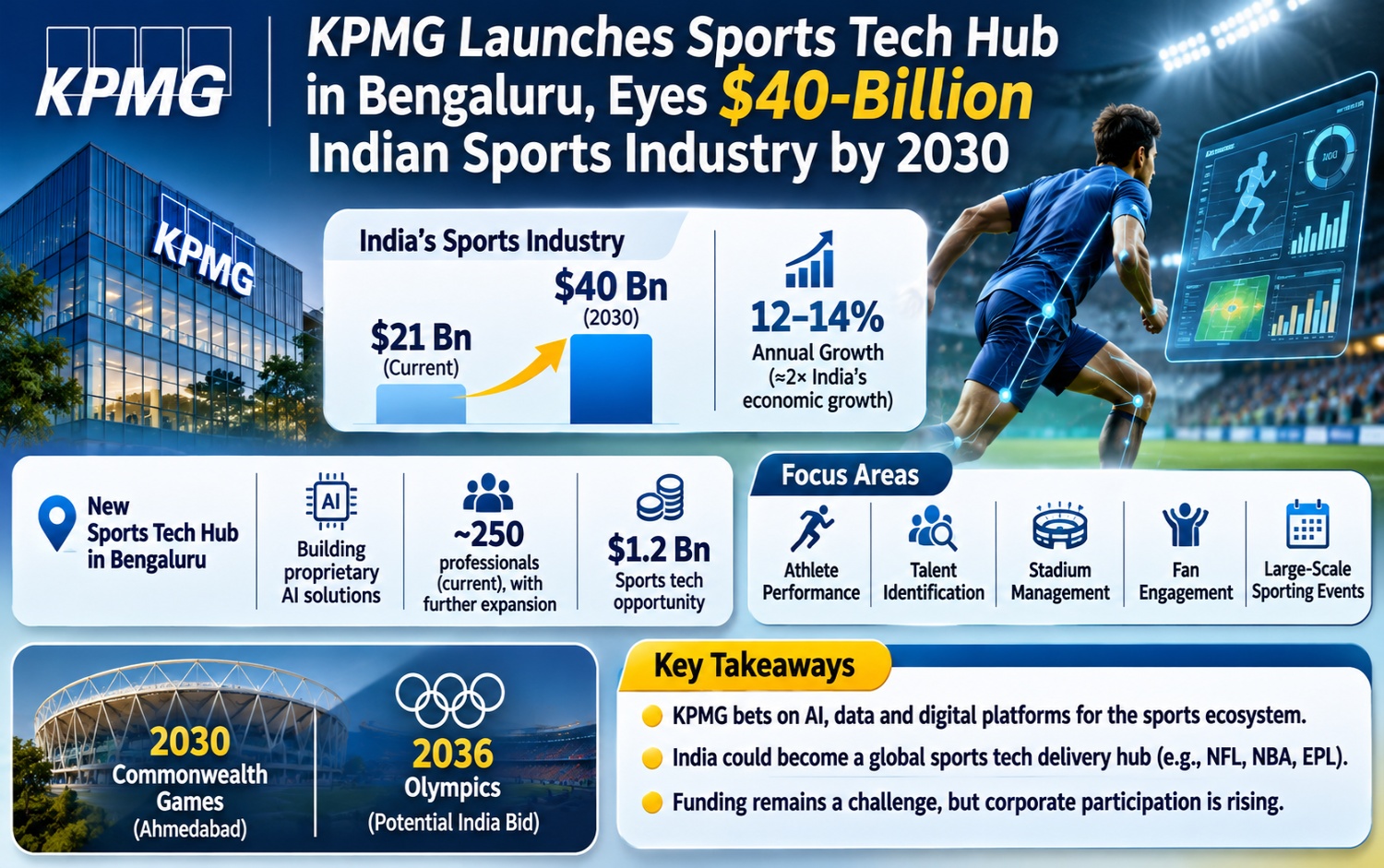
India’s sports industry is attracting fresh corporate investment as technology, artificial intelligence and digital innovation create new business opportunities. Joining this growing market, KPMG in India has launched a Sports Technology Hub in Bengaluru, aiming to capitalise on an industry projected to expand from approximately $21 billion currently to $40 billion by 2030.
Launched on November 13, the new hub will develop technology solutions for athlete performance, talent identification, stadium management, fan engagement and large-scale sporting events.
The move highlights how professional services companies are increasingly looking beyond traditional consulting towards technology-driven opportunities in India’s expanding sports ecosystem.
For investors, the development also signals emerging opportunities across sports analytics, AI platforms, digital infrastructure and sporting event management.
Track Live : NSE Option Chain — Live | BSE Option Chain — Live Sensex & Bankex Options Data Today

India’s Sports Industry Growing at 12-14% Annually
KPMG believes India’s sports industry is entering a period of accelerated expansion.
Speaking to Moneycontrol, Prasanth Shanthakumaran, Partner and Head of Sports Sector at KPMG in India, said the industry is currently growing at an annual rate of 12-14%, nearly twice the pace of overall economic growth.
“We are about $21 billion in the sports industry right now, growing at around 12 to 14 percent,” he said.
The upcoming 2030 Commonwealth Games in Ahmedabad and India’s potential bid to host the 2036 Olympics could further accelerate investments in sports infrastructure, technology and event management.
KPMG estimates that sports technology alone represents approximately $1.2 billion of the broader Indian sports industry.
The opportunity extends across government organisations, sporting federations, professional leagues, clubs, educational institutions and global capability centres.
India’s Sports Industry: Growth Opportunity
| Key Indicator | Estimated Value |
|---|---|
| Current Estimated Market Size | $21 billion |
| Projected Market Size by 2030 | $40 billion |
| Annual Growth Rate Cited by KPMG | 12–14% |
| Estimated Sports Technology Market | $1.2 billion |
Track Live : Nifty Levels Today | Sensex Levels Today
Sports technology creates a $1.2 billion opportunity in India
KPMG estimates that India’s sports technology market is worth approximately $1.2 billion.
The segment includes technology products and services that help sporting organisations improve performance, manage events, engage fans and generate commercial revenue.
The opportunities extend beyond professional cricket teams.
Potential customers include:
-
Government sports organisations.
-
National and state-level sporting federations.
-
Professional sports leagues.
-
Sports clubs and academies.
-
Educational institutions.
-
Stadium operators.
-
International sports organisations.
-
Sports-related global capability centres (GCCs).
This creates an opportunity for technology companies to provide services across the entire sports value chain.
For example, a sports federation can use athlete management software to monitor player development, while a professional league can deploy digital ticketing and analytics platforms to improve fan engagement.
The technology market also includes AI-powered scouting, performance tracking, computer vision, broadcasting solutions and commercial analytics.
KPMG Plans Proprietary AI Solutions and Workforce Expansion
A major focus of the Bengaluru Sports Technology Hub will be developing proprietary artificial intelligence solutions rather than relying entirely on external technology providers.
KPMG currently has approximately 250 professionals working across sports technology and related areas. The company plans to expand its workforce as business opportunities increase.
“The team is close to about 250 odd people right now working in sports tech across areas. And we see this going up as things work out,” Shanthakumaran said.
The company has already developed athlete management platforms and technology solutions for large sporting events.
Its athlete management systems use performance data to help coaches identify promising players from larger talent pools. AI capabilities can also support school sporting ecosystems by analysing historical performance and identifying potential athletes.
According to KPMG’s official announcement, the facility will showcase technology applications across several areas:
-
AI-powered fan engagement platforms.
-
Athlete performance analytics.
-
Computer vision-based training and match insights.
-
Smart stadium and venue management.
-
Digital ticketing and loyalty solutions.
-
Sponsorship measurement and commercial analytics.
-
Predictive maintenance.
-
Cybersecurity and data protection.
-
Sustainability solutions.
-
Generative AI-enabled content creation.
Read More : Rising Gold Prices Push 10 Jewellery Firms Toward IPOs; 8 Peers Raised Rs 3,547 Crore
Ahmedabad’s 2030 Commonwealth Games could accelerate sports technology investment
The upcoming 2030 Commonwealth Games in Ahmedabad could provide another growth opportunity for India’s sports technology industry.
India was officially confirmed as the host of the 2030 Commonwealth Games at the Commonwealth Sport General Assembly in Glasgow on November 26, 2025.
The event will be held in Ahmedabad and will mark the centenary edition of the Commonwealth Games.
According to Commonwealth Sport, the event is expected to feature between 15 and 17 sports.
Why are the Commonwealth Games important for sports technology?
Hosting an international multi-sport event requires extensive technological infrastructure.
Some of the areas where technology can play an important role include:
-
Athlete registration and accreditation.
-
Competition scheduling.
-
Venue and stadium management.
-
Ticketing and access control.
-
Real-time performance data.
-
Broadcasting and digital media.
-
Security and cybersecurity.
-
Transport and logistics.
-
Spectator engagement.
The Commonwealth Games could therefore create opportunities for Indian technology providers, consultants and infrastructure companies.
The event could also encourage investments in stadium modernisation, training facilities and digital sports infrastructure.
Commonwealth Sport reported in October 2026 that the Amdavad 2030 Organising Company had been incorporated on August 31, 2026, and that M. Thennarasan had been appointed its CEO.
Cricket continues to dominate India’s sports economy, but other sports are gaining ground
An important aspect of India’s sports industry is the concentration of commercial revenue in cricket.
According to KPMG’s 2025 Sportlight report, cricket contributes nearly 80% of India’s sports economy.
However, professional leagues and growing audience interest in other sports are gradually expanding the market.
Other sports creating commercial opportunities include:
-
Football.
-
Kabaddi.
-
Badminton.
-
Volleyball.
-
Hockey.
-
Tennis.
-
Women’s sports.
-
Chess.
The expansion of these sports is creating demand for athlete analytics, digital broadcasting, sponsorship management and fan engagement solutions.
For technology companies, a more diversified sporting ecosystem means opportunities beyond cricket-based platforms and services.
Sports manufacturing and infrastructure add further growth opportunities
KPMG’s earlier Sportlight report also highlighted two important segments of the Indian sports economy: sports goods manufacturing and sports infrastructure.
| Segment | Earlier KPMG assessment | 2030 projection |
|---|---|---|
| Sports goods manufacturing | $6.7 billion | $11 billion |
| Sports infrastructure investment | $2.7 billion | $6 billion
|
India Could Become a Global Technology Centre for Sports Organisations
KPMG is not limiting its ambitions to the domestic market.
The company sees an opportunity for India to become a technology and operational delivery centre for international sporting organisations, similar to its established role in global IT services.
Shanthakumaran highlighted potential opportunities involving the National Football League (NFL), National Basketball Association (NBA) and English Premier League (EPL).
“So NFL is running something, NFL’s back office, we can run the tech side and the operation side as well,” he said.
He added that India could become a technology centre for global sports entities.
Budget Constraints Remain a Challenge for Sports Technology Adoption
Despite the growth opportunity, limited budgets among Indian sports federations and organisations remain a significant challenge.
Technology adoption outside commercially successful sports such as cricket could take longer because many sporting bodies lack sufficient financial resources.
Shanthakumaran acknowledged that budget limitations remain a challenge but expects increasing corporate participation to support the sector.
Private companies are gradually investing in individual sports, infrastructure and technology, potentially creating additional funding opportunities.
KPMG has not disclosed a specific investment commitment for the Bengaluru hub. Funding is expected to come through its various service lines.
What KPMG’s Sports Tech Expansion Means for Investors
For investors, India’s sports technology industry represents an emerging opportunity rather than an established large-scale investment market.
IT services companies, AI developers, analytics providers, digital platform businesses and sports infrastructure companies could benefit as technology spending increases.
However, the pace of commercial adoption will depend on corporate sponsorship, government spending, sports federation budgets and the ability of technology providers to generate sustainable revenues.