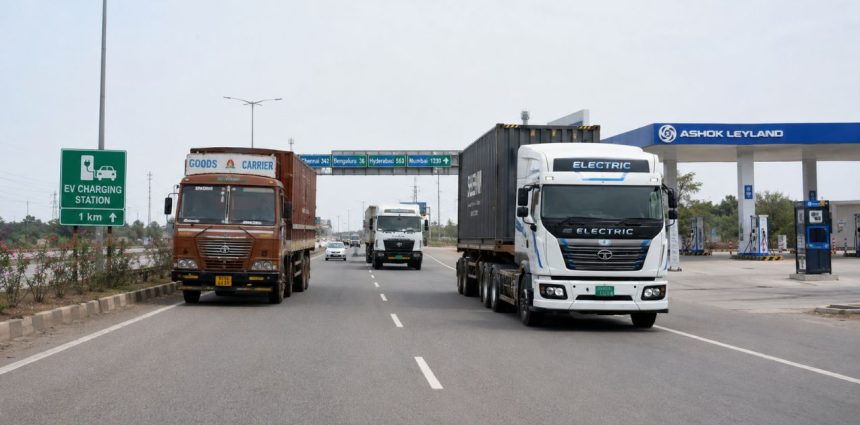
India’s freight sector is at an inflection point. With diesel prices breaching the psychologically critical ₹100-per-litre mark in 2026, the economics of running diesel-powered truck fleets have become increasingly difficult to justify for India’s largest industrial conglomerates. The result: a visible, accelerating pivot toward electric trucks, one now reflected in boardroom decisions, SEBI filings, and factory dispatch yards.
The Diesel Shock That Changed the Calculus
For years, fleet electrification in India was treated as an ESG aspiration, good on sustainability reports, and difficult to justify on spreadsheets.
The fuel shock of 2026 has fundamentally changed that narrative. Diesel crossing ₹100 per litre has done what years of incentives, awareness campaigns, and policy nudges could not; it has forced fleet operators to reconsider the basic mathematics of transportation. In logistics, mathematics always wins.
This shift is not incremental. Companies that once ran pilots are now signing multi-year contracts. Manufacturers that once struggled to find takers are now reporting enquiry pipelines dominated by large corporates.
Who Is Leading the Charge: Corporate Adopters at a Glance
| Company | Action Taken | Scale |
|---|---|---|
| UltraTech Cement | EV trucks for clinker transport (MP–Maharashtra) | 100 trucks; 75,000 MT/month |
| Paradeep Parivahan | 8-year EV fleet agreement with UltraTech | One of India’s largest trans-state EV fleets |
| Vedanta | Fleet electrification of light motor vehicles | 200+ EVs; ~14% of LMV fleet electrified |
| JSW Group | Entering EV truck manufacturing via JSW Greentech | Next-gen electric commercial vehicles |
| SAIL | Committed procurement under PM E-DRIVE | 150 e-trucks; 15% electrification target |
UltraTech Cement, India’s largest cement and ready-mix concrete manufacturer, has contracted approximately 100 EV trucks to transport 75,000 MT of clinker monthly from its Dhar Cement Works in Madhya Pradesh to its Dhule Cement Works in Maharashtra, covering a roundtrip distance of roughly 400 kilometres.
This makes UltraTech the first cement company in India to deploy EV trucks at this scale for long-distance transportation, with an eventual target of 500 electric trucks under the Government of India’s eFAST initiative.
In January 2026, Paradeep Parivahan Limited, a BSE SME-listed logistics company, signed an 8-year agreement with UltraTech Cement for EV-based bulk logistics services, deploying one of the country’s largest trans-state electric truck fleets for heavy-duty bulk transportation.
Check Live: VEDANTA Options Chart | Nifty Trader
Why Cement, Steel, and Ports Are the Early Movers
Not all freight segments are electrifying at the same pace. The sectors seeing the strongest early adoption share one key structural feature: predictable, fixed routes with centralised hubs that simplify charging logistics.
| Sector | Why EV Trucks Work Here |
|---|---|
| Cement | Fixed plant-to-grinding-unit routes; high diesel consumption |
| Steel & Mining | Captive logistics corridors; ESG mandates from investors |
| Ports | Short-haul terminal operations; zero-emission zone pressure |
| E-Commerce | Urban delivery density; last-mile route efficiency |
| FMCG Distribution | Hub-and-spoke model: centralised depot charging feasible |
Sanjeev Kumar, President, MHCV at Ashok Leyland, noted that these applications are particularly promising because vehicles operate within defined ecosystems where charging can be planned efficiently. The company is seeing strong interest from multinationals, large fleet operators, e-commerce and logistics firms, FMCG distributors, municipal institutions, and port operators.
Also Read: Govt Cuts Windfall Tax on Petrol, Diesel Exports From June 1; Oil Stocks Back in Focus
Manufacturers Report a Surge in Demand
The demand signal is now clear on the supply side. Blue Energy Motors, a manufacturer of heavy-duty electric and LNG trucks, reported that enquiries for its e-trucks have nearly tripled over the last four to five months, with the bulk of interest coming from large corporates and fleet operators.
“Businesses today are increasingly focused on building resilience against fuel price volatility and supply-chain uncertainties,” said Anirudh Bhuwalka, Founder and MD at Blue Energy Motors.
Ashok Leyland has commenced delivery of its AVTR 55T Electric, BOSS 19T Electric, and BOSS 14T Electric trucks to Billion Electric Mobility under a 180-vehicle order.
Government Policy Is Adding Tailwind
The Centre has put serious money behind freight electrification. In July 2025, the Ministry of Heavy Industries launched India’s first dedicated electric truck incentive scheme under PM E-DRIVE, allocating ₹500 crore to incentivise 5,600 electric trucks, with a maximum subsidy of ₹9.6 lakh per vehicle, conditional on scrapping old diesel trucks, and a dedicated ₹100 crore for 1,100 e-trucks in Delhi alone.
| PM E-DRIVE E-Truck Scheme — Key Parameters | |
|---|---|
| Total Outlay (e-trucks) | ₹500 crore |
| Target Deployment | 5,600 e-trucks |
| Maximum Incentive | ₹9.6 lakh per vehicle |
| Delhi Allocation | ₹100 crore (1,100 e-trucks) |
| Eligible Categories | N2 (3.5–12T) and N3 (12–55T) |
| Battery Warranty | 5 years / 5 lakh km |
| Key Target Sectors | Cement, steel, ports, logistics |
Although e-trucks currently cost 2–3.5 times more to purchase than equivalent diesel trucks, lower operating and maintenance costs narrow the total cost of ownership gap to roughly 1.2–1.5 times, and PM E-DRIVE subsidies help bridge this gap further.
The Registration Data Tells the Story — With an Important Caveat
According to the International Energy Agency (IEA), India’s electric truck registrations increased fourfold, from around 200 units in 2024 to nearly 800 units in 2025. The momentum is continuing into 2026 on the back of fresh corporate commitments and policy disbursements.
India’s broader electric commercial vehicles market was valued at USD 6.3 billion in 2025 and is projected to grow at a CAGR of 23.59% through 2034, according to IMARC Group estimates.
| India Electric Truck Registrations (IEA Data) | |
|---|---|
| 2024 | ~200 units |
| 2025 | ~800 units (4x growth) |
| ECV Market Size (2025, IMARC) | USD 6.3 billion |
| Projected CAGR (2026–2034, IMARC) | 23.59% |
However, context matters: India sold nearly 4,20,000 trucks in 2025 alone, making 800 electric registrations a market penetration of under 0.2%. The sector is firmly at the proof-of-concept stage, not mass-market inflection.
The Headwinds: Why Scale Remains an Open Question
The enthusiasm at the corporate level masks a more complicated reality on the ground. Three structural barriers remain unresolved.
| Challenge | Detail |
|---|---|
| Upfront cost gap | E-trucks cost 2–3.5x more than diesel equivalents; subsidies narrow but don’t close this gap. |
| Scrappage condition | PM E-DRIVE incentives require scrapping existing diesel trucks, difficult for operators on thin margins |
| Charging infrastructure | Outside industrial corridors and metro hubs, charging density remains inadequate for long-haul operations |
“Truck prices have tripled over the last decade while freight rates have risen barely 20%,” said Chirag Katira, General Secretary of the All India Motor Transport Congress. “For most fleet owners today, the business is about survival, not expansion.”
The scrappage-linked incentive structure, he argued, makes the scheme structurally inaccessible to the majority of India’s fragmented, small-operator trucking base.
The IEA itself cautioned that electrification of trucks in India is expected to remain relatively slow due to higher upfront costs and operational barriers, even as it acknowledged the impressive 4x registration growth in 2025.
The corporate adoption wave is real. But it is, for now, a large-company phenomenon playing out on fixed industrial corridors. The mass-market transition, involving India’s millions of independent truckers, remains a policy and financing problem that subsidies alone have not solved.
The Road Ahead
Industry executives expect progress over the next two to three years as battery energy density improves, charging corridors expand, and total cost of ownership continues to narrow.
Innovative ownership models, including Battery-as-a-Service, battery swapping, and EV-specific fleet financing, could broaden adoption beyond large corporates to mid-sized operators. Policy continuity and dedicated EV freight corridors will be critical.
The direction is clear. The pace remains contested.
Disclaimer: This article is for informational purposes only and does not constitute investment advice. Readers are advised to consult a SEBI-registered financial advisor before making any investment decisions. NiftyTrader does not hold positions in any of the companies mentioned above.