
Indian IT stocks fell up to 8% on Friday, June 19, after Accenture trimmed its FY26 revenue guidance and flagged weak discretionary spending. Infosys hit a five-year low and the Nifty IT index slid to a three-year-plus low.
Key Takeaways
- Nifty IT crashed as much as 6% to about 27,012 — its lowest in more than three years. All five of the day’s biggest Nifty 50 losers were IT names.
- Infosys cracked about 8% to roughly ₹1,035, a five-year low, and was the single worst Nifty 50 performer. TCS fell ~6.5% to near ₹2,060, closing in on a six-year low.
- The trigger was Accenture’s overnight Q3 FY26 report. It cut FY26 local-currency revenue growth guidance to 3–4% from 3–5%, and its stock plunged ~16–17%, its worst single session since 2016.
- Part of Accenture’s weakness is Middle East-specific (a ~$400 million Q3 hit from the Iran conflict); the rest reflects cautious enterprise spending, a mixed but cautious read-through for Indian IT’s FY27.
- What to watch: option positioning and FII-DII flows will show whether this is a one-day shock or the start of a fresh down-leg in IT.
Indian IT was the worst place to be on Dalal Street on Friday. The Nifty IT index tumbled as much as 6% in early trade to around 27,012, its lowest level in more than three years, as every large software exporter sold off after Accenture’s weak guidance overnight. All five of the day’s biggest Nifty 50 losers were IT stocks.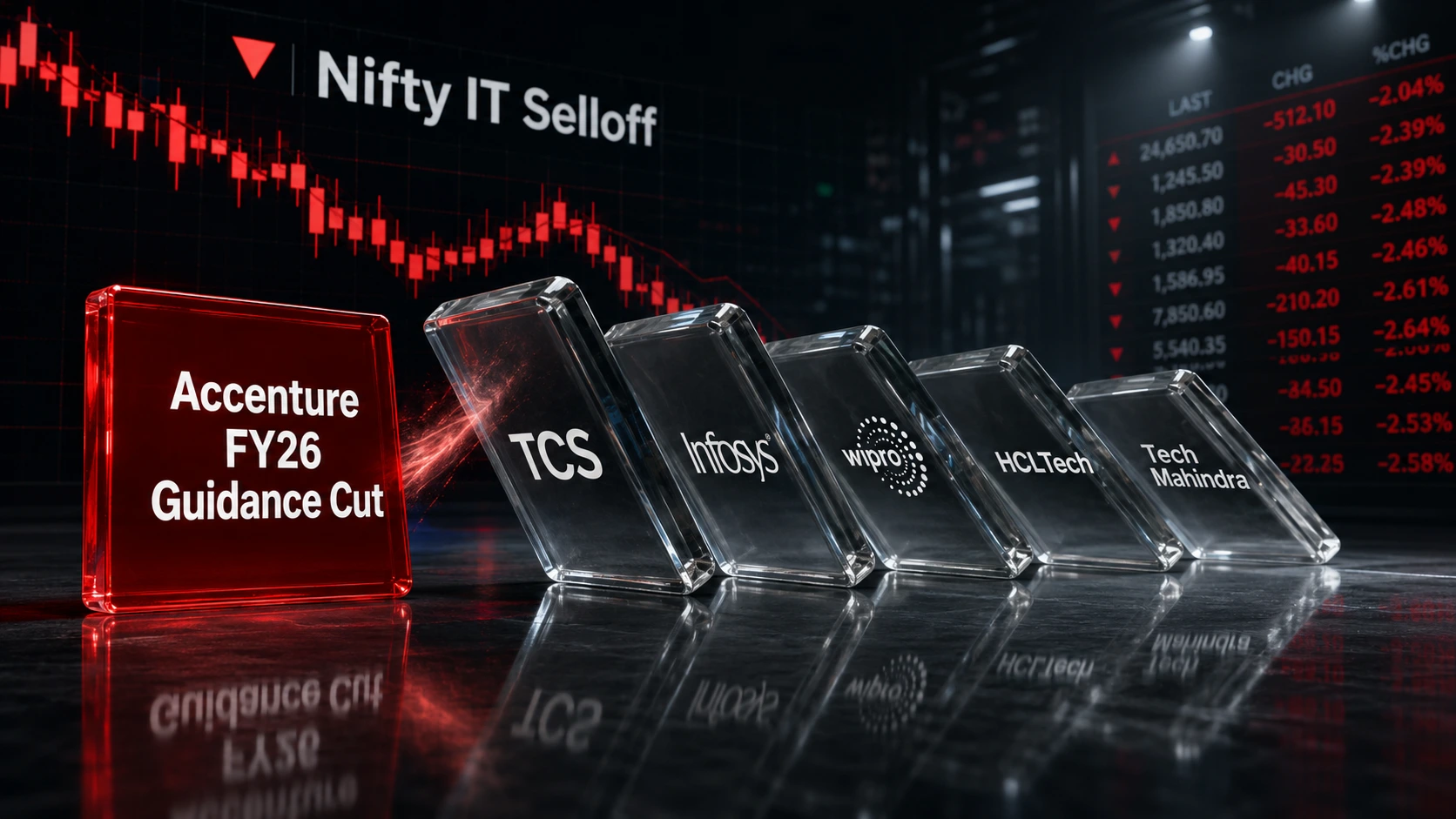
How Indian IT stocks reacted
Infosys led the fall, cracking about 8% to roughly ₹1,035, a five-year low, and emerging as the worst performer on the Nifty 50. TCS sank about 6.5% to near ₹2,060, closing in on a six-year low. Large- and mid-cap peers followed it lower.
| Stock | Approx. fall (June 19) | Day’s low (₹) | Notable level |
|---|---|---|---|
| Infosys | ~8% | 1,035 | 5-year low; top Nifty 50 loser |
| TCS | ~6.5% | 2,060 | Near 6-year low |
| Tech Mahindra | ~6% | — | — |
| Mphasis | ~6% | 2,200 | — |
| HCLTech | ~5.5% | — | — |
| Wipro | ~4% | — | ADR fell ~3.6% overnight |
| Nifty IT (index) | ~5–6% | 27,012 | 3-year-plus low |
Source: NSE/BSE intraday data, June 19, 2026 (via Business Today / HDFC Securities). Figures are intraday and may differ from the official close.
The slide had been signalled overnight: Infosys ADRs fell about 10% in US trade and Wipro ADRs slipped ~3.6%.
What spooked the Street: Accenture’s Q3 and a guidance cut
Accenture is the global bellwether for IT services, so Indian investors read its results closely. After the US close on June 18, the company reported fiscal Q3 (ended May 31) earnings that beat on profit but missed on revenue and bookings, and, crucially, it lowered the top end of its full-year outlook.
| Metric | Q3 FY26 | Read |
|---|---|---|
| Adjusted EPS | $3.80 (+9% YoY) | Beat consensus (~$3.72) |
| Revenue | $18.7 bn (+6% USD, +3% local currency) | Slightly below estimate (~$18.78 bn) |
| New bookings | $19.32 bn (−2% USD) | First decline in recent quarters |
| Operating margin | 17.0% (+20 bps) | Profitability still expanding |
| Q4 FY26 revenue guide | $17.75–18.4 bn | Implies just 1–5% local-currency growth |
| FY26 revenue growth | cut to 3–4% (from 3–5%) LC | The headline negative |
Source: Accenture Q3 FY26 results & Form 8-K (SEC), June 18, 2026; Street estimates per LSEG/Reuters.
Accenture’s own stock paid the price, sliding roughly 16–17% to close near $128, its steepest single-session drop since 2016. The damage spread across the sector overnight: Cognizant fell about 11% and Capgemini around 9%.
It wasn’t only weak demand
Here is the nuance the headlines miss. Management said part of the shortfall was geopolitical: the Iran conflict knocked an estimated $400 million off Accenture’s Middle East business in the quarter, and it expects more pressure in Q4.
The rest is structural, cautious enterprise spending, delayed projects, a slowdown in its US federal unit (about a 1% drag on FY26), and the slow conversion of AI bookings into actual revenue.
For Indian IT, which is far more US- and Europe-facing than Middle East-exposed, that mix matters. The company-specific and regional pieces won’t all carry across, but the discretionary-spending caution will.
Why Accenture moves Indian IT
Accenture and India’s top exporters chase the same large digital-transformation contracts from the same client base, much of it in North America.
Indian firms typically sit on the execution side of those deals, so when Accenture signals that clients are slowing discretionary spend, the market assumes lower deal flow for Infosys, TCS and Wipro in the same window.
With about $72 billion in trailing revenue, Accenture’s commentary is treated as a proxy for the whole offshore industry.
The read-through for FY27
Analysts were quick to flag the risk to Indian IT’s next financial year. Accenture’s soft Q4 guide implies that macro-led demand issues could persist into the first half of Indian FY27 (April–September 2026), brokerage Equirus noted. Wipro looks most exposed, Goldman Sachs has warned FY27 could be its fourth straight year of revenue decline.
Even Accenture’s aggressive deal-making drew scepticism: it announced $4.18 billion of cybersecurity acquisitions and lifted FY26 acquisition spend to $9 billion from $5 billion, but Morgan Stanley had already cut its rating, questioning whether product-led M&A delivers the revenue visibility that traditional services once did.
For context, Infosys is now down more than a third from its December 2025 high near ₹1,655, a reminder of how sharply sentiment has soured on the sector this year.
What traders should watch next
A one-day gap-down on a global cue is not, by itself, a trend. The cleaner signal is positioning.
On NiftyTrader’s FII-DII tracker, watch whether foreign flows turn into a multi-day selling streak rather than reacting to a single print.
In derivatives, track open-interest build-up and put-call shifts in Infosys and TCS and whether option writers move to defend lower strikes across the Nifty IT names, that tells you if smart money sees more downside or is fading the panic.
Track live institutional flows on the NiftyTrader FII-DII page and check fresh option positioning on the NSE Option Chain before the next session.
Bottom line
The IT sell-off is real, but it is part global cue, part regional shock and part a deeper question about how quickly AI spending turns into IT-services revenue.
Accenture’s guidance cut keeps the discretionary-spend cloud over Indian IT into the first half of FY27, and with Infosys and TCS sitting at multi-year lows, the market is already pricing in caution.
Whether this is a bottom or another leg down will be decided less by one day’s headlines and more by deal flow, FY27 commentary from the Indian majors, and how institutions position from here.
Disclaimer: This article is for information only and is not investment advice. All figures are intraday and should be verified against primary exchange and company sources.