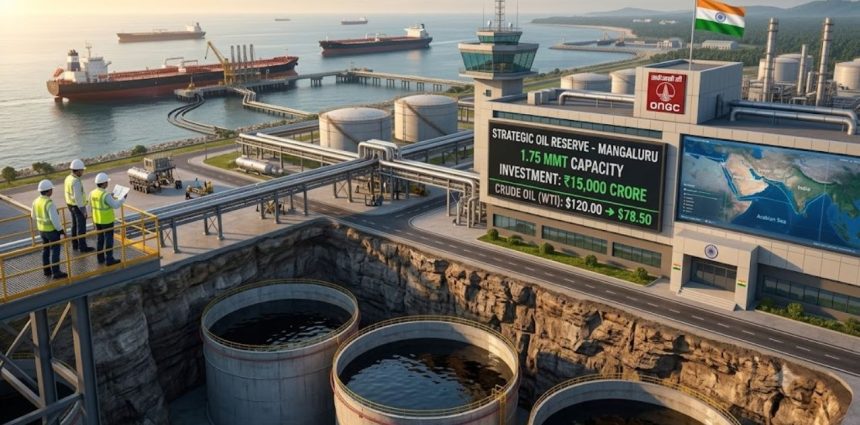
The Centre has directed ONGC to build and fill a 1.75-million-tonne strategic crude reserve at Mangaluru, an outlay of roughly ₹15,000 crore, the first time a state-run oil major, rather than the usual government SPV, has been handed an emergency stockpile.
Key Takeaways
- ONGC has been asked to build and fill a 1.75 million tonne (MMT) strategic petroleum reserve at Mangaluru, an estimated ₹15,000 crore (about $1.6 billion), roughly ₹5,000 crore to build and ₹10,000 crore to fill at current prices.
- It is the first time a PSU oil producer (not the state SPV, ISPRL) has been directed to develop a strategic reserve. ONGC already owns the land.
- The push follows the 28 February Iran war, which sent Brent from ~$72 to nearly $120 before collapsing back to ~$78, making this a relatively cheap moment to fill a reserve.
- India holds far less strategic crude than its peers, about 21 million barrels versus China’s ~1,397 million (US EIA).
- For ONGC shareholders, the open question is cost recovery: the structure and commercial terms of a strategic, non-revenue asset are still unclear.
A national reserve, built on a company’s balance sheet
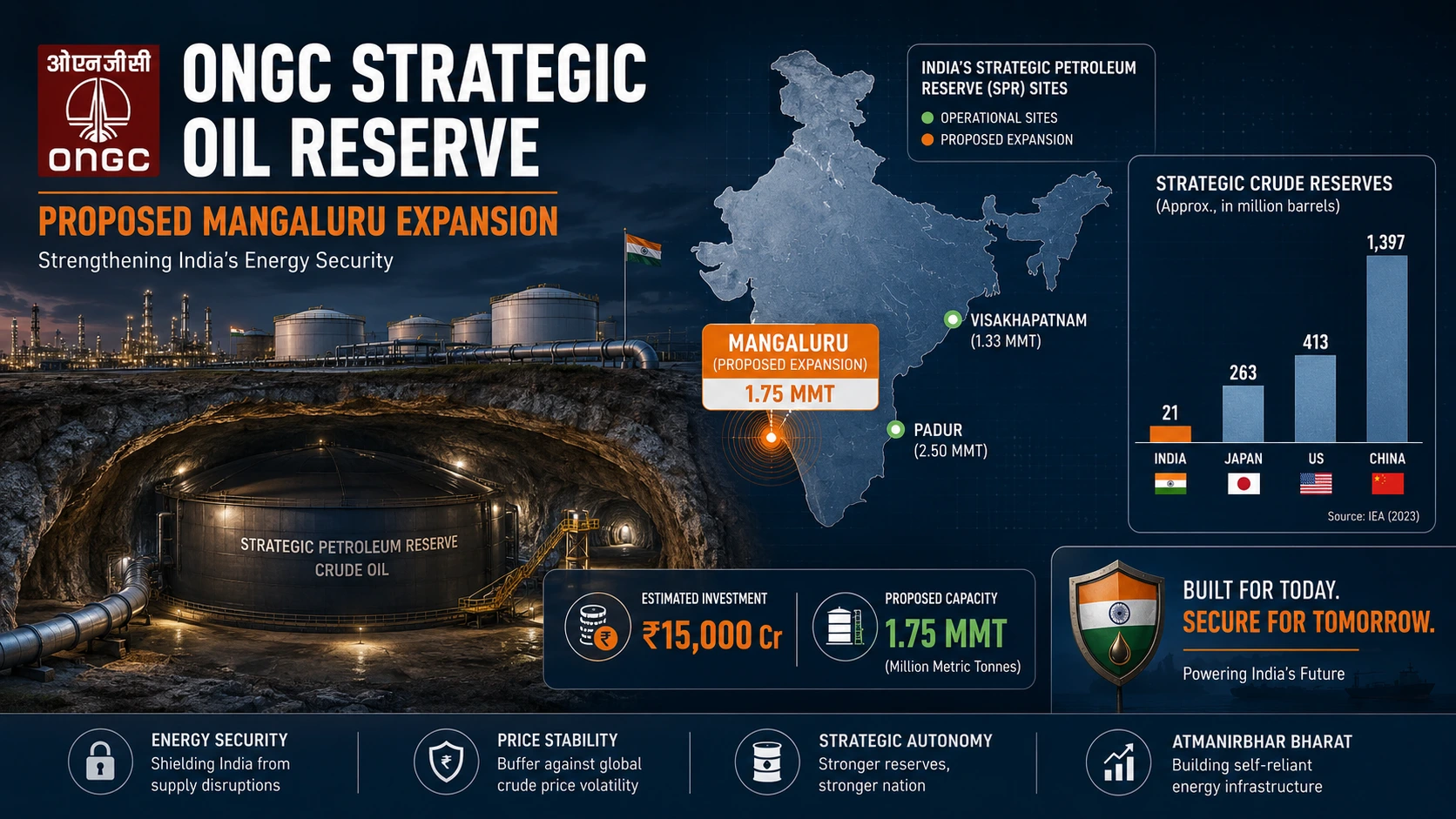
The government has asked Oil and Natural Gas Corporation (ONGC) to build and stock India’s next strategic petroleum reserve (SPR), a 1.75 MMT underground cavern at Mangaluru that could cost the company close to ₹15,000 crore, according to people familiar with the plan first reported by The Economic Times.
ONGC already owns the land; the spend splits into roughly ₹5,000 crore of construction and about ₹10,000 crore to buy the crude that fills it.
What makes this notable is the who, not just the how much. India’s three existing strategic caverns were funded by the government and are owned and run by Indian Strategic Petroleum Reserves Ltd (ISPRL), a state-owned special purpose vehicle.
This is the first time a listed oil major has been asked to develop one. The reports did not spell out how ONGC would recover the investment or whether the facility would be purely strategic or carry a commercial component.
| The proposed ONGC facility | Detail |
|---|---|
| Location | Mangaluru (ONGC-owned land) |
| Capacity | 1.75 MMT (~13 million barrels) |
| Construction cost | ~₹5,000 crore |
| Cost to fill with crude | ~₹10,000 crore |
| Total estimated outlay | ~₹15,000 crore (~$1.6 billion) |
| Capacity added to national SPR | ~one-third (1.75 of 5.33 MMT) |
Check Live: OIL & NATURAL GAS CORPORATION Share Price Chart
Why now: the Iran war exposed a thin buffer
The trigger was geopolitics. The US and Israel struck Iran on 28 February 2026, and the retaliation that followed put the Strait of Hormuz, the chokepoint for roughly a fifth of seaborne oil, squarely in the firing line. Brent climbed from about $72 a barrel just before the war to nearly $120 at its March peak.
India, which imports more than 80% of its crude, scrambled to secure cargoes to keep refineries running. China, sitting on the world’s largest strategic stockpile, did the opposite; it leaned on its reserves and cut May crude imports by roughly a third from pre-war levels. That contrast is exactly what prompted New Delhi to ask ONGC to add storage.
Here is the part the original wire copy missed and the part that matters most for traders: the war premium has since drained away.
Brent had slid back to around $78 by 18 June, near its late-February level, after Washington and Tehran signed an interim peace deal and shipping through Hormuz began to normalise, a fall of about 35% from the peak.
That makes filling a reserve now far cheaper than it would have been in March, echoing 2020, when India bought crude near $19 a barrel during the COVID crash to top up its caverns.
How India’s reserve stacks up
Even after this addition, India’s cushion is modest. The existing network covers only about 9–10 days of national demand; the International Energy Agency benchmark for member countries is 90 days of imports.
| India’s SPR network | Capacity | Status |
|---|---|---|
| Visakhapatnam (Andhra Pradesh) | 1.33 MMT | Operational (ISPRL) |
| Mangaluru (Karnataka) | 1.50 MMT | Operational (ISPRL) |
| Padur (Karnataka) | 2.50 MMT | Operational (ISPRL) |
| Phase-I total | 5.33 MMT | ~9–10 days of demand |
| Chandikhol (Odisha) | 4.00 MMT | Phase-II, PPP (yet to be awarded) |
| Padur extension | 2.50 MMT | Phase-II, PPP (Megha Engineering, as reported) |
| Proposed ONGC cavern, Mangaluru | 1.75 MMT | New directive |
In global terms the gap is stark. India’s strategic holdings are a rounding error next to China’s, on US Energy Information Administration data cited by ET:
| Country | Strategic crude held (approx.) |
|---|---|
| China | ~1,397 million barrels |
| United States | ~413 million barrels |
| Japan | ~263 million barrels |
| India | ~21 million barrels |
India also softened its purist stance in 2021, letting ISPRL use up to half its capacity commercially, leasing 30% to refiners and traders and trading with 20% of the stored crude.
Phase-II reserves at Chandikhol and a second Padur cavern were cleared the same year on a public-private partnership basis, with viability gap funding capped at 60% of cost.
What it means for ONGC and the stock
This is where NiftyTrader readers should focus.
ONGC closed near ₹248 on 16 June, sitting close to its 52-week low of ₹228.61 and well below the ₹307.50 high, down around 5% over the year, despite a strong Q4 in which net profit jumped 45.6% to ₹10,819 crore. The stock trades on a single-digit P/E of roughly 9.
A ₹15,000 crore commitment is material, about 5% of ONGC’s ~₹3.06 lakh crore market value.
There is a genuine tension here. As an upstream producer, ONGC’s earnings rise and fall with crude realisations, and the very price collapse that makes the reserve cheap to fill also trims the company’s top line.
Layer on a large, strategic, non-commercial asset, and the natural question from the market is how the company earns a return on it.
Watch closely for whether the final structure is purely strategic or includes a commercial leasing element, that detail will shape how investors read the capex.
Track how the F&O desk is positioning on this name with ONGC’s live option chain and open interest, and watch institutional flows on the FII-DII activity dashboard.
Bottom line
The directive marks a quiet shift in how India funds energy security, moving part of the bill onto a PSU’s balance sheet rather than the exchequer’s. Strategically it is sound and well-timed, with crude back near pre-war levels.
But for ONGC shareholders the story is less about the geopolitics and more about returns: until the cost-recovery mechanism and the strategic-versus-commercial split are clear, the ₹15,000 crore reads as an obligation, not an opportunity.
FAQs
How much oil does India hold in strategic reserves?
India’s three operational caverns hold up to 5.33 MMT, enough for roughly 9–10 days of national demand, far short of the IEA’s 90-day import-cover norm. Commercial inventories held by refiners add further cushion.
Why is ONGC building this and not ISPRL?
ISPRL, a government SPV, built and runs the existing three reserves. This is the first time a state-run oil producer has been directed to develop an SPR, using its own land and balance sheet, a new funding model for India.
Is lower crude good or bad for ONGC?
It cuts both ways. As a producer, ONGC earns less per barrel when crude falls, pressuring profits. But cheaper crude also makes filling a strategic reserve less expensive, a mixed picture for the stock right now.
Disclaimer: This article is for educational and informational purposes only. It is not investment advice or a recommendation to buy, sell or hold any stock or commodity. Please consult a registered financial advisor before making investment decisions.