Maruti Suzuki FY27-FY31: Sets Sights on 40 Lakh Capacity, 7 New SUVs and EV Push
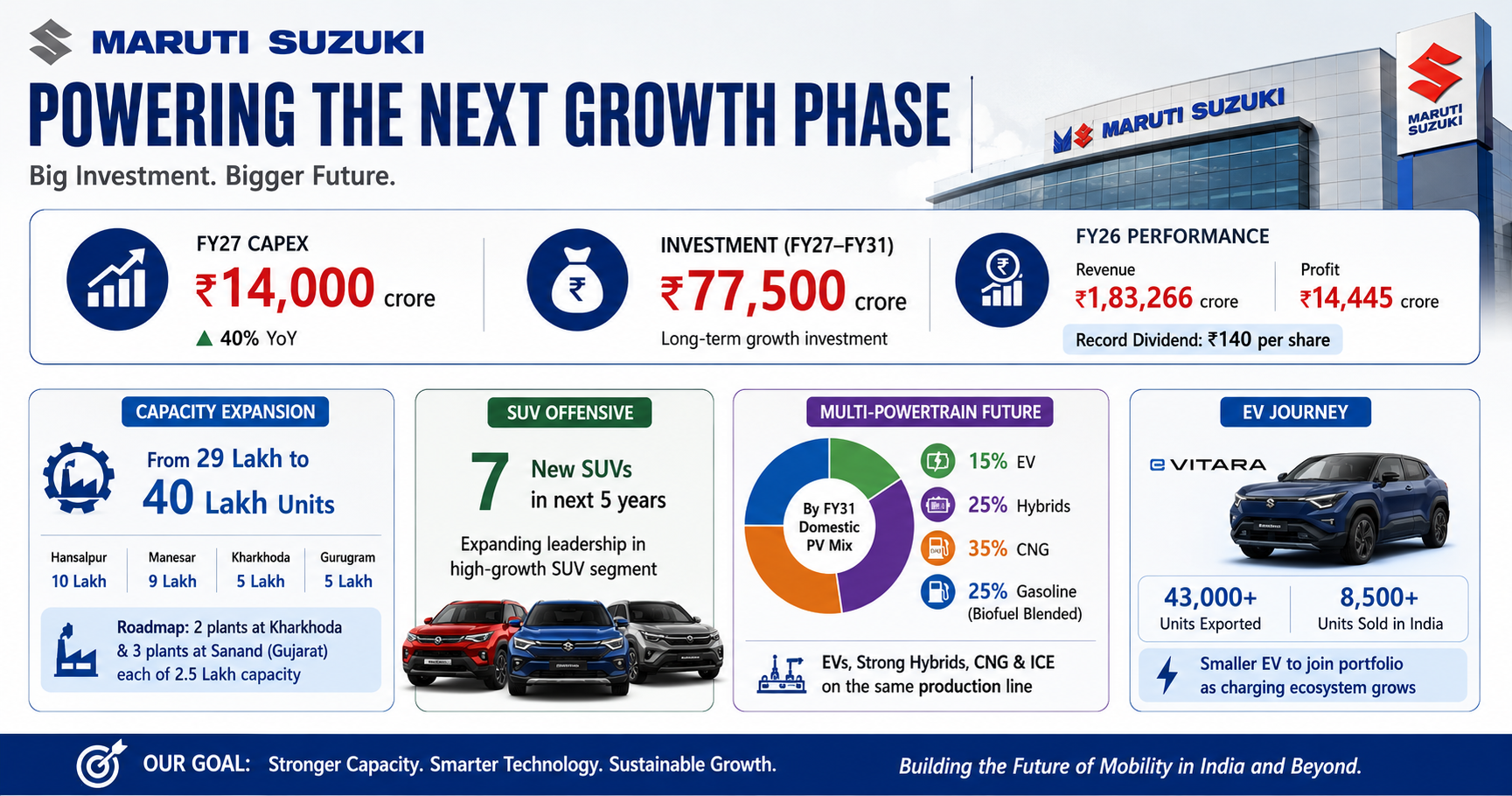
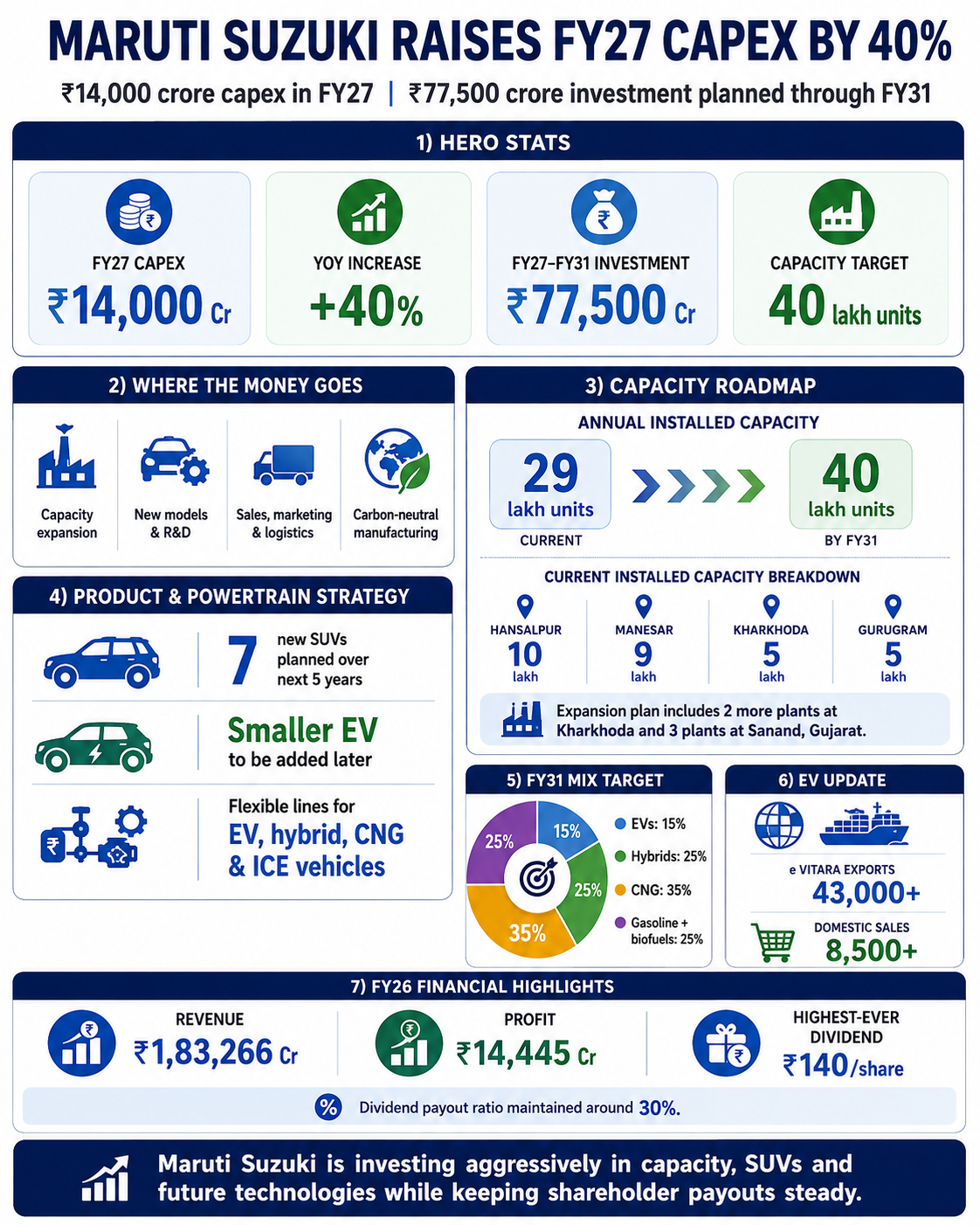
Maruti Suzuki is preparing for a much bigger investment cycle, and the numbers are difficult for investors to ignore. The automaker plans to raise FY27 capital expenditure by 40% to ₹14,000 crore and commit a total ₹77,500 crore investment through FY31.
The move comes as Maruti Suzuki looks beyond its traditional small-car dominance and prepares for higher production capacity, more SUVs, electric vehicles and hybrid models. For investors, the key question is whether this aggressive spending can translate into stronger volumes, market share and long-term earnings growth.
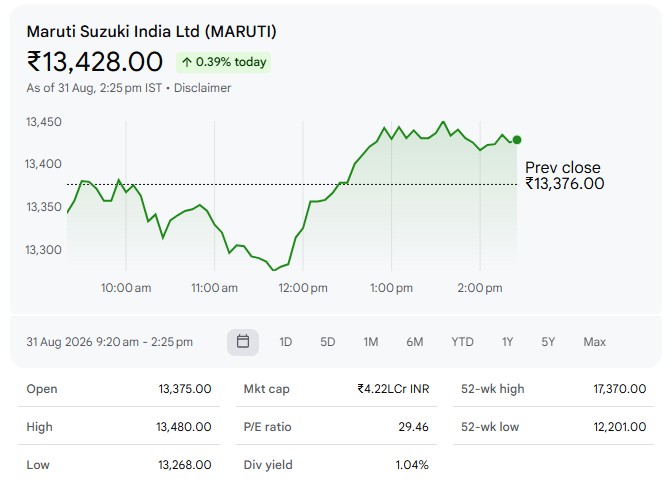
Track Live : NSE Option Chain — Live
Capex & Financial Footprint
- FY27 Capital Expenditure: Increasing by 40% year-on-year to ₹14,000 crore (up from approximately ₹10,000 crore in the previous fiscal year).
- Long-Term Investment: A planned capital deployment of ₹77,500 crore running through FY31 to facilitate capacity, R&D, and new infrastructure.
- Fiscal Performance: Achieved its highest-ever consolidated revenue of ₹1,83,266 crore and a profit of ₹14,445 crore for the preceding period, enabling a record dividend payout of ₹140 per share.
Maruti Suzuki FY27-FY31: Maruti Suzuki is targeting a 40 lakh-unit production capacity
One of the biggest takeaways for investors is Maruti Suzuki’s production expansion plan.
The company has now reached an annual installed production capacity of 29 lakh vehicles after commissioning its fourth plant at Hansalpur in Gujarat and second plant at Kharkhoda in Haryana.
The Hansalpur facility has an annual capacity of 10 lakh units, while Manesar has capacity for 9 lakh units. Kharkhoda and Gurugram each have capacity of 5 lakh units.
Maruti Suzuki now wants to take total capacity to 40 lakh units.
The roadmap includes two additional plants at Kharkhoda and three plants at the upcoming Gujarat facility in Sanand. Each planned plant is expected to have capacity of 2.5 lakh units.
For investors, higher capacity could provide Maruti Suzuki with greater room to respond to rising demand, particularly if its SUV, hybrid and EV portfolios gain traction.
1. Scaling to 40 Lakh Production Capacity
- Current Footprint: The company’s installed capacity has already scaled to 29 lakh (2.9 million) units annually, bolstered by recent expansions at the Kharkhoda plant in Haryana and a fourth production line at Hansalpur, Gujarat.
- The 40 Lakh Target: Multi-phase infrastructure work—anchored by an upcoming greenfield facility at Sanand, Gujarat—will systematically elevate total capacity to the 4 million mark.
Seven new SUVs could change Maruti Suzuki’s market strategy
Maruti Suzuki is also accelerating its SUV strategy, with seven new SUVs planned over the next five years.
The company currently sells five SUV models — Fronx, Brezza, Jimny, Grand Vitara and Victoris.
The expansion is important because SUVs have become a major battleground for Indian passenger vehicle companies. Maruti Suzuki is attempting to strengthen its position in this segment while maintaining its traditional advantage in small cars.
The company currently commands an 83% share of the small-car market during April-July FY27. Small-car volumes also increased 63% year-on-year during the period.
“There is a huge potential for small cars in future as household incomes continue to grow,” Takeuchi said.
The strategy therefore appears to be two-pronged: protect its small-car leadership while using new SUVs to capture additional market share.
Track Live : BSE Option Chain — Live Sensex & Bankex Options Data Today
2. A 7-SUV Product Offensive
- A New Micro-SUV (Codenamed Y43): Positioned below the Fronx, this sub-4 meter vehicle is engineered specifically to rival the Tata Punch and Hyundai Exter.
- A 3-Row Premium Family SUV: Expected to be a larger, three-row iteration of the Grand Vitara.
- Mid-Life Lifecycle Updates: Comprehensive mid-life refreshes for reigning market favorites like the Fronx, Brezza, and Jimny.
Maruti Suzuki is preparing for EVs, hybrids and CNG
The ₹77,500 crore investment plan also reflects the changing technology landscape.
Maruti Suzuki said its new manufacturing plants are being designed with flexibility to produce EVs, strong hybrids, CNG and internal combustion engine vehicles on the same production line.
By FY31, the company expects its domestic passenger vehicle volumes to comprise 15% EVs, 25% hybrids, 35% CNG and 25% gasoline blended with biofuels.
Maruti Suzuki entered the EV market with the e Vitara in FY26. The company has exported more than 43,000 units and sold around 8,500 units domestically so far.
Takeuchi also indicated that a smaller electric car could eventually be added as India’s charging infrastructure develops.
Read More : Max Estates Residential Market Push: Rs.420 Crore Deal Secures 84.71 Acres in Delhi
3. The Bigger EV & Multi-Powertrain Push
- 6 Lakh Battery EVs (BEVs): Following the debut of its flagship e Vitara, the company plans to systematically launch 4 new EVs to achieve market leadership in the BEV segment by 2031. This includes the highly anticipated family-oriented electric MPV (codenamed YMC).
- 10 Lakh Hybrids & Alternative Fuels: Hybrids, existing CNG models, flex-fuel vehicles, and compressed biogas (CBG) variants will cover the remaining green portfolio. To back this up, Maruti is investing ₹561 crore into setting up four biogas plants to support carbon-neutral manufacturing.
What the Maruti Suzuki investment means for investors
For shareholders, the increased capex has both opportunities and risks.
On the positive side, higher investment could strengthen Maruti Suzuki’s production capacity, SUV portfolio, EV capabilities and technology pipeline. Successful execution could support higher sales volumes and strengthen the company’s long-term competitive position.
However, investors will also watch whether the large investment translates into adequate returns. Higher capital expenditure can put pressure on free cash flow in the near term, making execution, capacity utilisation and new-model demand particularly important.
The company is nevertheless maintaining its dividend commitment. Maruti Suzuki follows a dividend payout policy of 18–40% of profit and said it is maintaining a payout of around 30% despite rising capital expenditure.
For FY26, the board recommended a record ₹140 per share dividend, while consolidated revenue reached ₹1,83,266 crore and profit stood at ₹14,445 crore.
Here’s what happened today and why traders reacted
At its 45th Annual General Meeting, Maruti Suzuki India Managing Director and CEO Hisashi Takeuchi outlined the company’s ambitious investment roadmap.
“For FY27, we have planned a 40% jump in capital expenditure in a single year from around ₹10,000 crore last year to ₹14,000 crore this year,” Takeuchi said.
He added that Maruti Suzuki has planned ₹77,500 crore of capex from FY27 to FY31.
The planned investment will cover capacity expansion, new model development, research and development, plant maintenance, sales and marketing infrastructure, logistics and carbon-neutral manufacturing initiatives.
That makes the capex announcement more than just a spending increase. It signals that Maruti Suzuki is preparing its business for a significantly different product and production mix over the next five years.
What could move Maruti Suzuki shares in the coming days
The market is likely to focus on several developments following the AGM.
First, investors will track whether the ₹14,000 crore FY27 capex begins translating into higher production and sales. Second, the launch pipeline of seven SUVs could become an important trigger for Maruti Suzuki’s market share.
EV sales will also remain closely watched. The company’s ability to introduce a smaller EV at the right price and timing could determine how quickly it gains ground in India’s electric car market.
For traders, the immediate focus may remain on sentiment around the aggressive investment plan. For long-term investors, however, the bigger story is whether ₹77,500 crore of investment through FY31 can create a larger, more diversified Maruti Suzuki with stronger SUV, hybrid and EV businesses.