Need To Know
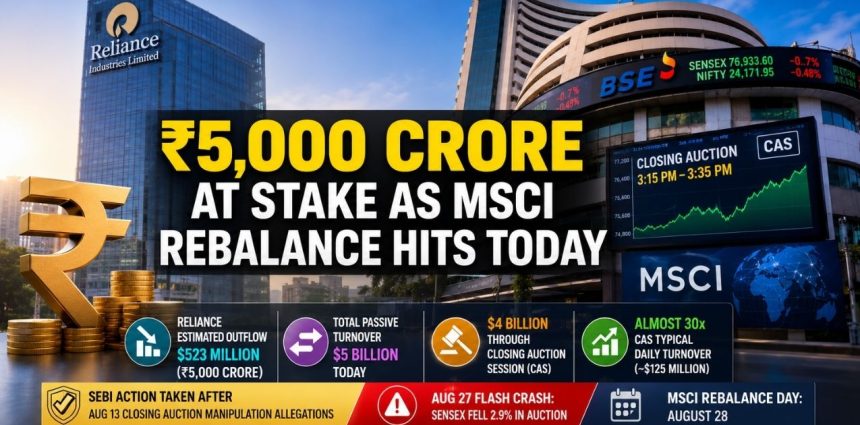
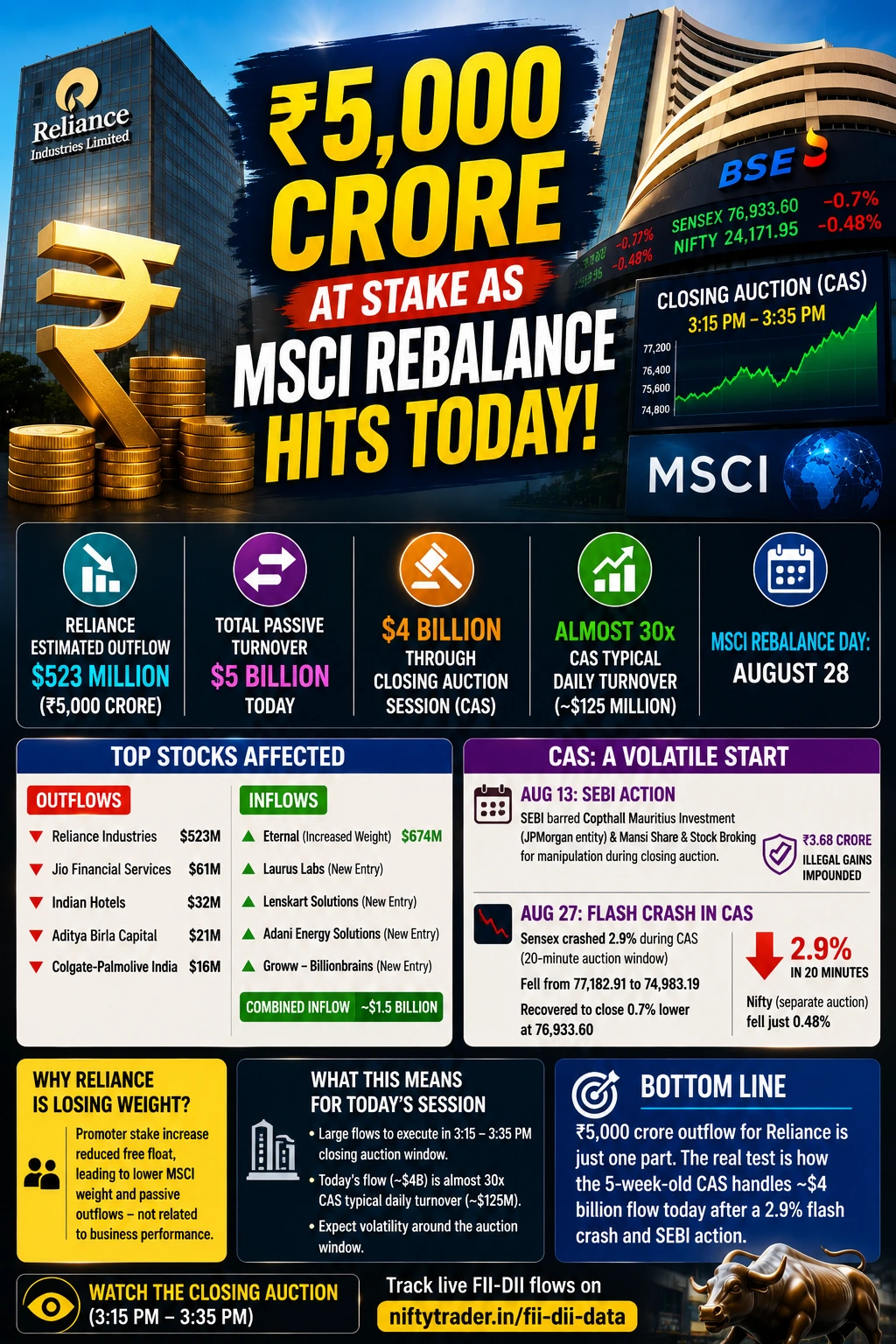
Nuvama estimates Reliance Industries faces an estimated MSCI-linked passive outflow of $523 million, at the RBI’s reference rate of ₹95.561 on August 28, that works out to nearly ₹5,000 crore.
But Reliance’s number is only one piece of a much larger test: Bloomberg-cited estimates put at Business Standard suggest today’s MSCI rebalance could generate close to $5 billion in passive-fund trading turnover, with roughly $4 billion potentially routed through India’s Closing Auction Session (CAS), almost 30 times the auction’s typical daily turnover of about $125 million.
CAS, live since August 3 across NSE, BSE, and MSEI, arrives at today’s test already under a cloud: SEBI barred JPMorgan-owned Copthall Mauritius Investment and Mumbai’s Mansi Share and Stock Broking from the market over alleged manipulation during the August 13 closing auction, and on August 27, the first monthly derivatives expiry under CAS, the BSE Sensex plunged 2.9% in the auction window before recovering to close just 0.7% lower, while the NSE Nifty, which runs its own separate auction, moved only 0.48% the same day. SEBI Chairman Tuhin Kanta Pandey has said the mechanism is staying regardless.
Track today’s FII-DII cash-market activity live on NiftyTrader’s FII-DII Tracker: niftytrader.in/fii-dii-data
Note: This is a live trading session. Today’s rebalance-linked flows execute through the 3:15-3:35 PM closing auction; final prices may move once it settles.
The ₹5,000-Crore Number: What Nuvama’s Estimate Actually Says
Nuvama’s note, cited by Business Standard and Business Today, attributes Reliance’s reduced MSCI weight to the company’s own promoter stake increase, which has shrunk its free float.
At $523 million, converted using the RBI’s own reference rate of ₹95.561 on August 28, that comes to approximately ₹4,999 crore, near enough to ₹5,000 crore on primary-source math alone.
This is an estimated passive outflow tied to index-driven portfolio adjustment, not a confirmed cash withdrawal from the stock.
Check Live: Reliance Option Chain Live – RIL Options Data
The Real Story Is $4 Billion, Not $523 Million
Reliance’s outflow is sizeable, but it’s one piece of a far bigger market-structure test.
Business Standard’s republishing of Bloomberg’s reporting cites Brian Freitas of Periscope Analytics estimating close to $5 billion in total passive-fund trading turnover from today’s rebalance, with about $4 billion of that potentially routed through the Closing Auction Session.
Freitas has said the situation could get pretty messy, since that expected flow is almost 30 times what the CAS window has typically handled in a normal session, which has run to roughly $125 million a day.
CAS Has Had A Volatile First Month
CAS wasn’t tested quietly before today. SEBI’s first enforcement action tied to the mechanism came after Copthall Mauritius Investment, a JPMorgan Chase-owned entity, and Mumbai-based Mansi Share and Stock Broking allegedly placed and cancelled large orders during the August 13 closing auction to influence the Sensex’s closing level and benefit their options positions; the regulator impounded roughly ₹3.68 crore in alleged wrongful gains and barred both firms pending further proceedings.
Then came August 27, the first monthly derivatives expiry since CAS’s launch. Exchange data cited by Bloomberg show the Sensex fell from 77,182.91 at the end of continuous trading to a low of 74,983.19 during the 20-minute auction, a 2.9% intraday plunge, before recovering to close 0.7% lower at 76,933.6. Reliance, the Sensex’s most heavily weighted stock, was among the names caught in that swing.
The NSE Nifty, which runs a separate closing auction, ended just 0.48% lower the same day, underlining that the sharpest volatility so far has been concentrated on the BSE side of the mechanism. SEBI Chairman Tuhin Kanta Pandey has said publicly that CAS will continue regardless of the criticism, even as the regulator says it remains open to feedback.
Why Reliance Is Losing Weight
The mechanics behind Reliance’s outflow are unrelated to the CAS controversy. MSCI periodically re-weights constituents based on free float, the share of stock available for public trading. Nuvama’s note attributes Reliance’s reduced weight to the company’s own promoter stake increase mechanically shrank its free float, meaning passive funds tracking the index now need proportionally fewer Reliance shares, independent of the company’s underlying business performance.
Also Check: Reliance PCR, OI Chart & Options Data Live
The Rest of the Board
Three other stocks face smaller weight-driven outflows: Jio Financial Services at an estimated $61 million, Indian Hotels at $32 million, Aditya Birla Capital at $21 million, and Colgate-Palmolive India at $16 million.
On the inflow side, Eternal’s increased weight is expected to draw the largest gain among existing constituents at roughly $674 million, while new entrants Laurus Labs, Lenskart Solutions, Adani Energy Solutions, and Groww-parent Billionbrains Garage Ventures are drawing a combined estimated $1.5 billion, per Business Standard.
What This Means For Your Trading Session
The passive selling reflects index mechanics, not necessarily a change in Reliance’s underlying business outlook. Much of today’s rebalance is expected to execute through the closing auction, since that’s how passive funds transact nearest to the official closing price, though some orders may be handled during the regular session instead.
Given the scale involved is close to 30 times what CAS has typically processed, and the mechanism’s only large-scale precedent, August 27, produced a 2.9% Sensex swing inside 20 minutes, today’s auction window is worth watching regardless of what happens in regular trading. Reliance closed at ₹1,287 on August 28, its last session before today, with a market capitalisation of roughly ₹17.42 lakh crore.
Bottom Line
Reliance’s own estimated MSCI outflow is nearly ₹5,000 crore. But the number that matters more today is $4 billion, the sum that could pass through a five-week-old auction mechanism that has already drawn a SEBI enforcement action and produced a 2.9% flash crash, the only other time a large flow tested it. Whether today’s far bigger flow clears more smoothly than August 27 did is the real story.
Read Next: 14 IPOs List This Week—Most Came From Last Week’s Rush
Disclaimer: This article is for informational purposes only and does not constitute investment advice. NiftyTrader does not recommend buying, selling, or holding any security mentioned. Please consult a SEBI-registered investment advisor before making any investment decisions. Data has been sourced from brokerage notes, RBI reference rates, SEBI orders, exchange data, and other publicly available sources as cited; figures are estimates and subject to change once today’s closing auction executes.