Need to Know
- The Sensex‘s indicative value plunged nearly 2.9% in the 20-minute Closing Auction Session on Thursday, sliding from 77,182.91 to 74,983.19 before recovering to close 539 points, or 0.7%, lower at 76,933.59.
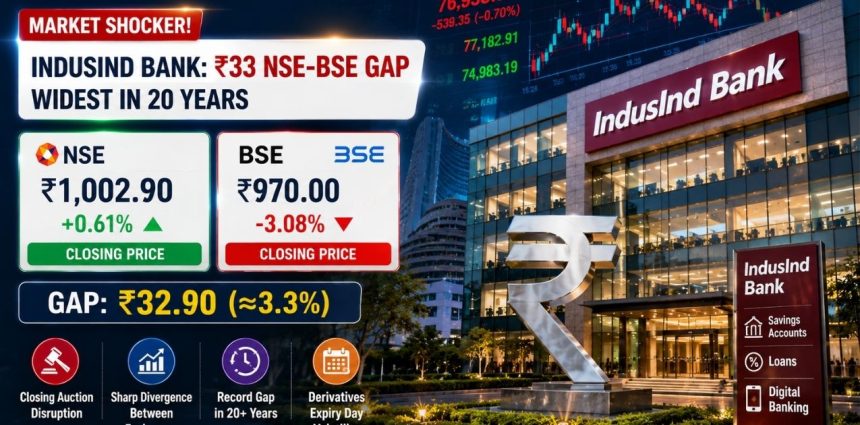
- IndusInd Bank closed the same session at ₹1,002.90 on the NSE and ₹970 on the BSE, a ₹32.90 gap that Bloomberg and Business Standard both reported as the widest between the two exchanges for the stock in more than two decades.
- AU Small Finance Bank, IDFC First Bank, and Federal Bank also closed at sharply different levels on the NSE and BSE; exact rupee figures for these three were not independently verified at the time of writing.
- A Sensex 75,000-strike put option expiring that day reportedly surged as much as 4,800% during the auction window before giving back most of the move.
- The episode is the second disruption tied to the Closing Auction Session (CAS) this month, after SEBI barred JPMorgan-linked Copthall Mauritius Investment Ltd. and Mumbai brokerage Mansi Share and Stock Broking Ltd. on Aug. 19 over alleged manipulation during the Aug. 13 auction.
Thursday’s derivatives expiry turned into a stress test for India’s three-week-old Closing Auction Session, as the Sensex’s indicative level swung nearly 2,200 points inside a 20-minute window and IndusInd Bank closed at two different prices depending on which exchange a trader was watching.
Both events unfolded days after SEBI’s first enforcement action under the new mechanism, and together they’re forcing a hard question: is CAS delivering the cleaner price discovery it promised or opening new cracks that thin liquidity and expiry-day positioning can exploit?
Sensex’s Indicative Value Plunges Nearly 2.9% in Minutes
Continuous trading in Sensex constituents ended at 3:15 p.m. Thursday with the index at 77,182.91. Within the auction that followed, its indicative level fell as low as 74,983.19, a drop of roughly 2,200 points, or 2.9%, before recovering most of the decline to close at 76,933.59, down 539.35 points, or 0.7%, for the day. It was the first monthly derivatives expiry since CAS took effect on Aug. 3, and much of the swing played out inside the narrow 3:15–3:35 p.m. auction window itself.
The move showed up even more dramatically in options. A Sensex put option at the 75,000 strike, expiring that same day, reportedly surged as much as 4,800% during the auction before surrendering most of the gain as the underlying index recovered.
The spike has been linked to orders in an index-heavy stock hitting the 3% band allowed under the mechanism. No regulatory finding has tied Thursday’s swings to manipulation; traders have largely pointed to thin liquidity colliding with heavy expiry-day positioning under a still-new auction format.
Check Live: Sensex Option Chain Live—OI, IV & LTP by Strike
IndusInd Bank’s ₹33 NSE-BSE Gap Is the Widest in Two Decades
Shares of IndusInd Bank closed Thursday’s auction at ₹1,002.90 on the NSE, while the same stock settled at ₹970 on the BSE, a fall of more than 3% on that exchange alone.
The ₹32.90 difference between the two exchanges’ official closes was the widest gap recorded for the stock in more than 20 years.
| Exchange | Closing Price (₹) | Move vs. Previous Close |
|---|---|---|
| NSE | 1,002.90 | Reference close |
| BSE | 970.00 | Down more than 3% |
| Gap | 32.90 | ~3.3% of NSE close |
Source: NSE and BSE closing data, Aug. 27, 2026
The banking sector’s stress wasn’t limited to one stock. The BSE Bankex index indicated a drop of as much as 3.3% during the auction before paring losses to close 1.7% lower, and AU Small Finance Bank, IDFC First Bank, and Federal Bank all recorded sharp NSE-BSE divergences of their own, though verified rupee figures for those three weren’t available at the time of writing.
Check Live: INDUSIND BANK Options Chart | Nifty Trader
Why Same-Stock Prices Can Diverge Between NSE and BSE
The NSE and BSE run separate auction books and calculate separate reference prices for the same stock. Because the two exchanges conduct their own closing auctions, differences in order flow, liquidity, and reference prices can produce different equilibrium prices for the same stock, exactly what played out in IndusInd Bank on Thursday.
Karthik P, a partner at Mumbai-based Karna Stock Broking LLP, warned that “traders and other market participants are losing confidence” and may start steering clear of the market if the volatility continues.
Varun Khandelwal, founder of Gurugram-based proprietary trading firm Bullero Capital, pointed to a more structural problem: because there’s no reliable way to estimate where a stock will close on each exchange during the auction, pure arbitrage between NSE and BSE becomes nearly impossible.
A Dubai-based hedge fund trader who trades across global markets said he hadn’t previously seen a same-day, same-stock gap of this scale between two exchanges.
The Gap Nearly Vanished by Friday Afternoon
The divergence didn’t last. By Friday afternoon trade, IndusInd Bank was quoted at roughly ₹988.30 on the NSE and ₹988.20 on the BSE, within 10 paise of each other, against a ₹32.90 spread a day earlier.
That’s arguably the most useful data point in this story for traders: the rapid convergence suggests Thursday’s divergence was concentrated in the auction window rather than representing a lasting difference in the stock’s underlying market price.
How the Closing Auction Session Actually Works
The Closing Auction Session works on a simple principle: one auction, one clearing price. Under CAS, continuous trading in eligible stocks ends at 3:15 p.m., and the reference price for the auction is the volume-weighted average price of trades executed between 3:00 p.m. and 3:15 p.m.
A 20-minute auction then runs to 3:35 p.m., during which investors can place, modify, or cancel orders within a band of 3% above or below that reference price.
The exchange matches orders at the single equilibrium price that clears the most volume, and that becomes the stock’s official close.
SEBI introduced the system on Aug. 3 to replace the older VWAP-based closing method, aiming for a single, auction-derived closing price rather than a formula-derived one.
Inside SEBI’s First CAS Manipulation Case
SEBI’s scrutiny of the mechanism didn’t start with Thursday’s swings. On Aug. 19, the regulator’s Whole-Time Member, Kamlesh Chandra Varshney, issued an interim order restraining Copthall Mauritius Investment Ltd., a Mauritius-based foreign portfolio investor linked to JPMorgan Chase & Co., and Mumbai-based Mansi Share and Stock Broking Ltd. from accessing the securities market.
Both were also barred from participating in the Closing Auction Session itself, directly or indirectly, until further orders; for Mansi, the restriction applies to its proprietary trading account.
The order concerns the Aug. 13 CAS on the BSE, a weekly Sensex expiry day, during which SEBI identified three sharp movements in the index’s indicative equilibrium price occurring within windows of just two to 28 seconds. During the first spike, Copthall accounted for 99.91% of the ₹66.64 crore in buy-order value, placing 32 limit-buy orders across all Sensex constituents priced around 3% above the reference price.
The pattern repeated across the second and third spikes; in the third, Copthall’s limit-buy orders aggregated about ₹98.12 crore, or 85.21% of total buy-order value, before it cancelled those orders across 30 Sensex stocks. Mansi, which SEBI said held expiry-day put positions that would benefit from a lower close, placed 12.77 lakh shares in sell orders across eight Sensex constituents and subsequently cancelled 12.65 lakh of them, a 99.06% cancellation rate. SEBI’s order is a prima facie, interim finding, not a final adjudication of wrongdoing.
| Entity | Role | Amount Impounded |
|---|---|---|
| Copthall Mauritius Investment Ltd. | JPMorgan-linked FPI | ₹2.96 crore |
| Mansi Share and Stock Broking Ltd. | Mumbai brokerage (proprietary a/c) | ₹71.65 lakh |
| Total | — | ₹3.68 crore |
Source: SEBI interim order, Aug. 19, 2026
It’s the first enforcement action SEBI has taken under the new CAS mechanism, coming within six days of the alleged manipulation, a fast turnaround by the regulator’s own historical standards.
Why the Next Expiry Could Matter More Than Thursday
SEBI Chairman Tuhin Kanta Pandey has so far defended the mechanism rather than retreated from it. Days before the Aug. 19 order, he told reporters, “CAS is here to stay for sure,” while adding that the regulator would look at improving any genuine constraints participants flag.
After Thursday’s swings, he reiterated that no changes to CAS are currently planned, framing the volatility as a byproduct of a system still absorbing its first monthly expiry rather than evidence the design itself needs reworking.
For traders, that means the mechanism isn’t going away, which puts the burden on participants to adapt around it rather than wait for a redesign. Expiry days, and monthly expiries in particular, look like the sessions most likely to produce outsized indicative-price swings and cross-exchange gaps until participation broadens and liquidity in the auction window deepens.
Institutional flows tend to concentrate around expiry weeks, so traders may want to track FII-DII positioning alongside CAS data to see whether institutional flows are amplifying or absorbing expiry-day volatility—NiftyTrader’s FII-DII Tracker is a useful daily reference for that.
The open questions now are less about whether Thursday was manipulation, nothing points that way so far, and more about whether the market has learned enough from two disruptions in three weeks. Will NSE-BSE spreads stay this tight on non-expiry days?
Will SEBI’s enforcement speed deter the kind of order-spoofing seen on Aug. 13? And will retail and institutional participation grow fast enough to absorb expiry-day flows without indicative prices swinging 2,000-plus points in 20 minutes? The next monthly expiry, in late September, will be the first real test.
Read Next: India’s e-Rupee Has Crossed ₹28,000 Cr. Now Comes the Global BRICKS Test
Frequently Asked Questions
What is the Closing Auction Session (CAS) in Indian stock markets?
CAS is a 20-minute call auction, from 3:15 p.m. to 3:35 p.m., that SEBI introduced on Aug. 3, 2026, to set the official closing price for eligible stocks and the Sensex. It replaced the earlier VWAP-based closing formula and instead matches buy and sell orders at a single equilibrium price within a band of 3% around a reference price.
Why did IndusInd Bank close at different prices on the NSE and BSE?
Because the NSE and BSE run independent auction books with separate reference prices, order flow and liquidity differences during the 20-minute window can push each exchange’s equilibrium price in different directions. On Aug. 27, that produced a ₹32.90 gap, the widest for the stock in more than two decades, which narrowed to about 10 paise by the next session.
Was Thursday’s Sensex swing linked to manipulation?
There’s no regulatory finding connecting Thursday’s auction swing to manipulation. It was the first monthly derivatives expiry since CAS began, and market participants have mainly attributed the move to thin liquidity meeting heavy expiry-day positioning. Separately, SEBI’s Aug. 19 order did find alleged manipulation tied to the Aug. 13 weekly expiry, involving different entities and a different session.
What did SEBI’s Aug. 19 order against Copthall and Mansi say?
SEBI restrained Copthall Mauritius Investment Ltd. and Mansi Share and Stock Broking Ltd. from the securities market and impounded a combined ₹3.68 crore, alleging the two placed aggressive, largely cancelled orders during the Aug. 13 CAS to move the Sensex’s closing price in favour of their expiry-day options positions.
Is SEBI planning to change or scrap the CAS mechanism?
Not based on SEBI Chairman Tuhin Kanta Pandey’s public comments so far. He has said CAS is here to stay while remaining open to addressing specific participant concerns, and reiterated after Thursday’s swings that no changes are currently planned.
This article is for informational purposes only and does not constitute investment advice, a recommendation, or an offer to buy, sell or hold any security. Equity investments are subject to market risk. Readers are advised to consult a SEBI-registered investment advisor before making any investment decisions. NiftyTrader.in and the author accept no liability for outcomes arising from reliance on this content.