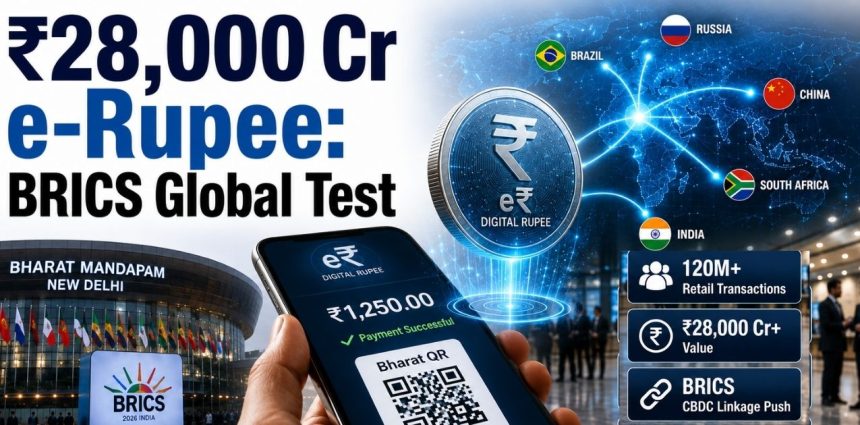
India is set to pitch cross-border digital payments and central bank digital currency (CBDC) interoperability to its BRICS partners when it hosts the bloc’s leaders at Bharat Mandapam in New Delhi on September 12-13. The push comes as the Reserve Bank of India has formally recommended that a CBDC-linkage proposal be placed on the summit agenda, building on a framework floated at last year’s Rio de Janeiro summit.
A finance-track meeting chaired by Finance Minister Nirmala Sitharaman is scheduled for September 1-2 at Bharat Mandapam, where counterparts from the 11-member grouping will thrash out practical mechanisms to cut cross-border trade costs and expand settlement in national currencies.
This follows the first finance-track meeting of India’s 2026 chairship, held in Jaipur on August 12-13 under the theme “Building for Resilience, Innovation, Cooperation, and Sustainability.”
India will also press the bloc on the need for more balanced trade among members, an issue that has gained urgency as India’s trade deficit with China widens and the rupee-ruble settlement with Russia remains lopsided in Moscow’s favour.

Finance Ministers Meet First, Leaders Follow
The September 1-2 meeting is designed to convert months of technical groundwork into language leaders can sign off on at the summit.
RBI Governor Sanjay Malhotra said on August 11 that all BRICS nations see “a lot of scope for reducing cost” in cross-border payments, while Commerce and Industry Minister Piyush Goyal has separately flagged New Delhi’s preference for settling trade in national currencies over the dollar.
Two payment-infrastructure ideas are likely to anchor the discussion: mBridge, a multi-CBDC settlement experiment linked to the Bank for International Settlements that had processed transactions worth tens of billions of dollars by late 2025, and BRICS Pay, a proposed retail rail that would let members’ QR and instant-payment systems talk to each other.
Neither amounts to a common currency, both are settlement plumbing, not a shared unit of account, and officials on both sides have framed the effort as cost reduction rather than de-dollarisation.
BRICS Summit 2026 — Key Facts
| Detail | Data |
|---|---|
| Summit edition | 18th BRICS Summit |
| Venue | Bharat Mandapam, New Delhi |
| Dates | September 12–13, 2026 |
| Finance ministers’ meeting | September 1–2, 2026 |
| India’s BRICS chair | 4th time (after 2012, 2016, 2021) |
| Bloc membership | 11 full members |
| Combined GDP share | ~40% of global GDP (exceeds G7) |
| 2026 theme | “Building for Resilience, Innovation, Cooperation, and Sustainability” |
The Digital Rupee’s Track Record So Far
India’s own CBDC pilot gives it a working example to bring to the table. The retail e-rupee, launched December 1, 2022, has crossed 120 million cumulative transactions worth more than ₹28,000 crore, with roughly 8 million active users, RBI Deputy Governor T. Rabi Sankar said at a post-policy briefing in December 2025.
A separate industry estimate published in January 2026 put active users closer to 5 million across 16 banks, a gap likely reflecting differences in how “active” is defined, flagged here rather than silently reconciled.
Nine banks joined the original wholesale and retail pilots: State Bank of India, Bank of Baroda, Union Bank of India, HDFC Bank, ICICI Bank, Kotak Mahindra Bank, Yes Bank, IDFC First Bank, and HSBC, with Federal Bank added subsequently.
Even so, e-rupee volumes remain a rounding error next to UPI, which handles more than 14 billion transactions a month.
RBI has been trying to widen the digital rupee’s use case through programmable welfare disbursements, routing subsidies, and food benefits through pilots in states including Maharashtra and Gujarat, precisely because organic retail adoption has been slow.
India’s e-Rupee (CBDC)—Adoption Snapshot
| Metric | Latest Figure | Source / Period |
|---|---|---|
| Retail CBDC transactions (cumulative) | 120 million+ | RBI Dy Governor T. Rabi Sankar, Dec 2025 |
| Value of retail CBDC transactions | ₹28,000 crore+ | Dec 2025 |
| Active CBDC users | ~8 million (RBI) vs ~5 million (industry est.) | Dec 2025 / Jan 2026—flagged discrepancy |
| Pilot launch date | December 1, 2022 | RBI |
| Core participating banks | 9 initial + Federal Bank added later | RBI |
| UPI monthly transactions (for scale) | 14 billion+ | NPCI, 2026 |
Trade Imbalance and the De-Dollarisation Undertone
Washington has taken notice. The US administration has previously threatened tariffs on BRICS members pursuing dollar alternatives and has already imposed duties on Indian goods partly tied to India’s purchases of Russian crude.
That backdrop raises the stakes for New Delhi, which has publicly insisted its CBDC-linkage push is about cutting transaction costs and expanding the rupee’s international footprint, not building an anti-dollar bloc.
BRICS—Brazil, Russia, India, China, South Africa, and six newer entrants, including the UAE, Saudi Arabia, Egypt, Ethiopia, Iran, and Indonesia—now accounts for roughly 40% of global GDP, more than the G7. India takes the chair for a fourth time this year, having previously hosted in 2012, 2016, and 2021, in a year the grouping marks two decades since its founding.
What It Could Mean for Indian Markets
For now, the summit is a diplomatic and infrastructure story rather than an earnings one. e-Rupee volumes are too small to move balance sheets at the pilot banks, and any cross-border CBDC corridor would need years of technical and regulatory work before it affects trade flows or margins.
Traders tracking the theme will likely watch sentiment in listed banks already inside the CBDC pilot group, along with domestic payments and fintech names that could gain visibility if BRICS Pay-style interoperability advances.
None of this constitutes a near-term catalyst; the practical payoff, if any, plays out over years, not the two days of the summit itself.
Track Here: FII DII DATA| NIFTYTRADER
Need to Know
- India hosts the 18th BRICS Summit at Bharat Mandapam, New Delhi, on September 12–13, 2026—its fourth time chairing the bloc.
- A finance ministers’ meeting on September 1–2, chaired by Nirmala Sitharaman, will precede the leaders’ summit and focus on CBDC interoperability and trade-cost reduction.
- RBI has recommended a BRICS CBDC-linkage proposal for the summit agenda, building on a 2025 Rio declaration.
- India’s retail e-rupee has logged 120 million+ transactions worth ₹28,000 crore+ since its December 2022 launch, per RBI’s Deputy Governor, though user-count estimates diverge across sources.
- The push is framed by officials as cost reduction, not de-dollarisation, amid US tariff threats against BRICS members pursuing dollar alternatives.
Read Next: HDFC Bank, LIC Housing Push Back as ₹22,006 Cr Claims Get ₹6.25 Cr Payout
Disclaimer: This article is for informational purposes only and does not constitute investment advice. NiftyTrader does not recommend buying or selling any securities. Readers should consult a registered financial advisor before making investment decisions. Investments in securities markets are subject to market risks.