Key Takeaways
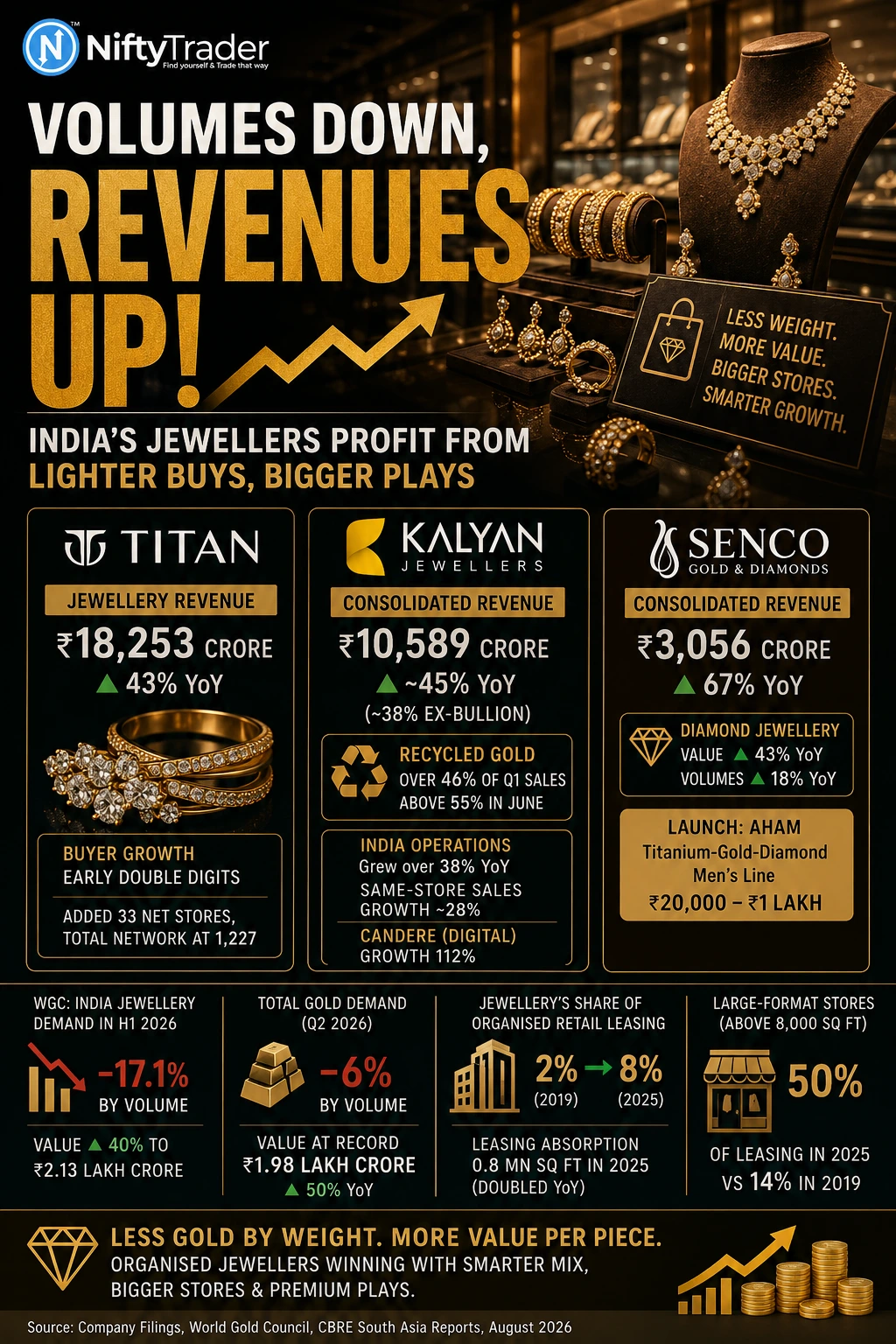
- Titan’s jewellery revenue jumped 43% YoY to ₹18,253 crore in Q1 FY27, aided by lighter, studded, and diamond-led buying even as buyer growth stayed in early double digits.
- Kalyan Jewellers‘ consolidated revenue rose to ₹10,589 crore (up ~45% YoY, ~38% ex-bullion), with recycled gold accounting for over 46% of Q1 sales and above 55% in June alone.
- Senco Gold’s diamond jewellery value grew 43% YoY with volumes up 18%, and the company launched an “Aham” titanium-gold-diamond men’s line priced at ₹20,000–₹1 lakh.
- WGC data shows India’s jewellery demand fell 17.1% by volume in H1 2026 even as value rose 40% to ₹2.13 lakh crore, a pattern echoed across the broader gold market, where total Q2 demand fell 6% even as value hit a record ₹1.98 lakh crore.
- CBRE data shows jewellery’s share of organised retail leasing rose from 2% (2019) to 8% (2025), with leasing absorption doubling to 0.8 million sq ft and large-format stores above 8,000 sq ft now accounting for half of all leasing, up from 14% in 2019.
India’s jewellery companies are selling less gold by weight and making more money doing it. Titan’s jewellery business grew 43% year-on-year in the June 2026 quarter, Kalyan Jewellers’ consolidated revenue rose to ₹10,589 crore, and Senco Gold posted record quarterly revenue, even as the World Gold Council recorded a 17.1% drop in India’s jewellery demand by volume for the first half of 2026.
The gap between the two numbers is the story: with gold prices near record highs, consumers are buying fewer grams but spending more per piece, and organised retailers are finding ways to grow despite the broader volume pressure.
The WGC numbers: volumes down, value up
According to the World Gold Council’s India Focus data, jewellery demand fell 15.4% by volume in the April–June 2026 quarter to 75.1 tonnes, compared with 88.8 tonnes a year earlier. In value terms, demand rose 34.4% to ₹1.13 lakh crore.
For the full first half of 2026, volumes were down 17.1% while demand value climbed 40% to ₹2.13 lakh crore.
The WGC attributed the volume decline to affordability pressure from high prices, with spending cushioned by a shift toward lighter-weight, lower-carat, and studded pieces.
The pattern holds across the wider gold market too: India’s total gold demand, jewellery, bars, coins and ETFs combined, fell 6% by volume in Q2 2026 to 131.4 tonnes, even as its value hit a record ₹1.98 lakh crore, up 50% year-on-year.
Titan’s jewellery arm grows 43% on lighter, studded demand
Titan Company’s jewellery division, its largest business, reported revenue of ₹18,253 crore for Q1 FY27, up 43% year-on-year, excluding bullion and Digi-Gold sales, the company said in its August 7 earnings release.
Buyer growth came in at early double digits, and average ticket sizes rose in the high double digits, while plain gold and studded jewellery each grew in the mid-thirties.
Within the portfolio, Tanishq, Mia, Zoya, and beYon combined grew 39%, and CaratLane grew 42%. Titan added 33 net jewellery stores during the quarter, taking its jewellery network to 1,227 outlets.
Check Live: Titan Company (TITAN) Option Chain Live – NSE
Kalyan Jewellers leans harder on recycled gold.
Kalyan Jewellers reported consolidated revenue of ₹10,589 crore for Q1 FY27, up from ₹7,300 crore a year earlier, a headline increase of roughly 45%, though the company’s own commentary cites 38% growth on an ex-bullion basis.
The bigger story is the mix shift: recycled gold accounted for over 46% of revenue in the quarter and crossed 55% in June alone, under the company’s “Shine with India” gold recirculation campaign launched in May.
Management has set a target of maintaining recycled gold’s share at 55–60% going forward, aimed at cutting dependence on imported bullion. India operations grew over 38% YoY with same-store sales growth of about 28%, and digital platform Candere grew 112%.
Check Live: KALYAN JEWELLERS INDIA Options Chart | Nifty Trader
Senco Gold bets on diamonds and a titanium debut.
Senco Gold reported consolidated revenue of roughly ₹3,056 crore for Q1 FY27 in its August 12 results, up 67% year-on-year, with diamond jewellery value up 43% and volumes up 18%, concentrated in the sub-₹50,000 category.
The Kolkata-based retailer opened eight new showrooms during the quarter, taking its network past 200 outlets, and launched “Aham,” a men’s collection combining titanium with gold and diamonds priced between ₹20,000 and ₹1 lakh, a bet on lower-ticket, design-led categories to offset gram-based volume pressure.
Bigger stores, higher-value retail leasing
The shift is also visible in real estate. A CBRE South Asia report, “All That Glitters: Jewellery Brands Recast India’s Retail Footprint,” found that jewellery’s share of organised retail leasing rose from 2% in 2019 to 8% in 2025, placing the category among India’s top three leasing drivers after fashion & apparel and food & beverage.
Leasing absorption by jewellery brands doubled to 0.8 million sq ft in 2025 from 0.4 million sq ft in 2024, with Hyderabad, Chennai, Bengaluru, Delhi-NCR and Mumbai accounting for most of that demand.
Large-format stores above 8,000 sq ft accounted for 50% of jewellery leasing in 2025, up sharply from just 14% in 2019, as brands replace 1,500–2,500 sq ft outlets with experience-led showrooms featuring bridal lounges and virtual try-on zones.
Same growth story, different Street reaction
The three results also show that revenue growth alone isn’t moving stocks the same way. Titan’s shares touched a record intraday high after its results, supported by margin expansion, EBITDA margin improved to 14.6% from 13.1% a year earlier.
Kalyan Jewellers’ stock fell more than 6% despite the revenue jump, as the consolidated gross margin slipped to 11.9% from 13.9% on a heavier exchange and recycled-gold mix.
Senco Gold’s shares dropped over 10% even after its strongest-ever quarterly revenue, as EBITDA margin fell to 7.0% from 10.1% and profit after tax declined 3% year-on-year.
The market, in other words, is no longer rewarding topline growth alone; it is asking how profitable that growth is.
Track daily institutional activity alongside these earnings trends on the NiftyTrader FII-DII Tracker.
Bottom Line
India’s jewellery sector is no longer being measured in grams sold. With gold prices still elevated, the next test for organised jewellers will be whether recycled gold, lighter-carat collections, and diamond-led ranges can continue offsetting pressure on traditional gold volumes.
As Kalyan and Senco’s stock reactions show, investors are already scrutinising how that growth is being bought, through margin-accretive premiumisation, or through exchange-heavy, lower-margin volumes.
Read Next: India’s Refiners Chase Oil as Far as the Americas as Russian Imports Fall ~800,000 BPD
Disclaimer: This article is for informational purposes only and does not constitute investment advice. Readers are advised to consult a SEBI-registered investment advisor before making any investment decisions. NiftyTrader.in does not guarantee the accuracy, completeness, or timeliness of the information presented.