Synopsis
- Kpler data shows Russian crude imports to India sliding to around 2 million bpd in August from a peak near 2.8 million bpd in July, as Ukrainian strikes disrupt Russian refining and exports
- IOC has issued a rare tender for Americas-origin crude alongside a separate Gulf-heavy tender; HPCL and MRPL made snap non-Russian spot purchases this week
- Brent fell to an intraday low of $85.01/bbl on Iran-Oman shipping talks, lifting BPCL, HPCL, and IOC shares, though the rally has cooled from its morning highs
- Russia’s own seaborne oil exports have dropped to about 3.5 million bpd over the past four weeks, from over 4 million bpd in July, as Ukrainian strikes hit loading capacity
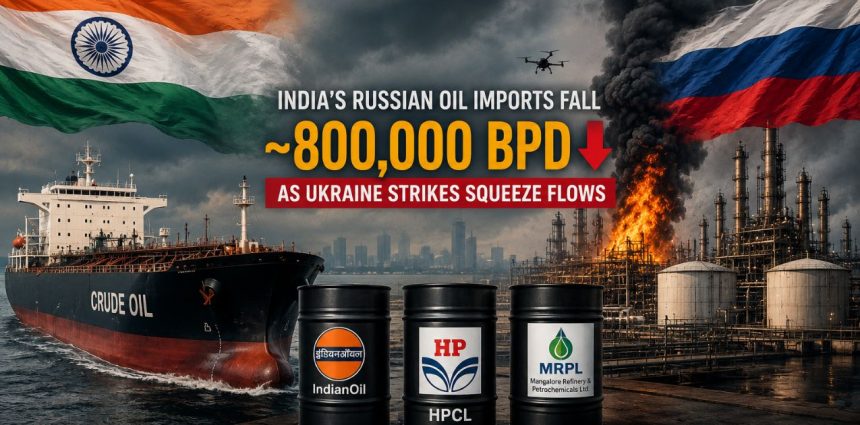
India’s biggest refiners are pulling back from the discounted Russian barrels that have anchored their import bills for three years, as Ukrainian drone and missile strikes on Russian refineries and Black Sea export terminals choke off the crude Moscow has left to sell abroad.
Kpler estimates put Russian crude imports into India at around 2 million barrels a day (bpd) this month, down roughly 800,000 bpd from a peak near 2.8 million bpd in July.
That retreat has sent Indian Oil Corporation (IOC), Hindustan Petroleum Corporation (HPCL), and Mangalore Refinery and Petrochemicals (MRPL) scouring West Africa, the Americas, and even the Persian Gulf for replacement barrels.
The shift lands at an awkward moment for India’s refining sector. Plant maintenance that kept run rates subdued through the monsoon months is winding down just as domestic fuel demand is expected to pick up, meaning refiners need dependable cargoes lined up well before tanks run low.
Check Live: INDIAN OIL CORPORATION Options Chart | Nifty Trader
Why Russian Crude Imports Are Falling
Ukraine’s sustained campaign against Russian refineries and Black Sea export terminals is doing double duty: it’s choking off the crude Moscow can load onto tankers and forcing Russian refiners to hold back more crude for domestic processing to plug fuel shortages at home.
Tanker-tracking data compiled by Bloomberg shows Russia’s own seaborne crude exports easing to about 3.5 million bpd over the past four weeks, down from a high of more than 4 million bpd in July.
Sumit Ritolia, Kpler’s senior manager of oil markets and refining, points to a combination of factors behind the August pullback: a natural cooling-off after an unusually heavy buying spree in June and July, tighter Russian export availability, stiffer competition from Chinese buyers for the same cargoes, and the seasonal refinery maintenance cycle.
Notably, October-loading cargoes of Sokol, which ships from Russia’s eastern ports, were booked unusually early this month, a sign that forward demand for the remaining available barrels is intensifying rather than cooling. Kpler expects Russian flows into India to settle back above 2 million bpd within a few months rather than fall further.
IOC, HPCL, and MRPL Cast a Wider Net
IOC, India’s largest refiner, has gone further afield than usual: one tender is open to Americas-origin barrels, a rare move for the company, while a second is skewed toward Persian Gulf grades. HPCL and MRPL each moved to lock in non-Russian cargoes on the spot market this week, trade sources said.
The diversification isn’t new; earlier this month HPCL secured roughly 2 million barrels of Nigerian crude (Forcados and Bonga grades) for its Visakh refinery, IOC picked up around 4 million barrels of Angolan and Congolese grades, and MRPL bought about 1 million barrels of Omani crude, but this week’s moves show refiners are still actively widening the net rather than treating earlier purchases as a one-off.
| Refiner | Recent Move | Sourcing Focus |
|---|---|---|
| IOC | Tender for Americas-origin barrels, plus a separate Gulf-heavy tender | Americas, Persian Gulf |
| HPCL | Snap spot purchase of non-Russian crude this week | Non-Russian grades |
| MRPL | Snap spot purchase of non-Russian crude this week | Non-Russian grades |
Source: Trade sources cited by Bloomberg/Business Standard, August 2026
Also Check: HINDUSTAN PETROLEUM CORPORATION Ltd Futures—Live Price, Open Interest & Basis Analysis
Kpler Data: Russia’s Share Cools From a Record High
Russian crude accounted for a record 50.83% of India’s oil imports in July, about 2.47 million barrels a day, according to Reuters trade-source data, with volumes climbing toward an estimated 2.8 million bpd by month’s end as Kpler’s tracking data was refined.
That made Russia India’s dominant supplier for a third straight month, even as war risk built up around two separate chokepoints: the Black Sea and the Strait of Hormuz.
| Month | Russian Crude to India (bpd) | Share of Total Imports |
|---|---|---|
| June 2026 | ~2.7 million | ~50% |
| July 2026 | ~2.8 million (peak) | 50.83% (record) |
| August 2026 (tracking) | ~2.0 million | Expected to normalize above 2 million bpd in coming months |
Source: Kpler vessel-tracking data and Reuters trade-source reporting, August 2026.
The pullback isn’t only about supply out of Russia. China has stepped up its own purchases of discounted Russian barrels, intensifying competition for cargoes that India and China have historically split between different loading regions, Russia’s eastern ports for China and European ports for India. That old divide is now getting tested.
A Cautious Return to the Persian Gulf
IOC’s Gulf-focused tender is notable because it comes despite the Strait of Hormuz still running well below normal. The waterway has been a recurring flashpoint since the US and Israel struck Iran in late February 2026, repeatedly disrupting a passage that normally carries roughly a fifth of the world’s seaborne oil trade.
A June memorandum of understanding briefly eased flows through the strait before lapsing in mid-August amid stalled talks.
Iran and Oman are now discussing a temporary joint maritime corridor, with technical talks continuing this week, though nothing has been finalised. Washington, meanwhile, has been tightening sanctions on countries and entities doing business with Iran rather than easing the pressure.
For Indian refiners weighing Russian crude against Gulf risk, some Gulf supply, even at elevated risk, beats being squeezed on both the Russian and Middle Eastern sides of the import basket at once.
Stocks to Watch: OMC Rally Cools as Crude Slides
The sourcing scramble is unfolding alongside a sharp pullback in global benchmark prices. Brent crude slipped to an intraday low of $85.01 a barrel on Wednesday, down 2.5% from Tuesday’s close of $87.27, as markets weighed the Iran-Oman shipping proposal against Washington’s sanctions escalation. WTI eased 2.7% to $80.08 from $82.36.
Oil marketing company (OMC) shares, which benefit when input costs fall, opened firmly higher; the Nifty Oil & Gas index touched an early high of 11,248.40 (+0.3%) from Tuesday’s close of 11,214.90, but individual stock gains have since cooled from those morning highs.
By midday, BPCL was up around 0.5% near ₹319.60, HPCL (HINDPETRO) was up about 0.6% near ₹375.25, and IOC was roughly flat near ₹139.03, easing off their sharper early-session moves as the broader crude rally itself lost some steam through the day.
Upstream names such as ONGC and Oil India moved the other way, since a softer crude tape trims the value of their own output.
What It Means for Pump Prices and Margins Ahead
Two forces are pulling in different directions for refiners cutting Russian crude imports right now. A softer Brent tape generally supports refining margins and eases India’s overall import bill.
But swapping discounted Russian barrels for American, West African, or Gulf cargoes typically means paying closer to benchmark prices and absorbing longer freight, which can offset some of that relief on a per-barrel basis.
How that nets out for refining margins depends on how long refiners need non-Russian barrels to plug the gap. Kpler’s own view is that Russian flows normalize back above 2 million bpd within a few months, which would limit the window in which refiners are paying up for substitutes.
Refiners extending their forward bookings, with October-loading Sokol cargoes already locked in unusually early, suggests they aren’t treating the current supply patchiness as a one-off.
That longer coverage window is itself worth tracking in the weeks ahead, both for what it signals about confidence in Russian flows resuming and for any read-through to crude oil futures positioning.
The Bigger Market Risk
The uncertainty is no longer simply “how much Russian oil can India secure?” It’s increasingly: can India lock in enough non-Russian crude at the right price before Chinese demand for the same discounted barrels tightens the market further and before refinery run rates climb back to full strength?
That’s the question that will decide whether this month’s scramble is a brief sourcing adjustment or the start of a more expensive stretch for India’s refiners.
Read Next: Groww Sees ₹4,000 Crore in Block Deals: What’s Behind the Rush?
FAQs
Why are Indian refiners cutting Russian crude imports in August 2026?
Ukrainian strikes on Russian refineries and Black Sea export terminals have reduced the crude available for Moscow to export, while Russian refiners are holding back more crude for domestic use amid a local fuel crunch. Seasonal maintenance at Indian refineries and rising Chinese demand for the same discounted barrels are adding to the pullback.
How much have India’s Russian oil imports fallen?
Kpler data shows Russian crude imports to India tracking near 2 million bpd in August, down roughly 800,000 bpd from a peak near 2.8 million bpd in July, when Russia’s share of India’s oil imports hit a record 50.83%.
Where are Indian refiners sourcing crude instead?
IOC, HPCL, and MRPL have turned to West Africa, the Americas, and the Persian Gulf, with IOC issuing a rare tender for Americas-origin crude alongside a separate Gulf-focused tender.
Is the Strait of Hormuz fully open for oil shipments now?
No. Flows remain well below pre-war levels. A June 2026 memorandum of understanding briefly eased restrictions before lapsing in mid-August, and Iran and Oman are now discussing a temporary shipping corridor, though it hasn’t been finalised.
Which oil stocks are in focus today?
BPCL, HPCL, and IOC all traded higher on August 26 as Brent crude fell toward $85 a barrel, though gains cooled from the morning’s sharper rally. Upstream names like ONGC and Oil India lagged on the softer crude tape.