
Shares of Billionbrains Garage Ventures, the parent company of Groww, came under pressure on Wednesday after another large block transaction hit the stock, adding to unusually heavy institutional activity seen just eight days earlier.
Around 12.75 crore shares, equivalent to nearly 2.1% of the company’s equity, changed hands in a block deal worth about ₹2,500 crore. Billionbrains shares fell as much as 3.19% to ₹196.54 in morning trade. Trading activity was also significantly higher than normal.
But Wednesday’s deal becomes more interesting when viewed alongside what happened on August 18.
Around 7.78 crore shares, or roughly 1.2% of the equity, changed hands in two block transactions worth nearly ₹1,500 crore on that day, when the stock fell more than 4%.
That puts the value of the two large block-deal episodes at roughly ₹4,000 crore in just eight days, involving shares equivalent to around 3.3% of the company’s equity.
| Date | Shares traded | Approx. value | Equity involved |
|---|---|---|---|
| August 18 | ~7.78 crore | ~₹1,500 crore | ~1.2% |
| August 26 | ~12.75 crore | ~₹2,500 crore | ~2.1% |
| Combined | ~20.53 crore | ~₹4,000 crore | ~3.3% |
The identity of the counterparties in the August 18 transactions was not immediately disclosed. In Wednesday’s case, reports linked the sale to early investor Ribbit Capital, although the seller was not independently identified in the block-deal data available at the time of reporting.
That leaves the market with a bigger question than simply who sold:
Is Groww experiencing routine early-investor profit-taking, or is a larger ownership reshuffle beginning to unfold?
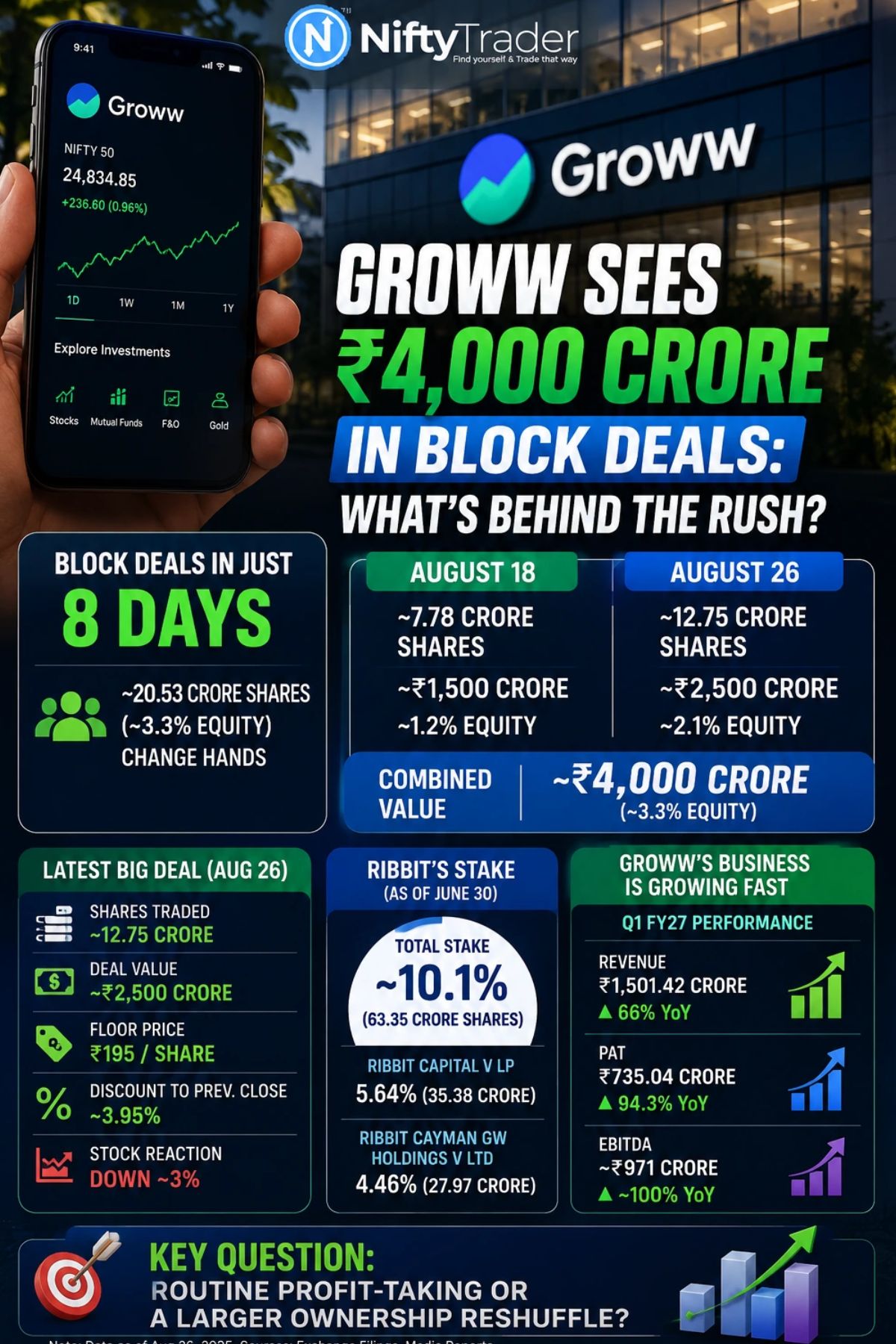
The ₹2,500-Crore Deal Was Larger Than Initially Expected
The first indication of a Ribbit transaction came a day earlier.
Reports said Ribbit Capital was looking to sell around 1.6% of Billionbrains Garage Ventures for approximately ₹1,914 crore, with a floor price of ₹195 a share.
The transaction that actually appeared on Wednesday was substantially larger: about 2.1% of the company for ₹2,500 crore. The reported ₹195 floor represented a discount of roughly 4% to the previous close of ₹203.01.
What happened in the latest deal?
- Shares traded: ~12.75 crore
- Equity: ~2.1%
- Deal value: ~₹2,500 crore
- Reported floor price: ₹195
- Previous close: ₹203.01
- Approx. discount: 3.95%
- Stock reaction: down about 3% in morning trade
There is another important detail many investors can miss:
This is a secondary transaction.
The ₹2,500 crore does not go into Groww’s business. The proceeds go to the shareholder selling the shares.
So Wednesday’s price reaction is fundamentally a supply-and-ownership event, rather than a fundraising event for the company.
Ribbit Still Had a Large Stake Before the Deal
The June 30 shareholding pattern provides useful context for the reported Ribbit sale.
Ribbit Capital V LP held 35.38 crore shares, or 5.64%, while Ribbit Cayman GW Holdings V Ltd held another 27.97 crore shares, or 4.46%.
Together, the two entities held about 10.1% of Billionbrains Garage Ventures at the end of June.
| Ribbit holding as of June 30 | Shares | Stake |
|---|---|---|
| Ribbit Capital V LP | 35.38 crore | 5.64% |
| Ribbit Cayman GW Holdings V Ltd | 27.97 crore | 4.46% |
| Combined | 63.35 crore | ~10.10% |
That means a 2.1% company-level transaction would be only a portion of Ribbit’s reported exposure, if Ribbit was indeed the seller.
The available reports identify Ribbit as the likely seller, but the transaction should not be described as definitively Ribbit’s sale unless the exchange disclosure confirms the counterparty.
The Twist: Groww’s Business Is Still Growing Fast
This is where the block-deal story becomes much more interesting.
Groww is not coming into this episode after a weak earnings quarter.
Quite the opposite.
For Q1 FY27, Billionbrains Garage Ventures reported consolidated PAT of ₹735.04 crore, up 94.3% year on year from ₹378.35 crore.
Revenue from operations rose 66% to ₹1,501.42 crore from ₹904.40 crore a year earlier.
| Q1 FY27 | Performance |
|---|---|
| Revenue from operations | ₹1,501.42 crore |
| Revenue growth | +66.0% |
| Consolidated PAT | ₹735.04 crore |
| PAT growth | +94.3% |
| EBITDA | ~₹971 crore |
| EBITDA growth | ~100% |
The operating picture is also broader than it was a year ago.
Groww added 115,000 net NSE active clients during Q1 even as the industry saw a decline in active clients, while its customer base and assets continued to expand.
And Groww’s operating dashboard updated as of August 25, 2026 showed:
| Groww operating metric | As of Aug 25, 2026 |
|---|---|
| Transacting users | 22.9 million |
| Customer assets | ₹3.76 trillion |
| SIP inflows | ₹86.47 billion |
| Stocks turnover | ₹5.71 trillion |
| Equity derivatives turnover | ₹4.81 trillion |
| MTF net book | ₹38.87 billion |
That creates the central tension in the story:
Groww’s business is expanding rapidly, yet large blocks of its shares are changing hands in the market.
Those two things can happen simultaneously.
And investors should not automatically treat the second as evidence that the first has weakened.
Groww’s Business Is Becoming More Diversified
Groww’s Q1 FY27 investor presentation also shows a shift in its revenue mix.
The contribution of equity derivatives to total income declined to 52% in Q1 FY27 from 56.4% a year earlier, indicating that other parts of the platform are becoming increasingly relevant to the business mix.
The company has been expanding across stocks, mutual funds, commodities, margin trading and other financial products.
That diversification matters because the long-term Groww story is no longer simply about retail options trading.
The platform is increasingly building an ecosystem around:
stocks → mutual funds → commodities → MTF → wealth products → asset management.
This could help reduce dependence on any single trading segment over time, although the sustainability of this diversification remains something investors will need to watch.
Also Read: Groww Profit Jumps 94% to ₹735 Crore: How India’s Largest Broker Is Building New Growth Engines
Why Early Investors May Be Selling Anyway
A large early-stage investor selling after a company’s successful listing does not necessarily mean the investor has turned bearish.
It can simply represent partial profit booking, portfolio rebalancing or capital recycling.
Groww’s IPO and subsequent market performance have also created a significantly larger monetisation opportunity for early investors than existed before listing.
That makes the current shareholder activity understandable even if the company’s operating trajectory remains strong.
The more important issue is whether one-off monetisation turns into a sustained supply overhang.
That is what traders will need to watch.
Groww Has Already Seen Another Big Supply Event
The August 18 episode makes Wednesday’s transaction harder to ignore.
On August 18, Groww shares fell 4.02% to ₹190.70, with about 7.78 crore shares changing hands in two block deals worth nearly ₹1,500 crore. The transactions represented about 1.2% of the company’s outstanding equity.
The stock’s reaction was notable because the block deals were large enough to dominate market activity.
The identity of the buyers and sellers was not immediately disclosed.
That means the safest interpretation is not:
“Investors are exiting Groww.”
It is:
“Large shareholders are transferring substantial amounts of Groww stock, and the market is testing how much supply it can absorb.”
That distinction matters because the available data does not establish that the same investors were behind both transactions.
The Ownership Picture Adds Another Twist
There is also a counter-signal.
Institutional ownership had been increasing before the latest transaction.
June shareholding data showed FII and DII ownership rising from March levels, even as promoter ownership remained broadly stable.
That suggests the stock’s ownership structure is changing rather than simply shrinking.
In other words:
One group of investors may be monetising while another group is accumulating.
That is classic ownership rotation.
The question is whether institutional demand can consistently absorb shares coming from early investors.
Check Live: FII DII DATA|NIFTYTRADER
The ₹4,000-Crore Question: One-Off Event or Emerging Pattern?
This is perhaps the most important question coming out of Wednesday’s trading.
In just eight days:
~₹1,500 crore → August 18
~₹2,500 crore → August 26
~₹4,000 crore combined
The transactions should not automatically be attributed to the same sellers.
But the sheer size is enough to make the stock’s supply equation a major near-term monitorable.
Wednesday’s trading volumes underline that point.
Business Standard reported around 58.89 lakh shares traded on BSE versus a three-month average of 41 lakh, while NSE volumes reached about 15.56 crore shares against a three-month average of 3.25 crore.
That is a substantial jump in activity.
For traders, the question now shifts from:
“Who sold?”
to:
“Who is absorbing the supply?”
The Valuation Test Is Getting Tougher
Strong earnings do not automatically make a stock cheap.
Groww’s Q1 numbers provide a strong fundamental backdrop, but the market is also valuing the company on expectations of continued customer growth, market-share gains, operating leverage and diversification.
That means the hurdle for future quarters is rising.
If profit growth remains close to the current pace, the stock can potentially absorb higher valuations.
But if earnings growth slows sharply while shareholder selling continues, the market could become much less forgiving.
This is the expectation gap investors need to watch.
The risk is not necessarily that Groww’s business is deteriorating.
The risk is that the stock’s expectations could remain ahead of the business for too long.
Read Next: Avaada Electro’s ₹7,600-Crore IPO Has a ₹6,000-Crore Promoter Exit at Its Core
What Could Decide Groww’s Next Move?
1. More shareholder selling
If Ribbit or other early investors continue reducing exposure, the stock could face further supply pressure.
But that would need to be established through fresh disclosures rather than inferred from today’s transaction.
2. Institutional accumulation
If FIIs, DIIs and other long-term investors absorb the shares, the recent deals could ultimately represent a transfer of ownership rather than a deterioration in sentiment.
3. Q2 earnings
This may become the most important fundamental test.
Q1 showed 94% PAT growth and 66% revenue growth.
The market will want to know whether that pace is sustainable.
The Next Signal Won’t Come From Today’s Block Deal
Wednesday’s fall does not establish that Groww’s business outlook has changed.
What it does show is that a meaningful amount of shareholder supply is entering the market at a time when the company’s operating performance remains strong.
That creates a genuine market tug-of-war.
On one side:
94% profit growth + 66% revenue growth + rising users + expanding products.
On the other:
large secondary transactions + early-investor monetisation + valuation expectations.
The next phase will depend on which side gains control.
If institutional demand absorbs the supply and Groww continues delivering strong earnings, the recent block deals could eventually be viewed as an ownership reshuffle.
If additional large holders sell and earnings momentum begins to fall short of expectations, the same transactions could become an early warning about valuation and supply pressure.
For now, the ₹4,000-crore block-deal activity is more a question than an answer: Groww’s business is still growing fast, but the market now has to prove that it can absorb the shares coming back from early investors.
Also Check: Groww IPO| NIFTYTRADER