India’s July inflation number looks uncomfortable at 4.45%. But for the Reserve Bank of India, the bigger question may be what happens underneath that headline number.
Food inflation climbed to 5.52% in July, while core inflation remained comparatively contained. At the same time, the RBI’s August Bulletin warned that higher food, fuel and other input costs could eventually translate into broader inflation.
That creates a more complicated setup for markets.
If these pressures remain concentrated in supply-sensitive categories, the RBI may retain room to wait. But if they start spreading into core inflation and services, the case for further easing could weaken.
And there is already a second layer to this debate. The August Monetary Policy Committee minutes showed policymakers were watching for second-round inflation effects and left the door open to tighter policy if those risks materialise.
So the market question is changing:
Is the RBI still waiting for inflation to cool — or is it beginning to worry about how far the current pressure could spread?
4.45% Inflation: The Headline Isn’t the Whole Story
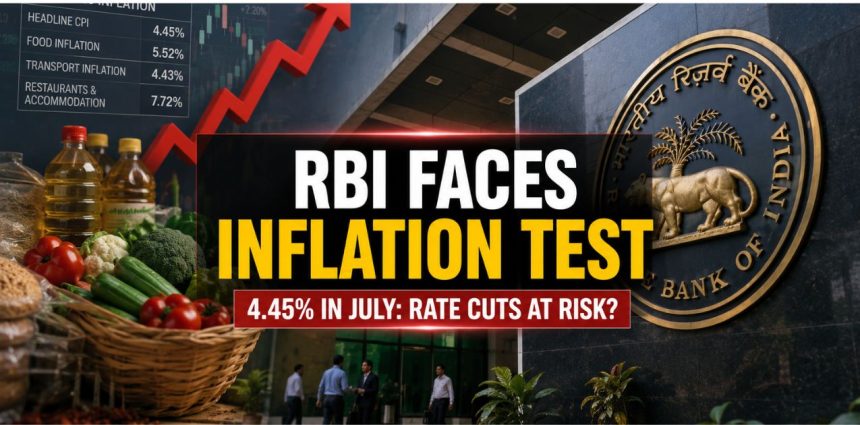
India’s headline CPI inflation rose to 4.45% in July from 4.38% in June, while food inflation increased to 5.52% from 5.32%. Both July figures are provisional.
The July data also showed notable inflation in several categories beyond food. Transport inflation was 4.43%, while restaurants and accommodation services recorded 7.72% inflation.
But these figures do not, by themselves, prove that a broad second-round inflation shock is already underway.
That distinction matters.
The RBI’s concern is less about one month of elevated food inflation and more about whether higher costs begin moving through the economy.
The inflation signals currently look like this:
| Indicator | July 2026 |
|---|---|
| Headline CPI | 4.45% |
| Food inflation | 5.52% |
| Transport inflation | 4.43% |
| Restaurants & accommodation | 7.72% |
The RBI therefore has two signals to balance:
Headline inflation is above its 4% target, but underlying price pressures have not yet shown the same degree of broad-based acceleration.
That is the expectation gap markets need to watch.
The Real RBI Risk Is Pass-Through
Food and fuel inflation do not automatically force a change in monetary policy.
The bigger risk is pass-through.
The transmission can look like this:
Food and fuel costs → transport and logistics → input costs → consumer prices → broader inflation
For example, higher fuel or transportation costs can raise expenses for manufacturers, distributors and service providers. If companies eventually pass those costs on to customers, inflation can move beyond the original supply shock.
That is when the RBI’s policy problem becomes more difficult.
A temporary food-price increase can potentially fade as supply improves.
A persistent increase in core prices is harder to dismiss.
The August Bulletin specifically flagged the risk that higher food, fuel and other input prices could translate into a broad-based increase in inflation.
The market therefore does not just need to watch whether food inflation rises again. It needs to watch whether the pressure starts appearing more widely across the inflation basket.
Also Read: RBI’s Inflation Gap Is Growing: What It Means for Rates Next
Why the Rate-Cut Debate Has Become More Complicated
The RBI kept the policy repo rate unchanged at 5.25% at its August 3–5 meeting and retained a neutral monetary policy stance.
That decision itself was not a rate-hike signal.
But the subsequent MPC minutes added a more cautious layer to the outlook.
RBI Governor Sanjay Malhotra said policymakers needed to remain watchful of the risk that higher food, fuel and input prices could translate into a broad-based increase in inflation. He added that evidence of such risks materialising could require policy tightening.
Deputy Governor Poonam Gupta went further, saying that there was no scope for further policy easing at that point and that a case for a rate hike could emerge during the fiscal year if inflation risks persisted.
Several other MPC members also highlighted the importance of monitoring second-round effects from supply-side inflation.
This changes the market framing.
The question is no longer simply:
“When will the RBI cut rates?”
It is increasingly:
“Does the RBI have enough inflation comfort to cut rates at all?”
That does not mean a rate hike is imminent.
It means the range of possible policy outcomes has become wider.
What the RBI Bulletin Says — And What It Doesn’t
There is an important distinction investors should not miss.
The August Bulletin article is not a fresh MPC policy decision.
The RBI has also clarified that views expressed in Bulletin articles are those of the authors and do not represent the official views of the central bank.
Therefore, the Bulletin warning should not be interpreted as the RBI announcing a change in rates.
Its importance comes from the risk it highlights — and the fact that the warning arrives alongside an MPC discussion that is already focused on whether supply-side pressures could become broader and more persistent.
This is where the story becomes more relevant for markets.
The Bulletin is highlighting the risk; the MPC minutes show why policymakers are taking that risk seriously.
Growth Is Still Giving the RBI Some Breathing Room
The inflation story is not entirely negative.
The August Bulletin said most high-frequency indicators showed sustained manufacturing and services activity in July. Merchandise exports and imports also recorded double-digit expansion, while liquidity conditions eased and foreign capital inflows rebounded.
That resilience matters for monetary policy.
The RBI does not face an economy that is simultaneously collapsing and experiencing inflation.
Instead, it is dealing with an economy where growth remains resilient while inflation risks are becoming less comfortable.
That gives the central bank a reason to remain patient — but it also means policymakers have less urgency to ease aggressively if inflation begins broadening.
Monsoon Could Decide How Much of the Inflation Pressure Fades
There is also a potential source of relief.
The RBI Bulletin said the recovery in the southwest monsoon during July helped kharif crop sowing move closer to normal acreage, partly mitigating risks to the agriculture sector.
If crop supplies improve and food arrivals strengthen, some of the current food inflation pressure could ease.
That creates an important uncertainty:
Will the food-price increase fade as supply conditions improve, or will higher fuel and input costs keep feeding through to consumers?
The answer could determine whether July’s inflation rise remains largely supply-driven or becomes a more persistent policy concern.
Crude Oil Is the External Risk Markets Cannot Ignore
India’s inflation outlook also remains exposed to global energy prices.
The latest MPC discussion specifically highlighted risks from global developments and oil prices. India imports a large share of its crude requirements, making energy shocks particularly important for inflation and the rupee.
Bond markets are already sensitive to this risk.
The 10-year government bond yield rose 9 basis points to 6.8495% in the week ended August 21, its sharpest weekly rise of the current financial year, with markets watching oil prices and the possibility of future RBI tightening.
That makes crude a key forward-looking indicator.
Even if domestic food inflation starts easing, a fresh oil shock could keep the RBI’s inflation problem alive.
What Traders Should Watch Next
| Signal | Why It Matters | What Would Change the View |
|---|---|---|
| Food inflation | Shows whether the July increase is temporary or persistent | Continued acceleration despite improving supply |
| Core inflation | Best signal of broader pass-through | Sustained rise across core categories |
| Crude oil | Key fuel and input-cost channel | A sharp, sustained rise in energy prices |
| Kharif output | Determines how much food supply can improve | Weak crop output or supply disruptions |
| G-sec yields | Reflect market expectations for rates and inflation | Sustained rise in benchmark yields |
| RBI commentary | Provides clues about the policy reaction function | More emphasis on second-round effects |
| FII flows | Influence liquidity, rupee and financial conditions | Renewed outflows alongside inflation concerns |
The bond market is already showing why this watchlist matters: the benchmark yield recently crossed 6.85% before easing slightly, while investors continued to assess oil prices and the RBI’s policy reaction function.
Check Live: FII DII DATA |NIFTYTRADER
What It Could Mean for Markets
The inflation risk will not affect every part of the market equally.
Banks and NBFCs: A shift in rate expectations can influence funding costs, credit demand and valuations.
Government bonds: G-sec yields could remain sensitive to changes in inflation expectations and the possibility of a longer period of tight or neutral policy.
FMCG and consumer stocks: Persistent food and input-cost inflation could pressure margins and household purchasing power.
Autos and industrials: Fuel, commodity and financing costs could become more important if inflation expectations rise.
The key point is not that these sectors will automatically move in one direction.
Rather, their valuations could become more sensitive to changes in the expected inflation and rate path.
The Bigger Question for Markets
India is not yet facing a confirmed broad-based inflation shock.
The current picture remains mixed: growth indicators are resilient, liquidity conditions are supportive and the July inflation increase is still heavily influenced by supply-side factors. At the same time, policymakers are explicitly watching whether those pressures begin producing wider second-round effects.
That is where the uncertainty lies.
If food and fuel pressures remain contained, the RBI could retain greater policy flexibility.
If they begin feeding into core prices, services and expectations, the case for aggressive easing could weaken — while the possibility of tighter policy becomes harder for markets to ignore.
For investors, 4.45% may not be the number that matters most. The bigger signal will be whether inflation stays concentrated — or starts spreading.
That could determine whether the RBI retains room to ease, or has to keep the door open to tighter policy in the months ahead.
Read Next: Max-Axis Case Ends: Why Axis Bank Investors May Still Be Watching SEBI’s Next Move
This article is for informational purposes only and does not constitute investment advice. Readers are advised to consult a SEBI-registered financial advisor before making investment decisions.