Key Takeaways
- RBI Governor Sanjay Malhotra told the MPC he wants more clarity on inflation’s trajectory before recalibrating the repo rate, per minutes of the August 3–5 meeting released Wednesday.
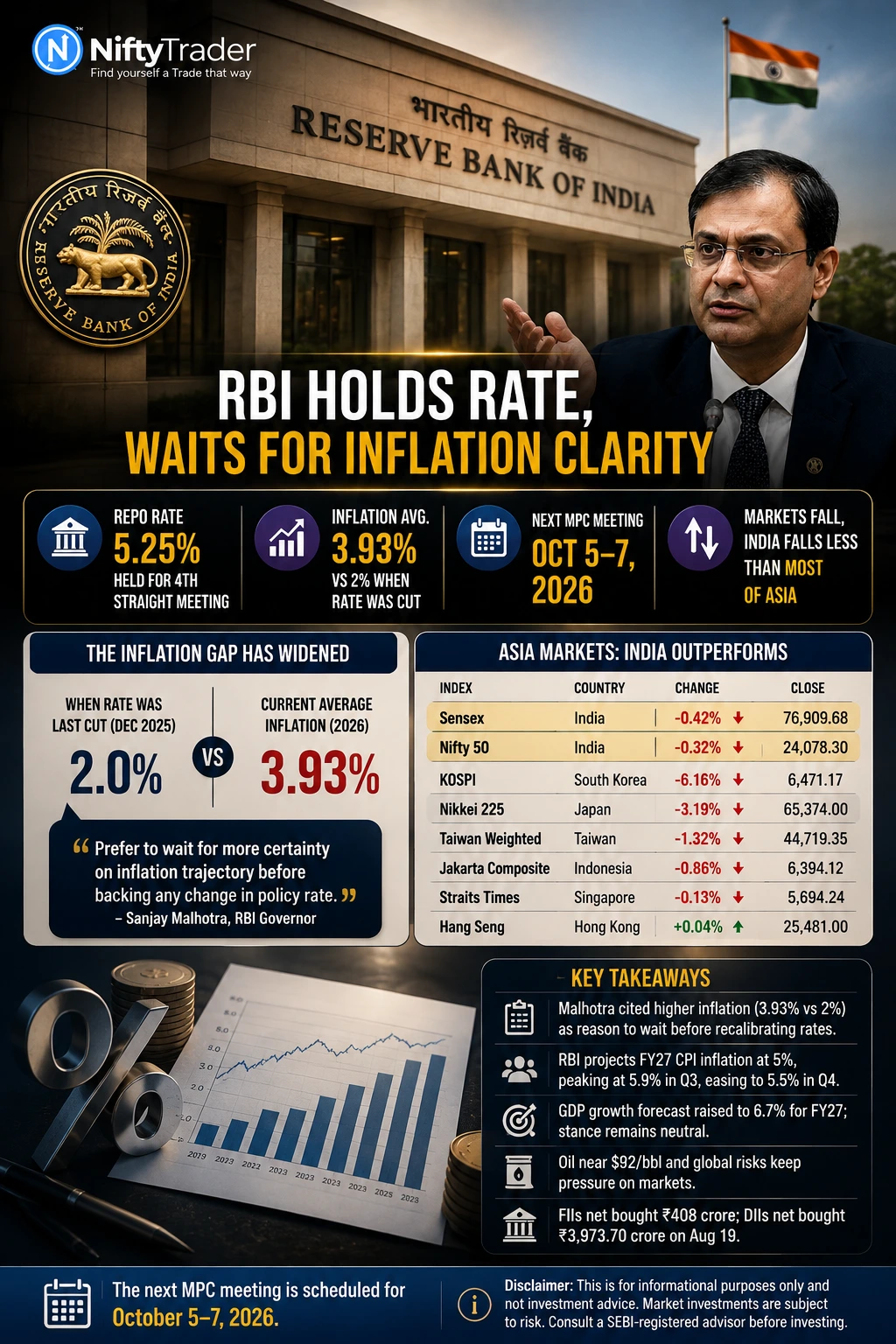
- The repo rate has been held at 5.25% for a fourth straight meeting, unchanged since the last cut in December 2025.
- Headline inflation has averaged 3.93% this year against just 2% when the rate was last cut — a gap Malhotra cited as grounds for recalibration.
- Sensex and Nifty extended their losing streaks on Wednesday, but the fall was mild next to South Korea’s KOSPI, which dropped over 6% the same session.
- The next MPC meeting is scheduled for October 5–7, 2026.
Reserve Bank of India Governor Sanjay Malhotra wants firmer evidence on where inflation is headed before recalibrating the policy rate, even as his own numbers hint at why the central bank might eventually have to move. The remarks appear in the minutes of the Monetary Policy Committee’s August 3 to 5 meeting, which the RBI released on Wednesday.
The six-member MPC voted to hold the repo rate at 5.25 percent for a fourth consecutive meeting, extending a pause that has held since the last cut in December 2025.
At its August 5 policy announcement, the MPC had already raised its FY27 GDP growth forecast to 6.7 percent from 6.6 percent and trimmed its CPI inflation projection to 5 percent from 5.1 percent, while retaining a neutral stance.
Malhotra: Prefer to Wait Before Recalibrating
Malhotra said he would prefer to wait for more certainty to emerge on the inflation trajectory before backing any change to the policy rate, according to the minutes. He wants clarity on how persistent current price levels prove to be, how the forecast evolves, and where inflation eventually settles.
He added that the central bank would need to tighten policy if food, fuel and input cost pressures broadened into the wider economy or unanchored inflation expectations, though he said evidence of that spillover remains limited so far.
The current price pressure, he said, is largely a supply side shock that does not yet call for a demand side monetary response.
Despite headwinds from the West Asia conflict, global supply chain disruption and an erratic monsoon, Malhotra said the Indian economy performed better than expected in the first quarter of FY27.
Also Read: RBI Rate Pause Likely This Week — Here’s What It Means for Your Home Loan EMI
The Inflation Math That Has Changed
Malhotra’s own comparison is the sharpest data point in the minutes. Average inflation was just 2 percent when the MPC last cut the repo rate to 5.25 percent in December 2025, he noted.
Headline inflation has since averaged 3.93 percent this year, and core inflation, a gauge the RBI tracks closely for underlying price pressure, is projected to average 4.3 percent in FY27, converging with headline inflation by the final quarter. That widening gap is what he flagged as a case for eventually recalibrating the rate.
The RBI’s own August projections put FY27 CPI inflation at 5 percent, with the quarterly path seen peaking at 5.9 percent in the third quarter before easing to 5.5 percent in the fourth.
Other MPC Members Flag Growth Resilience, Global Risk
Deputy Governor Poonam Gupta, also an MPC member, said global uncertainty eased briefly in June before flaring up again in July.
She pointed to improving monsoon distribution and resilient high frequency growth indicators, adding that the year’s growth outcome could beat the RBI’s June forecast even as inflation runs marginally lower than projected.
External member Saugata Bhattacharya said the balance of risks has kept shifting since the West Asia conflict began in late February, layering fresh uncertainty onto an already complex outlook.
Fellow external member Nagesh Kumar credited the economy’s resilience through the crisis but flagged that blockade risk around the Strait of Hormuz, a key crude oil shipping route, has not eased even as India works to manage the fallout.
Market Reaction: Sensex, Nifty Extend Losing Streak
The minutes landed on a weak trading day, though for reasons largely separate from the MPC’s commentary.
The BSE Sensex fell 325.78 points, or 0.42 percent, to close at 76,909.68, its fourth straight decline, while the Nifty 50 slipped 76.60 points, or 0.32 percent, to 24,078.30, extending its losing run to a seventh consecutive session.
Brent crude added to the pressure, trading close to $92 a barrel and extending gains for a fourth straight session, as the expiry of the US-Iran interim truce kept a premium on oil prices.
Bajaj Finserv and Bajaj Finance led the Sensex lower, both falling more than 1 percent, as rate-sensitive NBFCs came under pressure from rising global bond yields. HCL Tech and Infosys bucked the trend, closing among the day’s gainers as IT stocks outperformed the broader market.
Vinod Nair, Head of Research at Geojit Investments, linked Wednesday’s caution to positioning ahead of the US Federal Reserve’s FOMC minutes rather than to the RBI’s commentary, noting that the lack of a diplomatic resolution to the US-Iran standoff kept crude prices and bond yields elevated and pushed sentiment into risk-off mode. He added that IT stocks were the exception, gaining on value buying and support from a weaker rupee even as most other sectors sold off.
India’s Fall Was Mild Next to the Rest of Asia
Wednesday’s session looked orderly next to what played out elsewhere in the region. South Korea’s KOSPI dropped 6.16 percent to 6,471.17 and Japan’s Nikkei 225 slid 3.19 percent to 65,374.00, both far steeper losses than the Sensex or Nifty registered.
Taiwan’s Weighted Index fell 1.32 percent to 44,719.35, and Jakarta’s Composite eased 0.86 percent to 6,394.12. Singapore’s Straits Times dipped a modest 0.13 percent to 5,694.24. Hong Kong’s Hang Seng was the lone gainer among the region’s major benchmarks, edging up 0.04 percent to 25,481.00.
Asian Markets: India Outperforms Regional Peers
| Index | Country | Change | Closing Level |
|---|---|---|---|
| Sensex | India | -0.42% | 76,909.68 |
| Nifty 50 | India | -0.32% | 24,078.30 |
| KOSPI | South Korea | -6.16% | 6,471.17 |
| Nikkei 225 | Japan | -3.19% | 65,374.00 |
| Taiwan Weighted | Taiwan | -1.32% | 44,719.35 |
| Jakarta Composite | Indonesia | -0.86% | 6,394.12 |
| Straits Times | Singapore | -0.13% | 5,694.24 |
| Hang Seng | Hong Kong | +0.04% | 25,481.00 |
Source: The Tribune, citing exchange closing data.
The scale of the KOSPI’s slide points to a regional, not RBI-driven, sell trigger, South Korean chipmakers carry heavy weight on the index and are more exposed to global rate and trade jitters than India’s relatively insulated, domestic-consumption-led market.
For Indian investors, the read-through is that Wednesday’s fall had far more to do with global positioning ahead of the Fed minutes and Strait of Hormuz risk than with anything in the RBI minutes themselves.
Track live institutional activity on the NiftyTrader FII-DII Tracker (niftytrader.in/fii-dii-data).
Provisional NSE cash segment data for August 19 showed FIIs as net buyers of ₹408 crore and DIIs as net buyers of ₹3,973.70 crore — domestic buying that helped cushion Wednesday’s broader risk-off session.
What’s Next: October Policy Review
The MPC’s next meeting is scheduled for October 5 to 7, 2026, by when fresh CPI prints for August and September will be in hand.
The number to watch is whether core inflation keeps tracking toward the RBI’s own 4.3 percent FY27 estimate and converges with headline inflation by the fourth quarter, as the central bank’s August projections suggest. That convergence, more than any single data print, is what would turn Malhotra’s wait-and-watch stance into an actual policy debate.
Bottom Line
The August minutes confirm what the RBI signalled at its policy announcement: rates are on hold, but the door to tightening isn’t shut. Malhotra’s comparison of 2 percent inflation at the time of the last rate cut versus 3.93 percent now reads as a soft warning that the current stance may need revisiting if food and fuel prices broaden further.
Wednesday’s session offered a preview of how markets react to that tension, though the bigger mover was global positioning rather than the minutes themselves, with India’s losses notably smaller than the selloff that hit South Korea and Japan. The October 5–7 review, armed with two more months of inflation data, is the next real test of whether that gap keeps widening or starts to close.
Read Next: AI Revenue Is Surging. Why Did CLSA Cuts TCS, Infosys?
Disclaimer: This article is for informational purposes only; not investment advice. Market investments are subject to risk. Consult a SEBI-registered advisor before investing. NiftyTrader does not guarantee the accuracy or completeness of the information.