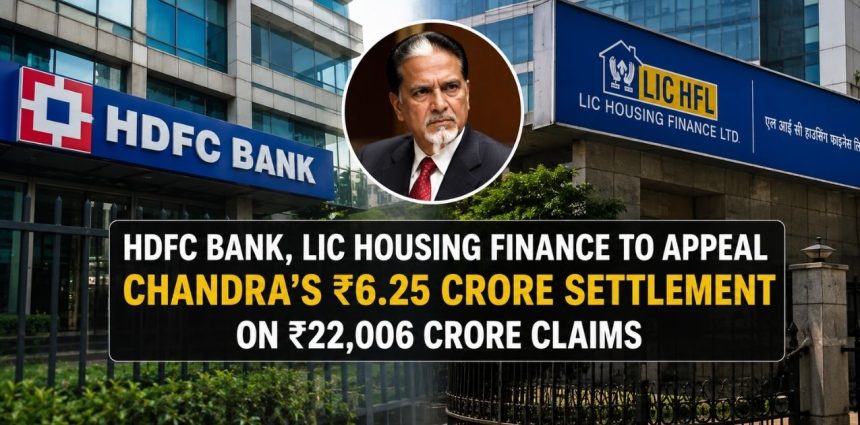
Mumbai: HDFC Bank and LIC Housing Finance are preparing to challenge before the National Company Law Appellate Tribunal (NCLAT) a ruling that lets Zee Group founder Subhash Chandra settle admitted creditor claims of Rs 22,006.57 crore for a personal payout of just Rs 6.25 crore.
The order has set off a public tug-of-war: dissenting lenders call the payout unviable, government sources say the widely reported 99.97 percent haircut figure is misleading, and Chandra himself disputes the size of the claim against him.
Need to Know
- NCLT approved Chandra’s personal insolvency plan on August 25, letting him pay Rs 6.25 crore against Rs 22,006.57 crore in admitted claims, a ~0.03% recovery.
- HDFC Bank and LIC Housing Finance, both dissenting creditors, are weighing an NCLAT appeal; LICHFL’s Rs 1,322.39-crore claim would fetch just Rs 38.09 lakh under the plan.
- Government sources say the Rs 22,006-crore figure covers guarantee claims across Essel/Zee-linked firms, not money Chandra personally borrowed.
- Chandra disputes the number too, saying objecting lenders’ actual claim totals Rs 3,992 crore, of which Rs 620 crore is settled and Rs 1,063 crore offered by borrowing entities.
Check Live: HDFC BANK Options Chart | Nifty Trader
What exactly did the NCLT approve?
The Delhi bench of the National Company Law Tribunal approved the plan on August 25 after a split verdict between two members was referred to a third, judicial member Nilesh Sharma, who cleared it under Section 114 of the Insolvency and Bankruptcy Code (IBC).
Judicial Member Ashok Kumar Bhardwaj had backed the plan, while Technical Member Reena Sinha Puri flagged what she called serious legal and procedural defects, forcing the reference to a third member.
The case traces back to 2022, when Indiabulls Housing Finance, now Sammaan Capital, moved the NCLT under Section 95 of the IBC after a Rs 170 crore loan to Vivek Infracon, guaranteed personally by Chandra, turned bad, opening a personal insolvency process that pulled in guarantees across multiple Essel and Zee-linked firms.
The approved plan involves Rs 6.25 crore for creditors plus a separate Rs 25 lakh earmarked for insolvency process costs and was backed by creditors holding 80.81 percent of the voting share.
Sharma’s order held that a resolution professional’s valuation showed Chandra’s personal estate was worth far less than what the plan offered, and that pushing him into bankruptcy instead would likely leave dissenting creditors worse off, not better.
Rs 6.25 crore or Rs 6.5 crore? Clearing up the confusion
Coverage of the ruling has cited both Rs 6.25 crore and Rs 6.5 crore as Chandra’s settlement figure, and both are technically correct.
The plan sets aside Rs 6.25 crore for creditor recoveries; add the Rs 25 lakh process-cost component, and the total works out to Rs 6.5 crore, the figure some outlets use instead. Either way, the recovery against Rs 22,006.57 crore in admitted claims comes to roughly 0.03 percent.
Why officials call the 99.97 percent haircut figure misleading
Government sources have pushed back on the framing that banks have written off 99.97 percent of Rs 22,000 crore in loans. The Rs 22,006.57 crore figure, they said, represents claims admitted against Chandra in his capacity as a personal guarantor for loans taken by several Essel and Zee-linked companies, not debt he personally borrowed.
The principal corporate borrowers remain separately liable for their debts, and the repayment plan envisages roughly Rs 1,494 crore in payments from those borrowing companies, independent of Chandra’s personal settlement.
Creditors also retain the right to recover dues from those companies, their securities, and other available assets.
Which lenders are pushing back, and how much do they stand to lose?
LIC Housing Finance, HDFC Bank, Axis Bank, Canara Bank, IDBI Trusteeship Services (representing a Franklin Templeton fund), RBL Bank, and Union Bank of India (UK) all voted against the plan, together holding just under 20 percent of the voting share against the 80.81 percent that approved it.
| Dissenting Lender | Voting Share | Exposure Detail |
|---|---|---|
| LIC Housing Finance | 6.09% | Rs 1,322.39 cr admitted claim; Rs 38.09 lakh recovery (0.028%) |
| IDBI Trusteeship (Franklin Templeton fund) | 3.36% | Not publicly disclosed |
| HDFC Bank | 3.17% | 3.2% of total admitted claims; inherited from HDFC Ltd pre-2023 merger |
| Axis Bank | 2.86% | Not publicly disclosed |
| Canara Bank | 1.60% | Not publicly disclosed |
| Union Bank of India (UK) | 0.76% | Not publicly disclosed |
| RBL Bank | 0.55% | Not publicly disclosed |
Rupee exposure not disclosed for all lenders in public filings; voting shares per NCLT order.
Chandra hits back: “Nothing left to lose”
Chandra has disputed the scale of the claim against him. In a statement, he said the total claim raised specifically by the objecting creditors is Rs 3,992 crore, not Rs 22,006 crore, and that of this, Rs 620 crore has already been settled while the underlying borrowing entities have offered another Rs 1,063 crore.
He added that entities for which he furnished guarantees have repaid close to Rs 43,000 crore against roughly Rs 45,000 crore in dues outstanding since January 2019, and that the remaining balance would be settled by those entities.
On August 28, Chandra went further, publicly addressing Reliance Industries chairman Mukesh Ambani over coverage of the case by the Network18 group, saying he has “nothing left to lose” after liquidating personal and family assets to meet repayment commitments.
Chandra’s disclosed net worth has also become a flashpoint, with dissenting creditors citing the steep decline as grounds for deeper scrutiny of his assets:
| Year | Disclosed Net Worth | Source |
|---|---|---|
| 2017 | Rs 45,888 crore | Certificate furnished to RBL Bank |
| 2018 | Rs 40,562 crore | Certificate furnished to Canara Bank |
| 2024 | Rs 31.79 crore | Filed with the Resolution Professional |
What this means for the broader IBC recovery story
Sources cited by news agencies were emphatic that the Chandra case is an exceptional personal-guarantor resolution, not representative of how corporate insolvency recoveries typically play out under the IBC.
Creditors have recovered about Rs 4.32 lakh crore through approved resolution plans up to March 2026, equal to 116.85 percent of liquidation value and 94.56 percent of fair value, while over 32,000 cases involving assets worth roughly Rs 14 lakh crore have been settled even before formal admission into insolvency proceedings.
Systemic net non-performing assets have fallen from 5.94 percent in March 2018 to 0.48 percent in September 2025, with the absolute figure dropping from about Rs 5.2 lakh crore to roughly Rs 94,000 crore.
An IIM Ahmedabad study cited alongside these figures found companies resolved through insolvency recorded 76 percent growth in sales, 50 percent growth in total assets, and 130 percent growth in capital expenditure post-resolution.
What happens next
The matter now returns to the original division bench of the NCLT, which will pass a formal order reflecting the majority view, as required under Section 419(5) of the Companies Act, 2013.
HDFC Bank and LIC Housing Finance are both expected to move the NCLAT in the coming weeks, while creditors’ separate claims against the underlying Essel and Zee companies and their assets remain ongoing and unaffected by Chandra’s personal settlement.
Read Next: Jio’s Rs 37,700 Crore IPO Aims To Dethrone Hyundai As India’s Biggest Ever
Disclaimer: This article is for informational purposes only and does not constitute investment advice. NiftyTrader does not recommend buying or selling any securities. Readers should consult a registered financial advisor before making investment decisions. Investments in securities markets are subject to market risks.