
Zerodha Merchant Banking Gets SEBI Approval, Eyes Entry Into IPO Business
Zerodha is moving closer to a major expansion beyond stock broking. The fintech giant has received approval from the Securities and Exchange Board of India (SEBI) for its application to enter the merchant banking business, according to sources familiar with the development.
But there is one important step still pending. The formal registration process with SEBI has not yet been completed, meaning Zerodha’s entry into merchant banking is not fully operational yet.
For investors, the development could be more significant than it initially appears. If the registration is completed, Zerodha could enter the IPO management and broader investment banking space at a time when India’s primary market is showing signs of a strong revival.
Track Live : GIFT Nifty Live – Today Price, Chart, Timings and Nifty Opening Signal
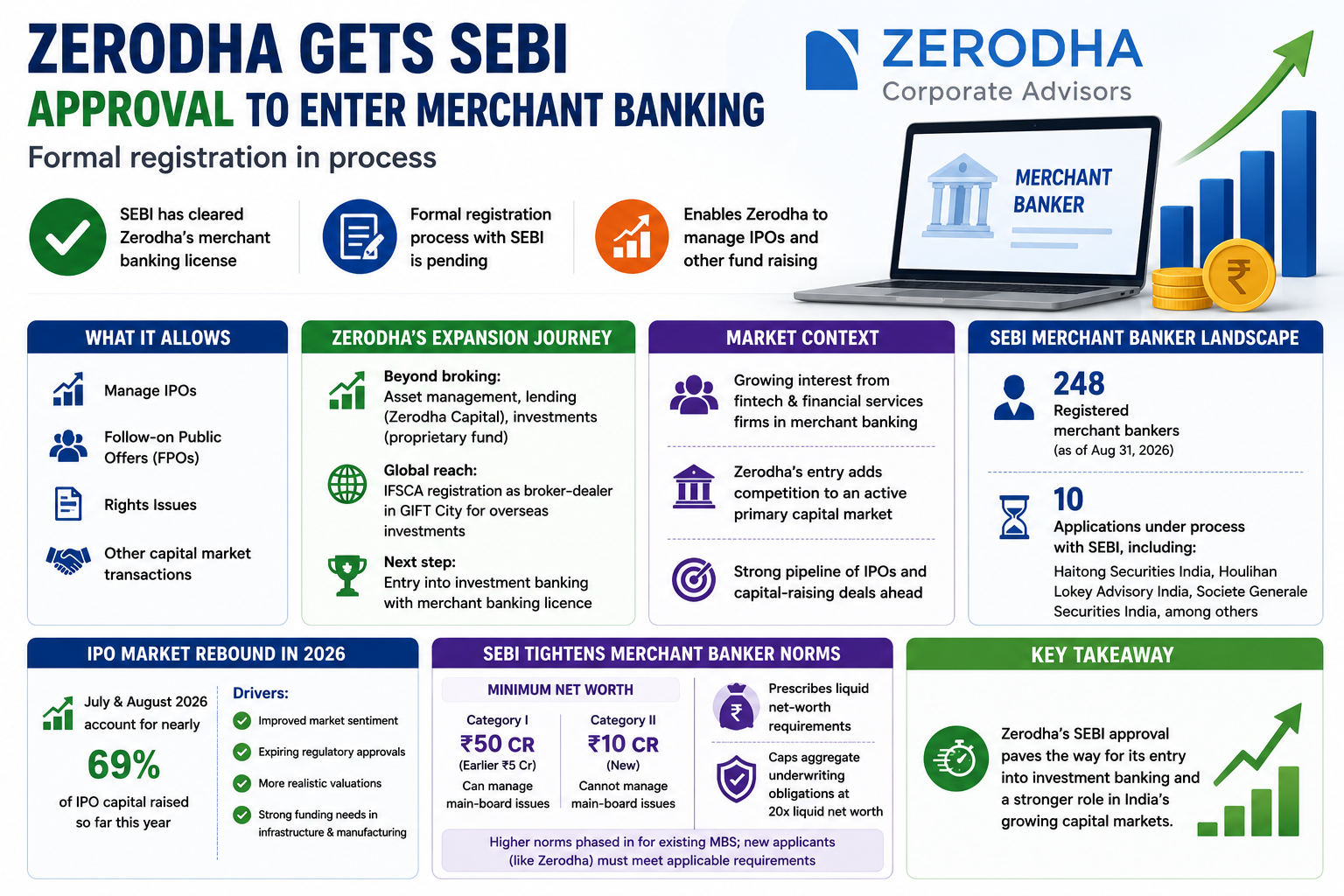
Zerodha’s merchant banking licence could open a new business opportunity
Zerodha’s application was filed through Zerodha Corporate Advisors on April 27, 2026. The company had earlier confirmed that it had applied for a merchant banking licence but said it would share details of its business plans after receiving the licence.
A merchant banking licence would allow Zerodha to participate in several capital-market activities. These include managing initial public offerings (IPOs), follow-on public offers (FPOs), rights issues and other fundraising transactions.
This would take Zerodha beyond its traditional broking business and put the company directly into competition with established Indian and global investment banks.
The move could also strengthen Zerodha’s position across different parts of India’s financial-services ecosystem.
- Higher Net-Worth Ceiling: SEBI raised the minimum net-worth requirement for Category-I merchant bankers from ₹5 crore to ₹50 crore. As a new applicant, Zerodha Corporate Advisors must meet this steeper ₹50 crore requirement upfront to handle main-board public issues.
- Underwriting Limits: The revised guidelines also restrict a firm’s aggregate underwriting obligations to 20 times its liquid net worth. This means Zerodha will have to carefully back its IPO underwritings with deep liquid reserves.
- The Entity: The application was filed under Zerodha Corporate Advisors on April 27, 2026.
- Current Status: SEBI has cleared the application, though the formal registration process is still underway.
- The Shift: This transitions Zerodha from a pure-play retail brokerage and asset management company into a primary capital market intermediary.
Why Zerodha’s move matters as India’s IPO market rebounds
The timing of Zerodha’s merchant banking entry is particularly important for investors watching the IPO market.
India’s IPO market experienced a sharp slowdown during the first half of 2026 as geopolitical tensions and market volatility made companies more cautious about launching public issues. Several companies deferred their listing plans during the period.
However, sentiment improved significantly in July and August. These two months accounted for nearly 69% of the IPO capital raised so far in 2026.
The recovery has been supported by more realistic valuations, expiring regulatory approvals and continued funding requirements across sectors such as infrastructure and manufacturing.
For Zerodha, a stronger IPO pipeline could create an attractive opportunity to build a new revenue stream through merchant banking services.
Track Live : NSE Option Chain — Live
- Revenue Pressures: For the financial year ending March 2025, Zerodha witnessed its first drop in core financial metrics—with operational revenue dropping 11.5% to ₹8,847 crore and profits dropping 23% to ₹4,237 crore due to SEBI’s strict tightening of regulatory norms on derivatives (F&O) trading.
- New Revenue Streams: Corporate advisory and public issue management allow Zerodha to charge hefty transaction-percentage fees, helping them diversify away from pure retail brokerage volume.
Strategic Impact for Zerodha
- Revenue Diversification: Moves Zerodha away from heavy reliance on retail trading brokerage, which is highly cyclical and vulnerable to regulatory changes on futures and options (F&O).
- Ecosystem Completion: Zerodha now owns the entire pipeline—from capital raising (Merchant Banking) and manufacturing investment products (Zerodha AMC) to distribution (Zerodha Broking & Coin).
- GIFT City Alignment: Complements its recent IFSCA broker-dealer registration in GIFT City, positioning it to facilitate both domestic and cross-border corporate transactions.
Read More : Sugar Stock Drops 7% as Government Cuts Dealer Stock Limit; Dwarikesh, Uttam Slide
Zerodha could face established investment banking competition
Entering merchant banking will not be an easy growth opportunity. Zerodha would be competing with established domestic and international investment banks that already have deep relationships with companies, promoters and institutional investors.
SEBI’s latest application data also shows continued interest in the sector. As of August 31, 2026, the regulator had 248 registered merchant bankers, while 10 merchant banking registration applications were under process.
These included applications from Haitong Securities India, Houlihan Lokey Advisory India and Societe Generale Securities India, among others.
Zerodha’s entry could therefore increase competition in an already active market, particularly if IPO and fundraising activity remains strong.
What This Means for Retail Investors & The Market
- Tech-Driven IPOs: Retail investors can expect a highly streamlined, deeply integrated IPO application and bidding experience within the Kite platform.
- SME IPO Boom Support: Zerodha could leverage its massive retail tech stack to bring greater transparency and liquidity to the rapidly growing Small and Medium Enterprise (SME) IPO sector.
- Increased Competition: Established institutional players (like ICICI Securities, Kotak Mahindra Capital, and Axis Capital) will face intense fee and technology competition from an agile fintech disrupter.
SEBI’s higher net-worth rules raise the entry barrier
Another important factor for investors is SEBI’s revised regulatory framework for merchant bankers.
The regulator has raised the minimum net worth requirement for Category I merchant bankers to Rs 50 crore from Rs 5 crore. Category II merchant bankers must maintain a minimum net worth of Rs 10 crore.
The distinction matters because Category I merchant bankers can manage main-board public issues, while Category II entities cannot.
The revised framework also includes liquid net-worth requirements and limits aggregate underwriting obligations to 20 times liquid net worth.
For a new applicant such as Zerodha, the applicable higher capital requirements will need to be met as part of the regulatory process.
Here’s what happened today and why traders reacted
The key development is not that Zerodha has already started managing IPOs. Rather, SEBI has cleared its application, while the formal registration process remains pending.
That distinction is important for investors because the approval signals regulatory progress but does not immediately translate into new earnings for Zerodha.
Still, the development highlights the company’s broader strategy of expanding beyond online stock broking.
Over the past few years, Zerodha has entered several financial-services segments, including asset management, lending through Zerodha Capital and proprietary investments. It has also received registration from the International Financial Services Centres Authority (IFSCA) as a broker-dealer in GIFT City.
The merchant banking business could therefore become another important part of Zerodha’s expanding financial-services platform.
What Zerodha’s move could mean for investors and traders
For investors, the immediate impact is likely to be limited because the formal merchant banking registration is still pending.
The bigger story is Zerodha’s continued diversification. Moving into IPO management and capital raising could potentially reduce its dependence on traditional broking revenues over the longer term.
It could also give Zerodha access to a different set of clients and transaction-based opportunities as India’s primary capital market expands.
Traders, meanwhile, are likely to focus on the next regulatory update and any formal announcement from Zerodha regarding its merchant banking plans.
The company declined to comment on the development when contacted by Moneycontrol on August 28.
For now, the SEBI approval represents an important regulatory milestone rather than a completed business launch. The next step—formal registration—will determine how quickly Zerodha can turn the approval into an operating merchant banking business.