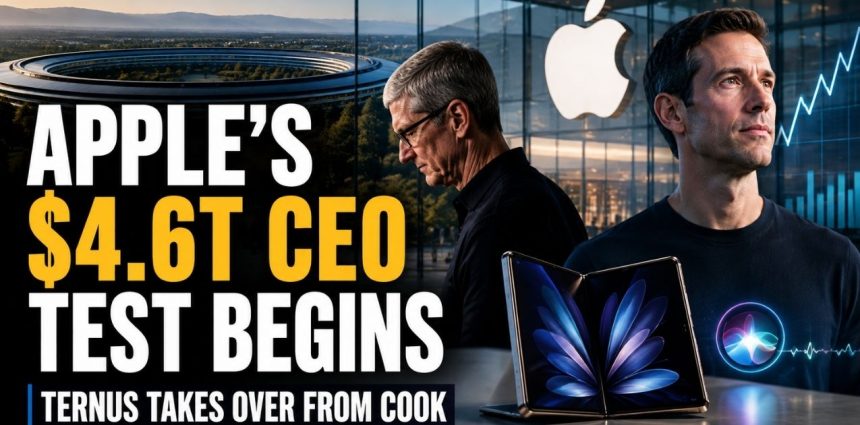
Synopsis: Tim Cook officially stepped down as Apple CEO on September 1, 2026, ending a 15-year run that turned a $350 billion company into a $4.6 trillion one. John Ternus, Apple’s hardware engineering chief, takes over immediately, with his first major test arriving just eight days later at Apple’s September 9 event, where a foldable iPhone is expected to headline the lineup.
NEED TO KNOW
- Tim Cook handed the Apple CEO role to John Ternus on September 1, 2026, moving into the newly created position of executive chairman.
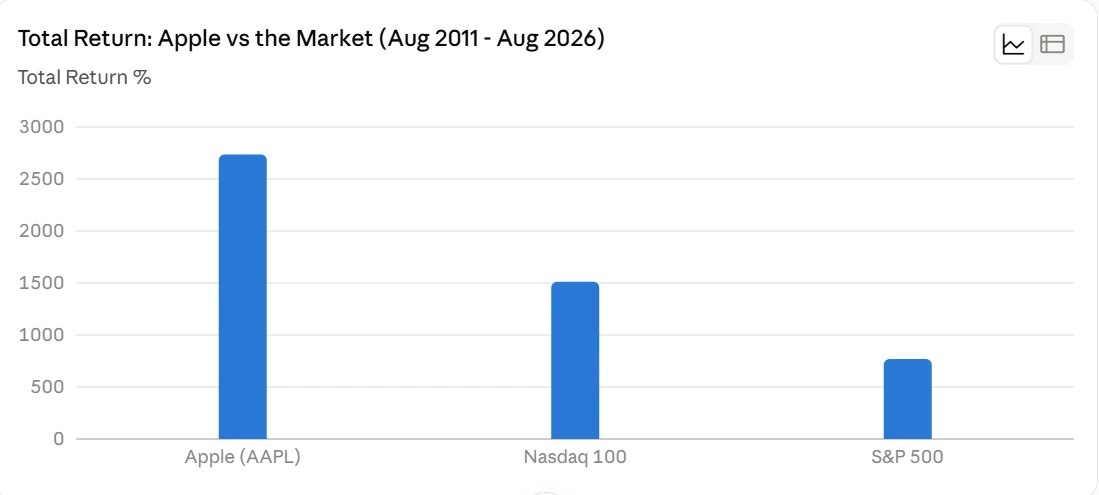
- Apple’s stock returned roughly 2,275% on price alone during Cook’s tenure, or 2,736% including dividends, comfortably beating the S&P 500 and Nasdaq 100.
- Ternus, a 25-year Apple veteran and mechanical engineer by training, has a foldable iPhone launch just eight days into the job, on September 9.
- Apple’s biggest unresolved problem is AI, where it trails rivals and is rebuilding Siri on Google’s Gemini models.
- India’s iPhone assembly base, led by Tata Electronics and Foxconn, is now central to Apple’s supply chain, with a direct read-through for listed Indian EMS stocks.
WHAT CHANGED AT APPLE’S TOP ON SEPTEMBER 1
Apple made the transition official on Tuesday. Cook, who succeeded Steve Jobs in August 2011, has moved to executive chairman of the board, a role in which Apple says he’ll keep managing relationships with the Trump administration and Chinese officials. Board chair Art Levinson becomes lead independent director the same day.
None of this was a surprise by the time it happened, Apple confirmed the succession plan back in April 2026, giving the company nearly five months to prepare. People familiar with the board’s thinking describe it as a long-planned handover, not a reaction to any crisis.
In his final memo to staff, Cook made clear he isn’t leaving Apple, only the CEO chair, and praised Ternus as having the mind of an engineer, the soul of an innovator.
TIM COOK’S 15-YEAR SCORECARD, BY THE NUMBERS
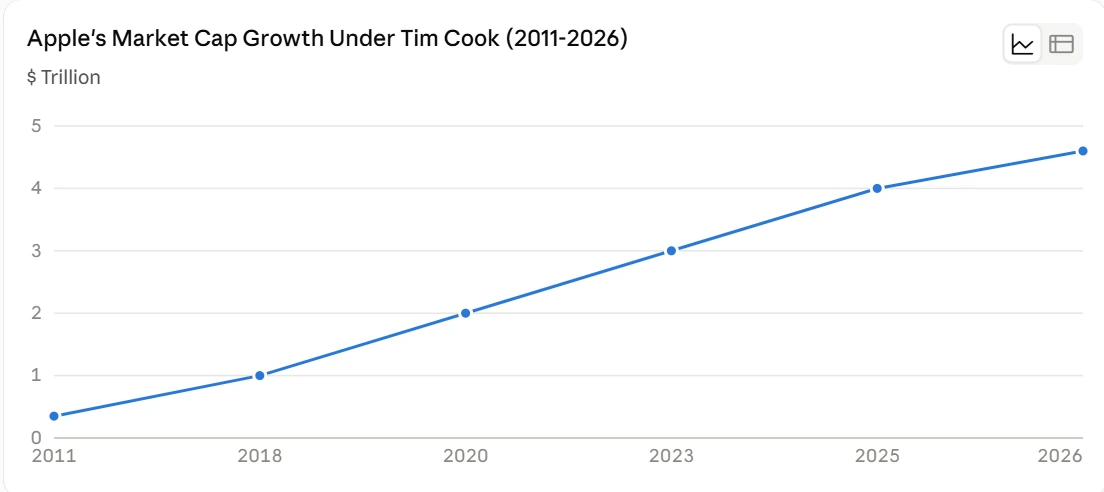
Cook inherited a company worth under $350 billion. He leaves one valued at roughly $4.6 trillion, the world’s second-largest public company behind Nvidia.
Apple crossed $1 trillion first among US companies, then $2 trillion in 2020, $3 trillion by 2022-23, and $4 trillion in October 2025. It briefly overtook Nvidia for the top spot in July 2026.
| Metric | 2011 (Cook’s start) | 2026 (Cook’s exit) |
|---|---|---|
| Market capitalization | Under $350 billion | ~$4.6 trillion |
| Annual revenue | ~$108 billion (FY2011) | $477 billion expected (FY2026) |
| Services revenue | $16 billion (FY2013) | Over $109 billion (FY2025) |
| iPhones sold/year | ~72 million | ~255 million (Counterpoint est.) |
| Shares outstanding | 2012 peak baseline | Down ~45%, lowest since 1998 |
| Forward P/E multiple | ~12x | ~33x (10-yr avg: 23x) |
| S&P 500 index weight | Under 3.3% | 7.1% (peaked ~7.9%) |
On buybacks alone, Apple has spent more than $840 billion repurchasing stock since fiscal 2012, the biggest capital-return program of any company that decade, while paying a dividend it reinstated in 2012 after a 17-year gap.
On a pure share-price basis, Apple gained ~2,275% under Cook. Including reinvested dividends, the total return climbs to ~2,736%, putting it among the 40 best-performing S&P 500 stocks of the era, though it still trails Nvidia, Tesla, and Broadcom.
WHO IS JOHN TERNUS?
Ternus, 50, is a mechanical engineer from the University of Pennsylvania who joined Apple’s product design team in 2001 after four years at a VR headset maker.
He moved up through Mac and iPad hardware, made VP of hardware engineering in 2013, and became SVP of Hardware Engineering in January 2021, reporting directly to Cook and overseeing the iPhone, iPad, Mac, Apple Watch, AirPods and Vision Pro. He also led the Mac’s multi-year transition to Apple’s own silicon chips.
Where Cook built his reputation running supply chain and operations, Ternus comes from the product side, which analysts read as a signal that Apple’s next chapter leans harder into hardware innovation: foldables, smart glasses, and mixed reality.
He’s kept a low public profile but is well regarded internally as an engineering leader with deep institutional knowledge, built over a quarter-century at the company.
THE SEPTEMBER 9 TEST: A FOLDABLE IPHONE AND TERNUS’S FIRST KEYNOTE
Ternus doesn’t get a grace period. Apple’s “Surprise and Shine” event on September 9 at the Steve Jobs Theater is his first keynote as CEO, and leaks point to the biggest iPhone redesign since the iPhone X. The headliner is expected to be Apple’s first foldable, reportedly called the iPhone Ultra, a roughly 5.5-inch external display with a 7.6-7.8-inch internal display in a book-style, iPad-like 4:3 format. First-run supply is reported to be thin, with pricing well above the existing Pro lineup.
Alongside it, Apple is expected to refresh the iPhone 18 Pro and Pro Max with a new 2nm A20 Pro chip, while the standard iPhone 18 has reportedly slipped to spring 2027. Apple enters the foldable category late, Samsung and Huawei have iterated on the format since 2019, and foldables were still only ~1.6% of global smartphone sales in 2025. But Counterpoint projects 21% further growth in 2026, making it the one growth pocket in an otherwise flat smartphone market.
THREE FIRES TERNUS HAS TO PUT OUT
AI is the most pressing. Apple has faced sustained criticism over a delayed Siri overhaul and a slower generative-AI push than Google, Microsoft or Amazon, leading to an AI leadership shake-up and a decision to rebuild Siri on Google’s Gemini models, with full rollout slated for this month. Wedbush’s Dan Ives has called the timing of Cook’s exit, mid-AI-transition, a genuine surprise even while backing Ternus as the right pick.
China dependency is the second. Much of Apple’s hardware supply chain still runs through China, even as Cook, now as executive chairman, keeps managing the Washington and Beijing relationship on tariffs, a job Ternus will increasingly need to share.
Services pressure is the third. Apple’s highest-margin business missed revenue estimates last quarter, and a US court ruling has already cut into the App Store’s in-app purchase commissions; Appfigures estimates US App Store commission revenue fell ~6% in the June 2026 quarter.
WALL STREET’S VERDICT
Wall Street’s welcome for Ternus has been noticeably cooler than the tributes paid to Cook. Of 58 analysts tracked by Bloomberg, 34 carry buy ratings on Apple, about 59%, versus roughly 95% bullish coverage on megacap peers Microsoft, Nvidia, and Amazon.
The average price target implies barely 1.5% upside from Apple’s price heading into the handover. Much of the caution is valuation: Apple trades near 33x forward earnings, above its 10-year average of 23x and well above the ~12x multiple it carried when Cook took over.
Analyst reads on what comes next and diverges. Evercore frames the timing as a transition from strength, not pressure, and expects minimal disruption since Apple’s own leadership team already knows Ternus well. Deepwater’s Gene Munster argues Ternus can reset investor perception around AI the way Cook once did around services, an opportunity to change the narrative and, with it, the multiple. D.A. Davidson’s Gil Luria expects the change to tilt Apple further toward new hardware categories: foldables, smart glasses, mixed reality, and AI-native devices.
WHY THIS MATTERS FOR INDIAN INVESTORS
This leadership change lands at a moment when India has become structurally important to Apple’s supply chain, not just its retail market.
Tata Electronics and Foxconn now anchor Apple’s India manufacturing base, Tata has absorbed Wistron’s and Pegatron’s local operations to scale its Hosur, Tamil Nadu, plant to roughly 75,000 workers, while Foxconn is building a large new facility near Bengaluru.
India-made iPhones now account for an estimated 14-25% of Apple’s global output depending on the month, and iPhone exports were reportedly India’s single largest branded export category in FY26, running into the tens of billions of dollars.
That build-out has a direct read-through for listed names. Dixon Technologies, India’s largest electronics contract manufacturer, has built Apple-ecosystem assembly ties alongside its Samsung and Motorola business, while smaller EMS players like Kaynes Technology and Syrma SGS stand to gain from deeper component localisation under India’s PLI, Semicon 2.0, and Mobile Phone Manufacturing Scheme incentives.
A Ternus-led Apple leaning harder into new hardware categories, as several analysts expect, plausibly needs more assembly capacity, not less, and India is positioned to absorb a growing share of it.
As the second-largest stock in the S&P 500 by weight, Apple’s sentiment swings around the CEO handover and the September 9 launch also tend to ripple into global tech risk appetite, indirectly shaping FII flows into India’s IT and electronics-manufacturing counters.
THE STAKES FOR TERNUS FROM HERE
Cook’s tenure will be remembered as the one that turned Apple from a single-hit-product company into a diversified, buyback-fueled compounding machine. Ternus will be judged on something Cook mostly avoided: launching a genuinely new product category at scale.
The foldable iPhone is the first data point, but it’s a hardware bet in a company whose real credibility gap right now is software and AI.
If the Gemini-powered Siri rebuild lands well this month, Ternus buys room for bigger swings, smart glasses, AI wearables, and the mixed-reality roadmap he inherits from a scaled-back Vision Pro effort.
If it stumbles again, the “engineer’s engineer” framing that got him here could turn into a liability fast, with Wall Street’s already-muted buy-side conviction giving him far less benefit of the doubt than Cook enjoyed for most of his 15 years.
Read Next: Ather Energy Stock Hits All-Time High As BlackRock, Hero MotoCorp Stake Hits 32.8%