Need to Know
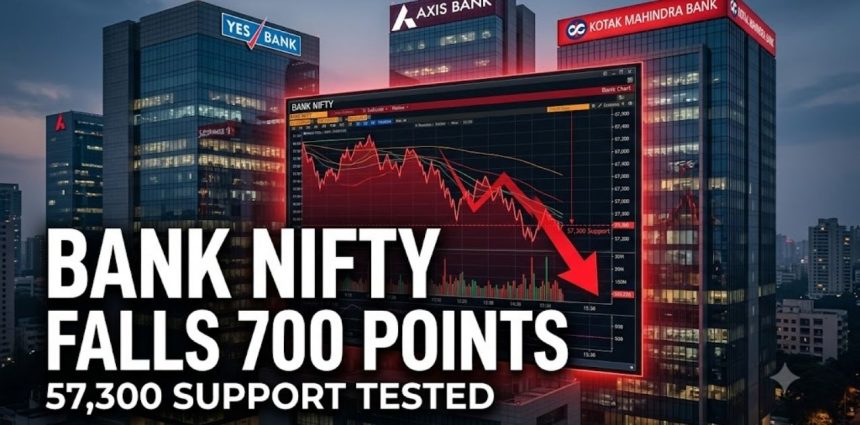
- Bank Nifty fell as much as 1% intraday on September 1 (Reuters, 10:21 am IST); wire reports through the morning pegged the session low near 57,316.60, more than 700 points below Monday’s close, but confirm the live figure against NSE before publish.
- The slide reverses Monday’s Closing Auction Session (CAS) rally: Bank Nifty was near 56,770 as late as 3:25 pm before a final five-minute auction surge of over 600 points pushed it to a close of 58,024.95, a net day’s gain Reuters pegs at roughly 500 points.
- Yes Bank and Axis Bank led Tuesday’s losses, down ~3% and over 2%, respectively, while Kotak Mahindra Bank and PNB bucked the trend.
- Nine of 16 major NSE sectors traded lower as Brent crude neared $91.30/barrel and US 10-year yields hit 20-month highs, even as India’s Q1 (Apr–Jun) GDP grew a stronger-than-expected 7.8% YoY.
- Bank Nifty’s slide brought it close to LKP Securities’ flagged 57,300 support zone, making the coming sessions a real test of whether Monday’s breakout has genuine follow-through.
Bank Nifty Erases Most of Monday’s Closing-Auction Rally
Bank Nifty fell as much as 1% intraday on September 1, according to Reuters, giving back a large chunk of Monday’s unusual late-session surge. Wire reports through the morning pegged the session’s low near 57,316.60, more than 700 points below Monday’s close of 58,024.95, while Reuters’ 10:21 am IST update had the index down roughly 600 points, or 1%, at that point.
Given how fast intraday levels were moving, treat the exact figure as provisional and check it against NSE’s live quote immediately before this goes out.
The reversal follows an unusual rally a day earlier. On August 31, Bank Nifty was trading near 56,770 as late as 3:25 pm before a burst of buying inside the Closing Auction Session (CAS) window added more than 600 points in the index’s final five minutes of trade, pushing it to a close of 58,024.95.
Reuters describes the net day’s move as a roughly 500-point gain recorded in the closing auction session, a smaller figure than the five-minute jump because Bank Nifty had spent most of Monday trading below its previous close.
Also Read: CAS Trading Faces Its Biggest Test as MSCI India Rebalance Sparks $1.3 Billion Flood
Banking Stocks: Who Fell, Who Held Up
| Stock/Index | Move | Direction |
|---|---|---|
| Yes Bank | ~3% | Fell |
| Axis Bank | >2% | Fell |
| IndusInd Bank | 1.7%–1.9% | Fell |
| Federal Bank | 1.7%–1.9% | Fell |
| SBI | 1.7%–1.9% | Fell |
| ICICI Bank | >1% | Fell |
| IDFC First Bank | >1% | Fell |
| HDFC Bank | Marginal | Rose |
| Bank of Baroda | Marginal | Rose |
| PNB | >1% | Rose |
| Kotak Mahindra Bank | ~2% | Rose |
| Nifty PSU Bank | ~0.64% | Fell |
| Nifty Private Bank | ~0.50% | Fell |
The split within the banking pack is notable in its own right: Kotak Mahindra Bank and PNB advanced even as Yes Bank and Axis Bank led declines, suggesting Tuesday’s selling was concentrated in the names that had rallied hardest during Monday’s auction window rather than reflecting broad, uniform weakness across the sector as a whole.
Check Live: Kotak Mahindra Bank, PNB, Yes Bank, Axis Bank
Broader Market Diverges as Crude, Yields Rise
Indian shares stayed subdued through the morning as rising crude prices and bond yields offset optimism over Monday’s stronger-than-expected GDP data. India’s economy grew 7.8% year-on-year in the April–June quarter, beating forecasts.
Brent crude was near $91.30 a barrel, up about 1% and extending Monday’s 2.5% gain, as escalating Middle East tensions pushed US 10-year yields to 20-month highs and German and French yields to 15-year peaks; India’s own 10-year yield was nearing 7%.
Kotak Securities’ Shrikant Chouhan noted that the pace of the global yield rise suggests markets are now pricing in a US rate hike this year alongside continued pressure on crude. Nine of 16 major NSE sectoral indices were trading in the red, with small-caps and mid-caps also softer, even as the divergence between a weak Bank Nifty and steadier headline indices pointed to sector-specific rather than market-wide stress.
Technical Levels: 57,300 Is the Line in the Sand
Monday’s technical commentary is proving prescient. LKP Securities’ technical analyst Vatsal Bhuva had flagged after Monday’s close that follow-up buying would be needed to confirm Bank Nifty’s breakout, given how much of the move came from the CAS window alone, pegging immediate resistance at 58,200 and support at 57,300.
Tuesday’s slide brought Bank Nifty close to that support zone directly. A bounce from here on genuine, broad-based volume, not another auction-driven spike, would suggest the breakout attempt is still alive; a decisive break below 57,300 would raise real doubts about whether Monday’s rally had any follow-through at all.
This is also the first genuine test since Bank Nifty entered its current nine-week consolidation band, broadly framed between 56,500 and 58,700, a sustained move past 58,000 would open the path toward that upper band, while a slip back into the 57,000–58,000 range would point to more sideways consolidation.
Why Monday’s Rally Reversed
Monday’s spike traces to a specific mechanical trigger. CAS is a 20-minute closing-auction mechanism SEBI introduced via a January 16, 2026, circular; it became operative on the NSE and BSE from August 3, 2026, running from 3:15 pm to 3:35 pm and replacing the earlier VWAP-based method for stocks with listed derivative contracts, around 200 names.
Monday was the first MSCI index-rebalancing day since CAS went live, and it produced an outsized reaction: NSE’s own disclosures show the session’s CAS turnover hit ₹39,718 crore, about 42 times the previous trading day’s level and 22% of the exchange’s entire cash-market turnover that day, drawing in more than 98,000 unique investors.
That compares with a typical daily CAS turnover of under 1% of cash volume through August, including just ₹945 crore two sessions earlier. Over its first month of operation (Aug 3–31), NSE recorded a cumulative CAS turnover of ₹63,000 crore.
The table below is compiled by NiftyTrader Desk from NSE’s official CAS turnover disclosures.
| Session | CAS Turnover | Share of Cash Turnover | Note |
|---|---|---|---|
| Typical August session | ₹9 cr–₹22 cr | ~1% | Excludes expiry days |
| Friday, Aug 28 | ₹945 crore | — | Last session before rebalancing |
| Monday, Aug 31 (MSCI rebalancing) | ₹39,718 crore | 22% | ~42x Friday; 98,000+ investors |
| Cumulative, Aug 3–31 (first month) | ₹63,000 crore | — | First month of CAS operation |
The concentration of rebalancing-linked flow meant a large part of Monday’s move occurred within a short auction window, making Tuesday’s follow-through especially important.
What Traders Should Watch Next
- 57,300: Immediate support, tested directly on Tuesday.
- 58,200: Near-term resistance flagged by LKP Securities.
- Yes Bank, Axis Bank: Weakest large banking names, a read on whether pressure broadens.
- Bank Nifty vs Nifty: Continued divergence would point to sector-specific rather than market-wide stress.
- Next derivatives expiry/MSCI review: Will show whether Monday’s turnover surge was a one-off or a recurring feature around rebalancing dates.
Tuesday’s slide is a reminder that a single-session, auction-driven jump is not the same as a confirmed trend. Until proven otherwise, 57,300 remains the level that decides whether the recovery story stays intact or the market treats Monday’s rally as a false start.
Read Next: Nifty Down 8% Despite Strong Earnings: IPO Rush Adds Risk
FAQ
Q1. Why did Bank Nifty fall on September 1, 2026?
Bank Nifty gave back most of Monday’s sharp late-session gain, which occurred largely during the Closing Auction Session amid MSCI rebalancing flows. Tuesday’s reversal means traders now need to see follow-through buying before treating Monday’s move as a confirmed breakout.
Q2. What is NSE’s Closing Auction Session (CAS)?
CAS is a 20-minute closing-auction mechanism introduced under a SEBI circular dated January 16, 2026, to determine official closing prices for eligible securities. It became operative on the NSE and BSE from August 3, 2026, replacing the earlier VWAP-based closing method.
Q3. Which banking stocks fell the most today?
Yes Bank and Axis Bank led the decline, down around 3% and over 2%, respectively, followed by IndusInd Bank, Federal Bank, and SBI.
Q4. What are the key support and resistance levels for Bank Nifty now?
LKP Securities flags support at 57,300 and resistance at 58,200; Tuesday’s session low tested that support directly.
Q5. Did the broader Indian market also fall today?
Indian shares stayed subdued, weighed down by rising crude prices and global bond yields tied to escalating Middle East tensions, even as Monday’s stronger-than-expected GDP data offered some counterweight.
Disclaimer: This article is for informational purposes only and does not constitute investment advice. Stock prices and index levels are intraday figures and subject to change. Readers should verify current market data independently and consult a SEBI-registered investment advisor before making trading or investment decisions.