Maruti Suzuki Shares Sink 4% Even as Mahindra, Bajaj Post Record August Sales
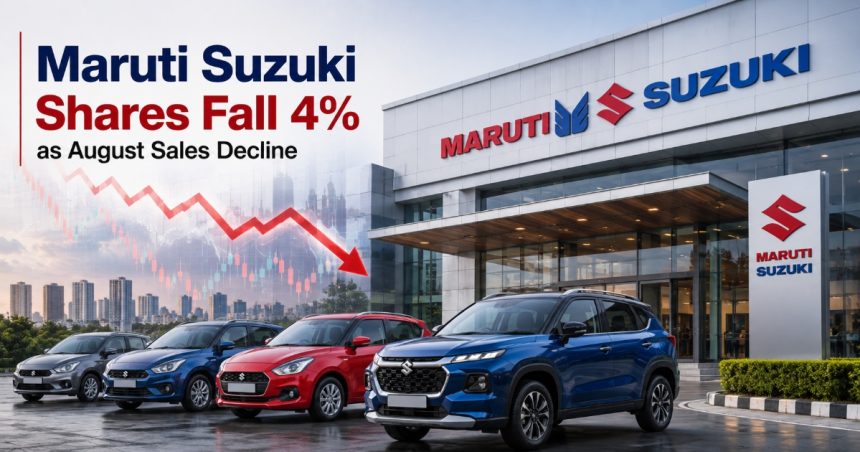
Maruti Suzuki shares came under pressure on September 1 after the automaker reported a 10% month-on-month decline in August sales, triggering a sharp reaction in the stock even as several key passenger vehicle segments continued to show strong year-on-year growth.
The contrasting numbers have created an interesting setup for investors. While Maruti Suzuki’s domestic passenger vehicle volumes improved significantly from last year, the sharp sequential decline from July has raised questions about near-term demand, monthly sales momentum and how the stock could perform against other auto names.
Track Live : NSE Option Chain — Live
Maruti Suzuki’s domestic passenger vehicle sales tell a different story
The headline August sales decline does not tell the complete picture.
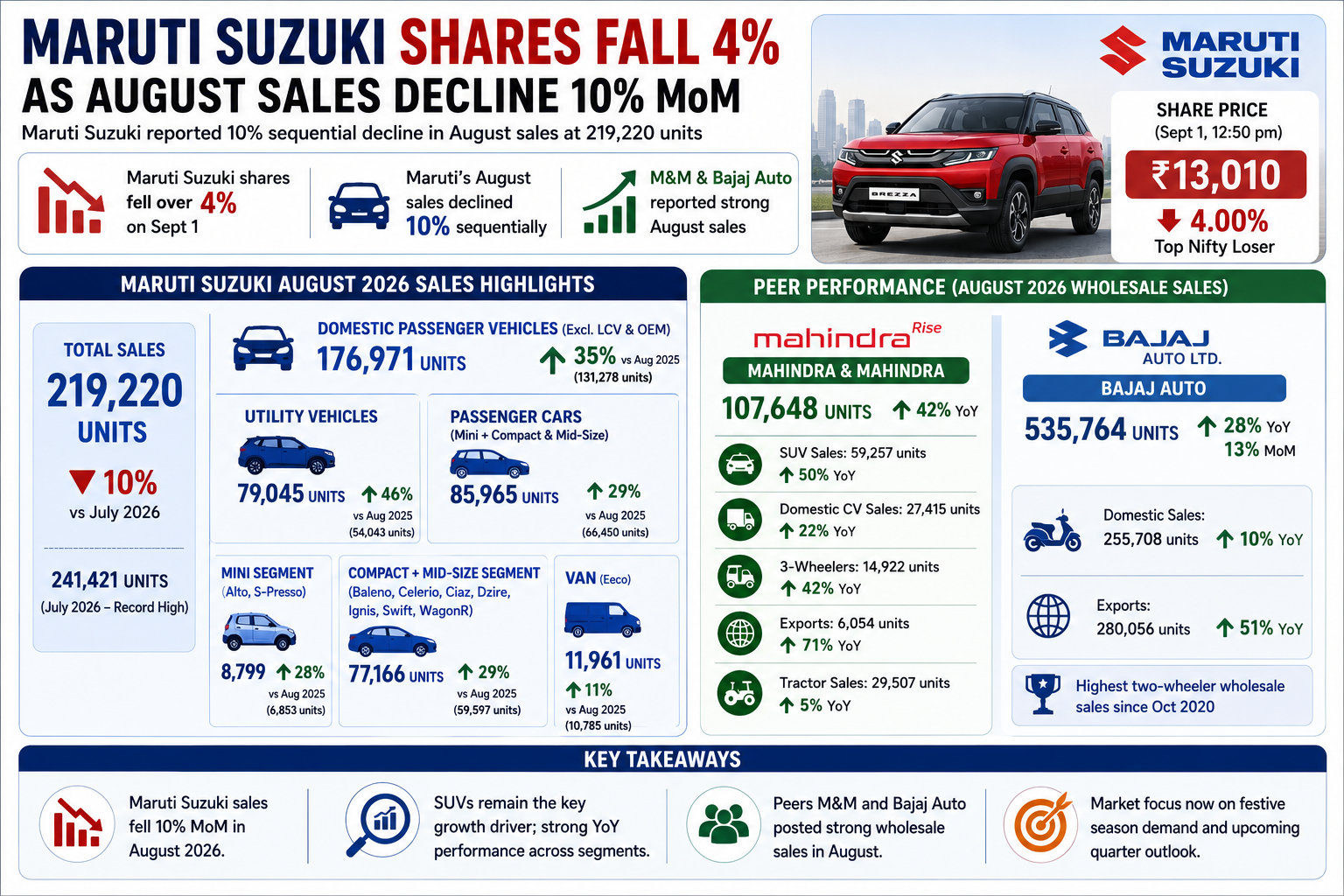
Maruti Suzuki’s domestic passenger vehicle sales, excluding light commercial vehicles and OEM sales, increased to 176,971 units in August 2026, compared with 131,278 units in August 2025.
That represents a substantial year-on-year increase and indicates that underlying demand remained considerably stronger than the headline sequential decline suggests.
The strongest contribution came from the utility vehicle segment, which includes several of Maruti Suzuki’s popular SUV and multi-purpose vehicle models.
Maruti Suzuki: Stock Slide & Sales Decline
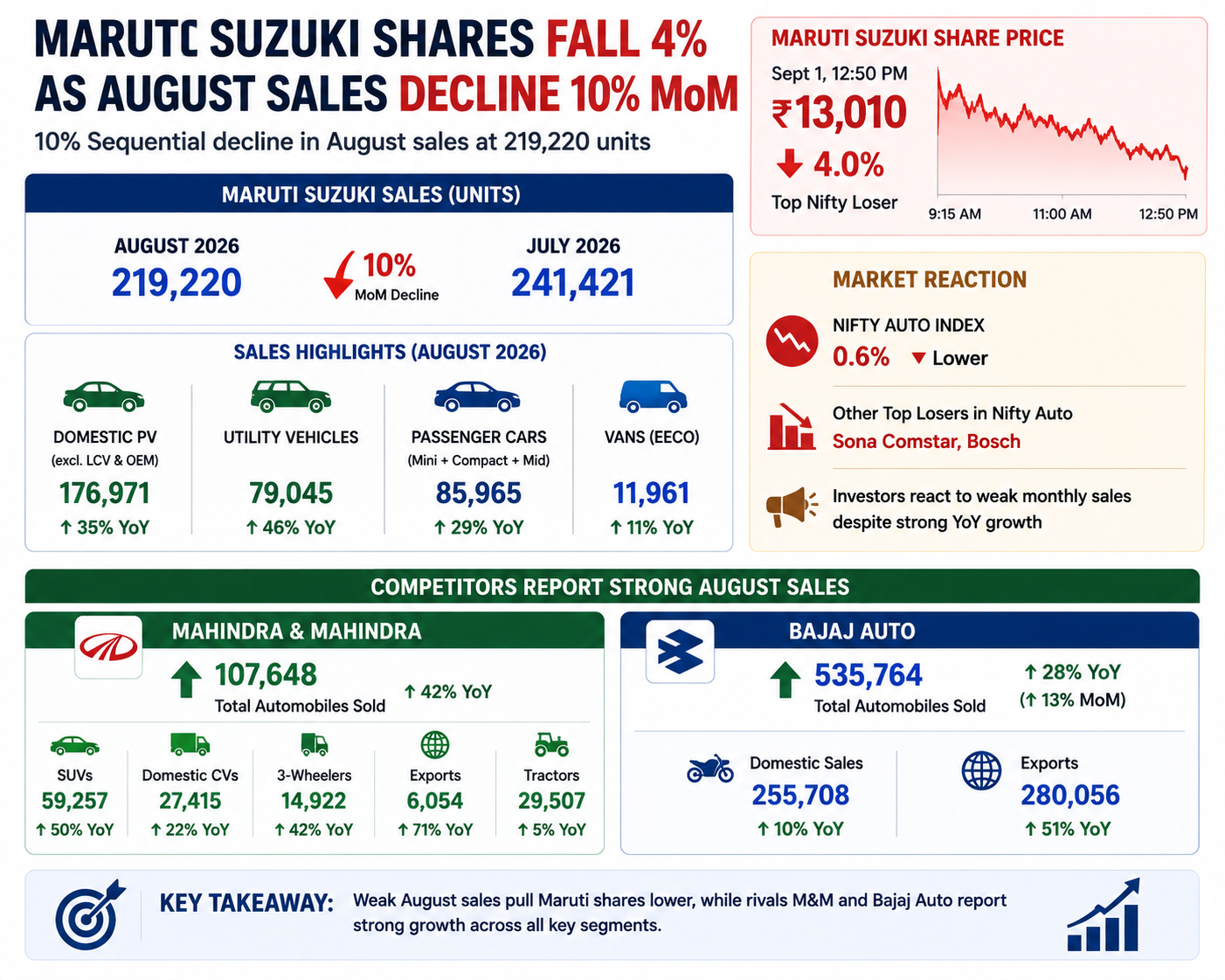
- Stock Impact: Maruti Suzuki shares fell over 4%, trading at Rs 13,010 apiece. It emerged as the top Nifty loser, dragging down the Nifty Auto index by 0.6%.
- Sequential Drop (MoM): August total sales stood at 219,220 units, registering a 10% decline from the record total sales of 241,421 units achieved in July 2026.
- Annual Growth (YoY): Despite the month-on-month drop, domestic passenger vehicle sales (excluding LCVs and OEM sales) rose significantly to 176,971 units from 131,278 units in August 2025.
SUVs remain a major growth engine for Maruti Suzuki
Utility vehicle sales reached 79,045 units in August, compared with 54,043 units in August 2025.
The category includes the Brezza, Ertiga, e Vitara, Fronx, Grand Vitara, Invicto, Jimny, Victoris and XL6.
The numbers underline the growing importance of SUVs and utility vehicles to Maruti Suzuki’s sales mix.
For investors, this remains an important trend because Maruti Suzuki has been investing heavily in expanding its SUV and electric vehicle portfolio. Strong SUV volumes could help the company defend its market position as consumer preferences shift toward larger vehicles.
Maruti Suzuki Segment-Wise Breakdown (YoY Comparison)
- Utility Vehicles (Brezza, Ertiga, Fronx, Grand Vitara, etc.): 79,045 units (Up from 54,043 units in Aug 2025) — Main Growth Driver.
- Compact + Mid-Size Cars (Swift, Baleno, WagonR, Dzire, etc.): 77,166 units (Up from 59,597 units in Aug 2025).
- Mini Segment (Alto, S-Presso): 8,799 units (Up from 6,853 units in Aug 2025).
- Vans (Eeco): 11,961 units (Up from 10,785 units in Aug 2025).
Track Live : Gap Up / Gap Down Stocks – Today’s NSE Opening Gaps
Small cars are also showing signs of recovery
Maruti Suzuki’s passenger car sales also increased year-on-year.
Combined sales across the Mini and Compact + Mid-Size categories stood at 85,965 units in August, compared with 66,450 units a year earlier.
The Mini segment, comprising Alto and S-Presso, recorded sales of 8,799 units versus 6,853 units in August 2025.
The Compact + Mid-Size segment, which includes Baleno, Celerio, Ciaz, Dzire, Ignis, Swift and WagonR, recorded sales of 77,166 units, compared with 59,597 units a year earlier.
Van sales through the Eeco also increased to 11,961 units from 10,785 units last August.
These figures suggest that the year-on-year demand environment remains encouraging despite the sharp monthly decline.
M&M and Bajaj Auto delivered a stronger August
Maruti Suzuki’s weak stock reaction becomes more significant when compared with the performance of other major automakers.
Mahindra & Mahindra reported automobile sales of 107,648 units across India and overseas in August, up 42% year-on-year.
Its SUV sales in India jumped 50% to 59,257 units, while domestic commercial vehicle despatches increased 22% to 27,415 units.
M&M’s exports also rose 71% year-on-year to 6,054 units, while tractor sales across markets increased 5% to 29,507 units.
Bajaj Auto also reported a strong month. Its total automobile despatches reached a record 535,764 units, up more than 28% year-on-year and nearly 13% month-on-month.
Mahindra & Mahindra (M&M): Strong SUV & Commercial Demand
- Total Sales: 107,648 automobiles sold globally, marking a massive 42% YoY growth.
- SUVs: Domestic SUV sales soared 50% YoY to 59,257 units.
- Commercial & 3-Wheelers: Domestic CV despatches grew 22% to 27,415 units, while three-wheeler sales jumped 42% to 14,922 units.
- Exports: Surged 71% YoY to 6,054 units.
- Tractors: Overall tractor sales rose 5% to 29,507 units.
Bajaj Auto’s export surge stands out
Bajaj Auto‘s August numbers were particularly strong in overseas markets.
Domestic despatches rose 10% year-on-year to 255,708 units, while exports surged 51% to 280,056 units.
Two-wheeler wholesale sales were reportedly the highest since October 2020, helped significantly by exports.
The contrast could influence investor sentiment within the auto sector, with traders potentially favouring companies showing stronger monthly momentum.
Bajaj Auto: Record-Breaking Two-Wheeler Sales
- Total Sales: 535,764 units, up 28% YoY and 13% MoM.
- Exports vs Domestic: Exports grew by a staggering 51% YoY to 280,056 units, outpacing domestic despatches which grew 10% to 255,708 units.
Here’s what happened today and why traders reacted
Maruti Suzuki shares fell more than 4% on September 1, making the stock one of the biggest losers on the Nifty.
At around 12:50 pm, Maruti Suzuki was trading 4% lower at ₹13,010 per share. The broader Nifty Auto index was down 0.6%, with Maruti Suzuki leading the losses, followed by Sona Comstar and Bosch.
The immediate trigger was Maruti Suzuki’s August sales figure of 219,220 units, down around 10% sequentially from the company’s record total sales of 241,421 units in July 2026.
For traders, the sharp month-on-month decline appears to have outweighed the company’s strong year-on-year performance in several domestic categories.
What the August sales numbers mean for Maruti Suzuki investors
The immediate pressure on Maruti Suzuki shares is likely to remain linked to the 10% month-on-month sales decline.
However, investors should not overlook the strong year-on-year growth across domestic passenger vehicles, SUVs and compact cars.
The key question now is whether the August decline was a temporary monthly fluctuation or the beginning of weaker sequential demand.
For long-term investors, Maruti Suzuki’s SUV expansion, EV strategy and growing domestic volumes remain important. For short-term traders, however, the comparison with strong August performances from M&M and Bajaj Auto could keep Maruti Suzuki shares under pressure.
The next few monthly sales reports will therefore be crucial. If Maruti Suzuki can regain momentum after August while maintaining strong year-on-year growth, the recent decline in the stock could eventually be viewed differently by investors. If sequential weakness persists, however, concerns around near-term earnings and market share could become more prominent.