
Foreign capital push may not stop with recent tax cut relief
What comes after the government’s major tax relief for foreign investors in government bonds?
Finance Minister Nirmala Sitharaman has hinted that more reforms could be on the way as India looks to attract greater foreign capital and deepen its bond markets.
Speaking at the Mindmine Summit 2026 in New Delhi, Sitharaman said the recent changes in capital gains and withholding taxes for government securities were only the beginning.
“We believe the bond market can be a good way to absorb the capital coming in. As of now we have done it only for government securities,” she said.
“Certainly, that is not the end of story. We recognise we need more foreign capital coming in.”
Track Live : Nifty Levels Today — Live Support, Resistance & CPR
Tax cut Government and RBI working together to deepen bond markets
The Finance Minister said the government and the Reserve Bank of India have been jointly evaluating ways to make India’s bond market more attractive to overseas investors.
“Between RBI, government we have analysed and taken steps towards capital gains tax, withholding tax,” Sitharaman said.
Earlier this month, the Centre announced significant tax relief for foreign portfolio investors (FPIs) investing in government securities.
Foreign investors are now exempt from capital gains tax on gains earned through the sale, transfer or exchange of government securities. The government has also removed the 20 percent withholding tax on interest income from such investments.
Previously, FPIs paid a 12.5 percent long-term capital gains tax on government securities held for more than 12 months, along with a 20 percent withholding tax on interest earnings.
Read More : Vedanta Demerger Goes Live: Aluminium Falls 5%, Yet Group Value Beats Rs 773 Pre-Split Price
Who benefits if foreign capital flows into India’s bond market?
A deeper and more liquid bond market could diversify funding sources beyond traditional bank loans, particularly for large infrastructure projects and capital-intensive businesses. If foreign capital inflows increase, several sectors could benefit from lower borrowing costs and improved access to long-term financing.
Banking
Banks with large government bond portfolios could benefit from treasury gains if bond yields decline and bond prices rise. Stronger bond market participation may also improve overall financial market liquidity.
NBFCs & Housing Finance Companies
Non-banking finance companies and housing financiers could see lower funding costs as bond market depth improves. Cheaper borrowing may support loan growth and help expand net interest margins.
Infrastructure
Infrastructure developers in sectors such as roads, ports, airports, and logistics could gain access to long-term capital through bond issuances, reducing dependence on bank funding and improving project viability.
Power & Utilities
Capital-intensive power and utility companies could refinance existing debt at lower rates and secure long-tenor financing better aligned with the long gestation periods of their projects.
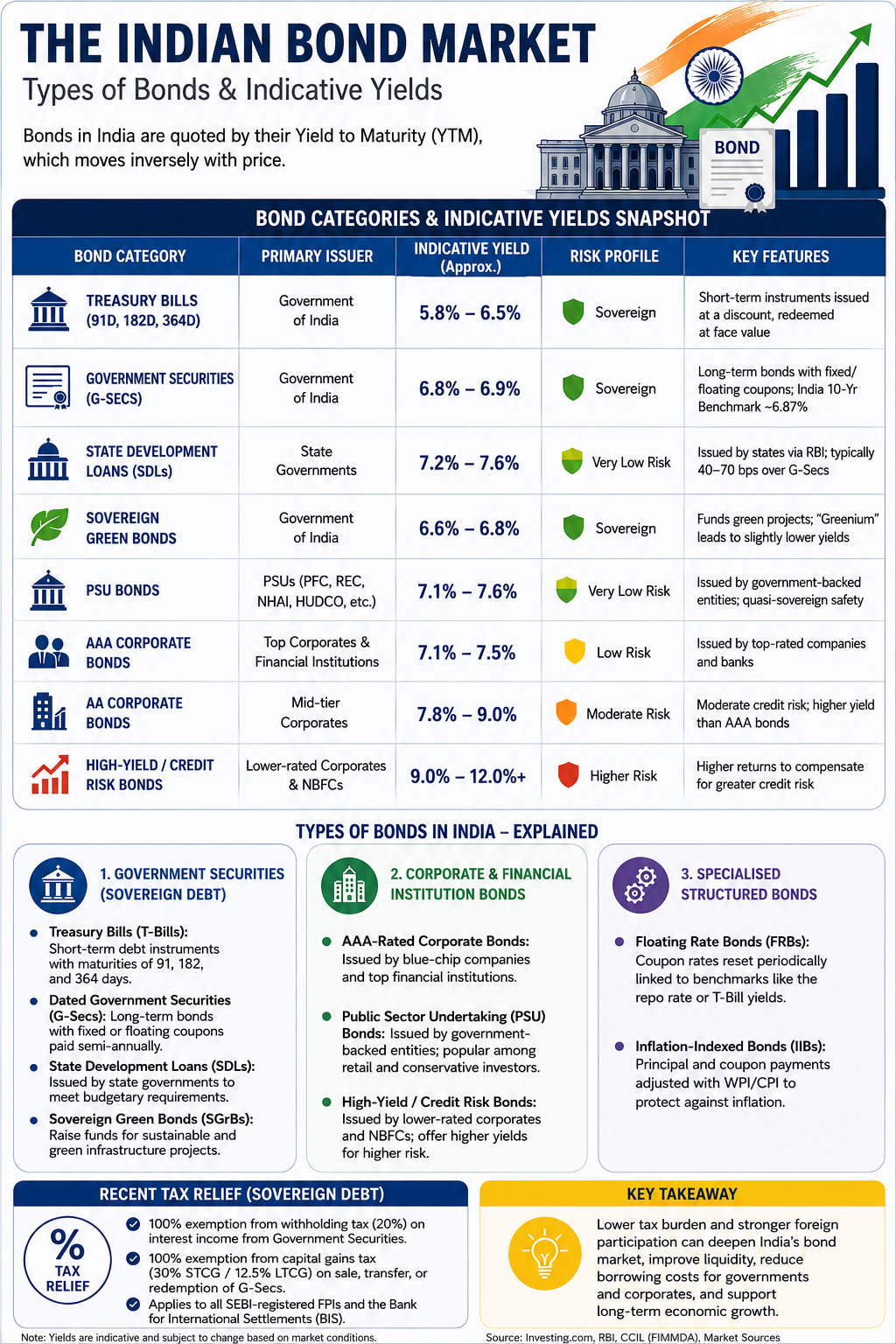
Types of Bonds in India: Yield (June 2026)
India’s bond market broadly consists of government securities, state government bonds, corporate bonds, PSU bonds, and specialized debt instruments. Unlike stocks, bonds are typically evaluated based on their yield rather than market price.
| Bond Category | Issuer | Indicative Yield (June 2026) | Risk Profile |
|---|---|---|---|
| Treasury Bills (91D, 182D, 364D) | Government of India | 5.8%–6.5% | Sovereign |
| Dated Government Securities (G-Secs) | Government of India | 6.8%–6.9% | Sovereign |
| State Development Loans (SDLs) | State Governments | 7.2%–7.6% | Very Low Risk |
| Sovereign Green Bonds | Government of India | 6.6%–6.8% | Sovereign |
| PSU Bonds | PFC, REC, NHAI, HUDCO, etc. | 7.1%–7.6% | Very Low Risk |
| AAA Corporate Bonds | Top-rated Corporates | 7.1%–7.5% | Low Risk |
| AA Corporate Bonds | Mid-tier Corporates | 7.8%–9.0% | Moderate Risk |
| High-Yield Bonds | Lower-rated Issuers | 9.0%–12.0%+ | Higher Risk |
| Floating Rate Bonds (FRBs) | Govt & Corporates | Variable | Depends on Issuer |
| Inflation-Linked Bonds | Govt & Institutions | Inflation-adjusted | Sovereign/Low Risk |
Government Securities
Treasury Bills (T-Bills): Short-term instruments with maturities of 91, 182, and 364 days. Issued at a discount and redeemed at face value.
Government Securities (G-Secs): Long-term sovereign bonds carrying fixed or floating coupon rates. The benchmark 10-year Government Security is currently yielding around 6.8–6.9%.
State Development Loans (SDLs): Bonds issued by state governments. They generally offer yields 40–70 basis points higher than comparable central government securities.
Sovereign Green Bonds: Issued to finance renewable energy and sustainability projects. Strong ESG demand often results in slightly lower yields than conventional G-Secs.
Corporate Bonds
AAA-Rated Corporate Bonds: Issued by financially strong companies and financial institutions. These provide a modest yield premium over government bonds.
PSU Bonds: Issued by government-backed entities such as REC, PFC, NHAI, and HUDCO. Popular among conservative investors due to their quasi-sovereign profile.
High-Yield Bonds: Issued by lower-rated corporates and NBFCs seeking growth capital. They offer higher returns but carry greater credit risk.
What More Measures Could Come?
While Finance Minister Nirmala Sitharaman did not specify the next set of reforms, her remarks that the recent tax relief for foreign investors is “not the end of the story” suggest that policymakers may be preparing additional steps to deepen India’s debt markets and attract long-term overseas capital.
Market participants will be closely watching for reforms in the following areas:
Corporate Bond Market Liberalisation: Easing investment restrictions and simplifying issuance norms could encourage greater foreign participation in corporate debt, helping companies diversify funding sources beyond traditional bank loans.
Tax Rationalisation: Further simplification of capital gains and withholding tax rules for foreign investors could enhance the attractiveness of Indian debt markets relative to other emerging economies.
Improved Market Access: Measures aimed at improving trading, settlement, and clearing infrastructure could make it easier for global investors to access Indian bond markets.
Higher Global Index Inclusion: Continued market reforms may support higher weightage for Indian debt securities in major global bond indices, potentially bringing in additional passive foreign inflows.
Retail investors continue supporting Indian stock markets
Sitharaman highlighted the growing role of domestic investors in supporting Indian markets during periods of global uncertainty.
“Our own participation in stock market has buoyed it considerably,” she said.
The rise in retail investor participation has helped Indian equity markets remain relatively resilient despite geopolitical tensions, inflation concerns and volatility in global financial markets.
The strong domestic investor base has increasingly become a stabilising force for Indian equities.
Tax Relief Measures: India’s Push to Attract Global Capital (2021–2026)
Over the past five years, India has introduced a series of tax and regulatory measures aimed at attracting foreign investment, deepening capital markets, and supporting long-term economic growth.
2021–2025: Sovereign Wealth Funds and Pension Funds
The government extended tax incentives for notified foreign Sovereign Wealth Funds (SWFs) and Pension Funds investing in eligible Indian infrastructure projects. These investors received exemptions on interest, dividend, and long-term capital gains income from qualifying investments, helping channel long-term capital into infrastructure development.
2021–2024: GIFT City (IFSC) Incentives
India expanded tax benefits for entities operating from the International Financial Services Centre (IFSC) in GIFT City, including tax holidays for eligible units and incentives for aircraft leasing, ship leasing, offshore banking, and capital market activities.
Dividend Tax Reforms
Following the abolition of the Dividend Distribution Tax (DDT), dividend income became taxable in the hands of investors. This allowed many foreign investors to benefit from lower tax rates available under Double Taxation Avoidance Agreements (DTAAs).
Tax Simplification and Compliance Reforms
The government continued efforts to streamline tax administration through digitalisation, faster processing, simplified compliance procedures, and rationalisation of various tax provisions to improve India’s ease of doing business.
June 2026: Landmark Tax Relief for Government Securities
In its most significant debt-market reform in recent years, the Centre exempted Foreign Portfolio Investors (FPIs) from paying capital gains tax on gains arising from the sale, transfer, or exchange of Government Securities (G-Secs). The government also removed the 20% withholding tax on interest income earned from such investments.
Before the change, foreign investors were subject to:
- 12.5% long-term capital gains tax on eligible G-Sec investments
- 20% withholding tax on interest income from government bonds
The move is aimed at increasing foreign participation in India’s sovereign debt market, improving bond market liquidity, and supporting capital inflows following the inclusion of Indian government bonds in major global bond indices.
Crude oil risks and shipping costs remain key concerns
The Finance Minister also pointed to emerging challenges from global energy markets.
According to Sitharaman, the concern is no longer limited to crude oil prices alone. Rising insurance costs and shipping risks linked to geopolitical tensions are also becoming important factors.
“Not only the price of crude which is a challenge, but insurance cover and risk of crude vessels passing through the Strait also high,” she said.
Higher shipping and insurance expenses could increase India’s import costs and put pressure on inflation if geopolitical tensions persist.
Forex reserves remain critical for economic stability
Sitharaman stressed the importance of maintaining strong foreign exchange reserves amid growing global uncertainties.
“India’s Exchange reserve needs to be adequate to meet the growing demand,” she said.
Healthy forex reserves provide protection against external shocks, support currency stability and help manage rising import bills during periods of market stress.
At the same time, she noted that India’s expanding domestic consumption remains a major source of economic strength.
“India has a large domestic market with consumption going up which is a comfort,” she said.
Government prepares for weaker monsoon amid El Niño concerns
On the agriculture front, Sitharaman said the government is preparing for a potentially weaker monsoon due to El Niño conditions.
However, she reassured markets that sufficient food stocks are available.
“This year because of El Nino, we are preparing for not such a good monsoon,” she said.
“There shouldn’t be a food shortage because of buffer stock.”
The Finance Minister also confirmed that fertiliser availability for the ongoing kharif season remains adequate.
“For kharif we have adequate fertiliser, but we need money for Rabi tendering,” she said.
She added that fertiliser supply conditions have improved after China resumed participation in the global market.
States accelerate data centre and GCC investments
Sitharaman also highlighted growing interest among states in attracting investments in data centres and Global Capability Centres (GCCs).
“States are coming up with policies on data centres, GCCs as they are job generating,” she said.
According to the Finance Minister, the Centre is working closely with states to ensure that policy frameworks supporting data centres and GCCs are properly understood and implemented.
The sector is expected to play an increasingly important role in employment generation, technology investment and India’s digital economy growth.
What is the impact on investors?
For bond market investors, Sitharaman’s remarks suggest that additional reforms aimed at attracting foreign capital could emerge in the coming months.
For equity investors, stronger foreign inflows may improve overall market liquidity and support valuations.
Government securities could become increasingly attractive to global investors following the recent tax changes, while domestic investors may benefit from deeper and more efficient capital markets.