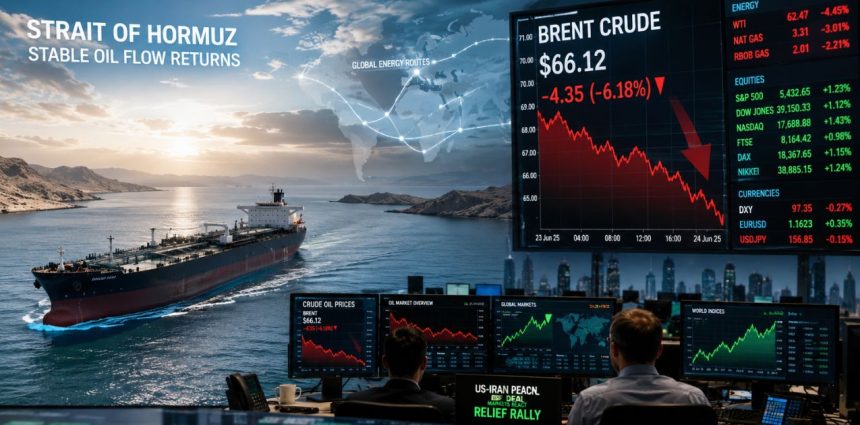
The United States and Iran have agreed on a peace framework aimed at ending four months of conflict. With the Strait of Hormuz set to reopen and crude oil crashing to two-month lows, India, which imports 85% of its oil, stands at the centre of the macro story.
Key Takeaways
- US President Donald Trump confirmed the peace deal on Truth Social on Sunday, calling it “complete”; formal signing is set for June 19 in Geneva, Switzerland.
- The Strait of Hormuz, carrying roughly 20% of the global oil supply, is declared open and “toll-free”; the US naval blockade of Iranian ports is to be lifted simultaneously.
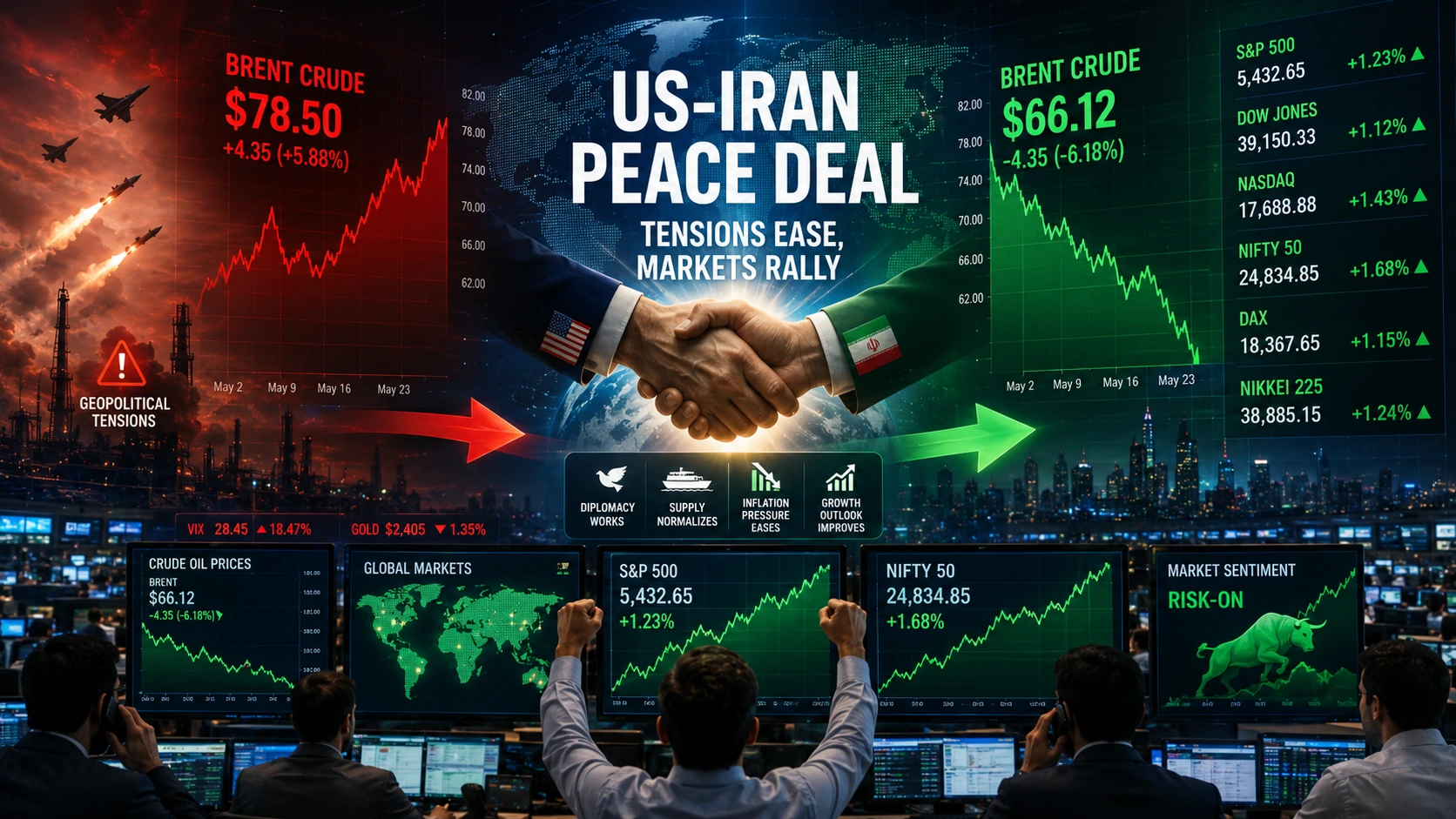
- Brent crude fell 4.70% to $83.23 per barrel; WTI slid 5.15% to $80.51, both at their lowest since early March 2026.
- Sensex surged over 1,200 points and Nifty50 reclaimed 24,000 on Monday morning; OMCs, aviation, paints, and tyre stocks led gains.
- Reports suggest up to $25 billion in frozen Iranian assets could be released as part of the broader framework.
The Deal: What Was Agreed
Pakistan Prime Minister Shehbaz Sharif, who played a mediating role, announced on X that “both sides have declared the immediate and permanent termination of military operations on all fronts, including in Lebanon.” Trump confirmed the development minutes later on Truth Social.
The peace memorandum of understanding will be formally signed in Geneva on June 19. Qatar also played a key facilitation role, with Qatari mediators travelling to Tehran on Sunday to help finalise the terms, according to Reuters.
The deal includes a 60-day structured ceasefire during which nuclear negotiations and sanctions relief talks will continue. Reports suggest up to $25 billion in frozen Iranian assets could be released by the United States as part of the broader implementation framework.
Deal Structure at a Glance
| Component | Detail |
|---|---|
| Ceasefire | Immediate cessation on all fronts, including Lebanon |
| Signing Date | June 19, 2026 — Geneva, Switzerland |
| Mediators | Pakistan (PM Shehbaz Sharif), Qatar |
| Frozen Assets | Up to $25 billion in Iranian assets reportedly under discussion |
| Nuclear Programme | Iran to dilute enriched uranium domestically; stockpile destruction under discussion |
| Extended Talks | 60-day window for sanctions relief and nuclear negotiations |
| Hormuz Status | Declared open toll-free; formal reopening tied to June 19 signing |
Strait of Hormuz: Why This Waterway Matters
The Strait of Hormuz is the world’s single most critical oil chokepoint, through which nearly 20% of global oil supply passes. Iran effectively closed the passage after the conflict began following US and Israeli strikes on February 28, sending Brent crude from below $70 to above $107 per barrel at peak tension in March 2026.
Trump authorised what he called the “toll-free opening” of the Strait and simultaneously ordered the removal of the US naval blockade on Iranian ports. “Ships of the World, start your engines. Let the oil flow!” he wrote.
However, maritime experts caution that full commercial shipping normalisation may take days to weeks even after the political announcement. Mine removal, safety verification, and insurance re-rating of the passage are procedural hurdles that cannot be bypassed by political will alone.
Nuclear Curbs: The Unresolved Core
The most consequential piece of the deal, Iran’s nuclear programme, remains subject to ongoing negotiation. A US official said the eventual agreement would result in the dismantling of Iran’s nuclear programme and destruction of its highly enriched uranium stockpile.
A senior Iranian official, however, told Reuters that the draft arrangement permits Iran to dilute enriched uranium within the country rather than transfer it abroad.
Iran denies seeking nuclear weapons. Hardline members of the US Congress have pushed for complete dismantlement. This gap is likely to be the central fault line during the 60-day negotiation window.
Lebanon: The Complication That Almost Broke the Deal
Lebanon emerged as one of the key obstacles. An Israeli strike on Beirut’s southern suburbs on Sunday, which Israel said targeted Hezbollah fighters backed by Iran, triggered sharp condemnation from Tehran and, unusually, from Trump himself.
“This morning’s attack on Beirut should not have happened, particularly on a special day when we are so close to a Peace Deal with Iran,” Trump wrote. Iranian negotiator Mohammad Baqer Qalibaf accused Washington of lacking the “will and ability to fulfill your commitments.”
Israeli PM Benjamin Netanyahu has reportedly clashed with Trump over demands to scale back Lebanon operations, maintaining that Israel must preserve operational freedom there. Tehran has insisted that a comprehensive Lebanon ceasefire is a central condition of any settlement. Despite the friction, both sides proceeded to finalise the framework.
Crude Oil Crash: The Macro Story for India
Brent crude fell 4.70% to $83.23 per barrel and WTI crude slid 5.15% to $80.51, two-month lows for both benchmarks. This matters acutely for India, which imports approximately 85% of its crude oil requirement.
A sustained $10 per barrel decline in Brent crude reduces India’s annual oil import bill by an estimated $15–20 billion, eases current account deficit pressure, supports rupee stability, and gives the Reserve Bank of India additional headroom on inflation management. Lower crude also directly feeds into lower input costs for aviation, paints, tyres, petrochemicals, and logistics sectors.
Asset and Sector Impact — Quick Reference
| Asset / Sector | Likely Impact |
|---|---|
| Brent Crude | Negative (prices fall) |
| Indian Rupee | Positive (CAD relief) |
| BPCL / HPCL / IOC | Positive (OMC margin relief) |
| Airlines (IndiGo) | Positive (ATF cost relief) |
| Paint Stocks | Positive (crude derivative inputs cheaper) |
| Tyre Stocks | Positive (crude input cost relief) |
| Logistics | Positive (fuel cost deflation) |
| Upstream Oil Producers (ONGC, Oil India) | Negative (lower realisations) |
Lower crude prices could benefit airlines, oil marketing companies, paints, tyres, and logistics firms, while easing inflation pressures for the broader economy. Upstream oil producers face lower realisations and may see margin compression if prices stay suppressed.
Lower crude prices have historically supported foreign investor sentiment toward Indian equities because they improve India’s inflation and current-account outlook. Traders will watch whether the sharp decline in oil prices translates into sustained FII buying in the coming sessions.
Indian Markets: Reaction on June 15
Indian markets reacted positively as lower crude prices improved sentiment toward oil-sensitive sectors. The Sensex surged over 1,200 points, and the Nifty50 reclaimed the 24,000 level in Monday morning trade.
IndiGo, BPCL, HPCL, IOC, and Larsen & Toubro, which carries West Asia project exposure, surged up to 4% each. Paint and tyre makers also saw sharp moves. Asian markets tracked the rally, with Japan’s Nikkei up over 5% and South Korea’s Kospi jumping nearly 6%.
Check live:
Risks That Could Unravel the Rally
Four risks are worth watching before treating this as a settled outcome.
Israel’s position remains the most immediate threat. Israel has not formally endorsed the framework and has stated it reserves operational freedom in Lebanon. Fresh Israeli strikes could trigger Iranian retaliation and put the ceasefire at immediate risk.
The nuclear impasse has not been resolved. The enrichment question, dilution inside Iran versus full dismantlement, will resurface during the 60-day talks, with US Congressional hawks and Iranian hardliners pulling in opposite directions.
The Hormuz shipping timeline may disappoint. Mine clearance and maritime safety certification mean full oil flow could take days to weeks longer than markets currently expect.
Iranian domestic opposition is a real friction point. Hardline factions have already held public protests against the deal, with demonstrators in Mashhad reportedly chanting opposition to Foreign Minister Abbas Araqchi.
Bottom Line
The US-Iran peace framework is the most significant geopolitical shift for global energy markets in years, and India sits at the direct intersection of its macro consequences.
Brent crude collapsing from $107 at peak conflict to $83 today structurally improves India’s current account, inflation trajectory, and the earnings outlook for the aviation, OMC, paints, and tyre sectors.
The formal signing on June 19 and Hormuz shipping confirmation are the two events that will determine whether this relief is durable.
Until then, markets are trading on optimism, and the Israel-Lebanon front remains the single biggest risk to that narrative.
Disclaimer: This article is for informational purposes only and does not constitute investment advice. Please consult a SEBI-registered financial advisor before making any investment decisions.