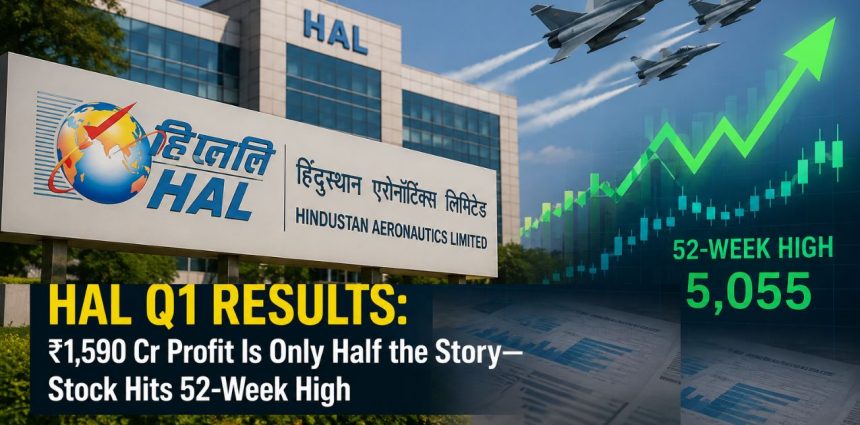
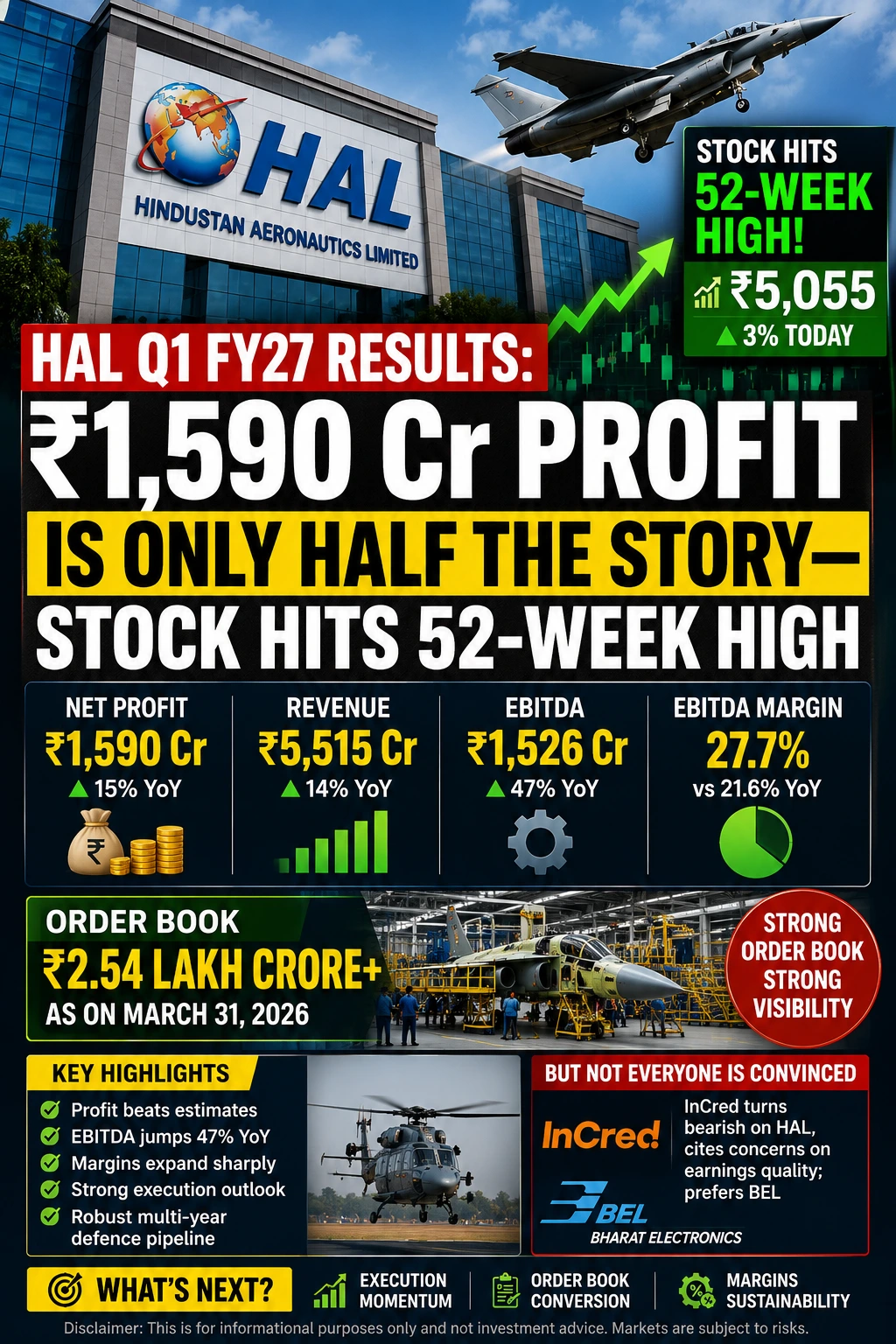
Hindustan Aeronautics Ltd. delivered a solid start to FY27, with HAL Q1 FY27 results showing consolidated net profit rising 14.9% year on year to ₹1,590 crore, from ₹1,384 crore in the year-ago quarter.
Revenue from operations increased 14.4% YoY to ₹5,515 crore, compared with ₹4,819 crore in Q1 FY26. The bigger operating signal, however, came from EBITDA, which jumped 46.9% to ₹1,526 crore, while EBITDA margin expanded to 27.7% from 21.6%.
The results also came in ahead of analyst expectations. Consolidated profit was estimated at ₹1,540 crore, revenue at ₹5,288 crore and EBITDA at ₹1,425 crore. HAL exceeded all three estimates.
HAL shares responded positively, rising around 3% to nearly ₹5,049 on the NSE after the results.
But the market’s next question is more complicated: Can HAL convert its enormous order book into sustained revenue and earnings growth while maintaining the stronger operating margins seen in Q1?
Check Live: HAL Option Chain (HAL) — Live OI, IV, Greeks & PCR
HAL Q1 FY27 Results: Key Numbers
| Metric | Q1 FY27 | Q1 FY26 | YoY Change |
|---|---|---|---|
| Revenue from Operations | ₹5,515 Cr | ₹4,819 Cr | +14.4% |
| Consolidated Net Profit | ₹1,590 Cr | ₹1,384 Cr | +14.9% |
| EBITDA | ₹1,526 Cr | ₹1,039 Cr | +46.9% |
| EBITDA Margin | 27.7% | 21.6% | +610 bps |
| EPS | ₹23.77 | ₹20.69 | +14.9% |
The standout number is clearly EBITDA growth.
Revenue increased 14.4%, but EBITDA expanded nearly 47%. That pushed the EBITDA margin up by roughly 610 basis points year on year.
For the market, that makes the Q1 result more significant than the headline 15% PAT growth alone.
HAL Q1 Results Beat Estimates: Why It Matters
The expectation gap was positive.
HAL’s reported numbers exceeded analyst estimates across the key operating metrics:
- Net profit: ₹1,590 crore vs ₹1,540 crore estimate
- Revenue: ₹5,515 crore vs ₹5,288 crore estimate
- EBITDA: ₹1,526 crore vs ₹1,425 crore estimate
- EBITDA margin: 27.7% vs 27% estimate
That combination gives the results a stronger market signal than a simple year-on-year profit increase.
The company delivered growth and an operating-margin improvement while beating consensus expectations.
Also Check: HINDUSTAN AERONAUTICS Options Chart | Nifty Trader
HAL Share Price: Stock Jumps 3% After Results
HAL shares rose around 3% to nearly ₹5,049 on the NSE after the Q1 results, extending the defence major’s recent upward momentum.
The positive reaction suggests investors initially focused on the earnings beat, margin expansion and long-term order visibility.
However, the stock’s next move may depend less on the Q1 headline and more on whether HAL can sustain execution through the rest of FY27.
That distinction matters because a strong result can support sentiment in the short term, while sustained earnings delivery determines whether the market continues to reward the stock over a longer horizon.
But Not Everyone Is Convinced: InCred Turns Cautious on HAL
HAL’s strong Q1 numbers and positive initial stock reaction do not mean the entire Street is bullish.
A fresh post-results assessment from InCred has raised concerns around the quality and sustainability of HAL’s earnings, with the brokerage taking a more cautious view on the stock and preferring Bharat Electronics (BEL) within the defence space.
The important distinction is that this is InCred’s interpretation of the results, not evidence that HAL’s reported Q1 numbers were weak.
The debate is instead moving toward earnings quality, execution and how much future growth is already reflected in the stock.
That creates a genuine bull-versus-bear setup.
The Bull Case
- ₹1,590 crore consolidated Q1 profit, up 14.9% YoY
- Revenue growth of 14.4%
- EBITDA growth of 46.9%
- EBITDA margin expanded to 27.7%
- Order book of ₹2,54,538 crore as of March 31, 2026
- Multi-year defence programme visibility
- Capacity expansion and production ramp-up potential
The Bear Case
- Expectations around HAL remain elevated after its strong multi-year performance
- Defence execution can be affected by programme and delivery schedules
- A large order book must ultimately convert into revenue and cash flows
- Margin strength needs to prove sustainable across subsequent quarters
- Any execution slowdown could widen the gap between market expectations and actual earnings
So the key question is no longer simply whether HAL delivered a good quarter.
It did.
The bigger question is whether the Q1 performance is strong enough to justify the expectations already embedded in the stock.
HAL Order Book: ₹2.54 Lakh Crore Is the Long-Term Catalyst
HAL’s FY26 annual report showed an outstanding order book of ₹2,54,538 crore as of March 31, 2026, up substantially from the opening order book of ₹1.89 lakh crore.
That provides a significant long-term revenue runway.
The company’s opportunity set spans:
- Aircraft
- Helicopters
- Aero engines
- Avionics
- MRO
- Upgrades
- New defence programmes
HAL has also highlighted supply-chain stabilisation, capacity expansion and faster production ramp-up as important drivers for the coming years.
This is the core structural argument behind the stock.
But there is a critical distinction:
Order book provides visibility. Execution creates revenue.
The market will increasingly monitor the second part.
HAL Q1 Profit Fell 62% QoQ: Should Investors Worry?
On a sequential basis, HAL’s Q1 numbers look dramatically weaker.
Consolidated net profit fell more than 62% from ₹4,196 crore in Q4 FY26, while revenue from operations declined more than 60% from ₹13,942 crore.
That comparison needs context.
HAL’s business can experience significant quarter-to-quarter fluctuations because defence deliveries, programme execution and revenue recognition can be concentrated toward particular periods.
Therefore, comparing Q1 FY27 with Q1 FY26 provides a cleaner view of the year’s opening-quarter performance than treating the Q4-to-Q1 decline as a standalone warning signal.
On that basis, the trend remains positive:
Revenue: +14.4% YoY
Net profit: +14.9% YoY
EBITDA: +46.9% YoY
EBITDA margin: 27.7%
The question now is whether the operating improvement continues as FY27 progresses.
Why HAL’s 47% EBITDA Growth Is More Important Than the 15% PAT Growth
The headline result is easy to summarise:
Profit up 15%.
But the more interesting operating signal is:
EBITDA up 47%.
That gap matters.
Revenue grew 14.4%, yet EBITDA expanded 46.9%, indicating significantly stronger operating profitability during the quarter.
The EBITDA margin rose from 21.6% to 27.7%.
If this improvement proves sustainable, it could support stronger earnings growth than the topline alone would suggest.
But that remains an uncertainty.
A single quarter does not establish a permanent margin trend.
That is why the next two or three quarters could be more important for investors than the Q1 headline itself.
HAL Stock: What Traders Should Watch Next
1. EBITDA margin sustainability
The 27.7% margin is one of the biggest takeaways from Q1.
Investors will want evidence that the improvement can persist as production and deliveries increase.
2. Order-book conversion
The ₹2.54 lakh crore order book is substantial, but the market will focus increasingly on delivery schedules and revenue conversion.
3. Production ramp-up
Capacity expansion and supply-chain improvements could determine how quickly HAL can execute its existing pipeline.
4. New defence orders
Fresh fighter, helicopter, upgrade and aerospace-related contracts could provide additional catalysts.
5. Valuation and expectations
This is where the market tension becomes important.
A stock can deliver good earnings and still struggle if expectations for future growth are even higher.
For HAL, execution needs to keep pace with the expectations created by its order book and defence-sector positioning.
HAL Q1 FY27 Results: Trader Setup
| Factor | Q1 Signal | Market Read |
|---|---|---|
| Net Profit | +14.9% YoY | 🟢 Positive |
| Revenue | +14.4% YoY | 🟢 Positive |
| EBITDA | +46.9% YoY | 🟢 Strong Positive |
| EBITDA Margin | 27.7% | 🟢 Strong Positive |
| Estimates | Beat | 🟢 Positive |
| Order Book | ₹2.54 Lakh Cr | 🟢 Strong visibility |
| Q4-to-Q1 Profit | -62%+ QoQ | 🟡 Needs context |
| Execution | Key FY27 variable | 🟡 Watch |
| Margin Sustainability | Uncertain | 🟠 Key risk |
| Valuation | Expectations elevated | 🟠 Key risk |
Why HAL Q1 Results Matter Today
HAL is one of India’s most closely watched defence stocks, so its quarterly performance has implications beyond the company itself.
The Q1 results reinforce the long-term defence manufacturing story: strong order visibility, rising production requirements and continued opportunities across India’s aerospace and defence ecosystem.
But the fresh brokerage caution adds an important counterpoint.
The market now has two competing signals to process.
On one side: a profit beat, strong EBITDA growth and a massive order book.
On the other: concerns about earnings quality and the sustainability of the current performance.
That tension is likely to keep HAL in focus well beyond the initial post-results move.
What Traders Are Watching
Immediate: Can HAL hold the post-result gains?
Near term: Does revenue growth accelerate through FY27?
Next quarter: Does EBITDA margin remain near elevated levels?
Medium term: How quickly does the order book convert into revenue?
Long term: Can production expansion translate into sustained earnings growth?
Final Take
HAL Q1 FY27 results were stronger than the headline 15% profit growth suggests.
Consolidated net profit rose 14.9% to ₹1,590 crore, revenue increased 14.4% to ₹5,515 crore, and EBITDA jumped 46.9% to ₹1,526 crore. EBITDA margin expanded to 27.7% from 21.6%, while the company also exceeded analyst estimates on profit, revenue and EBITDA.
HAL’s ₹2,54,538 crore order book provides a substantial long-term growth runway.
But the market’s next test is execution.
The post-result rally shows that investors initially welcomed the numbers. The cautious view from InCred, meanwhile, highlights why the story cannot be reduced to a simple “profit up 15%” headline.
For HAL, the order book provides the runway. Margin sustainability and execution will determine how much of that runway becomes earnings.
That is the key issue traders will be watching through FY27.
Read Next: Bata India Q1 Profit Jumps 23%: Can Premiumisation Keep the Momentum Alive?
Disclaimer: This article is for informational purposes only and does not constitute investment advice. Stock market investments are subject to market risks. Readers should conduct their own research and consult a SEBI-registered investment professional before making investment decisions.