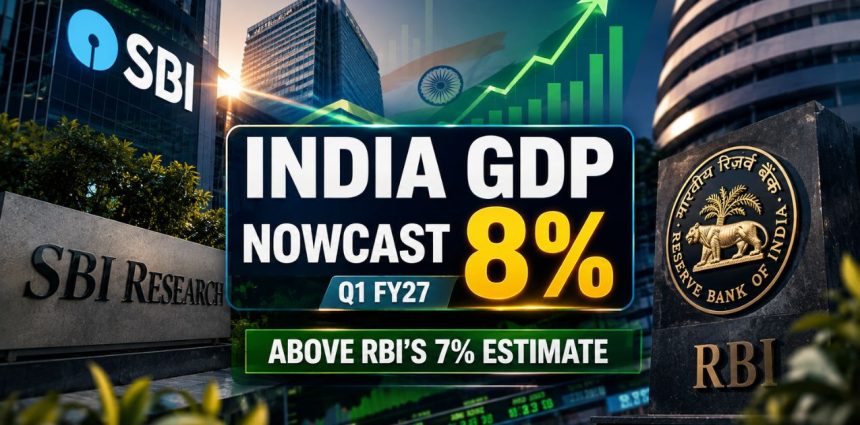
India’s economy may have started FY27 with stronger momentum than expected, with SBI Research nowcasting real GDP growth at around 8% for Q1 FY27.
The estimate is 1 percentage point above the RBI’s 7% Q1 projection cited in the SBI report, creating a notable expectation gap ahead of the official GDP release.
More importantly, the strength is not coming from a single indicator. SBI Research said 86% of its 50 leading indicators showed acceleration in Q1 FY27, compared with 69% in Q1 FY26. Separately, the bank’s broader nowcasting model uses 54 high-frequency indicators across agriculture, industry and services.
For stock-market investors, that distinction matters. A GDP print near 8% could strengthen earnings expectations for economically sensitive sectors, but the upside may not be automatic if currency weakness, crude prices, valuations or policy expectations become counterweights.
Why SBI Research Is Calling for 8% GDP Growth
SBI Research’s nowcasting framework uses 54 high-frequency indicators across agriculture, industry and services, along with a Dynamic Factor model with time-varying parameters.
Separately, its leading-indicator analysis tracks 50 indicators. Of these, 86% showed acceleration in Q1 FY27, compared with 69% in Q1 FY26.
That breadth strengthens the case behind the 8% nowcast, although the eventual official GDP print could still differ from the estimate.
| Growth signal | Q1 FY26 | Q1 FY27 |
|---|---|---|
| Leading indicators showing acceleration | 69% | 86% |
| SBI Q1 GDP estimate | 6.8% | 8.0% |
The key takeaway is that SBI Research is seeing acceleration across a wide range of economic signals rather than relying on one isolated data point.
Check Live: STATE BANK OF INDIA Option Chain (NSE) — Live OI, PCR & Greeks
8% GDP vs RBI’s 7%: Why the Gap Matters
The most market-relevant part of the report is the difference between the two estimates.
SBI Research Q1 FY27 nowcast: 8%
RBI Q1 FY27 projection cited by SBI: 7%
That is a 100-basis-point expectation gap.
If the official GDP number eventually lands close to SBI’s estimate, the market could begin reassessing the strength of India’s earnings and domestic-demand cycle.
But there is an important caveat: SBI’s 8% number is a Q1 nowcast, while GDP data will ultimately be determined by the official statistical release.
So traders should treat 8% as an important signal—not a confirmed GDP print.
Consumption Is Providing a Major Growth Cushion
Domestic demand remains one of the strongest pillars of the SBI estimate.
June indicators highlighted by SBI Research included:
- Passenger vehicle sales: +24.1% YoY
- Electricity demand: +11.5%
- Consumer credit: +15.8%
- Two-wheeler sales: +18.7%
- Three-wheeler sales: +26.1%
- Total Vahan registrations: +23.6%
- EV registrations: +55.3%
The breadth of these numbers suggests that consumption remained resilient across multiple categories.
For the stock market, that could keep autos, consumer discretionary businesses and lenders in focus if the momentum carries into corporate earnings.
Industrial Activity Adds to the Growth Momentum
Industrial indicators also strengthened the case for an 8% Q1 growth estimate.
SBI Research highlighted June:
- IIP growth: 7.3%
- Corporate industry credit: 19.2%
- Cement output: 9.8%
- Electricity generation: 9.8%
- Capital-goods IIP: 14.2%
The data points toward continued manufacturing and investment activity.
However, the picture is not uniformly strong across every industrial indicator. That matters because an 8% aggregate GDP estimate should not be interpreted as a boom in every part of the economy.
Services Sector Keeps the Growth Story Intact
Services remain critical to India’s overall growth engine.
SBI Research’s June indicators included:
- Services PMI: 57.3
- Service exports: +13.3% YoY
- Airport passenger traffic: +15.7%
- Airport cargo traffic: +22.3%
- Port cargo traffic: +9.3%
- GST e-way bills: +14.5%
- Bank credit: +18.6%
Most of the services indicators were supportive, although SBI Research identified freight and passenger traffic among the weaker pockets.
The overall message remains one of resilience rather than a uniformly accelerating services economy.
Government Capex Is Still Supporting Growth
Government spending is another important support for the GDP estimate.
Central government capex reached 27.8% of budget estimates in Q1 FY27, compared with 24.5% in Q1 FY26.
That represented 23.7% YoY growth.
For 20 states, capex spending stood at 10.5% of budget estimates versus 10.9% in Q1 FY26, although the actual spending still increased 5.5% YoY.
The distinction is important:
Central capex is accelerating strongly, while state-level utilisation is slightly lower than last year.
That suggests public investment remains supportive, but the momentum is not evenly distributed across government spending.
Credit Growth Sends Another Positive Signal
Bank credit is also pointing toward stronger economic activity.
Scheduled commercial bank credit growth accelerated to 17.7%, while deposits grew 12.7% for the fortnight ended July 15, according to SBI Research.
Incremental credit growth during Q1 FY27 was estimated at ₹5.71 lakh crore.
Industry and personal loans together accounted for approximately 63% of incremental credit growth, with industry contributing around 33% and personal loans around 30%.
SBI Research expects FY27 aggregate deposit growth at 14.5%-15%, while credit growth is expected at 16%-17%.
For banks, the next question is whether strong loan growth can continue without creating pressure on funding costs, margins or asset quality.
Monsoon Recovery Could Support Q2 Growth
The growth momentum could extend into Q2 FY27 if weather conditions remain supportive.
SBI Research noted that monsoon conditions improved sharply from a nearly 40% rainfall deficit in June to surplus rainfall in July and normal rainfall in August, bringing the overall deficit down to around 12%.
The Indian Ocean Dipole could also partly offset the impact of El Niño.
That is positive for agriculture, rural demand and consumption.
But there is still uncertainty. Weather conditions in the latter part of the monsoon season remain important, making rainfall one of the key variables for Q2 growth.
The Rupee Is the Biggest Risk to the Bullish GDP Story
This is where the SBI report becomes more interesting for investors.
Despite the strong domestic growth signals, SBI Research warned about renewed pressure on the rupee.
The currency had breached ₹96 per US dollar before recovering toward the ₹95-95.5/$ range.
SBI Research said calibrated RBI action and stronger policy signalling would be important because prolonged currency weakness could raise financial-stability concerns.
That creates the central market tension:
Stronger GDP → positive for earnings and domestic demand
Rupee weakness → risk through imported costs, crude prices and external financing conditions
So even if the official GDP print confirms an 8% growth rate, investors should not assume that the equity market will automatically respond with an equivalent rally.
Also Check: State Bank of India (SBI) Open Interest: Live OI Data
What 8% GDP Growth Could Mean for Stocks
Banks: Credit Growth Is the Key Signal
The 17.7% bank-credit growth rate is supportive for lenders.
If credit growth remains around the 16%-17% range projected by SBI Research, banks could continue to benefit from stronger economic activity.
Watch: loan growth, deposits, NIMs, funding costs and asset quality.
Capital Goods & Infrastructure: Capex Remains Supportive
Central government capex growth of 23.7% strengthens the investment-cycle argument.
Capital-goods and infrastructure companies could benefit if government spending translates into sustained order inflows and execution.
Watch: order books, execution and margins.
Auto Stocks: Consumption Signal Strengthens
Passenger vehicles, two-wheelers, three-wheelers and EV registrations all recorded strong growth.
That makes autos one of the clearest listed-sector proxies for domestic demand momentum.
Watch: monthly volumes, rural demand and margin trends.
Consumer Stocks: Demand Must Translate Into Earnings
The resilient consumption data is encouraging for discretionary businesses.
But investors will ultimately need to see the high-frequency strength translate into sales growth, volumes and profitability.
IT & Exporters: Rupee Direction Matters
A weaker rupee can support exporters through currency translation.
But persistent depreciation can also signal external pressure.
For exporters, therefore, why the rupee is weakening may matter as much as how much it weakens.
Why 8% GDP Does Not Guarantee a Stock-Market Rally
This is the key distinction investors need to understand.
A stronger GDP number can improve the economic outlook without producing an equally strong equity-market reaction.
Markets price future earnings and expectations, not GDP in isolation.
If investors have already anticipated stronger growth, an 8% GDP print could produce a smaller reaction than the headline suggests.
There is also a potential policy complication.
Stronger economic activity could reduce concerns about growth, while currency and inflation risks could keep the RBI cautious.
That leaves traders with a more important question:
Will stronger GDP translate into earnings upgrades, or has the market already priced in much of the growth optimism?
That is the real expectation gap.
SBI Q1 GDP Nowcast: Key Numbers
| Metric | SBI Research signal |
|---|---|
| Q1 FY27 GDP estimate | 8.0% |
| RBI Q1 projection cited by SBI | 7.0% |
| Leading indicators accelerating | 86% |
| Q1 FY26 leading indicators accelerating | 69% |
| SCB credit growth | 17.7% |
| FY27 expected credit growth | 16%-17% |
| Central government capex growth | 23.7% |
| State capex growth | 5.5% |
| Rupee recent breach | ₹96/$ |
| Rupee range cited by SBI after recovery | ₹95-95.5/$ |
Also Read: SBI Q1 Results Today: Will India’s Largest Bank Beat Profit Expectations?
What Traders Should Watch Next
1. Official Q1 FY27 GDP Data
The eventual government GDP release will determine whether SBI’s 8% nowcast is validated.
2. USD/INR
Another move toward or beyond ₹96/$ would increase focus on currency-related risks.
3. Bank Credit Growth
Investors will watch whether the 16%-17% FY27 credit-growth trajectory remains intact.
4. Monsoon Progress
Rural demand and Q2 growth expectations will depend partly on rainfall conditions.
5. Government Capex
The market will track whether central government investment momentum remains strong.
6. Corporate Earnings
The ultimate test is whether stronger macroeconomic activity produces higher revenue and profit expectations.
7. Crude Oil and Global Risks
Oil prices, geopolitical developments and global currencies could influence both the rupee and RBI policy expectations.
Final Take
SBI Research’s 8% Q1 FY27 GDP nowcast has strengthened the Indian growth narrative, particularly because the estimate is backed by broad high-frequency data.
The most important signal is not simply the 8% headline. Eighty-six percent of SBI’s 50 leading indicators showed acceleration in Q1 FY27, compared with 69% in Q1 FY26. The broader nowcasting framework uses 54 high-frequency indicators across agriculture, industry and services.
Consumption, industrial activity, services, credit growth and central government capex all provide additional support.
For stocks, that could keep banks, autos, capital goods, infrastructure and domestic consumption plays on the radar.
But the bullish macro picture comes with a counterweight.
The rupee’s breach of ₹96/$, global uncertainty and the possibility that strong growth is already reflected in valuations could limit the market’s response.
The real test is therefore not whether 8% GDP growth is good news. It is whether that stronger growth produces earnings upgrades faster than the market has already priced them in.
That is the gap traders should watch next.
Read Next: Siemens Q1 Results: ₹2,143 Cr Profit Hides 19% Core Drop
FAQs
What is SBI Research’s Q1 FY27 GDP estimate?
SBI Research estimates India’s real GDP growth at around 8% for Q1 FY27.
How does SBI’s estimate compare with the RBI?
SBI Research’s 8% Q1 FY27 nowcast is 1 percentage point above the RBI’s 7% Q1 projection cited in its report.
Is the 8% GDP figure official?
No. It is SBI Research’s nowcast. The official Q1 FY27 GDP number will be released later by India’s statistical authorities.
Why does SBI Research expect 8% growth?
The estimate is supported by resilient consumption, industrial activity, services, bank credit, government capex and improving monsoon conditions.
What is the biggest risk to the growth outlook?
SBI Research has highlighted rupee depreciation and financial-stability concerns, particularly after the currency breached ₹96/$.
Which sectors could benefit from stronger GDP growth?
Banks, autos, capital goods, infrastructure and domestic consumption sectors could benefit if stronger economic activity translates into higher corporate earnings.
Will an 8% GDP print automatically push stocks higher?
No. The market reaction will depend on the gap between actual GDP and expectations, valuations, earnings forecasts, crude prices, currency movements and RBI policy expectations.
Disclaimer: This article is for informational and educational purposes only and does not constitute investment advice or a recommendation to buy or sell any security. Investors should conduct their own research and consult a qualified financial adviser before making investment decisions. Investments in securities markets are subject to market risks.