
BSE Market Cap Jumps 6% in 4 Sessions to $5 Trillion on US-Iran Deal, Midcap Up 16%
Just a few weeks ago, concerns over rising crude oil prices, foreign investor selling, and geopolitical tensions were weighing heavily on Indian equities. Today, the picture looks dramatically different. India has reclaimed the $5 trillion market cap milestone, broader markets are outperforming benchmark indices, and investors are once again asking a critical question: Is this the start of a bigger rally, or just a temporary rebound?
This return to the $5 trillion market cap level comes after a sharp recovery in market sentiment following the US-Iran peace agreement, which eased fears of prolonged geopolitical disruption and boosted risk appetite across global markets.
Track Live : Live Stock Screener for Indian Markets
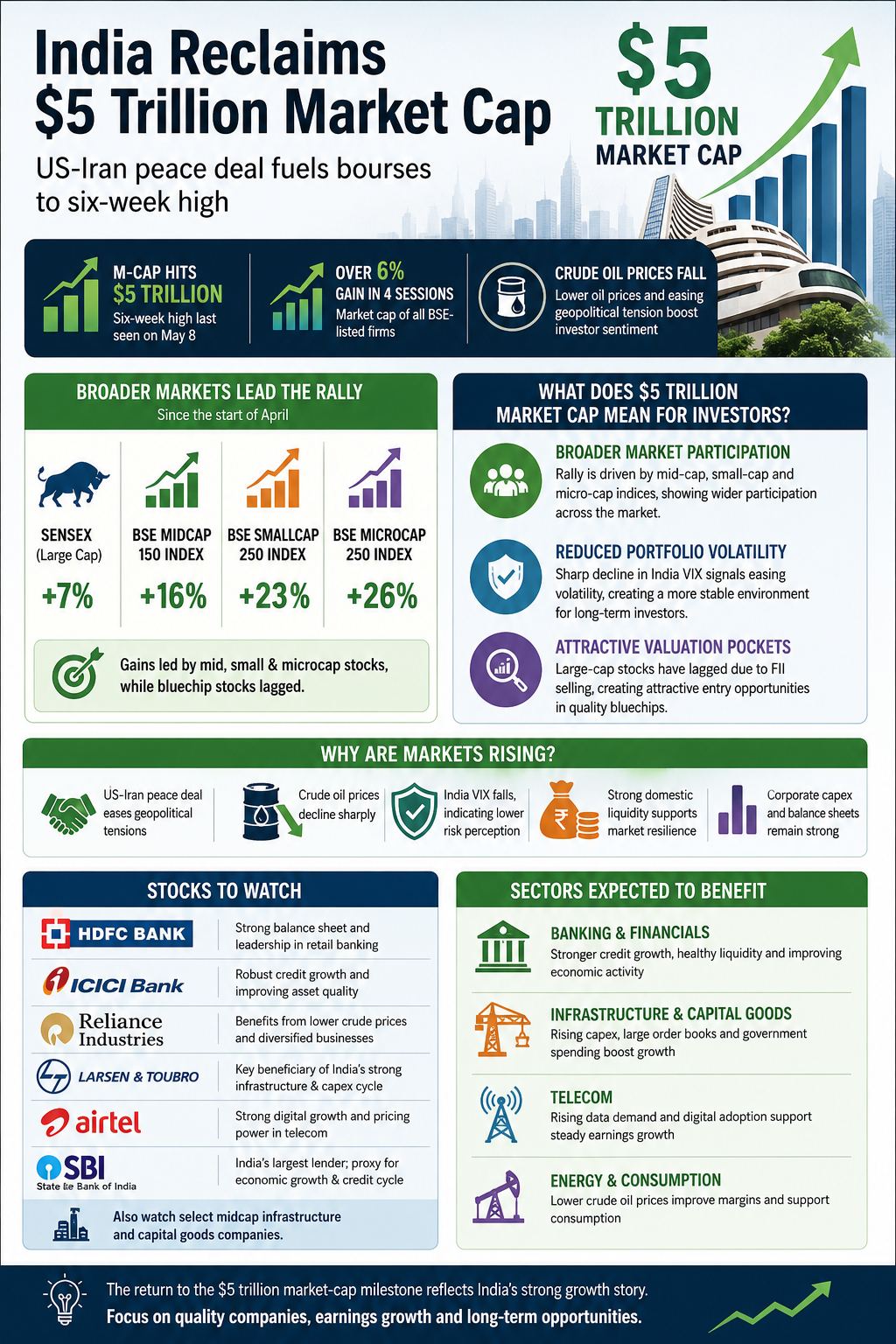
India Reclaims $5 Trillion Market Cap as BSE Market Cap Jumps
The combined market capitalization of all BSE-listed companies crossed $5 trillion, reaching its highest level in six weeks. This is the first time since May 8 that Indian equities have achieved the milestone.
Over the last four trading sessions, the total India market cap has surged more than 6%. Since April, the market value of listed companies has risen nearly 14%, highlighting the strength of the recent recovery.
A major trigger behind the rally was the sharp correction in crude oil prices. Lower oil prices reduce inflation risks for India and improve the outlook for corporate earnings.
Broader Market Participation
The recent rally has not been limited to a handful of heavyweight stocks. Mid-cap, small-cap, and micro-cap indices have significantly outperformed benchmark indices, indicating wider participation across sectors and market segments.
Lower Market Volatility
A sharp decline in volatility levels suggests investors are becoming more comfortable with risk. Lower volatility often creates a healthier environment for long-term wealth creation and systematic investing.
Emerging Value Opportunities
While broader markets have surged, many large-cap blue-chip stocks have lagged due to sustained foreign investor selling. This divergence has created attractive valuation opportunities in several fundamentally strong companies.
Why This Matters Going Forward
If crude oil prices remain stable, foreign investment flows improve, and corporate earnings continue to grow, the $5 trillion market-cap milestone could become a foundation for the next phase of India’s equity market expansion. However, investors should continue focusing on earnings quality, valuations, and sector-specific opportunities rather than chasing short-term market momentum.
Read More : Sensex Jumps 544 Points, Nifty Near 24,000 as US-Iran Deal Boosts FII Buying
Market Cap Milestones
- Current Status: The combined market value of BSE-listed firms crossed the $5 trillion mark.
- Historical Context: This is a six-week high, returning to levels last seen on May 8.
- Distance to Peak: The current value is 5.5% lower than the start of 2026 and 13% below the record high of $5.7 trillion set in September 2024.
Short-Term Gains (Past 4 Sessions)
- BSE Market Cap: Surged over 6%.
Medium-Term Gains (Since April 1)
- BSE Market Cap: Jumped nearly 14%.
- Benchmark Sensex: Gained 7% (lagging behind the broader market).
- BSE MidCap 150: Jumped 16%.
- BSE SmallCap 250: Jumped 23%.
- BSE Microcap 250: Surged 26%.
Financial Health of Corporate India
- Capex Growth: Capital expenditure for the top 500 listed non-financial companies nearly doubled to ₹10 lakh crore compared to pre-pandemic levels.
- Debt Levels: Net debt-to-equity ratios have fallen to multi-year lows.
- Cash Flow: Operating cash flow generation remains highly healthy.
Here’s What Happened Today and Why Traders Reacted
Several positive developments combined to fuel today’s market rally.
Key triggers included:
- US-Iran peace agreement reducing geopolitical risks
- Sharp fall in crude oil prices
- Decline in India VIX volatility index
- Continued domestic institutional buying
- Improved outlook for corporate earnings
- Growing confidence in India’s economic growth story
Corporate India’s Strength Continues to Support the Market
The India market cap recovery is not driven solely by global events. Corporate fundamentals remain strong.
The top 500 listed non-financial companies have nearly doubled their capital expenditure to around ₹10 lakh crore compared with pre-pandemic levels.
At the same time, companies have improved their balance sheets significantly. Debt levels have declined, cash flows remain healthy, and profitability has stayed resilient despite global uncertainty.
Many market experts believe these trends could support the next phase of earnings growth.
Experts See More Opportunities Emerging in Indian Equities
According to PhilipCapital, the US-Iran agreement could benefit Indian equities, bonds, and the rupee by reducing inflationary pressures and improving overall macroeconomic conditions.
However, the brokerage warned that a fresh rise in commodity prices or renewed geopolitical tensions could hurt earnings and economic growth.
Gaurav Bhandari, CEO of Monarch Networth Capital, said:
“The correction witnessed in large-cap sectors due to sustained FII selling appears excessive relative to underlying fundamentals.”
He expects banking stocks, telecom companies, and select IT stocks to lead the next phase of market recovery.
Bhandari also remains optimistic about quality small-cap and mid-cap companies where valuations have become more attractive after an extended period of consolidation.
What Impact Did This Have on the Market Today?
The return of the $5 trillion market cap mark boosted investor sentiment across sectors.
Financials, telecom stocks, and broader market companies witnessed increased buying interest. The decline in crude oil prices also improved sentiment toward sectors sensitive to energy costs.
Market breadth remained strong, indicating participation beyond a handful of heavyweight stocks.
What Does the $5 Trillion Market Cap Mean for Investors?
For investors, the India $5 trillion market cap milestone signals improving confidence in the economy and corporate earnings outlook.
The rally also highlights growing opportunities in mid-cap and small-cap segments, where earnings growth has remained robust.
However, investors should continue monitoring foreign fund flows, crude oil prices, and global geopolitical developments, as these factors could influence the sustainability of the current market rally.
With stronger corporate balance sheets, rising capital expenditure, and easing global risks, the return of India’s $5 trillion market cap may be more than just a milestone—it could be an early sign of the market’s next growth phase.
Stocks to Watch
As India’s equity market regains the $5 trillion market-cap milestone, investors are closely tracking sectors that could benefit from lower crude oil prices, improving economic activity, and stronger domestic investment flows. Several market leaders and select mid-cap companies appear well-positioned for the next phase of growth.
Banking & Financials
HDFC Bank
India’s largest private lender could benefit from improving credit demand, stable asset quality, and a potential return of foreign investor interest.
ICICI Bank
The bank continues to deliver strong earnings growth and remains one of the most closely watched financial stocks in the market.
State Bank of India (SBI)
As the country’s largest public sector bank, SBI is often viewed as a direct play on India’s economic growth and corporate lending cycle.
Energy, Telecom & Conglomerates
Reliance Industries
Lower crude oil prices can improve margins across its energy and petrochemical businesses, while its telecom and retail segments continue to support long-term growth.
Bharti Airtel
The telecom major remains a key beneficiary of rising data consumption, digital adoption, and strong pricing power in the sector.
Infrastructure & Capital Goods
Larsen & Toubro (L&T)
With corporate capex accelerating and infrastructure spending remaining robust, L&T is expected to remain a major beneficiary of India’s investment cycle.
Select Mid-Cap Infrastructure & Capital Goods Companies
Companies involved in power transmission, engineering, defence manufacturing, railways, and industrial construction could benefit from rising order books and strong earnings visibility.
Stocks to Watch: Current Price & Recent Change
| Stock | Current Price (₹) | Recent Change |
|---|---|---|
| HDFC Bank | 789.35 | +0.57% |
| ICICI Bank | 1,335.90 | +0.13% |
| Reliance Industries | 1,328.60 | +0.03% |
| Larsen & Toubro | 4,205 . 00 | +0.44% |
| Bharti Airtel | 1,857 . 00 | +0.22% |
| State Bank of India | 1,021 . 50 | +0.61% |
Why These Sectors Could Benefit
- Falling crude oil prices help reduce operating costs across multiple industries.
- Strong domestic liquidity supports credit growth and capital expenditure.
- Corporate balance sheets remain healthier than pre-pandemic levels.
- Large-cap valuations remain attractive after prolonged foreign investor selling.
- Government-led infrastructure spending continues to create opportunities across banking, engineering, and industrial sectors.
For investors, these sectors offer exposure to some of the biggest themes currently shaping the Indian market: economic growth, infrastructure expansion, corporate capex, and improving earnings momentum.