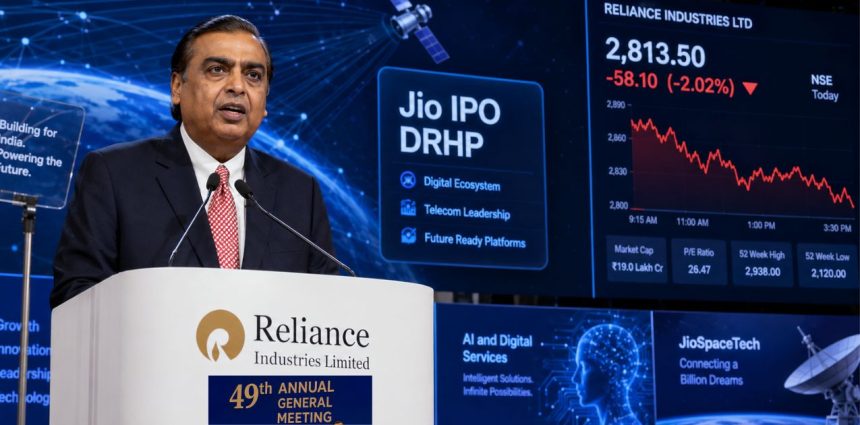
Reliance used its 49th AGM to file Jio Platforms’ IPO prospectus with SEBI, a step toward what is set to be India’s largest-ever public offering, alongside a record FY26 and a $110-billion AI bet. Yet RIL shares dipped nearly 1.5%, a classic “sell-the-news” move after a near-6% run-up, on a soft day for the wider market.
Key Takeaways
- Jio Platforms’ board approved its DRHP, filed with SEBI on 19 June, a 100% fresh issue of up to 27 crore (270 million) shares at ₹10 face value, reportedly ~$4 billion.
- The Jio IPO is set to become India’s largest-ever, overtaking Hyundai Motor India’s ₹27,870 crore and the NSE’s anticipated ~₹30,000 crore issue; valuation is pegged around $130–180 billion.
- FY26 was a record year, net profit attributable to shareholders rose 16% to ₹80,775 crore (₹95,754 crore on a total basis, the figure Ambani cited) on gross revenue of ₹11.76 lakh crore.
- But Q4 profit fell ~12.6% YoY to ₹16,971 crore, dragged by O2C/energy weakness even as Jio and Retail grew. The Board declared a ₹6/share dividend.
- RIL slipped ~1.45% to ₹1,308.90 on a soft market day, after a near-6% pre-AGM run-up. Analyst tilt stays bullish: 17 Strong Buy / 11 Buy of 29.
Jio IPO finally gets a date — DRHP filed today
The headline investors had waited months for came early in Mukesh Ambani’s address: the board of Jio Platforms approved its Draft Red Herring Prospectus (DRHP), the offer document a company must file before selling shares to the public, and the filing went to the Securities and Exchange Board of India (SEBI) on 19 June. Ambani called it “a deeply emotional moment” and said Akash, Isha, and Anant Ambani are leading the IPO process.
The structure has evolved. Reliance initially leaned toward a predominantly offer-for-sale (where existing investors sell down) before switching to a 100% fresh issue, meaning the proceeds flow into the company rather than to selling shareholders.
The filing, once expected in March, was pushed back as geopolitical tensions in West Asia and volatile equity markets prompted a rethink on timing.
The offer is a fresh issue of up to 27 crore (270 million) shares of ₹10 each, priced via book-building, with Reliance floating only about 2.5% of Jio while keeping its ~66% promoter stake. Reports peg the size at roughly $4 billion.
India’s largest-ever IPO in the making
The filing caps a journey that began in 2020, when Jio Platforms raised over ₹1.5 lakh crore from a marquee group of global investors, including Google, Meta, and KKR.
If it lists at the reported size, the IPO would dethrone Hyundai Motor India’s ₹27,870 crore (~$3.3 billion) October 2024 offering, currently the record, and outsize the NSE’s anticipated ~₹30,000 crore issue.
Valuation estimates broadly range $130–180 billion, with Jefferies having pegged Jio near $180 billion.
| Jio IPO — at a glance | Detail |
|---|---|
| Issue type | 100% fresh issue, up to 27 crore (270 mn) shares, ₹10 FV |
| Pricing | Book-building |
| Reported size | ~$4 billion (≈ ₹33,000–40,000 crore) |
| Valuation (reported/est.) | ~$130–180 billion |
| Float / promoter stake | ~2.5% float; RIL holds ~66% of Jio Platforms |
| DRHP filed with | SEBI — 19 June 2026 |
| Led by | Akash, Isha & Anant Ambani |
| India’s biggest IPOs | Issue size |
|---|---|
| Jio Platforms (proposed) | ~$4 billion—set to be the largest-ever |
| NSE (expected) | ~₹30,000 crore |
| Hyundai Motor India (Oct 2024) | ₹27,870 crore (~$3.3 bn) — current record |
“The relationship Reliance shares with its shareholders is a deep and sacred relationship founded on pride, trust, respect, and shared growth,” Ambani told shareholders, adding that the listing would show the world India can build technology companies of “global scale, global capability, and global value.” He assured “all prospective new investors that a brighter future awaits Jio.”
Jio’s earnings back the IPO story
The listing arrives with momentum behind it. For the March quarter, Jio Platforms posted revenue of ₹44,928 crore (up ~13%) and net profit of ₹7,935 crore (up 13%), while EBITDA grew ~18% and margins expanded 230 basis points to 52.4%, the profitable, scaling profile public-market investors look for.
Jio, now 10 years old, has crossed 524 million subscribers and climbed into the global top 20 on WIPO’s innovation ranking.
Check Live: RELIANCE INDUSTRIES Options Chart | Nifty Trader
Record FY26—but a softer Q4, driven by energy
FY26 was Reliance’s biggest year yet. Gross revenue (value of sales and services) crossed ₹11.76 lakh crore ($124 billion), up 9.8%, and profit hit fresh records: net profit attributable to shareholders rose 16% to ₹80,775 crore, while profit for the year on a total basis (including minority interests) reached ₹95,754 crore, up 17.8%, the figure Ambani highlighted as a record.
The March quarter was more mixed. Consolidated net profit fell 12.6% year-on-year to ₹16,971 crore (down 8% sequentially), even as revenue grew.
The culprit was energy: O2C EBITDA dropped ~12% sequentially to ₹14,520 crore and the oil-and-gas segment’s EBITDA fell ~18%, offsetting double-digit growth in telecom and retail.
Group EBITDA was roughly flat at ₹48,588 crore, with margin slipping ~200 bps to 14.9%. The board recommended a ₹6 per share dividend (record date 5 June).
| RIL FY26 snapshot (consolidated) | Figure | Change YoY |
|---|---|---|
| Gross revenue (Value of Sales & Services) | ₹11,75,919 cr ($124.0 bn) | +9.8% |
| EBITDA | ₹2,07,911 cr | +13.4% |
| Net profit (attributable to owners) | ₹80,775 cr | +16% |
| Profit for the year (total, incl. minority) | ₹95,754 cr | +17.8% |
| Q4 FY26 net profit | ₹16,971 cr | −12.6% (−8% QoQ) |
| Q4 FY26 revenue from operations | ₹2,98,621 cr | +12.9% |
| Q4 FY26 EBITDA (margin 14.9%) | ₹48,588 cr | ≈ flat (−200 bps) |
| FY26 dividend | ₹6 / share | — |
Note: RIL reports gross revenue (“Value of Sales & Services,” ₹11.76 lakh crore — the headline above) separately from “revenue from operations” (~₹10.6 lakh crore). Likewise, “profit for the year” (total) differs from “profit attributable to owners” by the minority stakes outside investors hold in Jio Platforms and Reliance Retail.
Consumer engines now drive over half of the group’s EBITDA
The consumer arms increasingly carry the group. Reliance Retail closed FY26 with gross revenue of ₹3,70,026 crore (up 11.8%), EBITDA of ₹27,033 crore and 387 million registered customers across more than 20,160 stores, having crossed the 20,000-store mark in Q4, a scale no Asian retailer has reached as fast, per Ambani.
Together with Jio, consumer businesses now contribute over 55% of consolidated EBITDA. A Reliance Retail IPO timeline, however, was not announced, a gap that may have added to the afternoon selling.
| Segment scorecard | Key numbers |
|---|---|
| Reliance Jio (Q4 FY26) | Revenue ₹44,928 cr (+13%); EBITDA ₹20,060 cr (+18%, margin 52.4%); PAT ₹7,935 cr (+13%); 524 mn subscribers |
| Reliance Retail (FY26) | Revenue ₹3,70,026 cr (+11.8%); EBITDA ₹27,033 cr (+8%); PAT ₹13,838 cr (+12%); 387 mn customers; 20,160 stores |
| O2C / Energy (Q4 FY26) | O2C EBITDA −12% QoQ to ₹14,520 cr, the drag on group profit |
The $110 billion AI bet—and a ‘Jio Call Agent’
Reliance formalised its AI strategy under the “Reliance Intelligence” brand, outlining a roughly $110-billion investment over seven years in AI and data centres, anchored by a 168 MW facility with Meta in Jamnagar.
Akash Ambani said the unit has moved into execution, building a multilingual AI suite across 22 Indian languages (JioBharatIQ, AI Vyapar, JioHealthIQ, JioLearnIQ and JioKrishiIQ), and unveiled “Jio Call Agent,” a native AI voice assistant built into the network that needs no separate app or number.
Jio is also exploring a sovereign Low Earth Orbit (LEO) satellite constellation. On clean energy, the Jamnagar Green Energy Giga Complex is entering its commissioning phase, with a 40 GWh battery gigafactory slated for late 2026.
Why did RIL shares fall on a day of big news?
RIL traded around ₹1,308.90, down 1.45% from its previous close of ₹1,328.10, after an intraday low near ₹1,307, as per sources.
Two things explain the dip.
First, expectations: the stock had already gained close to 6% in the four sessions into the AGM on IPO buzz, so “buy the rumour, sell the news” was the textbook setup, and traders zeroed in on what was still missing: a final valuation, exact issue size, listing date and a Retail IPO roadmap.
Second, the tape: the broader market was soft on Friday, with the Sensex slipping after five straight sessions of gains amid weakness in IT stocks.
Technically, the stock is basing well below its 5 January 2026 high of ₹1,611.80, with support around ₹1,250–1,260 and resistance near ₹1,340–1,360. Despite the day’s dip, the analyst tilt stays firmly bullish.
| Analyst view (29 analysts) | Count |
|---|---|
| Strong Buy | 17 |
| Buy | 11 |
| Hold | 0 |
| Sell | 1 |
| Strong Sell | 0 |
| PE ratio | 21.91x |
| NiftyTrader Stock Score | 8 / 10 |
Track the live to read the real-time sentiment behind the move
Bottom line
The AGM delivered the market’s single biggest ask, a concrete, filed step on the Jio IPO and a credible claim to India’s largest-ever listing, alongside record annual numbers and a clearer AI roadmap.
The near-term swing factor now shifts to the DRHP itself and SEBI’s review: its final valuation, float, and pricing will decide how a separately listed Jio re-rates the rest of Reliance, with a listing window likely stretching into late 2026 or 2027.
The muted share reaction simply reflects how much good news was already in the price and that the next set of catalysts (final IPO terms, a Retail IPO date) is still ahead.
For context on what to expect next, see our earlier preview,
RIL AGM 2026: Jio IPO and 4 things investors should watch.
Data as of 19 June 2026, ~2:55 PM IST. Live prices via NiftyTrader; financials per Reliance’s Q4/FY26 results and 49th AGM disclosures.