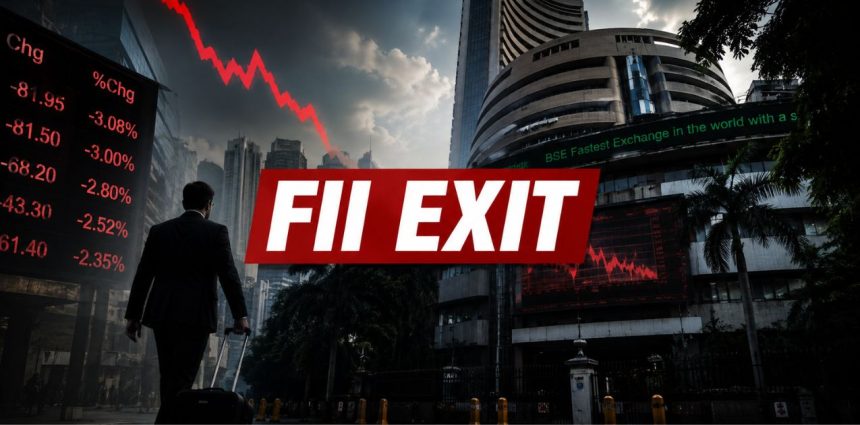
Foreign institutional investors have sold ₹1,26,089 crore worth of Indian financial stocks in CY2026 across 110 trading sessions, averaging ₹1,146 crore in outflows every single trading day, per NSE data compiled by Economic Times as of June 24, 2026.
Financials account for 44% of total FII outflows of ₹2,88,386 crore across all sectors, the most heavily sold segment by a wide margin.
Bank of Baroda (NSE: BANKBARODA), down 0.11% to ₹277.50 in mid-morning trade on Wednesday, sits at the sharpest end of this selldown, trading at a P/E of approximately 7x, near multi-year valuation lows per NSE data.
Track live FII and DII flows across sectors on NiftyTrader’s FII-DII Tracker →
Financials Sold Nearly 4x Harder Than Any Other Sector
The scale of the FII exit from Indian banks has no recent parallel. Total FII outflows from Indian equities between January and May 2026 reached approximately ₹2.3 lakh crore, already surpassing the ₹1.7 lakh crore withdrawn across the entirety of 2025.
Within that, financials took the heaviest blow; the IT sector, second on the selloff list, saw just ₹33,514 crore in outflows over the same period, per Economic Times data.
The month-by-month breakdown of FII selling in financial stocks:
| Month | FII Selling in Financials (₹ Crore) | Context |
|---|---|---|
| February 2026 | –8,418 | Net buying — only relief month in CY2026 |
| March 2026 | 60,655 | Sharpest single-month exit on record |
| April 2026 | 30,856 | Sustained pressure continued |
| May 2026 | 23,141 | Pace easing but still negative |
| CY2026 Total | 1,26,089 | 44% of all cross-sector FII outflows |
Source: Economic Times, NSE/SEBI data.
In March alone, DIIs absorbed the FII selling almost entirely, purchasing ₹1.16 lakh crore against FII outflows of ₹1.18 lakh crore, marking the first time domestic institutional ownership in Indian equities has exceeded FII ownership.
Why Banks? Liquidity, Macro, and the Index Weight Trap
Financials carry the largest weight in Indian benchmark indices, making them the most liquid exit door when global funds need to cut emerging market exposure fast. Elevated US inflation has kept Federal Reserve interest rates higher for longer, making US Treasury yields an attractive low-risk alternative to emerging market equities.
Rupee weakness against the US dollar compounds the problem for foreign funds, who face currency conversion losses when repatriating returns in dollar terms.
International investment mandates are additionally redirecting capital toward AI hardware supply chains concentrated in Taiwan, South Korea, and Japan, pulling allocation away from Indian equities broadly, but hitting financials hardest given their index dominance.
Santosh Meena, Head of Research at Swastika Investmart, told Economic Times: “Financials faced heavier selling than IT due to their index weight and macro sensitivity”, with high foreign ownership in banks and NBFCs leading to profit-booking, compounded by concerns over margin pressures and moderating credit growth.
Bank of Baroda: What Exchange Filings Actually Confirm
All figures in the table below trace directly to Bank of Baroda’s BSE regulatory filing dated May 8, 2026:
| Metric | Verified Figure | Source |
|---|---|---|
| Q4 FY26 Net Profit | ₹5,616 crore (+11.2% YoY) | BSE filing, May 8, 2026 |
| FY26 Full-Year Net Profit | ₹20,021 crore (first-ever ₹20,000 cr crossing) | BSE filing, May 8, 2026 |
| Net Interest Income Q4 FY26 | ₹12,494 crore (+8.7% YoY) | BSE filing, May 8, 2026 |
| Gross NPA Ratio | 1.89% (vs 2.26% in Q4 FY25) | BSE filing, May 8, 2026 |
| Net NPA Ratio | 0.45% | BSE filing, May 8, 2026 |
| Capital Adequacy Ratio | 15.82% | BSE filing, May 8, 2026 |
| Global Advances Growth | +16.2% YoY | BSE filing, May 8, 2026 |
| Dividend Declared | ₹8.50 per share (face value ₹2) | BSE filing, May 8, 2026 |
| Promoter Holding | 63.97% | Exchange disclosure, March 2026 |
| FII Holding | ~9.69–9.84% | Exchange disclosure, March 2026 |
The bank’s gross non-performing assets stood at 1.89%, improving from 2.04% in the previous quarter, with the board recommending a dividend of ₹8.50 per equity share for FY2025–26, subject to approval at the AGM. The fundamentals are not the problem.
The valuation compression is driven by FII selling mechanics, not earnings deterioration, the bank reported its highest-ever quarterly net profit of ₹5,616 crore in Q4 FY26 and crossed the ₹20,000 crore annual profit milestone for the first time.
Track Bank of Baroda’s live price and option chain data on NiftyTrader →
What Analysts Are Saying: A Split Verdict
The consensus 12-month price target for BANKBARODA stands at ₹311.35, with a high estimate of ₹350 and a low estimate of ₹225, per Investing.com data. The overall consensus rating is Buy.
IIFL Securities assigns a Reduce rating to Bank of Baroda with a target of ₹283, while recommending Buy on HDFC Bank, ICICI Bank, and Axis Bank in its June 2026 banking sector note.
| Broker / Platform | Rating | 12-Month Target (₹) |
|---|---|---|
| IIFL Securities | Reduce | 283 |
| TradingView Analyst Consensus | Buy | 293.57 |
| Investing.com Analyst Consensus | Buy | 311.35 |
| High Estimate (consensus range) | — | 350 |
| Low Estimate (consensus range) | — | 215 |
Sources: BusinessToday citing IIFL note June 2026; TradingView; Investing.com.
The structural valuation argument comes from Ambit Capital research cited by Economic Times: banks contribute 22% of NSE500 profits but account for only 13% of the index’s market capitalisation, a 9-percentage-point gap that remains historically wide even as earnings estimates stay reasonable.
The DII Counter-Trade and BoB’s Foreign Currency Push
Domestic mutual funds moved from 0.72% underweight in private sector banks in August 2025 to 0.78% overweight by May 2026, per Ambit Capital research, a 150-basis-point swing in institutional positioning over nine months that has received almost no retail attention.
FII flows are cyclical and can reverse quickly once macro conditions improve; potential triggers include de-escalation of geopolitical tensions, oil price stabilisation, rupee recovery, and softening US bond yields.
On the funding side, Bank of Baroda expects $4–5 billion in inflows through a combination of bonds, external borrowings, and FCNR(B) deposits, per a report by CNBCTV18 in the context of the bank’s investor engagement meeting held on June 22, 2026.
The bank has rolled out a special FCNR(B) deposit scheme effective June 11, 2026, offering up to 6% on USD deposits for 3–5 year maturities, in support of the RBI’s measures to boost foreign currency inflows.
Bank of Baroda subsequently raised FCNR(B) rates by a further 50 basis points, bringing the peak rate to 6.25% on five-year deposits as of June 16, 2026, per Business Standard.
These are debt-side instruments, not equity FII flows, but they directly reduce the bank’s foreign currency funding costs and ease the broader balance sheet pressure even as equity sellers remain active.
At a P/E of approximately 7x and P/B below 1x per recent exchange data, the valuation case for Bank of Baroda is clear.
At FII holding of approximately 9.7% with continued outflow risk and IIFL’s Reduce call sitting barely above Wednesday’s price, the timing risk is equally real.
The next concrete data point for investors will be the bank’s Q1 FY27 earnings, the date of which should be confirmed directly from BSE/NSE filings.
Also Read: How to Read an FII/DII Data Report (With Examples)
FAQs
Why are FIIs selling Indian bank stocks in 2026?
FIIs have sold ₹1,26,089 crore in Indian financial stocks in CY2026, 44% of all FII outflows of ₹2,88,386 crore, per NSE data compiled by Economic Times.
Key drivers are elevated US bond yields making US Treasuries attractive relative to emerging market equities, rupee weakness reducing repatriation returns for dollar-based funds; and the high index weight of financials making them the most liquid exit in any broad EM selldown.
Is Bank of Baroda a good buy right now?
BANKBARODA’s Q4 FY26 net profit rose 11.2% YoY to ₹5,616 crore, GNPA improved to 1.89%, and the board declared a dividend of ₹8.50 per share, all per BSE regulatory filing dated May 8, 2026.
Analyst consensus leans Buy with targets ranging ₹283–₹350. IIFL Securities holds a Reduce at ₹283. The stock trades near 7x P/E and below 1x P/B per recent exchange data. The valuation is compressed; the timing depends on when FII flows stabilise.
What are the verified Q4 FY26 results for Bank of Baroda?
Per BSE regulatory filing dated May 8, 2026: Q4 net profit was ₹5,616 crore (+11.2% YoY), NII was ₹12,494 crore (+8.7% YoY), GNPA was 1.89% (improved from 2.26% in Q4 FY25), Net NPA was 0.45%, Capital Adequacy Ratio was 15.82%, and a dividend of ₹8.50 per share was declared for FY26.
Disclaimer: Investments in securities are subject to market risks. This article is for informational purposes only and does not constitute investment advice. All figures should be independently verified on NSE/BSE before making investment decisions. SEBI Registration required for advisory services.