Key Takeaways
- Total FPI equity withdrawals in 2026 have reached ₹2.87 lakh crore, surpassing the ₹1.66 lakh crore pulled out during all of calendar year 2025, per NSDL data.
- June’s selling pace has broken the March-to-May tapering trend; watch this closely for the second fortnight.
- FPIs are selling equities but buying Indian government bonds via FAR, a rotation, not a full exit.
- Financial services remains the largest FPI holding at 30.27% and is the most likely first re-entry sector when flows turn.
- Brent crude was trading near $72–73 per barrel on June 25, down sharply from above $100 at the wartime peak, per market data.
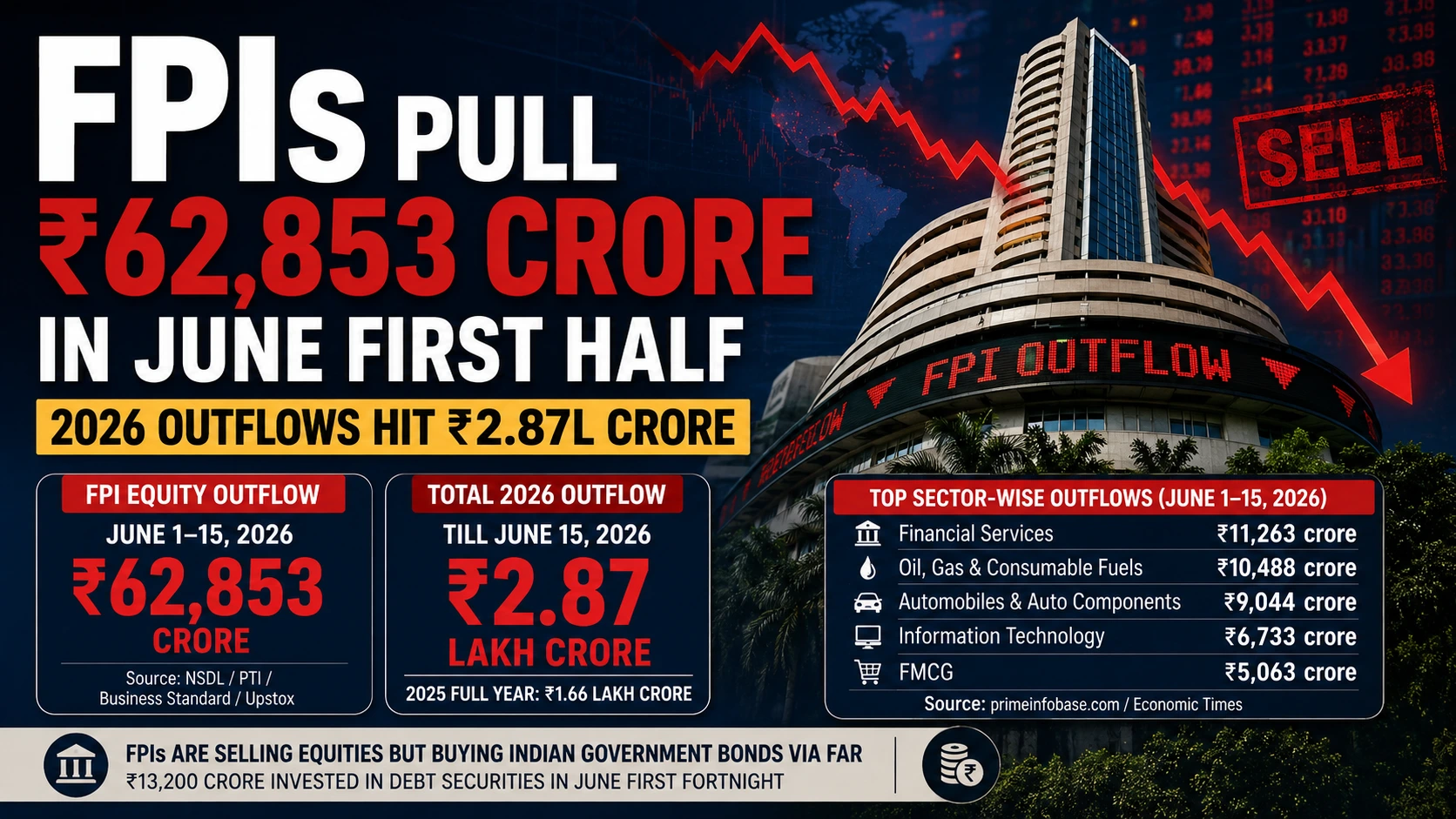
Foreign Portfolio Investors (FPIs) pulled out ₹62,853 crore from Indian equities in the first fortnight of June 2026, according to NSDL data reported by PTI, Business Standard, and Upstox.
Separately, sector-wise data from primeinfobase.com showed selling of ₹64,761 crore across the 19 sectors that recorded outflows, with financial services, oil & gas, automobiles, and IT hit hardest.
The June surge has pushed total 2026 FPI withdrawals to ₹2.87 lakh crore, already surpassing the ₹1.66 lakh crore pulled out during the entire calendar year 2025, making this among the sharpest annual outflows on record since FPIs were allowed to invest in Indian equities in 1993.
Check Here for more: NiftyTrader: Live Options Analytics for Indian Traders
Financial Services: Largest Outflow in Absolute Terms
Financial services saw the largest sector-wise FPI outflow in the first two weeks of June at ₹11,263 crore, followed by oil and gas at ₹10,488 crore and automobiles at ₹9,044 crore, per primeinfobase.com data.
The absolute rupee figure is high because financial services retained the highest FPI portfolio allocation at 30.27% despite the selling, with automobile stocks holding the second-highest sectoral allocation at 7.52%.
Cumulative outflows from financial services between January and April 2026 crossed ₹91,000 crore, per Economic Times. Still, U R Bhat, co-founder and director at Alphaniti, sees this as an opportunity: “When foreign investors choose to deploy capital, financial services will see the highest inflow as they have lightened their positions significantly in the sector, and the sector is attractive after the correction.”
Oil & Gas: Proportionally the Sharper Exit
The ₹10,488 crore oil and gas outflow is arguably the more alarming number. Siddarth Bhamre, head of institutional research at Asit C. Mehta, put it plainly: “While financial services saw the highest selling, it was not large relative to total foreign holdings.
The outflows from the oil and gas sector were substantial. “The selling in oil and gas was attributed to volatility in crude oil prices.
The sector carries far less index weight than financials, which makes a ₹10,488 crore exit a targeted risk reduction call, not passive rebalancing.
Sector-Wise FPI Outflows — June 1–15, 2026
| Sector | FPI Net Outflow (₹ Crore) | Jan–Apr Cumulative (₹ Crore) |
|---|---|---|
| Financial Services | 11,263 | 91,000+ |
| Oil, Gas & Consumable Fuels | 10,488 | ~36,000 |
| Automobiles & Auto Components | 9,044 | 17,985 |
| Information Technology | 6,733 | 24,870 |
| FMCG | 5,063 | — |
Source: primeinfobase.com / NSDL / Economic Times
Data Reconciliation Note
| Data Cut | Figure | Source |
|---|---|---|
| NSDL top-line equity outflow | ₹62,853 crore | NSDL / PTI / Business Standard |
| Sector-wise aggregate (19 sectors) | ₹64,761 crore | primeinfobase.com / Economic Times |
The difference reflects methodology: the NSDL top-line figure covers total net equity flows, while the primeinfobase.com sector-wise figure aggregates only the 19 sectors that recorded net outflows.
IT and FMCG: Structural vs. Seasonal
IT stocks have remained under pressure due to fears of artificial intelligence disruption, uncertainties about traditional outsourcing models, and future earnings visibility.
The ₹6,733 crore sold this fortnight adds to ₹24,870 crore in outflows between January and April, this is a structural derating, not an event-driven blip.
FMCG selling also came as investors watched rural demand risks from a weak monsoon, with below-average rainfall raising concerns over farm incomes and rural discretionary spending.
That one is seasonal and could reverse quickly if monsoon catchup data improves. Auto stocks were hit by concerns that elevated crude prices could dampen consumer sentiment and moderate vehicle demand, though with crude prices correcting, these pressures may ease and create room for investors to revisit the sector.
FPI Monthly Equity Flow Trend, 2026
| Month | FPI Net Equity Flow (₹ Crore) | Trend |
|---|---|---|
| January 2026 | -35,962 | Selling |
| February 2026 | +22,615 | Buying (only month) |
| March 2026 | -1,17,775 | Record monthly outflow |
| April 2026 | -60,847 | Selling continued |
| May 2026 | -32,963 | Pace moderating |
| June 2026 (1–15) | -62,853 | Selling re-accelerating |
Source: NSDL data / Business Standard / PTI
May had shown clear deceleration in selling intensity, from ₹1.17 lakh crore in March down to ₹32,963 crore in May. June’s first fortnight alone at ₹62,853 crore has broken that tapering trend, flagging that the pause was not a reversal.
The Debt Counterpoint Nobody Is Talking About
Oddly, while FPIs were aggressively selling equities, they were quietly buying Indian government bonds.
FPIs invested more than ₹13,200 crore in debt securities through the FAR route during the first fortnight of June, taking total FAR investments to nearly ₹28,000 crore so far in 2026.
This equity-sell, bond-buy split signals a risk-off rotation rather than a complete India exit, foreign investors are cutting equity exposure while still parking capital in sovereign paper.
Crude and the Rupee: The Two Variables That Matter
V K Vijayakumar, Chief Investment Strategist at Geojit Investments, said expectations of a peace agreement between the US and Iran resulted in a sharp correction in Brent crude prices to below $87 per barrel. “For a large oil importer like India, this is a significant positive.
India is facing a balance of payments deficit of about $60 billion in FY27,” he said. The Sensex confirmed this link when it jumped 1,695 points on June 12 after comments from US President Donald Trump raised hopes of easing US-Iran tensions.
The rupee has weakened nearly 6% in 2026 and around 10% over the past year, falling from the mid-80s level to about ₹95 per dollar. For every dollar-return-calculating foreign fund, a flat Nifty plus a 6% rupee depreciation produces a negative net return in dollar terms; that arithmetic is a key barrier to re-entry.
Domestic institutions and mutual fund SIP flows have cushioned the market, with AMFI data showing SIP collections of ₹30,954 crore in May 2026, helping absorb part of the FPI selling pressure.
Also Read: Stocks To Watch Today: IRFC ₹2,300 Cr OFS, LIC CFO Exit, ONGC Venezuela Deal
Frequently Asked Questions
Q. Is FPI selling in 2026 worse than any previous year?
FPIs have pulled out ₹2.87 lakh crore from Indian equities so far in 2026, according to NSDL data reported by PTI and Business Standard. That is already higher than the ₹1.66 lakh crore withdrawn in all of 2025, making 2026 one of the sharpest FPI selling years on record.
Q. Why did FPI selling re-accelerate in June after slowing in May?
The crude oil price spike through May kept risk aversion elevated even as monthly totals declined. The first fortnight of June at ₹62,853 crore, nearly double May’s entire ₹32,963 crore, reflects that the May moderation was driven by crude softening that had not yet fully materialised, and geopolitical uncertainty around the US-Iran peace timeline kept institutional foreign sellers active. The pace eased only in the final days of the fortnight, with FPIs selling just ₹1,082 crore on the last Friday, per PTI/Business Standard.
Q. What will bring FPI buying back to Indian equities?
Three triggers are being tracked by market participants: sustained softness in Brent crude, the US Federal Reserve signalling rate cuts (weakening the dollar and improving emerging market appeal), and Q1 FY27 earnings, starting July, confirming that corporate margins have held through the energy cost cycle.
The pace of FPI outflows moderated significantly in the latter half of the first fortnight, with FPIs selling only ₹1,082 crore on the final Friday, indicating that while risk aversion remained elevated, the intensity of foreign selling eased.
Disclaimer: This article is for informational purposes only and does not constitute investment advice. All data sourced from NSDL, primeinfobase.com, PTI, Business Standard, Upstox, Geojit Investments, and Economic Times. Consult a SEBI-registered financial advisor before making investment decisions. NiftyTrader is a financial markets information platform.