KEY TAKEAWAYS
- Spot gold at $3,981/oz on June 25, down nearly 29% from January 2026 record high of ~$5,595/oz
- US gold futures at $3,997/oz; metal trading below $4,000 for first time in months
- Deutsche Bank slashes Q3 target 22% to $4,300/oz; $3,800 bear case if Fed delivers 3–4 hikes
- Silver down 47% from January 30, dual industrial and investment headwind amplifying losses
- WGC survey (June 16): 89% of reserve managers expect global central bank gold holdings to rise next 12 months
- Central banks bought 244 tonnes in Q1 2026, annual net buying has exceeded 1,000 tonnes since 2022
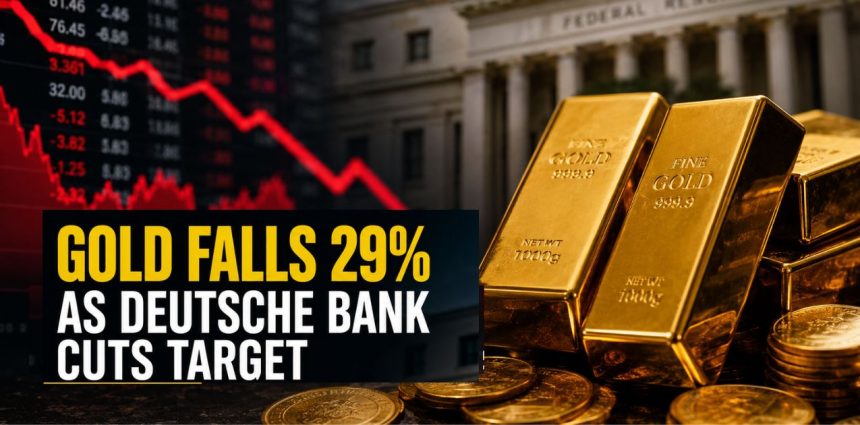
Gold Falls 29% as Deutsche Bank Cuts Target; Central Banks Keep Buying
Spot gold slipped to $3,981/oz on June 25, breaching $4,000 and down nearly 29% from its January 2026 record high of approximately $5,595/oz, according to Reuters, as Deutsche Bank slashed its Q3 2026 price target by 22% to $4,300/oz in a June 23 note and warned bullion could sink to $3,800 if the Federal Reserve under new chair Kevin Warsh delivers three to four rate hikes.
US gold futures tracked at $3,997/oz. Deutsche Bank analyst Michael Hsueh said that Fed repricing, together with resilient US macro data, has played the primary role in pushing gold lower, with the revised base case calling for gold to reach $4,800/oz in Q4, consistent with an indefinite Fed hold, while a risk case of three to four hikes may bring gold to $3,800/oz.
Yet central bank demand data released the same week showed the most bullish official-sector gold positioning in three decades.
Check HERE: Gold Price Today in India
How the Bull Run Broke
Gold’s collapse from ~$5,595 happened in two clear stages. A January surge to record highs reversed after the US-Iran conflict lifted energy prices and stoked rate-hike bets, sending gold down more than 21% since early March. Then Warsh compounded the damage.
The first FOMC meeting of the Warsh era revealed no resistance to market pricing for rate hikes, and the post-meeting press conference reinforced the potential for a further hawkish shift, with Deutsche Bank noting the Taylor rule prescription runs approximately 80 basis points above current policy rates.
Markets are now increasingly pricing in further Fed tightening later this year.
Elara Securities economist Garima Kapoor, in a June 22 report, sees three hikes of 25bps each, September and December 2026 and then January 2027, arguing that fresh H2 tariffs will keep inflation sticky on top of Middle East supply disruptions. If Elara’s projected rate hike path materialises, downside risks could move closer to Deutsche Bank’s $3,800 bear-case scenario.
Silver has been hit even harder, down 47% since January 30, because rate fears simultaneously suppress industrial output expectations and investment positioning, a dual headwind gold does not carry to the same degree.
Deutsche Bank Gold Forecast — Scenario Table
| Scenario | Fed Action | Deutsche Bank Target | Timeframe |
|---|---|---|---|
| Base case | Indefinite hold | $4,300/oz | Q3 2026 |
| Base case | Indefinite hold | $4,800/oz | Q4 2026 |
| Bear case | 3–4 rate hikes | $3,800/oz | H2 2026 risk |
Source: Deutsche Bank Research, analyst Michael Hsueh, June 23, 2026
Deutsche Bank noted that continued sales from gold-backed ETFs showed that the usual support for the metal is “notably absent,” while in China the metal’s onshore discount to Comex prices suggests imports will not provide support for the market.
Both signals point the same way, investor demand has pulled back sharply. The question is whether central banks alone can hold the floor.
Technical Picture and ETF Flows Already Broken
Gold remains in a bearish phase, holding well below the 200-day, 50-day, and 100-day simple moving averages; the clustered downside alignment reinforces a downside bias, while the RSI near 30 flirts with oversold territory and the MACD remains in negative territory with subdued momentum.
Gold has also broken below its 50-week moving average, the first breach since October 2023, when prices were near $1,800/oz.
By May 2026, global gold ETF outflows reached $2 billion, ending a nine-month inflow streak that had made 2025 the strongest ETF year on record, with total global ETF holdings ticking down to 4,121 tonnes.
Recent weakness in Chinese premiums and softer Indian demand trends, linked to India’s import duty and tax structure, have reduced some of the physical buying support that typically cushions price declines. These two markets represent a substantial share of global physical gold consumption, and both are currently providing less of a floor than in prior downturns.
Gold Price Scenarios — H2 2026 Roadmap
| Fed Path | Hike Count | Gold Price Range | Implication |
|---|---|---|---|
| Indefinite hold | 0 | $4,300–$4,800/oz | Deutsche Bank base case |
| Mild tightening | 1–2 hikes | $4,000–$4,300/oz | Rising market probability |
| Aggressive tightening | 3–4 hikes | $3,800–$4,000/oz | Deutsche Bank bear case |
| Recession pivot | Rate cuts resume | $5,000+/oz | Low near-term probability |
Source: Deutsche Bank Research June 23, Elara Securities June 22, NiftyTrader research
The One Buyer That Has Not Moved: Central Banks
Here is where the bear case runs into a structural wall. The WGC 2026 Central Bank Gold Reserves Survey, published June 16, showed that 89% of reserve managers expect global central bank gold holdings to increase over the next 12 months, while a record 45% expect their own institutions to add to their reserves.
Central banks collectively purchased 244 tonnes in Q1 2026, a 3% increase year-on-year, and annual net buying has exceeded 1,000 tonnes since 2022.
The value of gold held by foreign central banks is now approaching $4 trillion, surpassing their approximate $3.9 trillion holding in US Treasuries, the last time foreign institutions held more gold than US bonds was 1996.
74% of central bank survey respondents anticipate a moderate or significant decline in US dollar holdings within global reserves over the next five years, favouring gold instead.
Dilip Parmar, research analyst at HDFC Securities, said in a June 22 ET interview this is precisely why 2026 is structurally different from 2011: “Central banks and investors have been net buyers of gold in recent years as part of reserve diversification.
Geopolitical uncertainty and a gradual shift toward a multi-polar currency system underpin gold demand.” His call: range-bound correction, not a multi-year bear market.
2011 vs. 2026 — The Correction Compared
| Factor | 2011 Correction | 2026 Correction |
|---|---|---|
| Primary trigger | QE taper expectations | Warsh Fed rate hike pricing |
| Gold peak | ~$1,900/oz | ~$5,595/oz |
| Central bank stance | Net sellers or neutral | 1,000+ tonnes/year net buying |
| Gold vs US Bonds | Bonds dominant reserve asset | Gold overtook bonds (2026) |
| China demand | Rising premium | Flipped to discount |
| ETF flows | Inflows supporting prices | $2 billion outflow in May 2026 |
| Duration outlook | 4-year bear (2011–2015) | Range-bound correction, not multi-year bear (HDFC Securities, June 22) |
Source: World Gold Council, Deutsche Bank, HDFC Securities, NiftyTrader research
Gold is currently trading below Deutsche Bank’s revised Q3 target of $4,300, meaning the market has already corrected through the near-term forecast range. Central banks remain buyers even as ETF flows and market positioning have weakened.
The $2 billion May ETF outflow, the flipped China premium, and rising Fed tightening expectations are pulling in one direction. The 244 tonnes of Q1 central bank buying and the first gold-over-bonds reserve shift since 1996 are pulling in the other. The July FOMC is where that tension finds its next answer.
Also Check: Gold Option Chain — Live MCX Gold Options Data
FAQ
Q: What is the gold price in India today, June 25, 2026?
As of June 25, domestic retail data shows 24K gold trading at approximately ₹14,000–₹14,500 per gram and 22K gold at ₹12,900–₹13,300 per gram, varying by city. International spot gold is at $3,981/oz, down nearly 29% from January’s record. Prices exclude making charges and GST.
Q: Why is silver falling harder than gold in 2026?
Silver carries roughly 50% industrial demand exposure versus gold’s predominantly monetary role. Rate-hike fears simultaneously suppress industrial output expectations and kill investment positioning — a double hit gold does not carry to the same degree. Silver is down 47% from January 30 versus gold’s 29% decline, and that gap directly reflects this dual headwind. Source: ET, NiftyTrader research.
Q: What is the next major trigger for gold prices?
The July 2026 FOMC meeting. Any signal from Warsh confirming the September hike trajectory would validate the Elara three-hike sequence and bring Deutsche Bank’s $3,800 bear case into Q4 play. A hold with dovish language would support a recovery toward the $4,300–$4,800 base-case range. Source: Deutsche Bank Research June 23, Elara Securities June 22.
Disclaimer: This article is for informational purposes only and does not constitute investment advice. Gold prices are subject to high volatility and global macro risks. Please consult a SEBI-registered financial advisor before making any investment decisions. NiftyTrader does not hold positions in any commodities or securities mentioned.