
Domestic Investors absorb $800 million in IPO supply, but what kept internet stock valuations resilient?
Just months after a wave of high-profile IPOs entered the market, many investors expected internet company valuations to come under heavy pressure. Instead, the sector has remained surprisingly stable. The biggest reason? Domestic institutional investors (DIIs) stepped in aggressively, absorbing fresh equity supply worth more than $800 million and preventing a deeper correction in valuations.
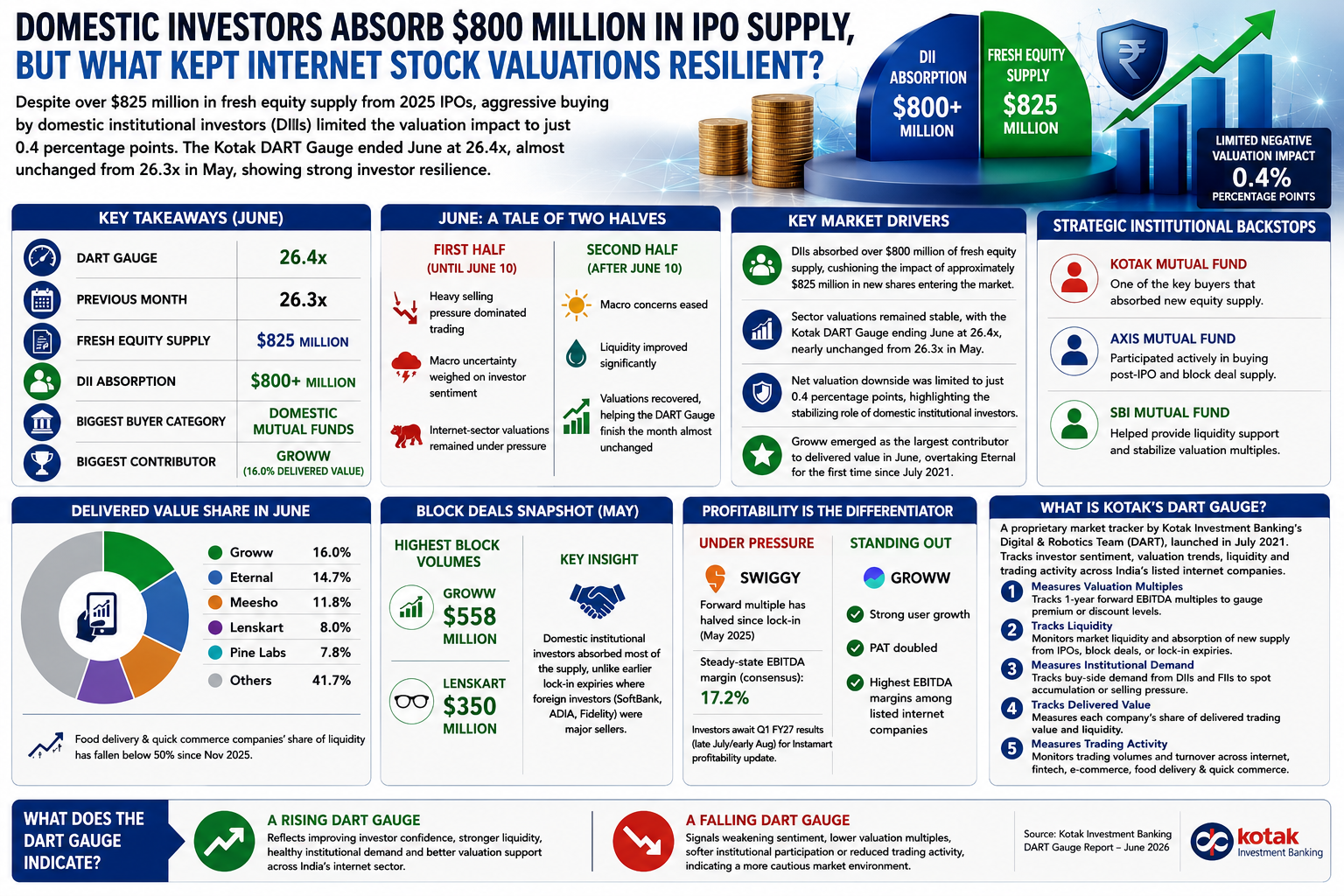
According to Kotak Investment Banking’s latest DART Gauge report, the internet sector valuation index ended June at 26.4x, almost unchanged from 26.3x in May, highlighting the resilience of investor demand despite a steady flow of new shares into the market.
Domestic Investors : Kotak calls June a ‘tale of two halves’
The report describes June as a month divided into two distinct phases.
The first half witnessed weak sentiment and selling pressure as investors remained cautious over macroeconomic concerns. However, market conditions improved significantly after June 10, when easing macro worries and improving liquidity helped valuations recover.
As a result, the Kotak DART Gauge finished the month at 26.4x, indicating that investor confidence returned despite the earlier weakness.
Read More : Trump Says Iran Ceasefire Is Over: Brent Crude Jumps 6%, Gold-Silver ETFs Fall 3%
Understand the June Market Dynamics
- Prevented Valuation Drops: Over $825 million in new shares hit public markets, but DII buying limited the net negative valuation impact to just 0.4 percentage points.
- Acted as Buyer of Last Resort: Domestic mutual funds like Kotak MF, Axis MF, and SBI MF heavily bought the supply, preventing a sharp drop in market multiples.
- Experienced a Tale of Two Halves: Heavy selling pressure and weakness dominated until June 10, followed by a strong recovery in liquidity and valuations as macro worries eased.
Key Takeaways
| Key Metric | June |
|---|---|
| DART Gauge | 26.4x |
| Previous Month | 26.3x |
| Fresh Equity Supply | $825 million |
| DII Absorption | $800+ million |
| Biggest Buyer Category | Domestic Mutual Funds |
| Biggest Contributor | Groww (16.0% delivered value) |
Track Live : FII DII Data Today – Live FII & DII Activity
Domestic mutual funds played a crucial role
Kotak said several domestic mutual funds emerged as key buyers during the period.
Strategic Institutional Backstops
- Kotak Mutual Fund: One of the key buyers that absorbed new equity supply.
- Axis Mutual Fund: Participated actively in buying post-IPO and block deal supply.
- SBI Mutual Fund: Helped provide liquidity support and stabilize valuation multiples.
These institutional investors absorbed a large portion of the fresh equity supply, reducing the pressure that usually follows IPO lock-in expiries and secondary market sales.
Their buying helped offset selling by existing shareholders and maintained stability across the sector.
Timeline of June’s Two-Halves Recovery
First Half (Until June 10)
- Heavy selling pressure dominated trading.
- Macro uncertainty weighed on investor sentiment.
- Internet-sector valuations remained under pressure.
Second Half (After June 10)
- Macro concerns eased.
- Liquidity improved significantly.
- Valuations recovered, helping the DART Gauge finish the month almost unchanged.
Key Market Drivers
- DIIs absorbed over $800 million of fresh equity supply, cushioning the impact of approximately $825 million in new shares entering the market.
- Sector valuations remained stable, with the Kotak DART Gauge ending June at 26.4x, nearly unchanged from 26.3x in May.
- Net valuation downside was limited to just 0.4 percentage points, highlighting the stabilizing role of domestic institutional investors.
- Groww emerged as the largest contributor to delivered value in June, overtaking Eternal for the first time since the DART Gauge was launched in 2021.
Here’s what happened and why investors are paying attention
Over the past few months, nearly $825 million worth of fresh equity from the 2025 IPO cohort entered the public market. Such large supply typically puts pressure on stock prices and valuation multiples.
However, domestic institutional investors absorbed more than $800 million of this supply, limiting the negative impact on sector valuations to just 0.4 percentage points.
In simple terms, DIIs acted as buyers when additional shares entered the market, helping maintain stability in India’s listed internet companies.
May tested the market even more
According to the report, May presented a much tougher test for investor demand.
Premium internet companies such as Groww and Lenskart contributed 6.2 percentage points to the overall DART Gauge after shares became available following post-lock-in expiries.
Meanwhile, older listed internet companies reduced the Gauge by 3.8 percentage points.
Despite this mixed performance, the valuation index still increased to 26.5x in May, compared with 24.1x in April, reflecting a net gain of 2.4 points.
The numbers suggest that strong demand for newer, profitable internet companies more than compensated for weakness elsewhere in the sector.
Groww emerges as the biggest liquidity leader
One of the biggest shifts highlighted in the report was the rise of Groww.
In June, the online investment platform accounted for 16% of the sector’s delivered value, overtaking Eternal, which recorded 14.7%.
This marked the first time since the DART Gauge was launched in July 2021 that Eternal was not the sector’s leading stock by delivered value.
Groww’s influence was even stronger in May, when its share reached 24.8%, largely driven by heavy block trades following the expiry of its post-IPO lock-in period.
Other major contributors during June included:
- Meesho – 11.8%
- Lenskart – 8.0%
- Pine Labs – 7.8%
The report also noted that food delivery and quick commerce companies, which had dominated trading volumes for several years, have seen their combined liquidity share fall below 50% since November 2025.
Block deals reveal changing investor preferences
Block and bulk deal data provided another important insight.
During May, Groww recorded block trades worth $558 million, the highest among internet companies, while Lenskart followed with $350 million.
Unlike previous lock-in expiries that saw foreign investors such as SoftBank, ADIA and Fidelity exit positions, domestic institutional investors absorbed most of the available shares this time.
This changing ownership pattern reflects growing confidence among Indian institutional investors in the country’s digital economy.
Profitability is becoming the biggest differentiator
Kotak believes investors are increasingly rewarding companies with stronger profitability.
The report highlights that stocks with a larger gap between their near-term EBITDA multiples and long-term sustainable EBITDA expectations witnessed weaker demand.
Swiggy illustrates this trend.
Its forward valuation multiple has nearly halved since the end of its lock-in period in May 2025, even though the market continues to estimate a long-term EBITDA margin of 17.2%.
Investors are now closely watching the company’s Q1 FY27 results, expected in late July or early August, to assess whether Instamart can achieve contribution margin profitability.
In contrast, Groww has continued to attract investors through strong fundamentals, including rapid user growth, doubling profit after tax and the highest EBITDA margins among listed internet companies.
What is Kotak’s DART Gauge?
The Kotak DART Gauge is a proprietary market tracker developed by Kotak Investment Banking’s Digital & Robotics Team (DART). Introduced in July 2021, it is designed to measure investor sentiment, valuation trends, liquidity, and trading activity across India’s listed internet and new-age technology companies. Rather than tracking only stock prices, the Gauge combines multiple market indicators to provide a broader view of the sector’s health.
1. Measures Valuation Multiples
The DART Gauge tracks the forward EBITDA valuation multiples of India’s internet companies, helping investors assess whether the sector is trading at a premium or discount relative to its historical range. Higher multiples generally indicate stronger investor confidence and expectations for future growth.
2. Tracks Liquidity
The Gauge monitors market liquidity by assessing how easily shares can be traded without causing significant price swings. It reflects whether fresh equity supply from IPOs, block deals, or lock-in expiries is being absorbed smoothly by the market.
3. Measures Institutional Demand
One of its key functions is tracking buy-side demand from domestic institutional investors (DIIs) and foreign institutional investors (FIIs/FPIs). It highlights whether institutional investors are accumulating shares or reducing exposure, particularly during periods of heavy equity issuance or post-IPO lock-in expiries.
4. Tracks Delivered Value
The DART Gauge measures each company’s share of delivered trading value, showing which internet businesses attract the most investor activity and liquidity. Companies with rising delivered value typically play a larger role in shaping overall sector valuations.
5. Measures Trading Activity Across Internet Companies
The Gauge also tracks trading volumes and turnover across a basket of internet, fintech, e-commerce, food delivery, and quick-commerce companies. This helps identify changing investor preferences and sector leadership as new IPOs and business models gain traction.
What does a rising or falling DART Gauge indicate?
A rising DART Gauge generally reflects improving investor confidence, stronger liquidity, healthy institutional demand, and better valuation support across India’s internet sector. Conversely, a falling DART Gauge signals weakening sentiment, lower valuation multiples, softer institutional participation, or reduced trading activity, indicating a more cautious market environment.