
Maruti Suzuki Q1 FY27 Results on July 31, 5:15 PM IST: Revenue May Jump Over 30%
Maruti Suzuki India Ltd, the country’s largest passenger vehicle manufacturer, will announce its Q1 FY27 (April–June 2026) financial results on Friday, July 31, 2026. While analysts expect the company to report one of its strongest revenue performances in recent years, investors are also preparing for a quarter in which profits could remain under pressure despite record vehicle sales.
The board will meet to approve the June-quarter results earlier in the day, followed by an analyst conference call scheduled for 5:15 PM IST. With Maruti Suzuki’s stock trading near record highs, the market reaction is expected to depend not only on the headline numbers but also on management’s outlook for demand, margins and commodity costs.
Get More Updates : Results Calendar — NSE & BSE
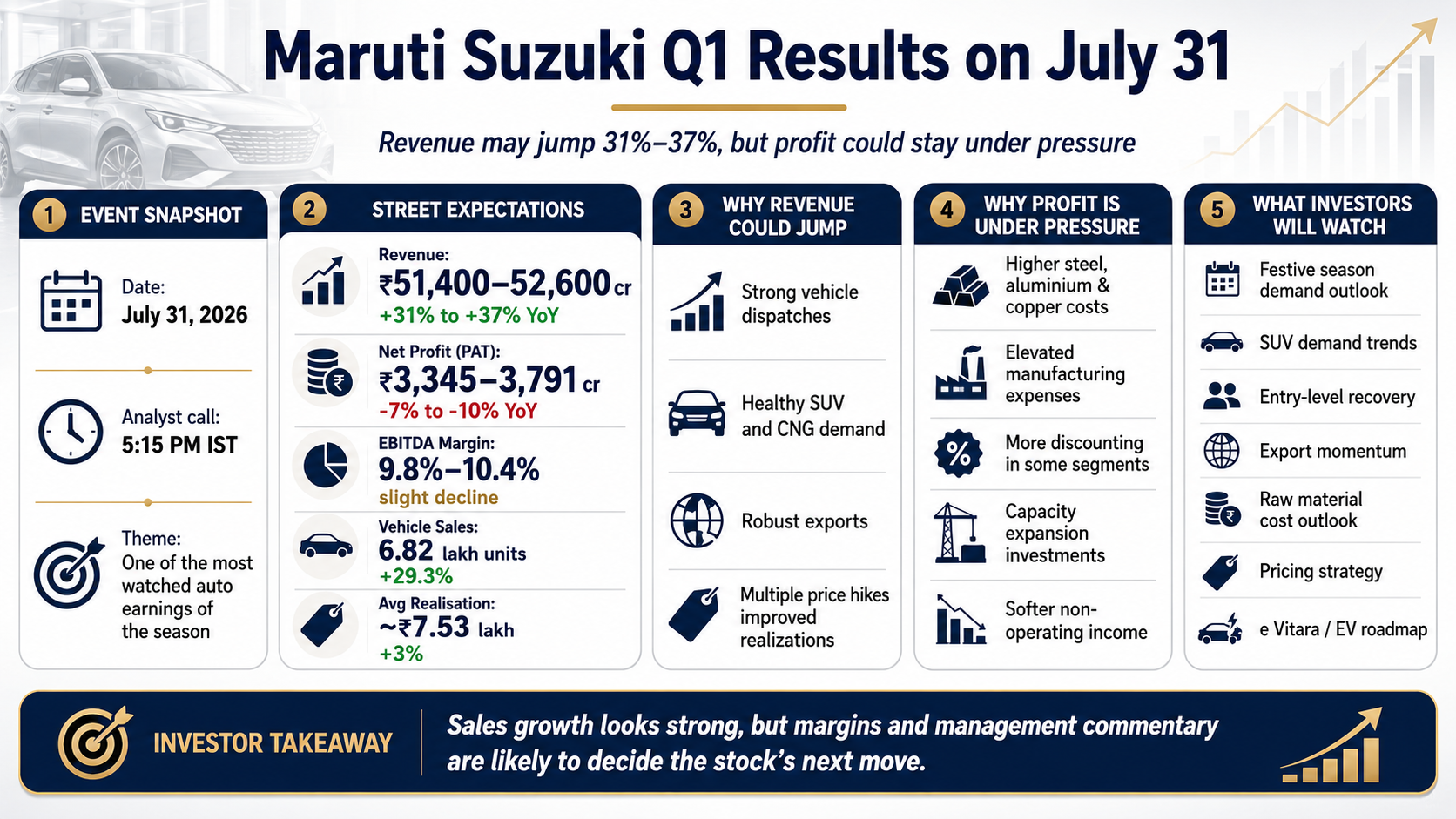
Key expectations from Maruti Suzuki Q1 FY27
According to consensus estimates from brokerage firms, Maruti Suzuki is expected to deliver strong top-line growth driven by higher vehicle volumes, improved realizations and robust exports.
| Metric | Street Expectation | YoY Trend |
|---|---|---|
| Revenue | ₹51,400–52,600 crore | ▲31%–37% |
| Net Profit (PAT) | ₹3,345–3,791 crore | ▼7% to ▼10% |
| EBITDA Margin | 9.8%–10.4% | Slight decline |
| Vehicle Sales | 6.82 lakh units | ▲29.3% |
| Average Realisation | Around ₹7.53 lakh | ▲3% |
The contrasting expectations for revenue and profit suggest that Maruti’s June quarter could be a classic case of strong sales growth offset by higher operating costs.
Why is Maruti Suzuki expected to report over 30% revenue growth?
The biggest driver is a sharp increase in vehicle dispatches during the quarter.
Maruti Suzuki sold approximately 6.82 lakh vehicles, representing nearly 29.3% year-on-year growth. Demand remained healthy across several product categories, particularly SUVs and CNG models, while exports also delivered a strong performance.
The company also implemented multiple price hikes during the quarter, helping average realizations improve by an estimated 3%. Higher selling prices combined with a richer product mix are expected to push quarterly revenue above ₹51,000 crore, marking one of the strongest June-quarter performances in the company’s history.
Strong export momentum could provide another boost. Overseas shipments remained robust during the quarter, supporting revenue growth even as competition in the domestic market intensified.
Read More : RBI Revives Polymer Currency Plan After 17 Years: Why ₹10 and ₹20 Notes Are Under Trial
1. Strong volume growth (+29.3% YoY)
Maruti sold around 6.82 lakh vehicles during Q1 FY27, one of its strongest June-quarter performances. Higher sales volumes directly lift revenue.
2. Price hikes improved realizations
The company implemented multiple price increases during the quarter. Brokerages estimate the average realization per vehicle increased by around 3%, helping revenue grow faster than volumes.
3. Record exports
Exports remained a key growth driver, supported by strong overseas demand. Export volumes and a better sales mix are expected to contribute meaningfully to revenue growth.
4. Higher CNG and SUV sales
Demand for higher-value SUVs and CNG models remained healthy. The richer product mix supports revenue because these vehicles generally generate higher realizations than entry-level cars.
Why could net profit decline despite record sales?
While revenue is expected to grow sharply, analysts believe profitability may not keep pace because of rising costs.
Higher prices of key raw materials such as steel, aluminium and copper continued to increase manufacturing expenses during the quarter. Although Maruti implemented price hikes, these increases are not expected to fully offset higher input costs.
Brokerages also expect operating margins to remain under pressure due to:
- Elevated commodity prices
- Higher manufacturing and operating expenses
- Increased discounts in certain vehicle segments
- Investments related to production capacity expansion
- Softer non-operating income compared with the previous year
As a result, net profit is expected to remain flat or decline by 7–10% year-on-year, despite healthy revenue growth.
1. Commodity inflation
Steel, aluminium and copper prices remained elevated during the quarter, increasing manufacturing costs for every vehicle sold.
2. Margin compression
Brokerages expect EBITDA margins to soften to roughly 9.8%–10.4%, reflecting higher raw material and operating costs. Even with strong revenue growth, lower margins can reduce profit growth.
3. Higher discounts and operating expenses
The company is expected to have offered higher discounts in some segments while also incurring higher expenses related to capacity expansion and operations. These factors weigh on earnings.
4. Lower other income
Some analysts also expect lower non-operating or other income compared with the year-ago quarter, which could further pressure reported profit.
Margins will be the biggest number to watch
For many investors, EBITDA margins could prove more important than revenue or profit.
Analysts estimate EBITDA margins will be around 9.8% to 10.4%, slightly below the year-ago level. Any margin performance above expectations could indicate that the company is successfully passing on higher costs to customers, while a sharper decline may raise concerns about profitability over the coming quarters.
What investors should watch during the earnings call
The management commentary scheduled after the results may have a greater impact on the share price than the quarterly numbers themselves.
Investors will closely track updates on:
- Festive season demand outlook
- SUV demand trends
- Recovery in entry-level car sales
- Export growth and international demand
- Raw material cost outlook
- Future pricing strategy
- Capacity expansion plans
- Progress on the e Vitara electric SUV and EV roadmap
Positive guidance on these factors could improve investor sentiment even if quarterly profits remain under pressure.
How Maruti compares with the sector
India’s automobile sector has reported mixed trends this earnings season.
Mahindra & Mahindra recently delivered strong quarterly growth, supported by robust SUV demand and contributions from group companies, while analysts expect Maruti Suzuki to demonstrate the benefits of its scale through healthy revenue growth despite a more challenging cost environment.
The June-quarter results will therefore provide a broader indication of consumer demand in India’s passenger vehicle market and whether manufacturers can protect margins in the face of higher input costs.
What could move the stock after the results?
The market is entering the earnings announcement with cautious optimism.
A stronger-than-expected margin performance, better profitability or upbeat management guidance could support the stock, while a larger-than-expected decline in margins or a cautious outlook on demand and commodity costs may weigh on investor sentiment.
Given the stock’s strong run in recent months, management commentary on the second half of FY27 could become the biggest driver of the post-results share price reaction.
Key takeaways
- Maruti Suzuki will announce Q1 FY27 results on July 31, 2026.
- Revenue is expected to rise 31–37% year-on-year to around ₹51,400–52,600 crore.
- Vehicle sales increased 29.3% during the quarter.
- Average realization is expected to improve by around 3% following multiple price hikes.
- Net profit may decline 7–10% due to higher steel, aluminium and copper costs.
- EBITDA margins are expected to remain under pressure at 9.8%–10.4%.
- Management commentary on festive demand, exports, pricing and EV strategy will be closely watched.
Bottom line
Maruti Suzuki’s Q1 FY27 results are shaping up to be one of the most closely watched earnings announcements of the season. The company is widely expected to post more than 30% revenue growth, reflecting strong vehicle demand, higher realizations and healthy exports. However, the spotlight is likely to remain on profitability, as rising commodity costs continue to squeeze margins.
For investors, the headline numbers will only tell part of the story. The real focus will be on whether Maruti Suzuki can protect margins, sustain demand through the festive season and provide a confident outlook for the rest of FY27. With expectations already high, the management’s commentary on costs, pricing and electric vehicle strategy could determine how the market reacts after the results are announced.