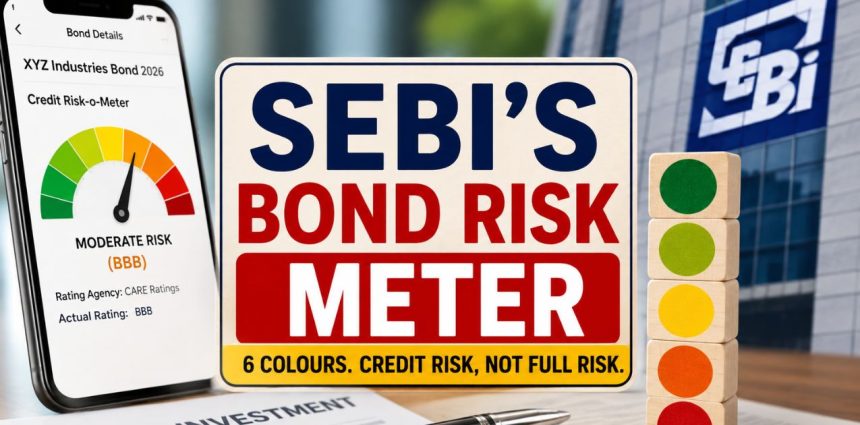
SEBI has proposed a mandatory Credit Risk-o-Meter for debt securities — a six-level colour scale that would put a simple visual risk signal alongside existing AAA-to-D credit ratings. Public comments close September 3, 2026. But there is a catch: the colour measures only credit risk, not the full risk of owning the bond.
The Quick Take
If you’ve ever bought a bond online and wondered whether AA+ is actually “safe” enough, SEBI wants to make that decision easier to read at a glance. This proposal is aimed squarely at that problem, retail investors who struggle to interpret alphanumeric ratings before they invest.
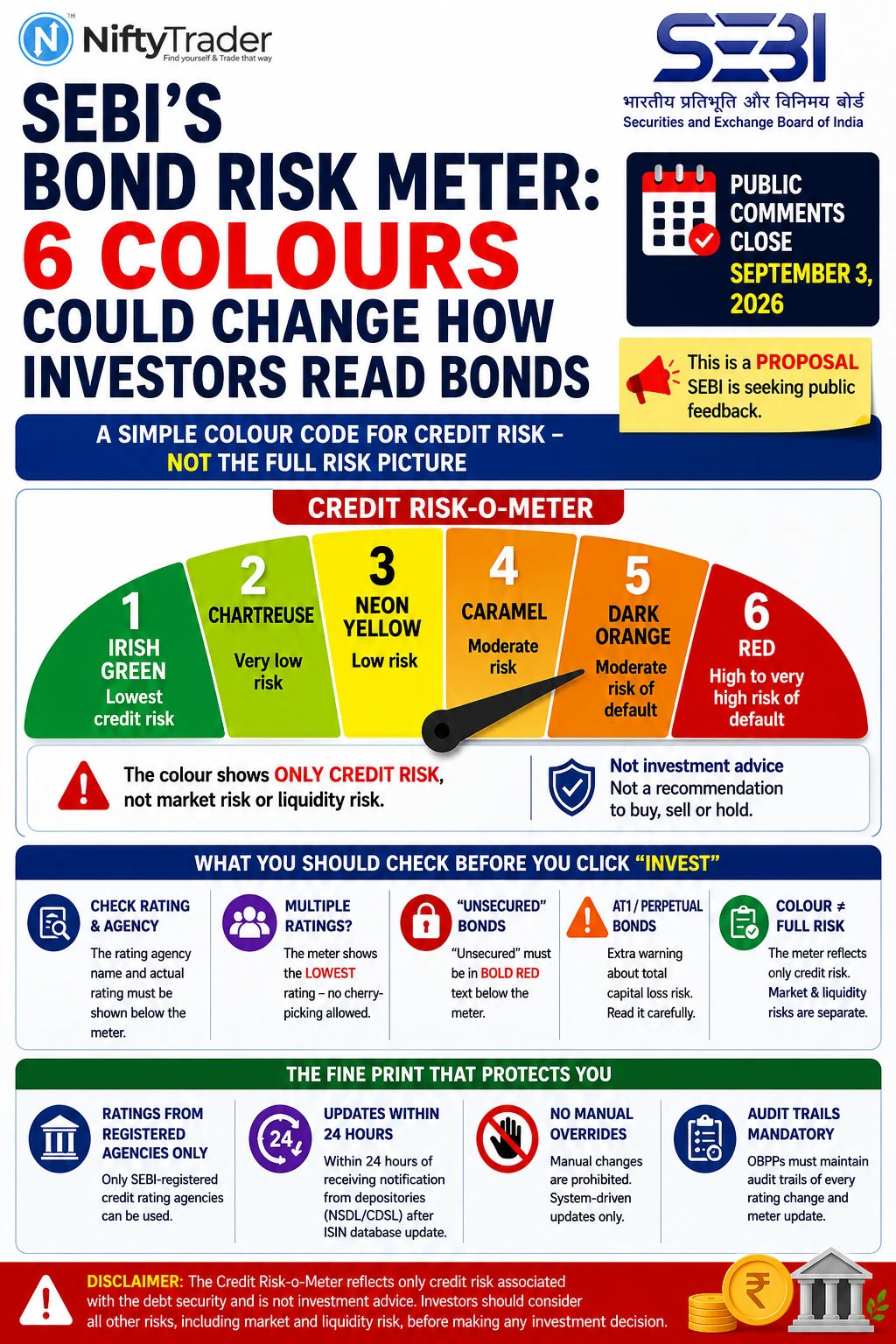
AAA to D vs SEBI’s New Colour Scale: What Changes for Investors
| Existing Rating (stays) | New Colour Layer (added) |
|---|---|
| AAA | Irish Green — Lowest credit risk |
| AA+, AA, AA- | Chartreuse — Very low risk |
| A+, A, A- | Neon Yellow — Low risk |
| BBB+, BBB, BBB- | Caramel — Moderate risk |
| BB+, BB, BB- | Dark Orange — Moderate risk of default |
| B+, B, B−, C+, C, C−, D | Red — High to very high risk of default |
The point: the letters aren’t going anywhere, the colour just sits on top of them, so you see the lowest credit risk to highest credit-default risk before you read the fine print.
Why SEBI Is Doing This Now
SEBI’s own reasoning is blunt: retail investors unfamiliar with fixed-income markets struggle with alphanumeric ratings. The proposal, born from market-participant suggestions, vetted by the OBPP working group, and deliberated by CoBoSAC, borrows the same visual logic already used for mutual funds.
Also Read: SEBI’s New FPI Rule Could Leave Brokers Holding
Where You’ll Actually See It
Issuers and Online Bond Platform Providers (OBPPs) must display the meter across covered debt securities on:
- Offer documents
- Abridged prospectuses
- Private Placement Memorandums
- Every advertisement
- OBPP web and mobile platforms — with a condensed version suitable for mobile interfaces
What You Should Check Before You Click “Invest”
- The rating agency name and actual rating must sit right below the meter — always check both, not just the colour.
- Multiple ratings on one bond? The meter shows the lowest one — the platform can’t cherry-pick the best rating to show you.
- “Unsecured” bonds must carry that word in bold red text below the meter — a visual red flag on top of the colour.
- AT1/perpetual bonds get an extra warning disclaimer about total capital loss risk, read it, don’t skip it.
- The colour is not investment advice. SEBI’s own mandated disclaimer states the meter reflects only credit risk and is not a recommendation to invest, market and liquidity risks sit outside what the colour shows you.
The Fine Print That Protects You
OBPPs can’t fudge this: ratings must come only from SEBI-registered agencies. The proposed system would be automated, with updates required within 24 hours of receiving notification of a rating change from the depositories following the corresponding ISIN database update, and manual overrides prohibited. Platforms must also maintain audit trails of every update.
Read Next: FIIs Cut HDFC Bank Stake. Why Are Smaller Banks Winning?
Frequently Asked Questions
What is SEBI’s Credit Risk-o-Meter?
A proposed mandatory colour scale — from Irish Green (lowest credit risk) to Red (highest risk of default) — displayed alongside existing AAA-to-D bond ratings to make credit risk easier to read visually.
Does the colour meter replace the credit rating?
No. SEBI calls it an “additional disclosure mechanism” — the CRA name and actual rating must still be shown in text below the meter.
By when can the public submit comments?
September 3, 2026, via SEBI’s online comment form.
Which bonds does this cover?
Non-Convertible Securities, Commercial Papers, Securitised Debt Instruments, Security Receipts, and Structured/Market-Linked Debentures — public issue or private placement.
Will this apply to bonds I already hold?
The consultation paper does not clearly state whether the proposed disclosure would extend to all existing outstanding securities, making this an implementation point to watch.
How fast must the colour update if a bond gets downgraded?
Within 24 hours of receiving notification of a rating change from the depositories, following the corresponding ISIN database update — no manual overrides allowed.
Does the colour meter tell you the full risk of a bond?
No. SEBI’s mandated disclaimer states the meter is based only on credit risk evaluation and does not constitute investment advice; it does not capture market or liquidity risk.
When does this take effect?
30 days after SEBI issues the final circular, following review of comments received by September 3, 2026.
Disclaimer: This article is for informational purposes only and is not investment advice. SEBI’s Credit Risk-o-Meter is a proposal and reflects credit risk only, not market or liquidity risk.