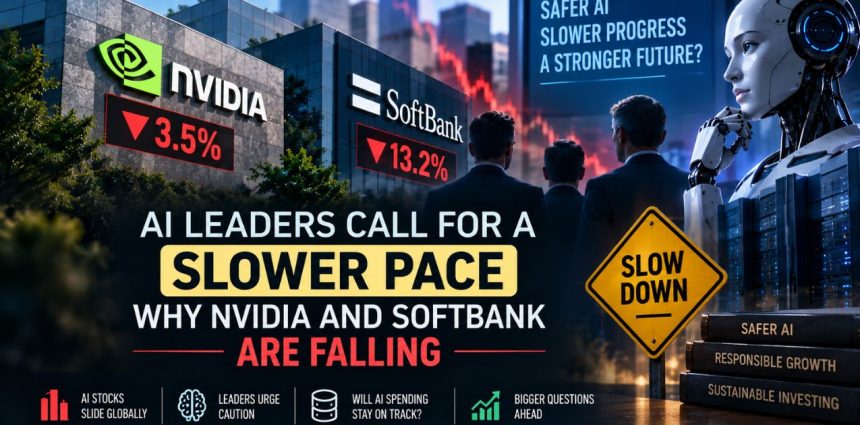
AI leaders calling for a slower pace of development sent AI-linked stocks tumbling across global markets on Monday, raising a new question for investors: what happens to the AI investment boom if the technology’s development starts moving more slowly than markets have assumed?
AI leaders calling for a slower pace of development sent AI-linked stocks tumbling across global markets on Monday after leading AI executives warned about the risks of rapid AI progress, raising a new question for investors: what happens to the AI investment boom if the technology’s development starts moving more slowly than markets have assumed?
The reaction was sharp. The Nasdaq 100 fell 1.7% in early trading, while the Philadelphia Semiconductor Index dropped about 6%. Nvidia declined 3.5%, AMD fell 5.6% and Micron dropped 6.7%. Semiconductor equipment makers Lam Research and Applied Materials lost about 8% and 7%, respectively.
The selling was not limited to the US. ASML fell 6.7% in Europe, while SoftBank plunged as much as 13.2% in Japan. South Korea’s SK Hynix and Taiwan Semiconductor Manufacturing Co. also declined as investors reassessed the future pace of AI-related demand.
But this is where the story becomes more complicated.
The market is reacting to a possible slowdown in AI development at a time when actual AI infrastructure spending remains extraordinarily strong.
Why AI Stocks Are Falling Now
The immediate trigger was an essay from Anthropic CEO Dario Amodei calling for the AI industry to pace the development of increasingly powerful models.
Amodei said AI capabilities are advancing rapidly and argued that development needs to be paced so safety measures can keep up. The comments added to a growing debate among AI leaders about the risks associated with increasingly powerful systems.
OpenAI CEO Sam Altman and xAI chief Elon Musk have also backed the need for greater caution around AI development, adding weight to the debate. Reuters reported that Altman also said OpenAI would not proceed with an IPO this year.
For investors, however, the concern is less about the technology debate itself and more about what a slower development cycle could eventually mean for AI spending.
Check Live: NiftyTrader: Live Options Analytics & F&O Trading Tools
The Market Is Questioning the AI Spending Machine
AI has become one of the biggest drivers of corporate capital expenditure.
That spending flows through the entire technology chain:
AI models → GPUs → memory → networking → data centres → electricity → cooling → semiconductor equipment.
If frontier AI development slows materially, investors may eventually ask whether companies still need to expand this infrastructure at the same pace.
That is why the sell-off has reached companies far beyond AI model developers.
| Segment | Stocks under pressure | Market concern |
|---|---|---|
| AI chips | Nvidia, AMD, Micron | Future compute demand |
| Memory | SK Hynix | High-bandwidth memory demand |
| Equipment | ASML, Lam Research, Applied Materials | Semiconductor capital expenditure |
| AI investment | SoftBank | Exposure to AI companies |
| Data-centre infrastructure | GE Vernova, Siemens Energy | Pace of infrastructure expansion |
Reuters reported losses across all these areas as investors reassessed the AI spending cycle.
But Nvidia’s Numbers Tell a Very Different Story
There is a major contradiction that investors cannot ignore.
Nvidia’s latest results show that AI demand has not suddenly disappeared.
The company reported fiscal second-quarter revenue of $96.2 billion, up 106% from a year earlier. Data Center revenue reached $89 billion, up 117% year-on-year.
That means Monday’s sell-off should not be interpreted as proof that current AI demand has collapsed.
Instead, the market is beginning to price a different possibility:
Could future AI spending grow more slowly than today’s valuations assume?
That distinction matters.
Nvidia can continue reporting extraordinary growth while its share price still falls if investors believe the growth rate will eventually moderate.
The $2 Trillion Question
Nvidia has previously highlighted enormous demand visibility across the AI infrastructure ecosystem, with its latest earnings discussion pointing to a cloud-industry backlog exceeding $2 trillion and extremely large planned capital expenditure by major hyperscalers.
The company has also maintained an exceptionally bullish long-term outlook, including an expectation for approximately 70% revenue growth in fiscal 2028.
That creates the biggest expectation gap in the current sell-off:
AI safety leaders are asking the industry to slow the pace of development, while the infrastructure industry is still preparing for years of aggressive AI expansion.
Until those two trends converge, markets are likely to remain sensitive to every major AI development.
SoftBank Shows How the Risk Is Spreading
SoftBank’s sharp decline is particularly important because the company is not simply another technology stock.
It is deeply exposed to the AI investment ecosystem.
The company’s links to OpenAI and other AI investments mean that a reassessment of AI valuations can affect SoftBank even if its underlying businesses are not directly selling AI chips.
Reuters reported that SoftBank fell as much as 13.2% in Monday’s trading.
That makes SoftBank a useful market signal.
The AI trade is no longer just about semiconductor companies.
It increasingly involves investment companies, private AI labs, cloud providers, data-centre operators and infrastructure financiers.
The Financing Risk May Be Bigger Than the Safety Debate
One of the most important details in the Reuters report is the role of financing.
AI companies are increasingly relying on debt and complex financing structures to fund the enormous infrastructure requirements of the sector, even as borrowing costs remain elevated.
That creates a forward-looking risk.
If AI demand continues accelerating, large infrastructure commitments can be absorbed by rapidly growing revenues.
But if demand growth slows while companies remain locked into long-term leases, debt obligations, energy contracts and data-centre commitments, the economics become more difficult.
Recent market commentary has similarly highlighted the risk that long-term infrastructure commitments could become burdensome if AI demand does not meet expectations.
This does not mean the AI financing structure is already in crisis.
It means the market is beginning to ask a question that was less important during the strongest phase of the AI rally:
How much future growth is already embedded in today’s infrastructure commitments and stock valuations?
Also Read: US Stocks Slip at open: Nasdaq Futures Down 1.5% as Oil Jumps Nearly 3%, AI Fears Weigh
BIS Adds Another Warning
The timing of Monday’s sell-off is also significant because the Bank for International Settlements has warned that the AI-driven market rally is showing signs of vulnerability.
Reuters reported that the BIS highlighted concerns about the long-term profitability of AI ventures, rising debt among major US technology companies and more than $1 trillion in aggregate tech-firm borrowing by 2025.
The BIS did not describe the market as being in immediate financial stress.
That distinction is important.
But rising borrowing costs combined with huge AI capital commitments could increase the sensitivity of AI-linked companies to any deterioration in expected growth.
OpenAI and Anthropic Are Sending Different Market Signals
Another unusual feature of Monday’s market reaction is what is happening around the major AI labs.
OpenAI is delaying its IPO, while Anthropic is reportedly continuing preparations for a public listing.
Reuters also reported that Nvidia is in talks to become an anchor investor in Anthropic’s potential IPO.
That creates a strange contradiction:
The AI industry is debating whether development should slow, yet capital is still being deployed aggressively into the companies building the technology.
For investors, this could become increasingly important if private-market valuations, public-market multiples and infrastructure spending begin moving in different directions.
Not Everyone Believes the AI Race Will Slow
The bearish interpretation is not universally accepted.
Reuters reported that some investors dismissed the safety warnings, while Deutsche Bank argued that the competitive race between companies and countries makes it difficult for major AI players to voluntarily step back while rivals continue advancing.
Morgan Stanley has previously projected that AI spending could exceed $1.2 trillion by 2027, highlighting the enormous scale of the investment cycle.
There is also a geopolitical reason for caution around any slowdown.
The US and China are competing aggressively for AI leadership. US President Donald Trump has rejected calls for a major slowdown and stressed the importance of maintaining US technological leadership. China has also criticised the idea of slowing AI development.
That makes an industry-wide voluntary slowdown difficult to achieve.
What Investors Should Watch Next
The next phase of the AI trade may depend less on individual safety statements and more on whether those statements begin changing corporate spending plans.
Investors should watch:
- Nvidia’s forward data-centre demand
- Hyperscaler AI capital expenditure
- HBM and semiconductor orders
- Data-centre construction commitments
- AI-company financing and debt issuance
- OpenAI and Anthropic funding or IPO developments
- Semiconductor equipment orders
- AI-related earnings guidance
If companies continue increasing capex, Monday’s sell-off could prove to be largely a valuation and sentiment reset.
But if major AI companies begin delaying data-centre projects, reducing chip orders or cutting infrastructure budgets, the market could face a much bigger reassessment.
The Bigger Market Question
Monday’s sell-off does not prove that the AI boom is over.
In fact, Nvidia’s latest results point in the opposite direction, with triple-digit Data Center growth and enormous future demand visibility.
What has changed is the risk being priced into the trade.
For the first time, the market is being forced to consider whether the pace of AI capability development, infrastructure investment and earnings growth can remain aligned.
That uncertainty matters because a large part of the global equity rally has increasingly depended on expectations of continued AI-driven productivity, earnings and capital expenditure.
The immediate question is not whether AI will stop. It is whether AI spending can continue accelerating at the rate investors have come to expect.
If the answer remains yes, Monday’s decline could eventually look like a sharp but temporary reset.
If the answer changes, the consequences could extend far beyond Nvidia and SoftBank.
Key Takeaways
- Global AI-linked stocks fell sharply after major AI leaders called for a slower pace of development.
- Nvidia fell 3.5%, while SoftBank dropped as much as 13.2% and ASML lost 6.7%.
- Nvidia’s latest results still show exceptionally strong AI demand, making this more of an expectations shock than evidence of an AI-demand collapse.
- Rising debt and infrastructure commitments create a potential risk if AI spending eventually slows.
- The next major market signal will be whether hyperscalers and AI companies actually change their capital-spending plans.
Read Next: JPMorgan’s Trading Ban Is Gone. So Why Is CAS Still Blocked?
Disclaimer
This article is for informational purposes only and does not constitute investment advice. Market prices can change rapidly, and investors should conduct their own research before making financial decisions.