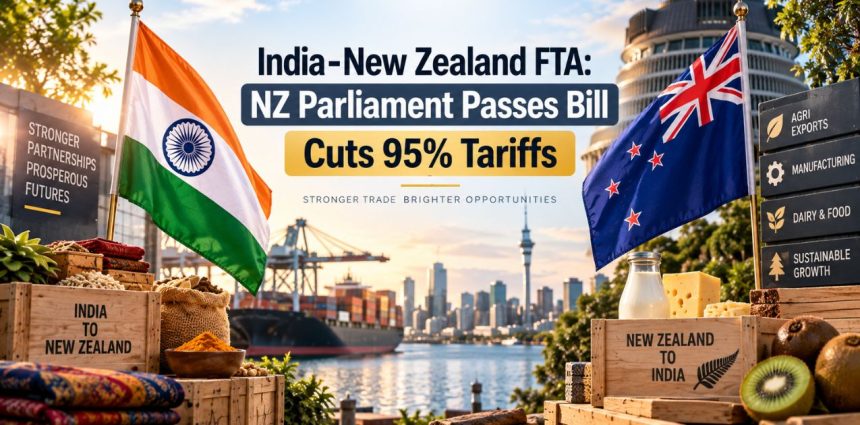
New Zealand’s Parliament passed legislation on Wednesday to implement its free trade agreement with India, clearing New Zealand’s side of a deal that eliminates or reduces tariffs on 95% of its exports to India by value.
The bill passed 93-29, but the vote, and the tariff headline, tell only part of the story. Buried in the treaty text are three things Indian exporters and investors should know before this India-New Zealand FTA is fully in force: dairy access that’s more limited than it first appears, though not the total shutout it’s often described as; a $20 billion private-investment pledge that New Zealand’s own outward-investment record makes hard to credit; and a domestic political fight that isn’t over.
What New Zealand’s Parliament Actually Passed
What Parliament approved on Wednesday was the third reading of the India Free Trade Agreement Legislation Amendment Bill, an omnibus bill numbered 327-2 steered through the House by Trade and Investment Minister Todd McClay.
The bill passed 93 votes to 29, with the governing National Party, the opposition Labour Party and the ACT Party voting in favour. “For exporters, the benefits are immediate and substantial,” McClay said in a statement, adding that the government expects the agreement “to enter into force this year.”
The agreement itself was signed months earlier, on 27 April 2026 in New Delhi, by India’s Commerce and Industry Minister Piyush Goyal and McClay, with Prime Minister Christopher Luxon present.
Wednesday’s vote completed New Zealand’s half of a two-track ratification process: New Zealand needed Parliament to pass enabling legislation, while India ratifies trade agreements through executive and Cabinet approval rather than a parliamentary vote.
Royal Assent, a formality, is expected to follow shortly, after which the Governor-General can set a commencement date by Order in Council once the FTA’s entry-into-force date is confirmed, according to the bill’s official disclosure statement.
Also Read: EU-India FTA Moves Closer to Signing: 7 Indian Sectors in Focus
Tariff Cuts at a Glance
| Category | New Zealand → India | India → New Zealand |
|---|---|---|
| Tariff lines opened | About 70% of India’s tariff lines | 100% of New Zealand’s tariff lines |
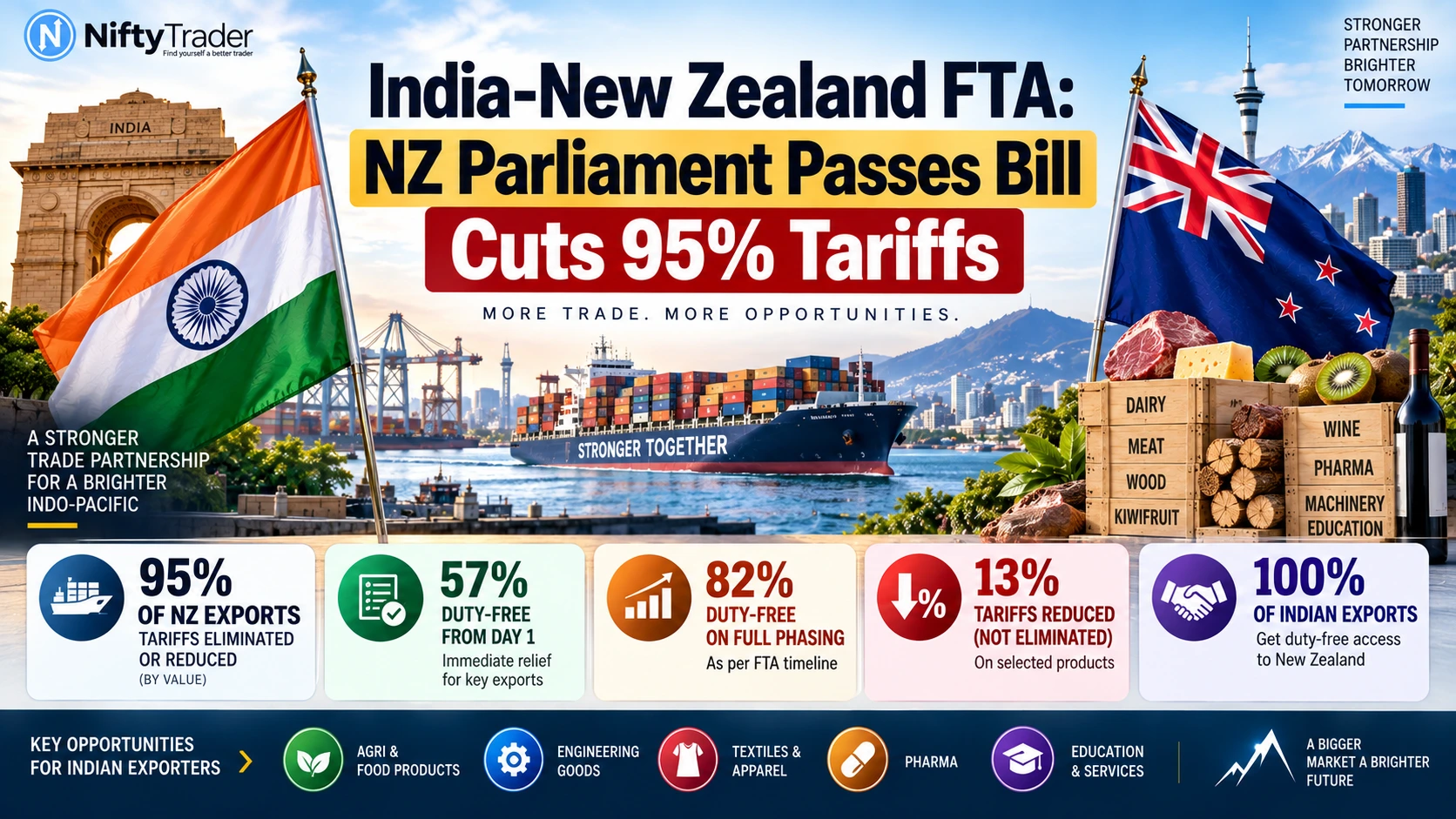
| Share of trade covered | About 95% of New Zealand’s exports by value | 100% of Indian exports |
| Duty-free from Day 1 | About 57% of exports | 100% of exports |
| Duty-free once fully phased in | About 82% of exports | 100% (already Day 1) |
| Remaining tariffs | About 13% see reduced, not eliminated, duties | None |
| Notable phased items | Kiwifruit (duty-free in-quota, 50% cut outside quota); apples (new quota — NZ’s first-ever preferential access in an Indian FTA); mānuka honey (in-quota tariff cut 75% over 5 years); wine (cut 66–83% over 10 years, from tariffs as high as 150% today); forestry (95%+ duty-free immediately, rest phased over 7 years); seafood (phased over 7 years) | None |
Sources: New Zealand Ministry of Foreign Affairs and Trade (Key Outcomes); Reuters.
New Zealand and India have set an aspirational goal, part of the New Zealand-India Strategic Partnership Roadmap 2030, agreed alongside PM Modi’s July 2026 Auckland visit, to double two-way trade to NZ$7 billion (about ₹35,000 crore) by 2030, according to MFAT. That’s against a base of NZ$3.99 billion (US$2.29 billion) in the year to June 2026, Reuters reported.
Also Read: US House Blocks India Tariff Bid: The 100% Threat Takes a Twist
The Fine Print: Dairy Is More Complicated Than “Excluded”
India has kept fresh dairy, milk, cream, cheese, yoghurt and butter outside the deal. New Zealand First leader Winston Peters points to that exclusion when he describes dairy as roughly 30% of New Zealand’s total goods exports left without reciprocal access.
But it isn’t a total blank: New Zealand’s trade ministry says tariffs on bulk infant formula, other dairy-based preparations and peptones will phase out over seven years, the in-quota tariff on albumins (a milk protein) is halved, and a new fast-track mechanism lets New Zealand dairy ingredients enter India duty-free for further manufacturing and re-export.
India has also committed to consulting New Zealand if it ever offers a comparable economy with better dairy terms in the future.
New Zealand’s apple, kiwifruit and mānuka honey quotas are new ground, too, MFAT says New Zealand is the first country to win preferential apple access and the first honey exporter to win preferential access in any Indian FTA.
But continued access comes with a catch flagged by critics: it depends on New Zealand funding and delivering “Action Plans” within five years designed to boost India’s own domestic production and quality of the same three products, reviewed every six months by a Joint Agriculture Productivity Council.
University of Auckland law professor emerita Jane Kelsey, in an analysis published on bilaterals.org, called this “a seeming own goal”, comparing it to New Zealand’s past export of kiwifruit vines to Chile, which became a competing supplier.
The US$20 Billion Question
Under the FTA’s Investment Cooperation and Promotion chapter, New Zealand has committed to “promote” investment into India with the aim of lifting private-sector investment by US$20 billion (roughly NZ$34 billion) over 15 years, a commitment that “applies only to private sector investment”, not government spending, according to MFAT’s own summary.
India will set up a dedicated “New Zealand Investment Desk” to help New Zealand investors, and the chapter sits outside the FTA’s normal dispute-settlement process, including investor-state dispute settlement, though MFAT confirms a separate “remedial” process applies if the target is missed.
The scale of that ambition looks harder to reach when set against New Zealand’s actual investment record.
Jane Kelsey’s analysis, citing Statistics New Zealand balance-of-payments data, notes that New Zealand’s total outward foreign direct investment to every country in the world totalled just NZ$1.463 billion in 2025 and averaged a net outflow of roughly minus NZ$28 million a year over the preceding decade.
Meeting a NZ$34 billion target aimed at India alone within 15 years would, she argues, require an unprecedented reversal of that pattern.
How the mechanism works and how it compares:
| India-New Zealand FTA | India-EFTA TEPA | |
|---|---|---|
| Private-sector investment goal | Up to US$20 billion over 15 years | US$100 billion over 15 years |
| Job creation target | Not specified | 1 million direct jobs |
| Review points | Years 5, 10 and 15, by consensus-based Investment Committee | Comparable structure |
| Flexibility if target missed | New Zealand may request a 3-year grace period, subject to India’s consent | Explicit 3-year grace period; target linked to a 9.5% Indian GDP-growth assumption |
| Remedy for India if unmet | May raise tariffs or suspend quotas as a “rebalancing” measure, via a remedial process outside normal dispute settlement | Comparable rebalancing mechanism |
| Status | Enabling legislation passed; entry into force expected around October 2026 | Already in force since October 2025 |
Sources: New Zealand Ministry of Foreign Affairs and Trade; Jane Kelsey/bilaterals.org treaty-text analysis; Angel One.
New Zealand’s own National Interest Analysis, using economic modelling from Motu Economic and Public Policy Research Trust, projects a net economic benefit overall, per the bill’s disclosure statement. But per Kelsey’s reading of that analysis, the modelled GDP gain by 2037 works out to just 0.07% of GDP, or about NZ$401 million, relative to a no-deal baseline.
Why 29 MPs Voted No
The 29 votes against came from New Zealand First, the Green Party, Te Pāti Māori, and independent MPs Tākuta Ferris and Mariameno Kapa-Kingi, per Interest.co.nz’s reporting on the bill’s first reading, where the same 93-29 split held.
New Zealand First, led by Foreign Minister Winston Peters, has been the most vocal opponent inside the governing coalition itself. Peters called the deal “neither free nor fair” when it was concluded in December 2025, arguing it “gives too much away, especially on immigration, and does not get enough in return for New Zealanders, including on dairy.”
His party invoked the coalition’s “agree to disagree” provision to formally register opposition while remaining in government.
Peters has also raised immigration as a separate flashpoint, alleging during the first reading that the government had “covertly” tightened immigration settings in a way that specifically targeted Indian applicants — a claim McClay rejected, telling reporters New Zealand First should “stop promoting misinformation for the sake of gaining votes”.
Because New Zealand First withheld support, the government needed Labour’s backing for a majority; Labour confirmed it would back the legislation about a week before the April 2026 signing.
What Changes in New Zealand Law
The enabling bill makes several concrete legal changes, per its official disclosure statement: it amends the Dairy Industry Restructuring Act 2001 to administer the albumin quota; raises the threshold above which Indian investors need Overseas Investment Office consent to buy “significant business assets” in New Zealand from NZ$100 million to NZ$200 million; adds a transitional safeguard mechanism to the Tariff Act 1988 letting New Zealand impose duties on Indian imports if an investigation finds serious injury to a domestic industry; and creates new rules-of-origin certification requirements under the Customs and Excise Act 2018.
It also creates strict-liability offences, fines up to NZ$200,000 for exporting under the quota system without a valid allocation or certificate, and up to NZ$10,000 for supplying false information to quota administrators.
On 14 September 2026, two days before the final vote, the bill was formally divided: the sections setting up quota-administration systems for apples, kiwifruit and mānuka honey were split into a separate bill at the Committee of the Whole House stage, standard procedure for omnibus legislation of this kind.
What It Means for Indian Exporters and Investors
For Indian businesses, market access into New Zealand is the more straightforward side: all Indian goods get duty-free entry from Day 1.
India’s Ministry of Commerce and Industry has flagged textiles, apparel, leather, footwear and handicrafts as the labour-intensive sectors expected to gain most, alongside engineering goods, marine products and auto components. India’s leather industry alone is projected, per industry estimates cited in Indian government messaging, to grow to US$50 billion by 2030.
On services, India has made commitments on almost 100 sub-sectors above its existing WTO obligations, plus a Most Favoured Nation commitment that automatically extends any future improvements India grants other FTA partners, according to MFAT. Sectors of interest to New Zealand include engineering, environmental services, education, and audio-visual services.
Pharmaceutical and medical-device exporters get reduced regulatory duplication under dedicated annexes, and New Zealand has agreed, under a side letter, to review its Geographical Indication protections with a view to matching EU-level protection for Indian names, a review starting on signature and due to complete within six months of entry into force, with a public consultation process included.
Check Live: Participant Wise OI — FII, DII, Client, Pro Positions Today
Mobility pathways for Indian professionals:
| Pathway | Volume | Duration | Who it covers |
|---|---|---|---|
| Temporary Employment Entry (TEE) visa | 1,667 visas/year, capped at 5,000 holders at any time — 1,467/year for 13 skill-shortage occupations on Immigration NZ’s “Green List,” 200/year for “iconic” Indian occupations | Up to 3 years | IT, engineering, healthcare, construction and other Green List trades; plus yoga, music, culinary and Ayurvedic (AYUSH) professionals |
| Working Holiday Scheme | Up to 1,000 places/year | 12 months, multiple entry | Ages 18–30 |
| Student work rights | Uncapped | 20 hrs/week while enrolled | International students |
| Post-study work visa | Uncapped | 2 years (bachelor’s) up to 4 years (PhD) | Graduates of NZ institutions |
Source: New Zealand Ministry of Foreign Affairs and Trade (Key Outcomes).
Early Signs: The “Halo Effect” Before the Deal Even Takes Effect
New Zealand’s government says exporters are already benefiting from anticipation of the deal.
McClay’s office said in July 2026 that apple export volumes to India had jumped 63% versus the 2024 season, from 27,000 tonnes to 45,000 tonnes with the season still underway, and that India had climbed from New Zealand’s seventh-largest apple export market to its fourth-largest within two years.
Both governments have also agreed to formally review the FTA one year after it enters into force, McClay said when the deal was concluded, a checkpoint that would fall in late 2027 on the expected October 2026 start date, around the same time as the first progress reviews of the kiwifruit and apple Action Plans.
Timeline: From Negotiation to (Almost) Force
| Date | Milestone |
|---|---|
| March 2025 | Formal negotiations launch during PM Luxon’s visit to India |
| 22 December 2025 | Negotiations conclude; New Zealand First confirms it will oppose enabling legislation |
| 27 April 2026 | FTA formally signed in New Delhi |
| 21 June 2026 | Enabling bill introduced; passes first reading 93-29 |
| 24 June–18 July 2026 | Bill referred to Foreign Affairs, Defence and Trade Select Committee |
| 10–11 July 2026 | PM Modi visits Auckland; NZ-India Strategic Partnership agreed |
| 14 September 2026 | Bill formally divided; TRQ provisions split into a separate bill |
| 16 September 2026 | Third reading passes 93-29 |
| ~October 2026 (expected) | FTA enters into force |
Sectors to Watch
- Textile, apparel and leather exporters positioned for duty-free access to a developed Pacific market
- Engineering goods and auto component manufacturers named in India’s official trade-gain summaries
- Marine and seafood processors covered under the same duty-free access
- Pharmaceutical and medical-device exporters gaining reduced regulatory duplication
- IT and professional services firms with New Zealand-facing operations
- New Zealand-facing dairy exporters, bulk infant formula, dairy preparations and albumins get partial relief, but fresh dairy stays shut out
- New Zealand wine, kiwifruit and honey exporters, whose gains are phased and, in three cases, tied to delivering capacity-building commitments to India
Key Takeaways
- New Zealand’s Parliament passed the India-New Zealand FTA’s enabling legislation 93-29; National, Labour and ACT in favour, New Zealand First, the Greens, Te Pāti Māori and two independents opposed.
- Tariffs fall on 95% of New Zealand’s exports to India by value; 57% duty-free immediately, rising to 82% over time.
- All Indian exports get 100% duty-free access to New Zealand from Day 1.
- Fresh dairy stays excluded, though infant formula, dairy preparations and albumins get partial, phased relief.
- New Zealand has pledged to promote up to US$20 billion in private-sector investment into India over 15 years; missing that goal lets India raise tariffs or suspend quotas.
- Up to 5,000 Indian professionals can work in New Zealand at any time, plus 1,000 working-holiday visas annually.
- The deal is expected to enter into force around October 2026, with a formal review a year later.
Read Next: Reliance Raises ₹12,500 Crore as Banks Seek New Ways to Deploy Cash
This article is for informational purposes only and does not constitute investment advice. NiftyTrader Desk is not a SEBI-registered investment adviser. Readers should consult a qualified financial adviser before making decisions based on developments in trade policy.