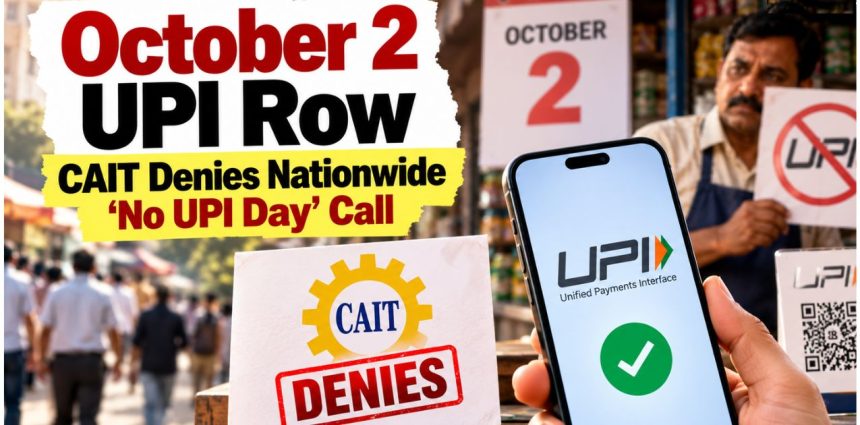
CAIT has denied calling for a nationwide “No UPI Day” on October 2, even as regional trader groups protest the new 0.4% MDR on eligible high-value UPI merchant payments.
Need to Know
- The Confederation of All India Traders, or CAIT, has denied reports that it announced or endorsed a nationwide “No UPI Day” on October 2. CAIT said it did not take a decision or pass a resolution for such a programme.
- Trader groups in Madhya Pradesh observed a “No UPI Day” protest on September 23, although participation was not uniform across markets. Local protests do not mean that UPI will stop working nationwide.
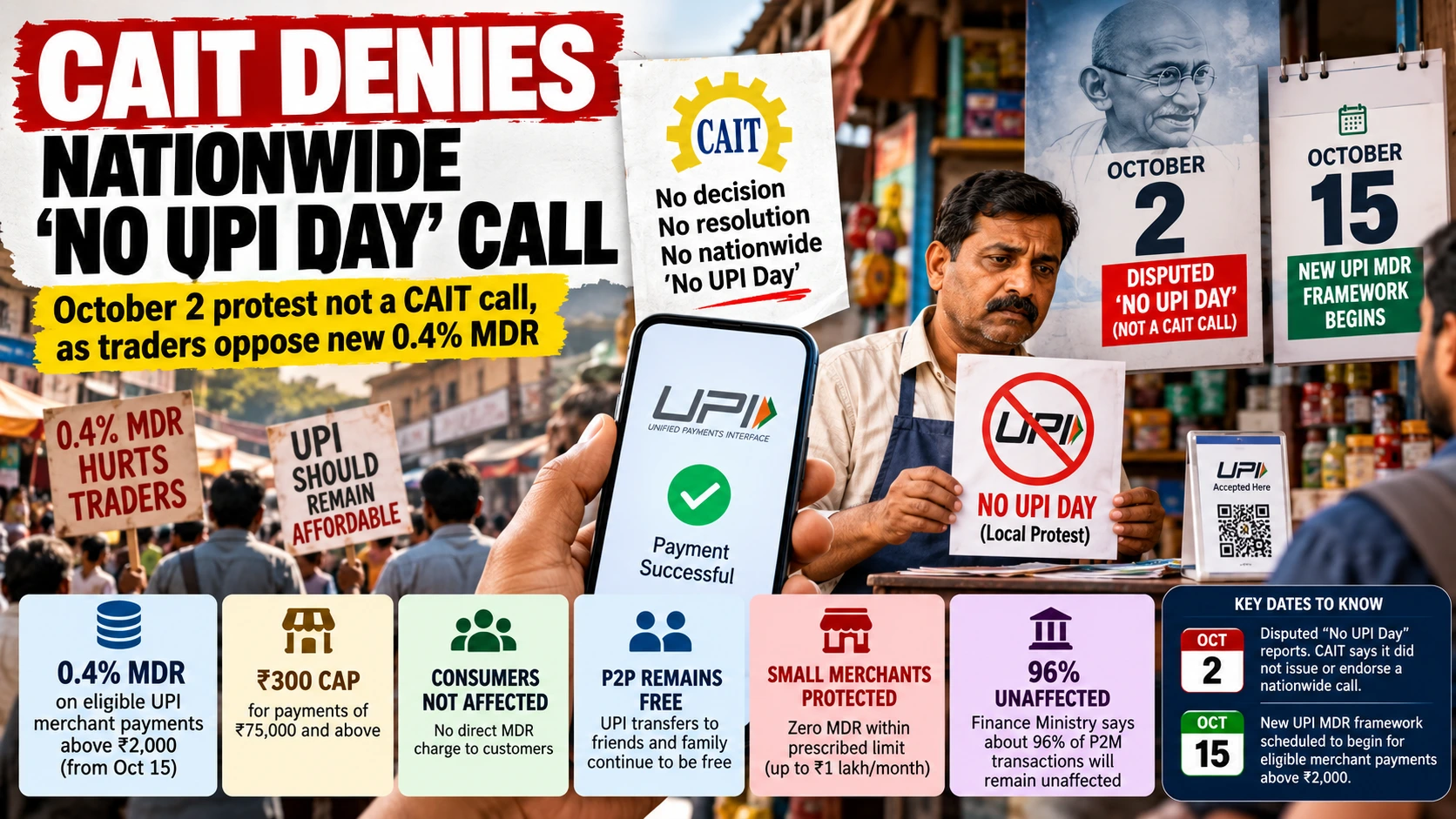
- The new UPI Merchant Discount Rate, or MDR, framework is scheduled to begin on October 15, 2026. A 0.4% MDR will apply to eligible person-to-merchant, or P2M, UPI transactions above ₹2,000, with the standard charge capped at ₹300 for payments of ₹75,000 and above.
- Consumers will not pay MDR directly under the announced framework. MDR is a merchant-side payment-processing charge, and banks have been advised to ensure that merchants do not pass it on to customers.
- The Finance Ministry said about 96% of P2M transactions will remain unaffected by the MDR framework, while all person-to-person, or P2P, UPI transactions remain free.
TRACK LIVE: NSE Option Chain Live — Nifty, Bank Nifty & All F&O Stocks for users tracking market sentiment around fintech, banking and payments-sector stocks.
CAIT denies nationwide ‘No UPI Day’ call
The Confederation of All India Traders has denied calling for or endorsing a nationwide “No UPI Day” on October 2, pushing back against reports and social-media messages that suggested an all-India trader-led UPI boycott.
CAIT said it had not taken any decision or passed any resolution to observe October 2 as a “No UPI Day.” It also said that campaigns, protests or programmes announced independently by regional trade bodies and other associations should not be attributed to CAIT.
The clarification materially changes the story around October 2.
The viral version suggested a nationwide trader-led boycott of UPI backed by CAIT. The confirmed position is narrower: individual trader groups or regional associations may organise protests, but CAIT says it has not issued a national call for merchants to stop accepting UPI.
For consumers, this means there is no confirmed nationwide UPI shutdown on October 2. The UPI network itself is not scheduled to be turned off. However, individual shops or local market associations may choose to prefer cash or another payment method during local demonstrations.
What is happening on the ground?
The protest against the new UPI MDR framework is real, but it should not be confused with a CAIT-led nationwide campaign.
Trader groups in Madhya Pradesh observed a “No UPI Day” protest on September 23, although participation was not uniform across markets. Some participating businesses covered QR codes and encouraged customers to pay in cash, but the protest did not amount to a nationwide interruption of UPI services.
The distinction is important.
A local decision by a merchant association not to accept UPI temporarily is not the same as:
- A nationwide trader strike
- A CAIT-backed boycott
- A technical outage of UPI
- A government order suspending UPI payments
Consumers may encounter individual merchants requesting cash or another payment method, particularly in markets where a local protest has been announced. But there is no confirmed basis to say that UPI will stop functioning across India on October 2.
Why are traders protesting the new UPI MDR framework?
The immediate issue is the Merchant Discount Rate, or MDR.
MDR is a payment-processing charge paid by merchants for accepting certain digital payments. Under the new UPI MDR framework, eligible person-to-merchant UPI transactions above ₹2,000 will attract a 0.4% MDR from October 15, 2026. For standard eligible transactions of ₹75,000 or more, the MDR is capped at ₹300 per transaction.
The policy is intended to create a more sustainable payment ecosystem. The government has said that payment infrastructure requires continuing investment in technology, cybersecurity, fraud prevention, customer support and payment-system resilience.
Merchant groups, however, are concerned that even a relatively low fee can affect businesses that handle frequent high-value payments or operate on thin profit margins.
UPI MDR framework from October 15
| UPI payment type | MDR treatment |
|---|---|
| Person-to-person, or P2P, transfer | ₹0 |
| Merchant payment up to ₹2,000 | ₹0 |
| Eligible standard P2M payment above ₹2,000 | 0.4% |
| Eligible standard P2M: ₹75,000+ | Maximum ₹300 |
| Eligible small P2PM merchant | Zero MDR within the prescribed limit |
| Capital-market payments | 0.02%, capped at ₹300 |
| Railways, telecom, insurance, fuel and specified categories | Flat ₹5 on eligible transactions above ₹2,000 |
The key phrase is eligible P2M transactions. Not every UPI payment above ₹2,000 will necessarily attract the standard 0.4% MDR because the framework includes category-specific rates and protections for eligible small merchants.
Do consumers have to pay UPI MDR?
Consumers will not pay MDR directly under the announced framework.
MDR is a charge within the merchant payment ecosystem, not a charge on customers. Banks have been advised to ensure that merchants do not pass the charge on to customers. UPI users should not be asked to pay a separate platform fee simply for making an eligible payment through a UPI app.
P2P transactions, including payments to friends, family members and personal bank accounts, remain free. Merchant payments up to ₹2,000 also remain free under the standard framework.
The Finance Ministry said about 96% of P2M transactions will remain unaffected by the new MDR framework, while all P2P UPI transactions remain free.
For example, a customer paying ₹1,500 at a shop through UPI should not face a new payment fee merely because the new MDR framework starts on October 15.
The charge is concentrated on eligible higher-value merchant payments.
A ₹10,000 UPI payment could cost the merchant ₹40
At the standard 0.4% MDR rate, the arithmetic is straightforward.
| Eligible payment value | Standard MDR at 0.4% |
|---|---|
| ₹3,000 | ₹12 |
| ₹5,000 | ₹20 |
| ₹10,000 | ₹40 |
| ₹25,000 | ₹100 |
| ₹50,000 | ₹200 |
| ₹75,000 | ₹300 |
| ₹1,00,000 | ₹300 cap |
For a merchant processing ten eligible UPI payments of ₹10,000 each in a day, the MDR could amount to ₹400 daily. Over a 30-day period, that would be ₹12,000, assuming the same payment pattern continues.
That does not mean every merchant will stop accepting UPI. Many businesses may continue accepting payments without any change. But the policy could influence payment preferences among merchants that process large transaction values, operate on thin margins or receive a substantial share of their revenue through digital collections.
The ₹2,000 UPI MDR debate has another layer: 18% GST
The MDR itself is not the only cost merchants are examining. An 18% Goods and Services Tax, or GST, applies to the MDR charge on eligible UPI merchant transactions.
For a ₹10,000 eligible UPI payment, the standard MDR at 0.4% would be ₹40. GST at 18% on that MDR would be ₹7.20. The upfront MDR-related outlay would therefore be ₹47.20.
| Eligible UPI payment | MDR at 0.4% | GST at 18% on MDR | Upfront MDR-related outlay |
|---|---|---|---|
| ₹3,000 | ₹12 | ₹2.16 | ₹14.16 |
| ₹5,000 | ₹20 | ₹3.60 | ₹23.60 |
| ₹10,000 | ₹40 | ₹7.20 | ₹47.20 |
| ₹25,000 | ₹100 | ₹18 | ₹118 |
| ₹50,000 | ₹200 | ₹36 | ₹236 |
| ₹75,000 or above | ₹300 cap | ₹54 | ₹354 |
NPCI has said GST-registered businesses can generally claim eligible input tax credit, or ITC, for GST paid on MDR, allowing that tax component to be set off against their output GST liability, subject to normal GST rules and eligibility conditions.
The position is more complicated for merchants who receive more than ₹1 lakh per month through UPI and therefore do not qualify for the small-merchant zero-MDR protection but whose annual turnover remains below the GST registration threshold. Such unregistered businesses may not be able to claim ITC on GST paid on MDR.
The Indian Express reported that government sources acknowledged this group could face an unrecoverable GST cost, with the issue potentially requiring further policy consideration.
This creates a genuine implementation question before October 15. While MDR applies only to eligible higher-value P2M payments, the effective cost can differ based on merchant classification, GST registration status and ability to claim input tax credit.
ALSO READ: UPI Fee Confusion Cleared: Government Clarifies Rs 2,000 Rule for Millions of Users
The MDR rate is not the same for every sector
It would be inaccurate to say that “UPI will now cost 0.4%” across all payments.
The 0.4% rate applies to eligible standard P2M transactions above ₹2,000. The framework provides different treatment for particular sectors, eligible small merchants and specific transaction types.
Category-wise UPI MDR structure
| Category | MDR on eligible transactions |
|---|---|
| Standard P2M payment above ₹2,000 | 0.4% |
| Standard P2M payment of ₹75,000 or above | ₹300 maximum |
| P2P UPI transfer | Free |
| P2M UPI payment up to ₹2,000 | Free |
| Eligible small P2PM merchant | Zero MDR within prescribed limit |
| Capital-market payments | 0.02%, capped at ₹300 |
| Railways, telecom, insurance, fuel and specified categories | Flat ₹5 for transactions above ₹2,000 |
The official framework identifies different MDR rates for sectors such as railways, telecom, insurance, fuel and agricultural inputs. It also applies a lower 0.02% MDR, subject to a ₹300 cap, to eligible capital-market transactions.
This makes the new UPI MDR framework more nuanced than a blanket 0.4% charge across all payments.
Small merchants receive separate protection
One of the most important policy details for smaller businesses is the zero-MDR protection available under the person-to-person-merchant, or P2PM, category.
Eligible small merchants receiving up to ₹1 lakh per month through UPI QR-code collections under the specified P2PM structure can continue with zero MDR. The policy is intended to protect many neighbourhood retailers, street vendors and smaller businesses from additional digital-payment acceptance costs.
A merchant may move from the P2PM category to the standard P2M framework if the prescribed monthly receipt threshold is crossed consistently, as set out in the official framework. Merchants should verify their classification directly with their acquiring bank, QR-code provider or payment service provider instead of relying on forwarded social-media messages.
The government has also proposed a dedicated support mechanism aimed at encouraging UPI acceptance and merchant onboarding among smaller businesses and in underserved regions. The detailed structure is expected to be finalised in consultation with the Reserve Bank of India.
Who decided the new UPI MDR?
Finance Minister Nirmala Sitharaman has said the decision to introduce MDR on specified high-value UPI merchant payments was taken professionally within the payment ecosystem and was not imposed by the government.
Speaking to PTI on September 25, Sitharaman said the decision was taken jointly by the National Payments Corporation of India, payment banks and merchant banks. She also rejected allegations that the policy had been driven by external pressure.
Sitharaman said the MDR is not a tax, cess or surcharge collected by the government. Instead, it is an ecosystem charge intended to support entities involved in processing digital payments, including banks, payment gateways, UPI applications and sponsoring banks.
The distinction does not change the practical impact for merchants: eligible transactions above ₹2,000 will still attract MDR from October 15. But it clarifies the government’s position that the fee is intended as a payments-infrastructure revenue mechanism rather than a government levy.
Why October 2 matters even though MDR starts October 15
The reported October 2 “No UPI Day” campaign falls 13 days before the new UPI MDR framework is scheduled to begin.
That means any action on October 2 would be a protest against an upcoming policy, not a response to MDR already being deducted from merchant settlements.
The timing has created an expectation gap.
Some consumers may interpret “No UPI Day” as meaning that UPI will stop working nationally. The policy issue is different: eligible higher-value merchant transactions are scheduled to attract MDR from October 15, while UPI continues to operate as a national payment network.
CAIT’s clarification is significant because it separates the actual policy change from the broader protest narrative circulating online.
Why investors are watching the UPI MDR shift
The new UPI MDR framework could change the economics of India’s digital-payments sector, particularly for the largest UPI applications and payment-service providers.
Reuters reported that PhonePe and Google Pay together accounted for about 80% of UPI payment value in August. Brokerage Bernstein estimates that the new fee pool could generate up to $1.1 billion in annual revenue for payment applications by March 2028. Based on their current share, PhonePe and Google Pay could receive roughly $900 million of that potential revenue pool.
The shift may strengthen the largest players because they already process a dominant share of UPI payment value and have the scale to expand merchant services, deepen distribution and invest in payment infrastructure.
For smaller payment providers, the MDR framework could increase competition for high-value transactions, where the potential revenue per payment is higher. Reuters reported that the policy may reinforce market concentration even as it creates new revenue opportunities within the payments ecosystem.
For merchants, the outcome could look different. Although the framework says MDR should not be separately passed on to customers, industry participants expect possible indirect effects through merchant payment preferences, settlement terms or broader pricing decisions. The scale of any such shift remains uncertain.
ALSO CHECK: FII DII Data Today: NSE/BSE Cash & F&O Activity
UPI is too large for this to be only about one day
The MDR debate has attracted intense attention because UPI now operates at enormous scale.
The Department of Financial Services has said UPI processed 2,451 crore transactions worth ₹29.9 lakh crore in August 2026, underlining the scale of the infrastructure that banks, payment-service providers and technology companies need to support.
UPI is used for everything from small daily purchases to large merchant payments. As volumes rise, the economics of the system become increasingly important for banks, fintech companies, UPI applications, payment aggregators and merchants.
The policy question is bigger than October 2:
Can India create a sustainable merchant-funded revenue model for larger digital payments without weakening the ease, affordability and widespread merchant acceptance that helped UPI grow?
The government’s position is that MDR will help support payment infrastructure, technology, fraud prevention and system security. Merchant groups are focused on whether the cost of accepting larger digital payments will pressure already-thin business margins.
CAIT vs ‘No UPI Day’: what is confirmed?
| Claim or development | Current position |
|---|---|
| CAIT called for a nationwide No UPI Day on October 2 | Denied by CAIT |
| CAIT passed a resolution for an October 2 boycott | CAIT says no |
| Some trader groups have protested the new UPI MDR framework | Yes |
| UPI will stop working nationwide on October 2 | No confirmed basis |
| New MDR framework begins October 15 | Yes |
| Standard MDR is 0.4% on eligible P2M payments above ₹2,000 | Yes |
| Standard MDR is capped at ₹300 for eligible payments of ₹75,000 and above | Yes |
| Consumers directly pay MDR | No |
| P2P UPI transactions remain free | Yes |
| Eligible small merchants can receive zero-MDR protection | Yes |
| Local merchants may choose to participate in protests | Possible, depending on local trade associations |
CAIT’s position is clear: it has not called for or endorsed a nationwide “No UPI Day” on October 2.
What UPI users should know before October 2
There is no confirmed nationwide UPI shutdown connected to CAIT’s clarification.
Consumers visiting markets or shopping areas where local trader groups have announced demonstrations may still find some merchants requesting cash or another payment method. That would be a local merchant-level decision, not a failure or suspension of the UPI network.
The more substantive policy change comes on October 15, when the new UPI MDR framework is scheduled to begin for eligible higher-value merchant payments.
October 2 vs October 15
| Date or issue | What it means |
|---|---|
| October 2 | Date linked to disputed “No UPI Day” reports. CAIT says it did not issue or endorse a nationwide call |
| October 15 | Scheduled start of the new UPI MDR framework for eligible P2M transactions above ₹2,000 |
| For consumers | UPI remains free under the announced framework, with no direct MDR charge |
| For merchants | Eligible higher-value transactions may attract MDR depending on merchant type, sector and transaction category |
What happens next?
The immediate date to watch is October 15, when the new UPI MDR framework is scheduled to begin for eligible merchant payments above ₹2,000.
The larger test will be whether merchants continue accepting higher-value UPI payments without changing their payment preferences and whether GST treatment, merchant classification and sector-specific questions are resolved without creating additional friction.
CAIT’s denial means there is no confirmed nationwide UPI shutdown on October 2. But regional protests, merchant concerns over MDR and the digital-payments industry’s response to the new revenue model will remain in focus well beyond that date.
Read Next: India H2 FY27 Borrowing Plan: ₹7.86 Lakh Crore, ₹15,000 Crore Green Bonds
Disclaimer: This article is based on publicly available information and official statements available at the time of publication. UPI rules, MDR details and trader-group actions may change as further clarifications are issued.