The US has set a zero tariff on a defined set of specialty drugs from India and 19 other jurisdictions, even as its 100% pharmaceutical duty began applying to more companies on September 29.
Pharma stocks gained while the broader market fell. But the relief is narrower than the headline suggests, and the question that matters for investors is how much of each Indian drugmaker’s US portfolio sits inside the exempt categories.
The Commerce Department’s Bureau of Industry and Security (BIS) defined the eligible products and listed India among 20 eligible jurisdictions in a notice published in the Federal Register on September 23 (91 FR 60360).
How the 100% Pharma Tariff Works
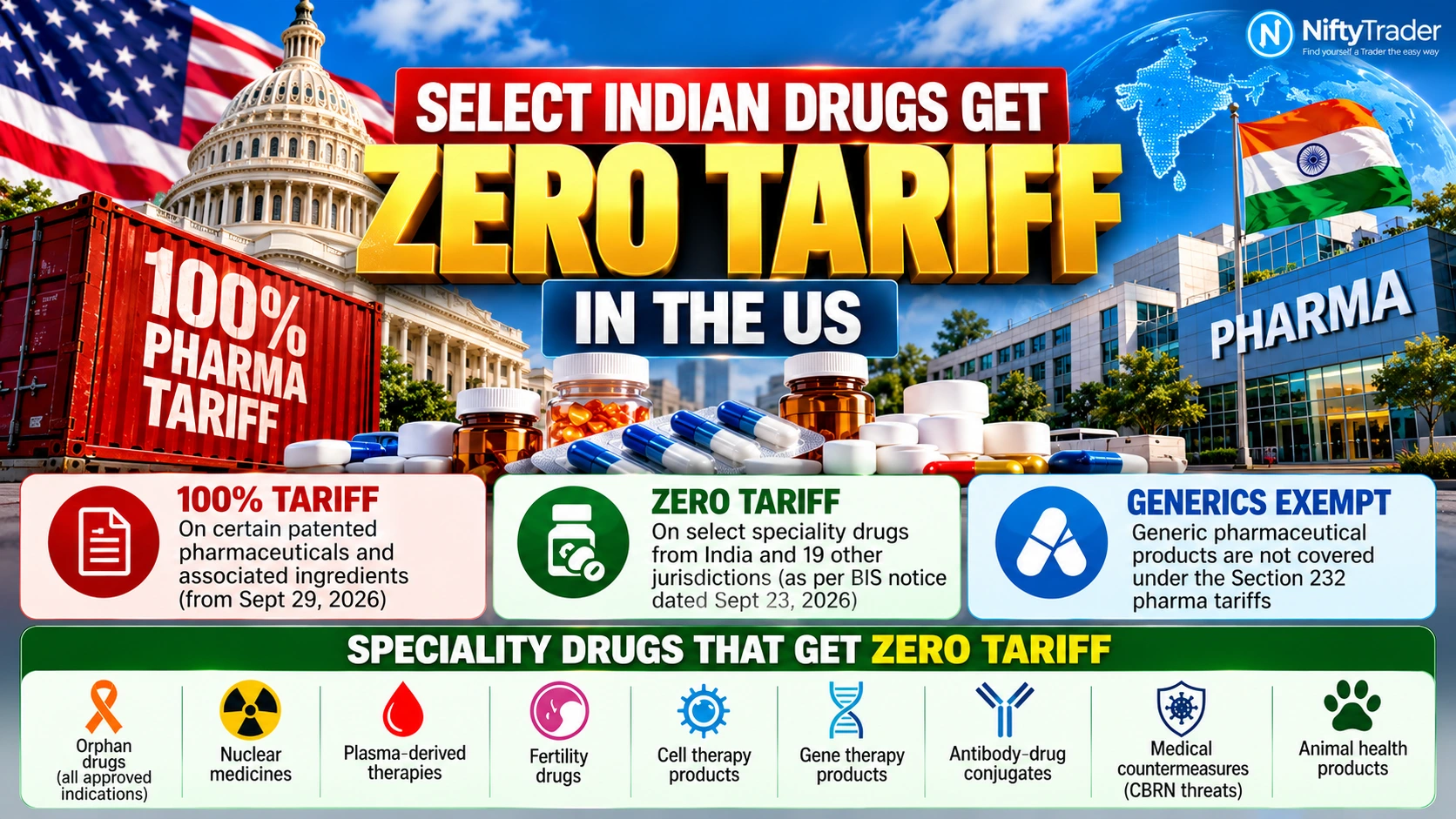
Proclamation 11020, issued on April 2, 2026, imposed a 100% ad valorem tariff under Section 232 of the Trade Expansion Act on certain patented pharmaceuticals and associated ingredients.
According to the BIS notice, it took effect on July 31 for companies listed in Annexe III of the proclamation and on September 29 for all other companies. Lower rates apply to products from certain jurisdictions and to companies with Commerce-approved onshoring agreements.
Which Specialty Drugs Get Zero Tariff
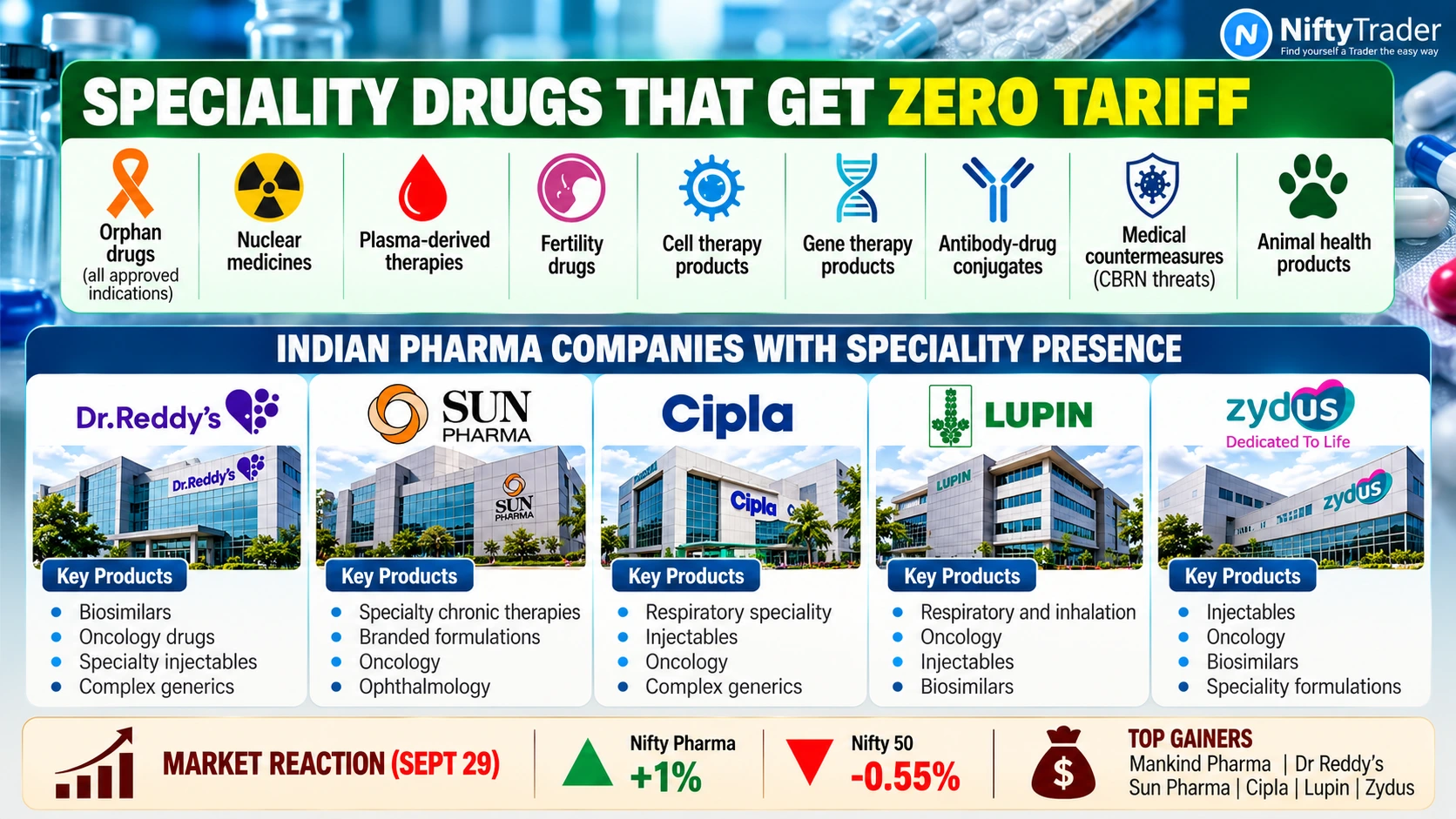
The zero rate covers drugs and ingredients where all approved indications are designated orphan, nuclear medicines, plasma-derived therapies, fertility drugs, cell therapy products, gene therapy products, antibody-drug conjugates, medical countermeasures for chemical, biological, radiological and nuclear threats, and animal health products.
A product qualifies through one of two routes, the notice says: it comes from a jurisdiction with a current or forthcoming trade and security framework agreement with the US, or Commerce determines it meets an urgent US health need.
Besides India, the eligible jurisdictions are Argentina, Bangladesh, Cambodia, Ecuador, El Salvador, the European Union, Guatemala, Indonesia, Japan, Jordan, Malaysia, North Macedonia, South Korea, Switzerland, Liechtenstein, Taiwan, Thailand, the United Kingdom and Vietnam. The notice says changes to the list may be published in a future notice.
Generics Remain Outside The Tariff Regime
Business Standard reported that the Commerce notice says generic pharmaceutical products and their associated ingredients are not covered by the Section 232 pharmaceutical tariffs. Generics are therefore not currently subject to the duty.
Why The Impact On Indian Drugmakers Is Narrower Than It Looks
The US is India’s largest pharma export market. Shipments there fell nearly 10% year on year to $9.47 billion in FY26, over 30% of total pharma exports, Business Standard reported, citing Pharmexcil data compiled from DGCI&S figures. Indian drugmakers also supplied nearly half of US generic prescriptions in 2022, according to IQVIA data cited by Reuters.
Because generics already sit outside the tariff, the exemption matters for the narrower set of Indian-made specialty products within its scope, not for the bulk of the US generics business.
How Pharma Stocks Moved On September 29
Pharma outperformed a falling market. Business Standard reported in the morning trade that the Nifty Pharma index rose more than 1% while the Nifty 50 fell about 0.55%. Upstox, citing NSE data, put the index’s intraday high at 27,032.40, up 1.01%. Moneycontrol later showed it up at 0.6%.
Moneycontrol reported that Dr Reddy’s Laboratories rose more than 2% to a one-month high of ₹1,247.70, heading for a third straight session of gains and up nearly 4% over the period. Mankind Pharma gained more than 4.5% and was the top gainer across the Nifty 200 and Nifty 500.
Sun Pharma rose nearly 1% and Cipla 0.3%. Lupin and Zydus Lifesciences also traded higher in early trade, Business Upturn data showed.
The exemption was not the only supportive factor. Business Standard quoted an analyst who also pointed to a weak rupee and fewer regulatory warning letters. Business Today noted the Nifty Pharma index is up about 18% this year, while the Sensex is down about 13%.
Dr Reddy’s, Lupin And Zydus: What To Check
Moneycontrol named all three as companies expected to benefit because of their specialty pharmaceutical presence.
The notice defines product categories, not companies, so the earnings effect depends on three company-level facts: which of their US products fall in the exempt categories, how much revenue those products generate, and whether they would otherwise have faced the 100% duty.
The uneven intraday moves across pharma stocks underline that the tariff treatment will not affect every company in the same way.
What To Watch Next
Company commentary on qualifying products and the US revenue mix, in upcoming results and earnings calls, is the first test. The BIS notice also lets companies submit product-specific requests for zero-tariff treatment on urgent US health need grounds on an ongoing basis from September 23, and says the eligible jurisdiction list may change in a future notice.
For broader market context, track institutional flows on NiftyTrader’s FII-DII Tracker: https://niftytrader.in/fii-dii-data
Bottom Line
The 100% tariff is the headline, but the exemption is product-specific: zero duty for defined specialty categories from eligible jurisdictions, with generics already outside the regime. For Indian drugmakers, the impact will vary with how much of the US portfolio falls in the exempt categories, and company disclosures will settle that.
Read Next: India Forex Reserves: BNP Flags $127 Billion FCNR Reversal Risk
Disclaimer: This article is for informational purposes only and does not constitute investment advice. NiftyTrader is a SEBI-registered platform. Market prices change rapidly. Verify company disclosures and regulatory notices before making investment decisions.