
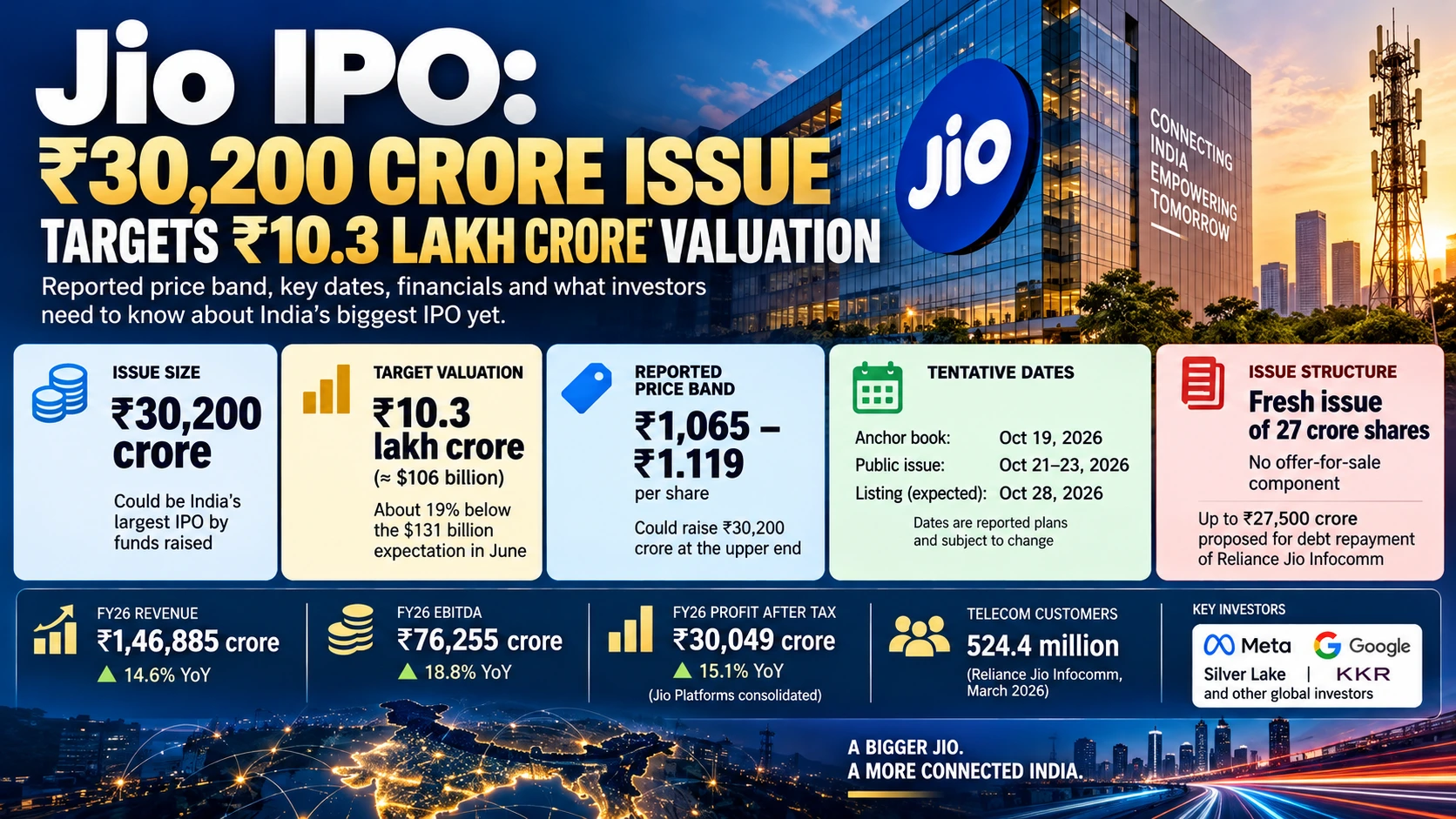
Jio Platforms‘ reported ₹1,065–₹1,119 price band implies a valuation of about $106 billion, roughly 19% below the $131 billion expectation reported in June. The proposed IPO could set a fundraising record, but final pricing and investor demand remain untested.
Jio Platforms’ proposed IPO is approaching a crucial pricing test. The Reliance Industries subsidiary is reportedly targeting a valuation of ₹10.3 lakh crore and a fundraising amount of around ₹30,200 crore, below the valuation expectations reported earlier this year.
The proposed issue could surpass Hyundai Motor India’s ₹27,859 crore IPO in 2024 to become India’s largest public offering by funds raised. But the valuation reset raises a key question: will the reported price make the offering attractive enough to draw strong demand in a volatile equity market?
According to Reuters’ October 9 report, Jio Platforms is targeting a valuation of approximately $106 billion, with a reported price band of ₹1,065–₹1,119 per share. The issue could raise about ₹30,200 crore at the upper end of that range.
These figures are based on people familiar with the transaction. They should not be treated as final IPO terms until confirmed in the relevant offer documents.
Jio IPO: How Much Has the Valuation Expectation Changed?
Reuters reported that the proposed valuation is below the approximately $131 billion expectation cited in June, when the company’s draft offer papers were filed.
Comparing the two reported dollar valuations, the difference is approximately $25 billion, or 19%. This measures the change between two reported valuation expectations; it is not a fall in Jio’s listed share price.
The broader market correction appears to have influenced pricing expectations. Reuters cited analysts who linked the lower proposed valuation to pressure on Indian equities amid an oil-price shock and geopolitical uncertainty.
For investors, a lower proposed valuation could improve the entry point relative to earlier expectations. But it does not automatically make the IPO inexpensive. That judgement will depend on Jio Platforms’ earnings, debt, growth prospects and the valuation investors assign to its digital businesses.
Track Live: Jio Platforms IPO
₹30,200 Crore Issue: Why the Fresh-Issue Structure Matters
Jio Platforms’ June draft prospectus provides for a fresh issue of up to 27 crore equity shares, with no offer-for-sale component. The reported price band would put the fundraising amount at approximately ₹30,200 crore at the upper end.
This structure matters because the proposed offering is designed to raise capital for the company rather than provide an IPO exit for existing shareholders.
Reuters reported that Jio plans to use up to ₹27,500 crore of the net proceeds to repay or prepay borrowings of its telecom subsidiary, Reliance Jio Infocomm. The draft prospectus also identifies general corporate purposes as an intended use of proceeds.
If the proposed allocation remains unchanged, debt repayment will be a central objective of the offering. Investors will still need to examine the final documents for the confirmed allocation, issue expenses and any changes in terms.
The SEBI-hosted draft prospectus remains the primary reference for the proposed issue structure.
Meta and Google: Does Investor Interest Guarantee Strong Demand?
Jio Platforms’ investor base includes Meta and Google, alongside major financial investors such as Silver Lake, KKR and other global institutions.
The Economic Times reported on October 10 that Akash Ambani and Isha Ambani have taken the IPO pitch to international investors. The report also said that some existing investors are seeking to increase their exposure rather than sell shares.
This is a potentially supportive signal, but it is not proof of final IPO demand. The reported investor positions are attributed to people familiar with the matter, rather than public commitments by each shareholder.
The stronger test will come when institutional and retail investors evaluate the offer at its final price. Until the subscription process begins, reported interest should not be confused with confirmed demand.
Jio Platforms FY26 Results: The Financial Numbers Behind the Valuation
Jio Platforms reported consolidated revenue from operations of ₹1,46,885 crore for FY2025–26, up 14.6% year on year. Consolidated EBITDA rose 18.8% to ₹76,255 crore, while profit after tax increased 15.1% to ₹30,049 crore, according to Reliance Industries’ FY26 analyst presentation.
Its telecom subsidiary, Reliance Jio Infocomm, served 524.4 million customers as of March 2026, according to the draft prospectus.
The distinction is important: the revenue, EBITDA and profit figures above refer to Jio Platforms’ consolidated financial performance, while the customer count refers to its telecom subsidiary’s operating base.
At the reported IPO valuation, investors will need to assess whether these financial results and Jio’s growth opportunities justify the proposed pricing. Its large customer base provides scale, but future returns will also depend on monetisation, competition, capital expenditure and sustainable cash generation.
Jio IPO Dates: What Is Reported and What Remains Unconfirmed?
Reports indicate that the IPO could open for public subscription on October 21 and close on October 23. The anchor-investor book is expected to open on October 19, with the listing potentially scheduled for October 28.
These dates remain reported plans rather than final confirmed dates. The draft prospectus leaves the price and issue-period fields blank, and the Economic Times has reported that the timing, valuation and other details could still change.
Investors should therefore verify the final timetable, price band and offer terms through updated company disclosures and exchange filings before making decisions. Unofficial grey-market premiums are not a guarantee of listing performance.
What the Jio IPO Could Mean for Reliance Industries Shareholders
Reliance Industries held 66.43% of Jio Platforms before the proposed issue, according to the June draft prospectus. Because a fresh issue creates new shares, the promoter’s percentage holding could be diluted; the final post-issue stake should be checked against updated offer documents.
A separate listing could give investors a direct route to Jio’s telecom and digital businesses and a more visible market valuation for Reliance’s holding.
However, Jio’s listing would not automatically translate into a matching increase in Reliance Industries’ share price. RIL’s valuation also reflects its retail, energy and other businesses, along with liabilities and the discount investors may apply to a holding company.
The eventual impact will depend on Jio’s final valuation, the public float, market conditions and how investors assess Reliance’s remaining businesses.
Three Things Investors Should Watch Next
- Final price and terms: Whether the reported ₹1,065–₹1,119 price band and ₹30,200 crore fundraising target are retained in the final documents.
- Actual subscription demand: Whether institutional and retail investors validate the reported interest from existing shareholders.
- Valuation versus earnings: Whether Jio Platforms’ consolidated financial performance, debt obligations and cash generation support the final valuation.
Jio’s proposed IPO combines a potentially record-setting fundraising target with a valuation expectation that has moved lower. That may improve its appeal, but it does not eliminate the risk of weaker-than-expected demand or disappointing listing performance.
The decisive test will be the final offer terms and the actual response from investors—not the size of the IPO or the prominence of its existing shareholders alone.
Related reading: Jio Platforms IPO and telecom tariffs: What could drive Reliance Industries shares?
Disclaimer: This article is for informational and educational purposes only and does not constitute investment advice or a recommendation to purchase, sell or hold any security. Reported IPO terms, valuations and dates may change. Investors should read the final offer documents and assess the associated risks before investing.