SBI Research has proposed abolishing equity LTCG tax and extending the holding period to two to three years as foreign investors continue selling Indian shares. But with domestic SIP contributions at record levels and government tax revenue at stake, can the proposal attract lasting foreign capital?
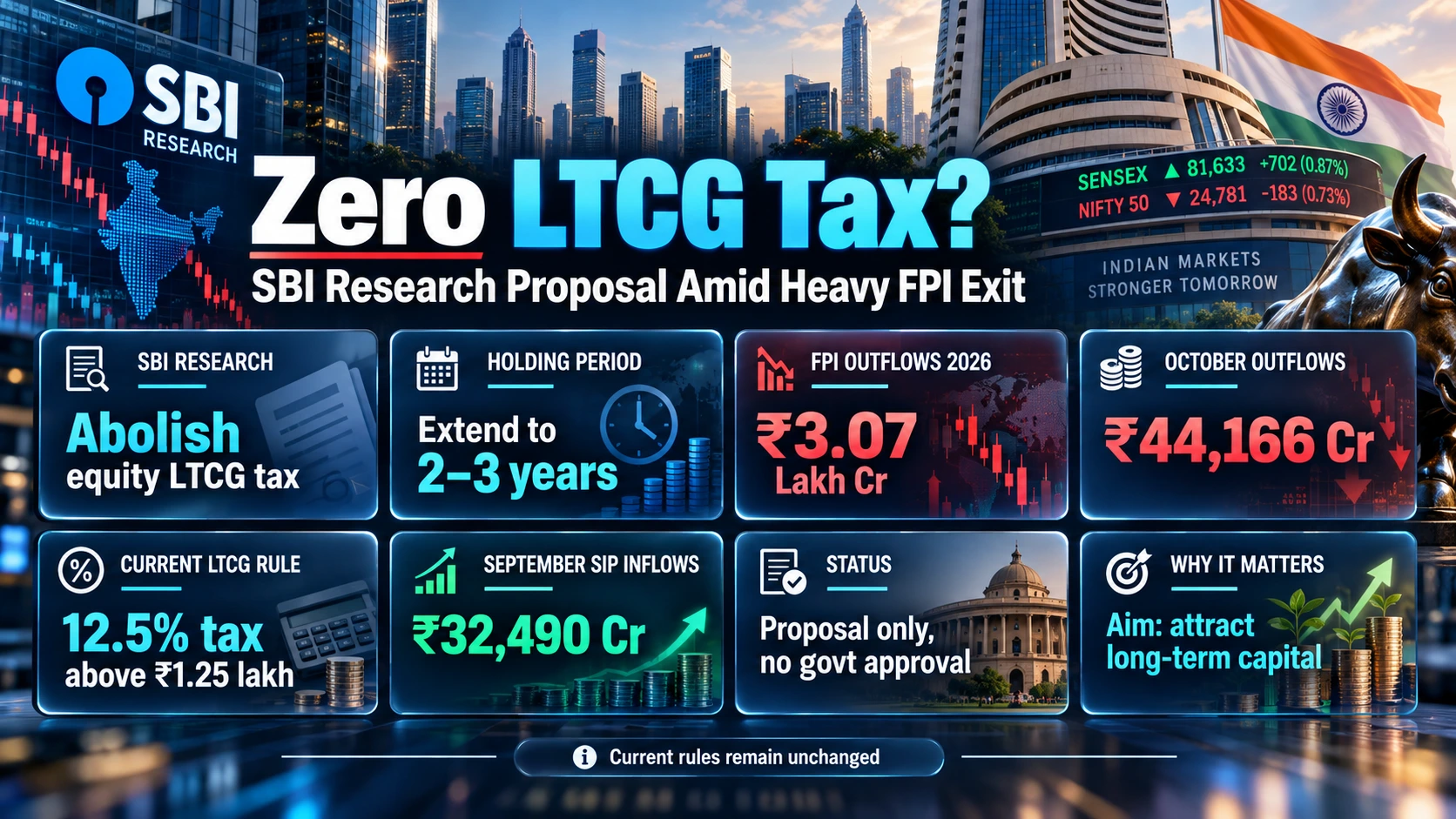
Foreign investors have withdrawn more than ₹3 lakh crore from Indian equities in 2026, intensifying the debate over how India can attract and retain overseas capital. SBI Research has now proposed a significant change to the equity taxation framework: abolish long-term capital gains (LTCG) tax on equities while extending the holding period to two or three years.
The proposal comes as domestic investors continue to channel money into equity mutual funds despite persistent foreign selling. According to Reuters, equity mutual funds attracted ₹38,307 crore in September, while systematic investment plan (SIP) contributions reached a record ₹32,490 crore.
The contrast raises a difficult question for policymakers. Can changes to capital-gains taxation persuade foreign investors to remain invested longer, or will global interest rates, currency risks and competing investment opportunities continue to drive capital away from India?
SBI Research’s recommendation is not a government-approved tax change. Its eventual impact would depend on the design of the proposed holding-period framework, the scope of any exemption and whether the change improves India’s competitiveness enough to attract additional investment.
Why SBI Research Wants the Equity LTCG Tax Framework Changed
In its latest Ecowrap report, SBI Research argued that monetary and foreign-exchange interventions by the Reserve Bank of India (RBI) may not be enough on their own to strengthen capital inflows. It called for structural policy measures to make Indian equities more attractive to foreign investors.
The report recommends two connected changes: abolishing LTCG tax on equities and extending the holding period to approximately two or three years.
This is different from merely asking investors to hold shares voluntarily for longer. The reference to extending the holding period could imply a change to the framework used to determine eligibility for long-term treatment or a related tax benefit. However, the report, as described in published coverage, does not provide enough detail to establish exactly how the revised holding period and proposed tax abolition would operate together.
The proposal is intended to anchor what SBI Research describes as volatile or “hot money” flows. The objective is to encourage more stable investment commitments and make domestic equities more competitive when global funds allocate capital across markets.
SBI Research also cited approximately $13 billion in equity outflows during FY27. That is a separate reporting-period figure and should not be confused with the cumulative calendar-year FPI outflows reported in October.
The key policy question is whether a longer holding-period framework combined with tax relief would generate genuinely new investment or mainly change the tax treatment of existing holdings.
Foreign Selling Has Exceeded ₹3 Lakh Crore in 2026
The scale of foreign selling explains why the proposal has attracted attention.
Business Today reported on October 13 that foreign investors had withdrawn ₹3,07,719 crore from Indian equities in 2026 so far, compared with ₹1,66,286 crore in 2025. Moneycontrol/PTI had reported ₹3.04 lakh crore on October 11. These figures reflect different publication snapshots; the rounded figure of over ₹3 lakh crore is the safer headline-level comparison until the data cutoffs are reconciled.
Persistent selling creates pressure on equity-market sentiment and can contribute to currency weakness when foreign investment withdrawals increase demand for foreign exchange.
Several factors may be influencing allocation decisions. Elevated crude oil prices can increase India’s import bill, while a stronger US dollar and higher US bond yields can make overseas investments more attractive. Capital has also been drawn towards the artificial-intelligence-led rally in North Asian markets.
Tax relief could improve the return investors retain after tax. But it cannot guarantee a reversal in flows when investors see stronger earnings prospects or better risk-adjusted returns elsewhere.
For that reason, the cumulative selling figure should be viewed as evidence of the challenge facing policymakers, not proof that taxation alone caused the withdrawals.
Record SIP Contributions Create a Market Contrast
The foreign-investment debate is taking place against a different trend in domestic savings.
According to Reuters’ report on September mutual fund flows, Indian equity mutual funds attracted ₹38,307 crore in September, their highest monthly inflow in five months. SIP contributions reached a record ₹32,490 crore.
Yet foreign investors withdrew $3.75 billion from Indian equities during September, and the Nifty 50 declined 6.1% for the month, Reuters reported.
The contrast matters because domestic inflows provide an important source of demand when overseas investors are selling. However, mutual fund subscriptions and foreign portfolio flows are different investment channels. Domestic buying does not automatically offset foreign selling rupee for rupee, nor does it guarantee that benchmark indices will rise.
This is the central market tension behind the SBI Research proposal: India has substantial domestic participation, but retaining foreign capital remains a challenge.
The next test is whether domestic investment stays resilient while foreign selling moderates—and whether any policy change attracts additional overseas money.
Investors can track daily FII and DII buying and selling to assess whether domestic institutions are absorbing foreign selling pressure.”
What Is the Current LTCG Tax on Equities?
Under the current tax framework, eligible long-term capital gains from listed equity shares, equity-oriented mutual fund units and specified business-trust units are generally taxed at 12.5% on aggregate gains exceeding ₹1.25 lakh in a financial year, subject to the applicable Securities Transaction Tax (STT) and other conditions.
The Income Tax Department’s guidance on the sale of shares explains the relevant provisions. Listed equity shares generally qualify as long-term capital assets when held for more than 12 months.
SBI Research’s proposed two-to-three-year holding period would therefore represent a potential change to the existing framework. It should not be described as the current eligibility requirement.
The precise mechanics remain important. The proposal does not, in the published descriptions available, establish whether the exemption would apply to every eligible long-term equity gain or only to investments meeting a new two-to-three-year threshold.
That distinction could determine which investors qualify, when the tax benefit becomes available and how much additional capital the measure attracts.
How Much Tax Could an Investor Pay Under Current Rules?
Consider an investor with ₹10 lakh of eligible Section 112A long-term capital gains in a financial year.
Assuming the entire gain qualifies for the provision, the full ₹1.25 lakh annual threshold remains available, and other individual tax adjustments are ignored, the illustrative calculation would be:
| Calculation | Amount |
|---|---|
| Eligible long-term capital gains | ₹10,00,000 |
| Annual threshold | ₹1,25,000 |
| Gains above the threshold | ₹8,75,000 |
| Tax at 12.5%, before surcharge and cess | ₹1,09,375 |
This is an illustration of the base tax under the existing framework, not a guaranteed tax saving under SBI Research’s proposal. The actual liability depends on the taxpayer’s circumstances and applicable rules, while any future exemption would depend on its final eligibility conditions.
The example shows why the proposal could be financially significant to qualifying investors. However, the potential benefit cannot be assessed fully until the government specifies which gains would qualify and how the proposed holding period would apply.
The Government Faces a Tax-Revenue Trade-Off
The proposal also raises a broader fiscal question: how much revenue would the government be willing to forgo to attract additional equity investment?
On July 20, the Finance Ministry told Parliament that there was no proposal under consideration to abolish LTCG tax for domestic equity investors. That was the government’s stated position at the time; it does not establish how officials will respond to SBI Research’s latest recommendation.
The revenue at stake is material. Reuters reported that LTCG tax collections on equities rose to ₹1.29 lakh crore in assessment year 2025–26, from ₹72,249 crore a year earlier.
A broad exemption could reduce receipts, depending on the final design and investor response. The government would need to weigh that loss against any additional investment, wider participation and potential benefits to capital formation.
There is also a distinction between equity investments and government securities. India introduced a tax exemption for specified foreign investors’ gains and interest connected with government securities effective April 1, 2026. That measure concerns government debt, not an across-the-board exemption from LTCG tax on equities.
The difference is important because changes to one asset class do not automatically establish a policy direction for another.
“The government’s earlier position on the proposal is explained in NiftyTrader’s report on why LTCG tax relief was ruled out.”
SBI Research Has Also Called for Changes to Foreign-Currency Inflows
The equity-tax recommendation forms part of a broader approach to strengthening India’s external accounts.
External commercial borrowings: SBI Research has called for greater clarity on withholding-tax provisions applicable to external commercial borrowings (ECBs), with the reported rate range spanning 5% to 20%. It highlighted the importance of consistent application of tax rules and clarity over benefits available under double taxation avoidance agreements.
Clearer treatment could help Indian borrowers and overseas lenders assess the cost of cross-border financing more confidently.
Repatriation of export proceeds: The report has also proposed bringing export earnings back to India within approximately six months, while allowing extensions in genuine cases. The aim is to improve foreign-exchange availability without ignoring legitimate commercial payment arrangements.
Together, the recommendations suggest that SBI Research sees foreign-capital attraction as a wider policy problem rather than one that can be resolved solely through equity taxation.
Could a Longer Holding Period Reverse Foreign Selling?
The proposal’s effectiveness would depend on how the new rules are structured and what motivates investors to leave.
A longer qualifying period might encourage investors to retain positions until they meet the eligibility threshold. However, it could also encourage some investors to time exits around that date rather than commit fresh capital.
Foreign portfolio investors are not a uniform group. Some make long-term allocations, while others actively adjust holdings in response to global yields, currency movements, valuations or earnings expectations. A tax concession may appeal to the first group without changing the decisions of investors seeking better risk-adjusted returns elsewhere.
There is also a difference between retaining existing capital and attracting incremental investment. Lower taxes on gains from positions investors would have held anyway may improve their after-tax returns without bringing additional money into the market.
A successful policy would therefore need to demonstrate that it generates sustained new investment, rather than simply reducing tax paid on existing gains.
What Investors Should Watch Next
Three developments will help determine whether SBI Research’s proposal moves beyond the policy debate.
First, investors should look for a formal government response or a tax-law amendment. Until then, the current LTCG rules remain applicable.
Second, foreign equity flows need monitoring alongside domestic mutual fund subscriptions. A moderation in FPI selling, sustained domestic inflows and improving market breadth would offer a more complete picture than any single flow figure. Readers can follow institutional activity through the NiftyTrader FII-DII Tracker.
Third, the external backdrop will remain important. A stronger rupee, moderating crude prices, competitive earnings and changes in global bond yields could influence foreign allocations alongside any potential tax reform.
SBI Research has introduced a significant proposal into India’s debate over foreign capital and equity taxation. But the proposal’s impact will depend on its final design, the government’s willingness to change the law and the wider conditions investors face.
For now, the key question is not whether zero LTCG tax sounds attractive. It is whether the proposed combination of tax relief and a longer holding period can persuade foreign investors to commit additional capital to Indian equities over time.
Read Next: Why Did the Kospi Fall 7% Despite Samsung’s Record Profit Forecast?
Frequently Asked Questions
1. Has the government abolished LTCG tax on equities?
No. SBI Research has recommended abolishing the tax, but the recommendation is not a government decision. The existing tax framework remains applicable.
2. What holding period has SBI Research proposed?
SBI Research has called for extending the holding period to approximately two or three years alongside abolishing equity LTCG tax. The exact mechanics connecting the longer period and the proposed exemption have not been fully specified in published coverage.
3. What is the current LTCG tax rate on eligible listed equities?
The general Section 112A rate is 12.5% on eligible long-term capital gains exceeding ₹1.25 lakh in a financial year, subject to applicable STT conditions and other rules.
4. Will zero LTCG tax necessarily bring foreign investors back?
No. Tax relief could improve post-tax returns, but currency weakness, global interest rates, crude oil prices, valuations and earnings expectations may continue to affect foreign investment decisions.
5. What other measures has SBI Research proposed?
The report also calls for clearer withholding-tax treatment of external commercial borrowings and repatriation of export proceeds within approximately six months, with extensions permitted in genuine cases.
Disclaimer: This article is for informational and educational purposes only and is not investment or tax advice. Tax treatment depends on applicable law, investor status and the type of security. Consult a qualified tax professional before making tax or investment decisions.