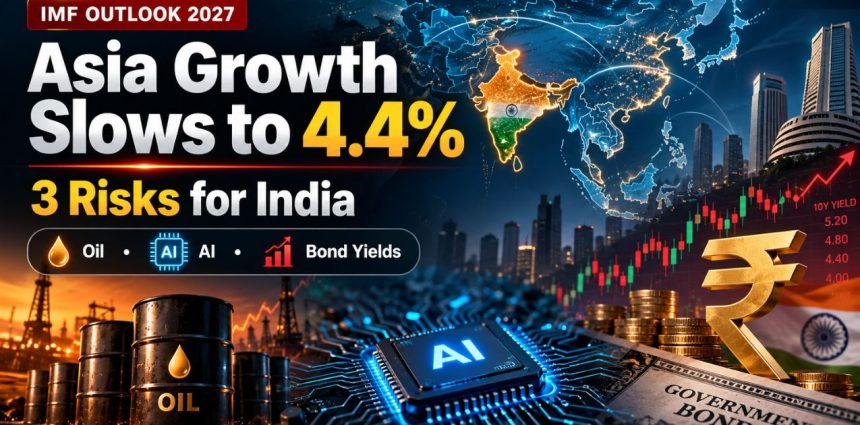
India’s inflation has climbed to 5.54%, the rupee remains under pressure and foreign investors continue to sell equities. The IMF’s latest Asia outlook highlights three global risks that could intensify those challenges.
Asia’s growth outlook is slowing, but the bigger question for India is how much pressure the region’s risks could add to domestic inflation, the rupee and financial markets.
The International Monetary Fund (IMF) expects Asia-Pacific growth to ease from 5% in 2025 to 4.8% in 2026 and 4.4% in 2027. Although the forecasts are higher than its April projections, the IMF warns that an energy shock linked to the Middle East conflict, a potential artificial-intelligence correction and rising global bond yields could threaten the outlook.
India has its own pressure points. Retail inflation accelerated to 5.54% in September, the rupee closed at ₹95.15 per dollar on October 14, and foreign portfolio investors withdrew ₹44,166 crore from Indian equities during October through the period reported on October 11.
These figures do not mean an Indian market downturn is inevitable. They show why global risks deserve attention: if energy costs rise, capital flows weaken and borrowing costs remain elevated, several pressures on the Indian economy could reinforce one another.
IMF’s Asia forecast: Slower growth, but higher than April estimates
The IMF projects Asia-Pacific growth of 4.8% in 2026 and 4.4% in 2027, compared with 5% in 2025. The revised projections are above its April estimates of 4.4% and 4.2%, respectively.
The upgrade partly reflects the boost from the AI boom in advanced Asian economies. However, emerging Asia is expected to grow more slowly as higher energy costs weigh on activity.
The distinction matters: the IMF has not simply downgraded Asia’s outlook. It has raised its forecasts while warning that risks remain tilted to the downside.
A prolonged Middle East conflict could keep commodity prices high and deplete oil reserves. A correction in AI demand could affect economies closely connected to the AI supply chain. Meanwhile, higher yields in major economies could spill over into Asian bond markets and increase financing costs.
For India, these are not three direct forecasts of economic damage. They are global risks that could reach the domestic economy through oil prices, inflation, the rupee and investor behaviour.
Risk 1: Higher oil prices could make inflation harder to control
India’s retail inflation rose to 5.54% in September from 4.83% in August, according to the government’s latest CPI release. Food inflation climbed to 7.74% from 5.97%.
The September headline reading moved closer to the Reserve Bank of India’s 6% upper tolerance limit. The RBI’s medium-term inflation target is 4%, with a tolerance band of 2% to 6%.
Food prices were a major part of the latest increase. Higher crude oil prices would present an additional risk if they persist, because energy costs can feed into transport, logistics, manufacturing and other business expenses.
The impact would vary across companies. Businesses that can pass on higher costs may protect margins, while those facing intense competition could have less room to raise prices. Households could also face pressure if essential expenses continue to increase.
What investors should watch: whether crude prices remain elevated and whether subsequent inflation readings show that September’s increase is becoming more persistent. One monthly CPI reading does not establish a new trend, and the IMF’s energy warning does not prove that oil caused September’s inflation rise.
Risk 2: Rupee pressure could magnify the cost of imported energy
The rupee strengthened for a third consecutive session on October 14, reaching ₹94.77 per dollar before closing at ₹95.15, according to Reuters. Gains were limited by importer demand for dollars and continuing portfolio outflows.
That movement illustrates the difference between a short-term recovery and a durable currency turnaround. The rupee can strengthen during individual sessions even when underlying dollar demand remains high.
Oil prices are important because India pays for imported crude in foreign currency. If crude becomes more expensive, the import bill can rise. If the rupee weakens at the same time, the rupee cost of those imports can increase further.
That combination could add to costs for businesses and complicate the inflation outlook. It could also influence expectations about interest rates and foreign investment.
Currency movements are affected by more than oil, however. The dollar’s global strength, investor flows, importer hedging and central-bank actions all matter.
What investors should watch: whether the rupee sustains its recovery and whether global conditions allow that improvement to continue. The October 14 close is a dated reference, not the current rate for every subsequent session.
Check Live: GIFT Nifty and global market cues
Risk 3: Foreign-investor selling could leave markets more vulnerable
Foreign portfolio investors withdrew ₹44,166 crore from Indian equities during October through October 11, according to reporting based on market-depository data. The same report put cumulative equity outflows for 2026 at more than ₹3 lakh crore.
The date matters: these are figures reported as of October 11, not a confirmed October 15 total. They refer to equity investments and should not be confused with broader foreign portfolio investment measures covering other asset classes.
The reported reasons for the selling included elevated crude prices, a stronger US dollar and higher US bond yields. The same coverage noted that AI-related investment opportunities were attracting foreign capital to North Asian markets.
Foreign selling does not automatically mean Indian shares must fall. Domestic investors can absorb some of the supply, and company earnings can support individual stocks. But sustained outflows can make market sentiment more sensitive to global shocks.
Higher global bond yields create another concern. If investors can earn more elsewhere, they may become more selective about emerging-market assets. Rising yields can also increase financing costs and make equity valuations harder to justify.
What investors should watch: whether foreign equity outflows moderate and whether global bond yields stabilise. A single day of inflows or outflows is less informative than the direction over time.
Track the latest FII and DII activity with the FII–DII Tracker
The AI risk: Why India should pay attention even without a semiconductor-led market
The IMF’s AI warning is important beyond the technology shares directly exposed to the boom.
A sharp correction in AI-related investment or valuations could change global risk appetite and the way investors allocate capital across markets. It could also affect spending by companies that are reassessing technology budgets.
Indian IT services businesses do not have the same exposure as semiconductor manufacturers, so a sell-off in chip stocks should not be treated as a direct forecast of weaker Indian IT earnings.
The potential connection is more indirect: weaker global sentiment could affect capital flows, while a slowdown in technology spending could influence demand for some IT services. The actual impact would depend on client budgets, company guidance and the scale of any correction.
For India, the concern is that an AI-related market shock could arrive at the same time as elevated inflation, currency pressure and foreign selling. That combination could matter more than any one risk on its own.
How these risks could reinforce one another
The transmission channels are connected.
If oil prices rise and remain high, India’s import bill and cost pressures could increase. If the rupee weakens at the same time, imported energy becomes more expensive in local-currency terms. Persistent inflation could then complicate the outlook for interest rates.
Meanwhile, rising global yields or an AI-related correction could make international investors more cautious. If foreign equity outflows persist, the market may become more sensitive to negative news.
This is a risk scenario, not a prediction. Lower oil prices, moderating inflation, a stabilising rupee or stronger foreign inflows could ease the pressure.
The important question is whether these risks remain separate—or begin to reinforce one another in India’s actual economic data.
What Indian investors should monitor next
Four indicators can help investors judge whether these risks are easing or building:
- Crude oil: A sustained decline could reduce pressure on the import bill and inflation outlook. A renewed rise would increase uncertainty.
- CPI inflation: The next releases will help establish whether September’s acceleration was temporary or part of a more persistent trend.
- Rupee movement: Watch the trend across sessions rather than relying on one day’s recovery.
- FPI equity flows and global bond yields: A slowdown in foreign selling and stable global yields would ease one source of market pressure. Continued outflows could leave equities more vulnerable to shocks.
These indicators should be read together. A stronger rupee alone would not resolve persistent food inflation, and a single session of foreign buying would not prove that capital flows have turned decisively.
The real test is whether global pressure reaches domestic fundamentals
The IMF’s outlook does not mean Asia’s growth engine has stopped. It means growth is expected to moderate and the risks around that path have increased—even after the forecasts were raised from April.
India’s challenge is how those external risks interact with domestic inflation, currency stability and investment flows. September’s higher CPI reading and the reported foreign equity outflows make that combination worth monitoring.
If energy prices ease, inflation moderates and foreign selling slows, some pressure could recede. If oil remains expensive while global yields rise and risk appetite weakens, the rupee, corporate costs and market sentiment could face renewed strain.
For Indian investors, the more useful signal is not the IMF forecast alone. It is whether the risks begin to reinforce one another in India’s inflation, currency and capital-flow data.
Need to Know
-
The IMF forecasts Asia-Pacific growth of 4.8% in 2026 and 4.4% in 2027, down from 5% in 2025—but above its April projections.
- India’s September CPI inflation rose to 5.54%; food inflation reached 7.74%.
-
The rupee closed at ₹95.15 per dollar on October 14 after touching ₹94.77 during the session.
- FPI equity outflows reached ₹44,166 crore in October through the period reported on October 11.
Read Next: US CPI Hits 3.7%, KOSPI Plunges 7% Intraday: Will Nifty Fall Today?
FAQ
1. What is the IMF’s latest Asia growth forecast?
The IMF expects Asia-Pacific growth of 4.8% in 2026 and 4.4% in 2027, compared with 5% in 2025.
2. Why does India’s September inflation matter?
CPI inflation rose to 5.54%, while food inflation reached 7.74%. If inflation remains elevated, it could put pressure on household spending, company costs and monetary-policy decisions.
3. How could the IMF’s energy warning affect the rupee?
Higher oil prices can increase India’s import bill and dollar demand. However, the rupee also depends on global dollar movements, investor flows and domestic policy.
4. Are foreign investors still selling Indian equities?
An October 11 report put October equity withdrawals at ₹44,166 crore through that reporting period and cumulative 2026 outflows above ₹3 lakh crore. These figures should not be presented as updated October 15 totals without checking newer data.
5. Does the IMF warning mean Indian markets will fall?
No. The IMF’s regional growth outlook is not a prediction of Indian share-price movements. Market outcomes depend on earnings, oil prices, inflation, currency movements and capital flows.
Disclaimer: This article is for information and educational purposes only and is not investment advice or a recommendation to buy or sell any security. Forecasts and market data can change. Readers should verify current information and consider their own financial circumstances before making investment decisions.