
Global Investors Returns to India’s Real Estate Market in Q3 2026
Foreign investors are making a strong comeback in India’s real estate market, and data centres are emerging as the biggest attraction. Institutional real estate investments reached $2.1 billion in the July-September quarter of 2026, signalling renewed interest in Indian property assets despite global economic uncertainty.
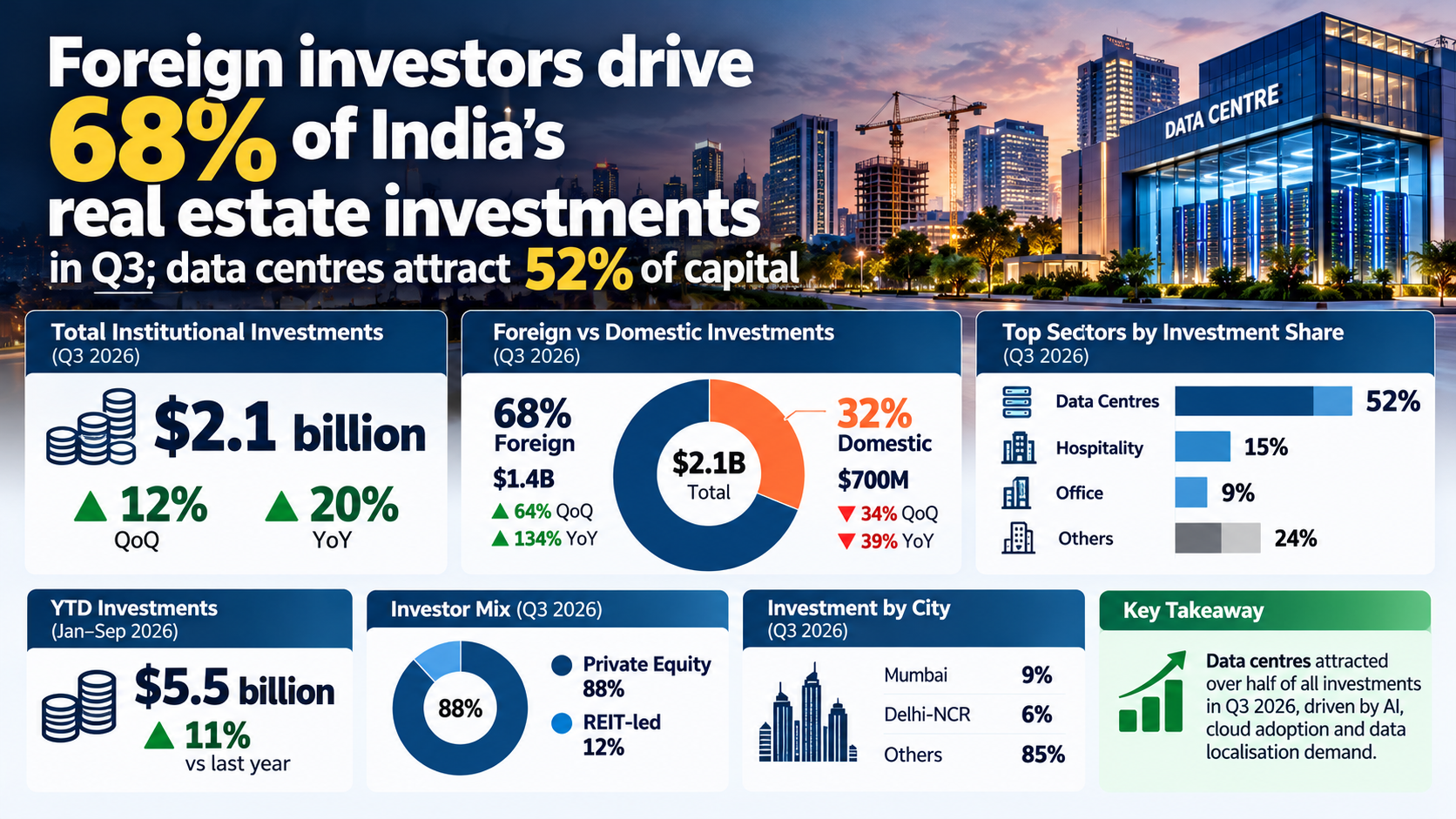
According to Cushman & Wakefield’s Q3 2026 Capital MarketBeat report, released on October 27, foreign investors contributed $1.4 billion, accounting for 68% of quarterly institutional investments. This ended four consecutive quarters in which domestic investors had led the market.
The shift highlights changing investment preferences and the growing importance of digital infrastructure in India’s commercial property market.
Track Live : NSE Option Chain — Live | BSE Option Chain — Live Sensex & Bankex Options Data Today
Global Investors : India’s Real Estate Investments Rise 20% Annually
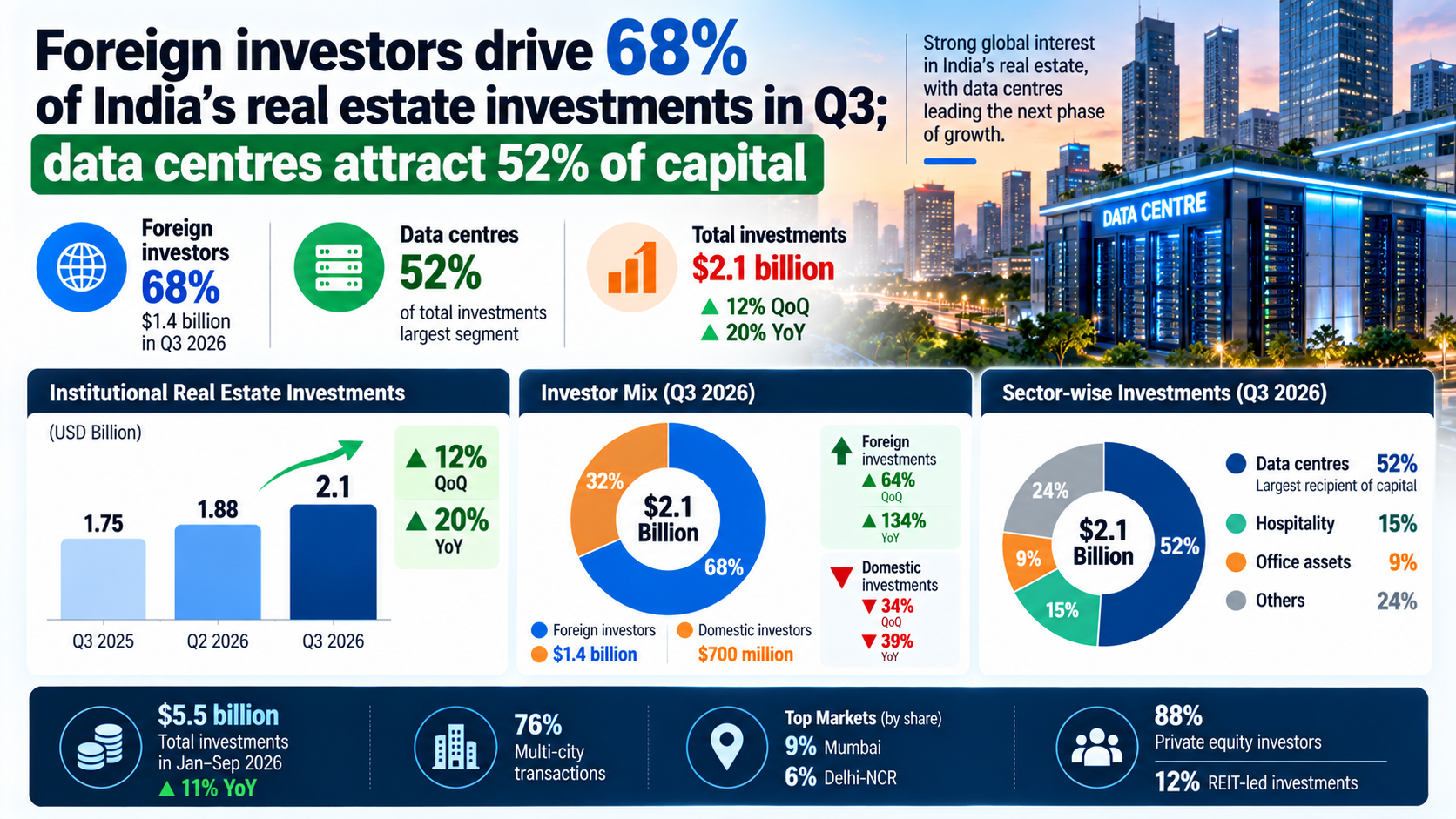
Total institutional real estate investments increased 12% quarter-on-quarter and 20% year-on-year to $2.1 billion in Q3 2026.
Foreign capital recorded particularly strong growth, rising 64% from the previous quarter and 134% compared with the same period last year. In contrast, domestic investments declined 34% sequentially and 39% annually to $700 million.
The broader nine-month picture, however, remains more balanced. Institutional investments reached $5.5 billion during January-September 2026, up 11% year-on-year.
Domestic investors accounted for 52% of cumulative investments, while foreign investors contributed 48%. Domestic investment grew 15% annually during the period, compared with an 8% increase in foreign capital.
Complete breakdown of the investment figures
| Investment metric | Amount | Growth / share |
|---|---|---|
| Q3 institutional investment | $2.1 billion | Up 20% year-on-year |
| Foreign investment | $1.4 billion | 68% of quarterly capital |
| Domestic investment | $700 million | Down 39% year-on-year |
| January–September investment | $5.5 billion | Up 11% year-on-year |
Data Centres Attract 52% of Institutional Real Estate Capital
Data centres emerged as the biggest investment destination in India’s real estate market during Q3 2026, attracting 52% of total institutional capital.
Growing demand for artificial intelligence (AI) computing, cloud services and data localisation is supporting investor interest in the segment. As businesses require more computing capacity and secure digital infrastructure, data centres are becoming an increasingly important part of India’s commercial property landscape.
Hospitality assets accounted for 15% of quarterly investments, followed by office properties at 9%.
The allocation towards data centres signals that institutional investors are looking beyond traditional commercial properties to assets linked to long-term digital infrastructure demand.
| Metric | Q3 2026 | Change |
|---|---|---|
| Total institutional investment | $2.1 billion | +12% QoQ; +20% YoY |
| Foreign investment | $1.4 billion | +64% QoQ; +134% YoY |
| Domestic investment | $700 million | −34% QoQ; −39% YoY |
| Total investment, first nine months | $5.5 billion | +11% YoY |
| Domestic share, first nine months | 52% | Majority of cumulative inflows |
| Foreign share, first nine months | 48% | Nearly half of cumulative inflows |
QoQ means quarter-on-quarter; YoY means year-on-year.
Track Live : Nifty Levels Today | Sensex Levels Today
Why data centres attracted 52% of capital
Data centres became the largest recipient of institutional real estate capital in Q3, accounting for 52% of quarterly investment. On a $2.1 billion total, that represents approximately $1.09 billion, calculated from the reported share.
Artificial intelligence workloads
AI training and inference require substantial computing power, specialised servers, electricity and cooling. The growth of these workloads creates demand for facilities capable of supporting high-density computing.
Cloud adoption and digital services
Businesses increasingly depend on cloud platforms, enterprise applications and digital storage. This supports demand for secure, scalable facilities that house computing infrastructure.
Data localisation and connectivity
Requirements around where certain data is stored and processed, combined with low-latency connectivity needs, can support demand for data centres located within India.
India Data Centre Market: H1 2026 and 2030 Outlook
| Metric | Figure | Details |
|---|---|---|
| Operational capacity in the top seven markets | 1,789 MW | Total operational capacity as of H1 2026 |
| New capacity added in H1 2026 | 178 MW | Capacity added during January–June 2026 |
| Additional capacity expected by 2030 | 3,860 MW | 509 MW under construction and 3,351 MW in the planning stage |
| Estimated development capital through 2030 | $29.9 billion | Projected capital requirement for India’s data-centre expansion |
Which other property segments attracted investment?
Hospitality — 15%
Approximately $315 million of Q3 investment, calculated from the reported share. Hotel and hospitality assets were the second-largest category in the Moneycontrol report, reflecting investor interest in this segment.
Office assets — 9%
Approximately $189 million, based on the reported share. Offices remain an important institutional asset class, although their share of Q3 investment in this particular report was lower than that of data centres and hospitality.
The remaining 24% of quarterly capital—approximately $504 million—was allocated to other asset categories, or transactions classified differently in the report. The supplied article does not provide a complete asset-by-asset breakdown.
Where is the investment going geographically?
The report says multi-city transactions represented 76% of Q3 investment activity. Mumbai accounted for 9%, and Delhi-NCR for 6%.
| Investment geography | Reported share |
|---|---|
| Multi-city transactions | 76% |
| Mumbai | 9% |
| Delhi-NCR | 6% |
| Other or separately classified activity | 9% |
Cushman & Wakefield Sees Confidence Despite Global Uncertainty
Somy Thomas, Executive Managing Director of Capital Markets at Cushman & Wakefield, said India’s real estate investment market delivered a strong quarter despite global economic uncertainties.
He noted that investors continue to focus on opportunities offering scale and long-term growth potential. The growing share of capital directed towards data centres reflects confidence in India’s digital infrastructure expansion.
However, the investment figures also suggest that capital is being deployed selectively rather than distributed evenly across property segments.
Read More : iPhone Prices Rise, Discounts Shrink: Is India Falling Out of Love as Sales Drop Up to 30%?
Comparison of India’s Real Estate Investment Reports — Q3 2026
Different property consultancies report different investment totals because their datasets and definitions of investment vary. The figures below should be compared with their respective scopes in mind.
| Research firm | Q3 2026 investment | January–September 2026 |
Key findings |
|---|---|---|---|
| Cushman & Wakefield | $2.1 billion | $5.5 billion | Institutional investment; data centres accounted for 52% of quarterly inflows. |
| Colliers | $1.4 billion | $5.9 billion | Institutional investment; domestic investors contributed about 60% of nine-month inflows. |
| CBRE | $9.5 billion | $18.6 billion | Broader real estate capital inflows; data centres accounted for 57% of Q3 investment. |
| Savills | $1.3 billion | $4.5 billion | Private-equity investment inflows; hospitality led Q3 activity with a 26% share. |
Mumbai and Delhi-NCR Attract Capital as Investors Diversify
Multi-city transactions accounted for 76% of institutional investment activity in Q3, indicating a preference for geographically diversified portfolios.
Among individual markets, Mumbai attracted 9% of investments, while Delhi-NCR accounted for 6%. The figures highlight the importance of looking beyond individual cities when assessing the overall flow of institutional capital.
Private equity investors contributed 88% of institutional investments during the quarter, while REIT-led investments accounted for the remaining 12%.
What India’s Real Estate Investment Trend Means for Investors
The latest data could strengthen investor interest in data centre operators, commercial property developers and businesses linked to digital infrastructure. However, the investment figures alone do not establish that any particular company’s earnings or share price will rise.
For stock market investors, the next indicators to watch include new data centre projects, leasing demand, capital expenditure, financing costs and future institutional investment trends.
The decline in domestic investment during Q3 also deserves attention, although domestic capital remained the larger contributor over the first nine months of 2026.
Overall, India’s real estate investment market recorded a strong third quarter, with foreign capital returning to the lead and data centres attracting the largest share of institutional funding. Whether this momentum continues will depend on sustained investor confidence, project execution and demand for digital infrastructure.