
Maruti Suzuki Q2 FY27 Results Reveal a Profitability Challenge Despite Record Sales
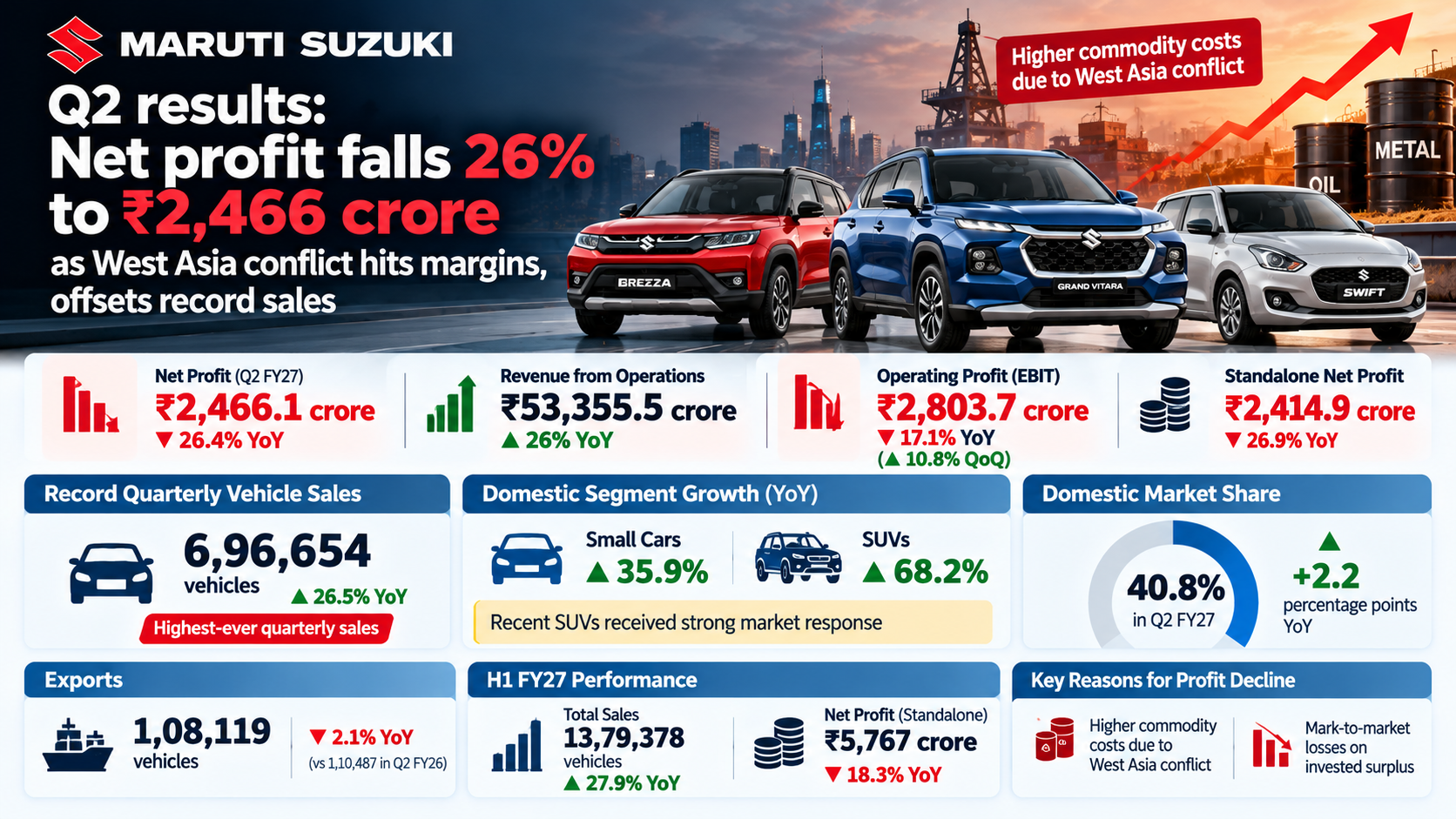
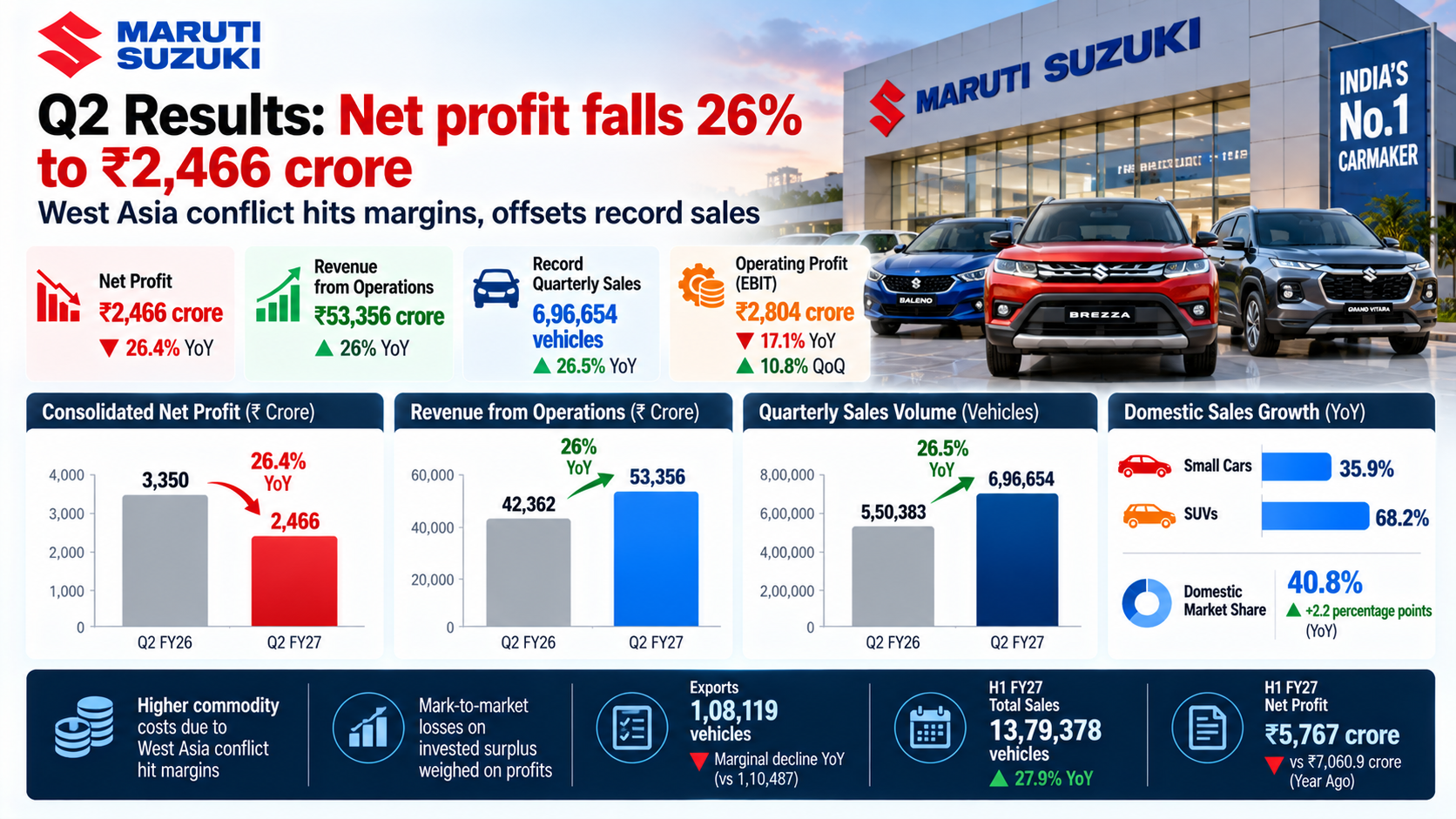
Maruti Suzuki has delivered record quarterly vehicle sales, but its latest earnings reveal a challenge for India’s largest passenger carmaker. The company’s consolidated net profit fell 26.4% year-on-year to ₹2,466.1 crore in Q2 FY27, even as revenue increased sharply.
The results highlight a growing concern for investors: strong vehicle demand does not necessarily translate into higher profits when operating costs rise. Higher commodity expenses linked to the West Asia conflict and mark-to-market losses on investments weighed on the company’s earnings.
Revenue from operations rose 26% to ₹53,355.5 crore, demonstrating strong business momentum despite the decline in profitability.
Track Live : NSE Option Chain — Live | BSE Option Chain — Live Sensex & Bankex Options Data Today
Maruti Suzuki Q2 FY27 Results: Record Vehicle Sales Strengthen Maruti Suzuki’s Market Position
Maruti Suzuki achieved its highest-ever quarterly sales volume of 6,96,654 vehicles, marking a 26.5% increase from the corresponding quarter last year.
Domestic demand remained strong across vehicle categories. Small car sales increased 35.9%, while SUV sales surged 68.2%, supported by a positive response to recently introduced models.
The company’s domestic passenger vehicle market share increased by 2.2 percentage points to 40.8% during the quarter.
Capacity additions helped Maruti Suzuki meet rising demand, but production continued to lag behind customer requirements. Network inventory stood at approximately 17 days, while pending bookings reached around 2 lakh vehicles at the end of September.
These figures indicate that demand remains healthy, although the company must continue expanding supply to convert pending orders into sales.
Maruti Suzuki’s Q2 FY27 results
The company announced its results on October 27, 2026, for the July–September quarter.
| Financial metric | Q2 FY27 | Year-on-year change |
|---|---|---|
| Consolidated net profit | ₹2,466.1 crore | −26.4% |
| Standalone net profit | ₹2,414.9 crore | −26.9% |
| Revenue from operations, consolidated | ₹53,355.5 crore | +26% |
| Operating profit (EBIT) | ₹2,803.7 crore | −17.1% |
| Total quarterly sales volume | 6,96,654 vehicles | +26.5% |
| Domestic passenger vehicle market share | 40.8% | +2.2 percentage points |
| Pending customer bookings | Approximately 2 lakh vehicles | Demand exceeds available supply |
Why profit fell despite record sales
Three factors explain the gap between Maruti Suzuki’s sales growth and its profit performance.
Higher commodity and raw-material costs
Rising costs of key materials, including steel and copper, weighed on operating profitability. Maruti Suzuki linked the pressure to the West Asia conflict, which has affected commodity costs.
Lower operating profit
EBIT fell from ₹3,382 crore to ₹2,803.7 crore. This indicates that the company generated less operating profit despite selling substantially more vehicles.
Mark-to-market losses on investments
Non-operating income declined sharply because of mark-to-market losses on invested surplus. These valuation losses affected the bottom line separately from the company’s vehicle sales and operating performance.
Higher Costs and Investment Losses Weigh on Quarterly Profit
Maruti Suzuki’s standalone net profit declined to ₹2,414.9 crore from ₹3,302.8 crore a year earlier. The divergence between revenue growth and profit performance highlights the pressure on margins.
Higher commodity prices can increase manufacturing costs, while geopolitical uncertainty may create additional volatility in supply chains and input prices.
Exports also weakened slightly, falling to 1,08,119 vehicles from 1,10,487 vehicles in the year-ago quarter amid challenging geopolitical conditions.
For investors, the key issue is whether the company’s strong sales growth can eventually translate into improved operating margins and earnings.
Track Live : Nifty Levels Today | Sensex Levels Today
Additional findings not fully covered in the supplied article
Expenses rose faster than revenue
Reuters reported that quarterly expenses increased to ₹50,604 crore from ₹39,008 crore a year earlier, as higher input costs offset strong sales growth.
| Financial indicator | Q2 FY27 | Year-ago quarter |
|---|---|---|
| Quarterly expenses | ₹50,604 crore | ₹39,008 crore |
| Increase in expenses | 29.7% | — |
| Revenue growth | 26% | — |
| Consolidated profit growth | −26.4% | — |
Profit fell short of analyst expectations
Reuters reported on October 27, 2026, that Maruti Suzuki’s standalone net profit was below the analyst consensus estimate.
| Metric | Amount |
|---|---|
| Standalone net profit reported | ₹2,414.9 crore |
| Analyst consensus estimate | ₹3,105 crore |
| Shortfall against estimate | ₹690.1 crore |
| Percentage below estimate | 22.2% |
Maruti Suzuki H1 FY27 Results Show Strong Growth but Lower Profit
For the first half of FY27, Maruti Suzuki reported record sales of 13,79,378 vehicles, up 27.9% year-on-year. Domestic sales reached 11,46,523 units, while exports accounted for 2,32,855 units.
Standalone net sales increased to ₹1,00,574.6 crore from ₹76,756.4 crore. However, standalone net profit fell to ₹5,767 crore from ₹7,060.9 crore during the same period last year.
The half-year figures reinforce the central message of the Q2 results: demand and revenue are growing, but profitability remains under pressure.
Read More : Why Global Investors Are Choosing Indian Data Centres Over Offices and Homes
Maruti Suzuki had already raised prices
The company increased prices on selected models by up to ₹20,000 in September 2026. Reuters reported that this was its third price increase since May. These increases did not prevent pressure on profitability.
This suggests the company has been attempting to offset cost inflation through pricing, but the available results do not show that these increases were sufficient to fully compensate for higher expenses.
Domestic demand was stronger than exports
| Sales category | Q2 FY27 | Year-ago quarter | Trend |
|---|---|---|---|
| Total vehicle sales | 6,96,654 | 5,50,077 approximately | +26.5% |
| Exports | 1,08,119 | 1,10,487 | −2.1% |
| Domestic passenger vehicle market share | 40.8% | 38.6% | +2.2 percentage points |
The domestic market was the primary growth driver, while exports declined slightly amid challenging geopolitical conditions.
Small cars and SUVs both contributed to growth
| Vehicle segment | Year-on-year sales growth |
|---|---|
| Small cars | +35.9% |
| SUVs | +68.2% |
The broad-based growth is significant because it shows that Maruti Suzuki’s performance was not driven exclusively by SUVs. Small cars also benefited from demand, while newer SUVs helped the company compete in a segment where it has faced strong competition.
H1 FY27 performance: Record volumes, lower profits
Maruti Suzuki’s first-half results show that the earnings pressure extends beyond a single quarter.
| Metric | H1 FY27 | H1 FY26 | Change |
|---|---|---|---|
| Total vehicle sales | 13,79,378 | 10,79,000 approximately | +27.9% |
| Standalone net sales | ₹1,00,574.6 crore | ₹76,756.4 crore | +31.0% |
| Standalone net profit | ₹5,767 crore | ₹7,060.9 crore | −18.3% |
| Domestic sales | 11,46,523 vehicles | — | — |
| Exports | 2,32,855 vehicles | — | — |
What Maruti Suzuki Q2 Results Mean for Investors
Maruti Suzuki’s latest results present both opportunities and risks for stock market investors. Record sales, rising market share and a substantial booking pipeline point to continued demand for its vehicles.
However, declining profit and operating earnings highlight the importance of monitoring commodity costs, margins and production capacity.
In the coming sessions, traders may focus on the market’s assessment of the earnings surprise, while longer-term investors may watch whether operating profitability recovers as sales increase.
The next major indicators will be commodity price movements, SUV demand, pending order conversion and export performance. Until margins show sustained improvement, strong sales alone may not be enough to guarantee a lasting positive reaction in Maruti Suzuki shares.