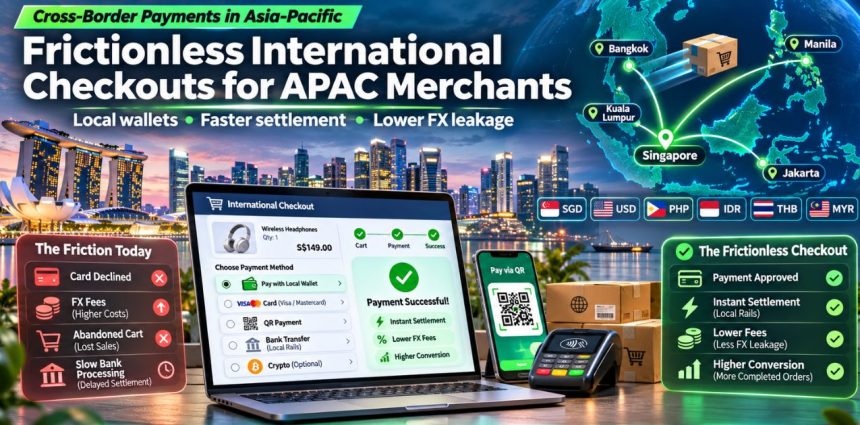
A Singapore brand can ship a parcel to Manila in two days. The payment? Slower, and pricier than it should be. Foreign cards bounce. Banks skim a bit on conversion. Processors tack on their own charge. By the time the order is packed, a fair chunk of profit has leaked away. So here’s a look at where APAC checkouts tend to snag, what helps, and what deserves a second look before a new payment option goes live.
Why Cross-Border Checkouts Fail for APAC Sellers
Here’s a familiar scene. A shopper in Jakarta fills a cart on a Singapore skincare site, reaches the payment page and sees prices in SGD, a card form and nothing else. No e-wallet. No bank transfer. Two seconds later, the tab disappears, and the analytics log one more abandoned cart.
Price is rarely the reason people quit at that last step. Habit is. In Indonesia, Vietnam and the Philippines, plenty of people pay with GoPay, MoMo or GCash every day and barely touch a credit card. Show them only a Visa form and many simply leave. A smaller group of buyers holds crypto, and some merchants add it too; this walkthrough explains how to accept crypto payments.
And the fees. Processors charge extra when the card is foreign. Then the bank adds its markup for swapping currencies. And if a buyer in Perth swears the parcel never came? Weeks of emails. Often the shop loses anyway. Each slice looks small. Stacked together on a S$40 order, they are not.
Singapore as a Fintech Hub: What the Rules Look Like
Singapore didn’t become a regional payments base by accident. Since 2020, e-wallets, remittance companies and crypto exchanges here have worked under one law, the Payment Services Act, and MAS (the Monetary Authority of Singapore) hands out the licences. In return, it wants client money kept apart, customers checked, and systems that don’t crash on a busy Friday.
Why should a small online shop care? Simple. The provider holding a merchant’s settlement money matters. Checking whether a payment partner is licensed or exempt in Singapore, and under which category, takes ten minutes on the MAS Financial Institutions Directory. Skipping that step is how businesses end up with frozen funds and no one to call.
MAS also keeps a cautious line on retail crypto. Token firms aren’t supposed to advertise in public spaces like MRT stations, and the regulator keeps reminding people that prices can crash. Any merchant looking at digital assets should read those warnings first. Seriously.
QR Payments and Local Rails: The Quiet Workhorses
Ask a hawker in Tiong Bahru how most customers pay now. The answer is usually a QR code taped to the counter.
SGQR merged dozens of separate codes into one label back in 2018. Then PayNow got linked to its neighbours. Thailand’s PromptPay came first, in 2021. India’s UPI and Malaysia’s DuitNow followed in 2023. Today a phone number is often enough to send money between these countries, and it lands in seconds. A wire used to take days.
Online shops can borrow the idea. People trust what they already use at home, so adding:
- PayNow for Singapore buyers
- DuitNow for Malaysian shoppers
- PromptPay for Thai customers
- QRIS for Indonesia
- GCash and Maya for the Philippines
often lifts sales more than a new website design would. Money usually arrives faster, and fees are lower than on international cards. Not always, though. A lot depends on the provider and the country pair.
There’s a bigger project in the background too. Project Nexus, started by the BIS Innovation Hub with MAS among the early partners, aims to connect domestic instant payment systems through a single shared platform instead of hundreds of separate bilateral deals. It’s not live for merchants yet. Worth watching, though.
Multicurrency Cards and Accounts
Not every sale is regional. An Australian buyer or a German distributor will still pay by Visa or Mastercard, and that’s fine.
The question is who absorbs the conversion. Multicurrency merchant accounts let a business price in AUD, USD or EUR, collect in that currency and convert later on its own terms. The buyer sees a familiar number. The seller avoids converting every single transaction at a bad rate.
Multicurrency corporate cards solve the other side: paying suppliers in Shenzhen or software vendors in the US without bleeding money on FX markups each time. Sounds minor? For a business importing stock monthly, the gap between a 3% card markup and a near-market rate adds up to real money by December.
A few things to check before signing up:
- Which currencies can be held, not just accepted
- How payouts to a Singapore bank account are priced
- Whether dynamic currency conversion is forced on buyers (it often annoys them)
- Chargeback handling for foreign cards
Crypto Checkouts: A Niche Option, Not a Default
Now crypto. Lots of noise around it, honestly. In practice, merchants mostly deal with stablecoins like USDT or USDC, which track the US dollar. They help in a few situations. A distributor in Dhaka whose bank transfer takes a week. A gamer in Vietnam with tokens already sitting in a wallet. A market where foreign cards keep bouncing.
What works in their favour is speed and the absence of chargebacks. Settlement can happen in minutes, any day of the week. Sounds great, until a customer wants a refund. Then someone on the team sends the money back by hand.
There are catches. Bitcoin can drop several percent in an hour, right between the buyer paying and the merchant converting. The accountant will have questions too, and the IRAS guidance on digital tokens is worth a proper read. And regulatory expectations keep shifting across the region.
That’s why most sellers don’t keep the coins. A processor swaps them into dollars or euros straight away, so the business never really sits on crypto. The Inqud crypto payment gateway is one example of this model, with acceptance, conversion and payouts handled in one place.
Who actually needs it? Not a bakery delivering cakes around Bedok. A SaaS firm billing clients in a dozen countries, maybe.
Building a Checkout Mix That Fits
Every shop’s list will look a bit different. Here’s roughly where to start:
- Open the analytics. Which countries bring visitors, and where do carts get dropped? The report is already sitting there.
- Then add what locals use. QR and wallet options for the top two or three markets usually bring the fastest gains.
- Fix FX leakage. Multicurrency accounts pay off once foreign sales become regular.
- Add niche methods carefully. Crypto or BNPL can wait until customers actually ask for them in emails or reviews.
- Test the checkout from abroad. A VPN and a foreign card reveal broken flows fast.
And keep the page short. Every extra field is another reason to leave.
Conclusion
Nobody needs every payment button on the market. Shoppers need the two or three they already use. Add visible FX costs and a licensed provider, and much of the friction disappears. Singapore merchants start ahead here, since PayNow already connects to Thailand, India and Malaysia. What’s left is the boring work on the payment page. Field by field.
Read Next: F&O Build-Up Nov 11: 108 Stocks Show Long Signals as Nifty Closes Above 25,250