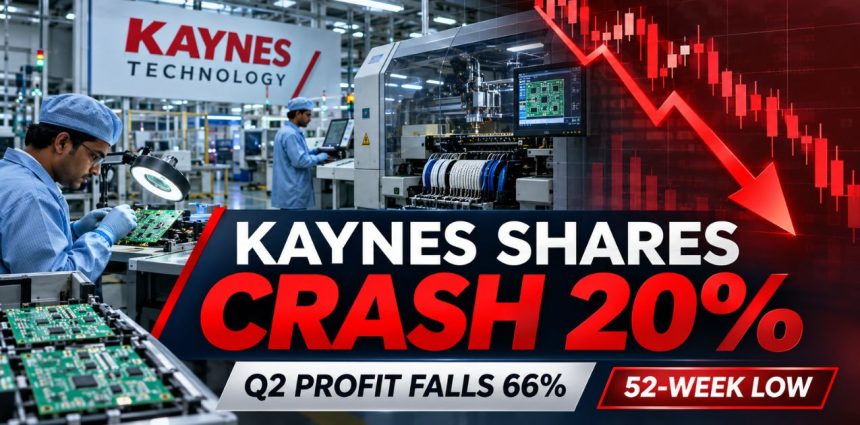
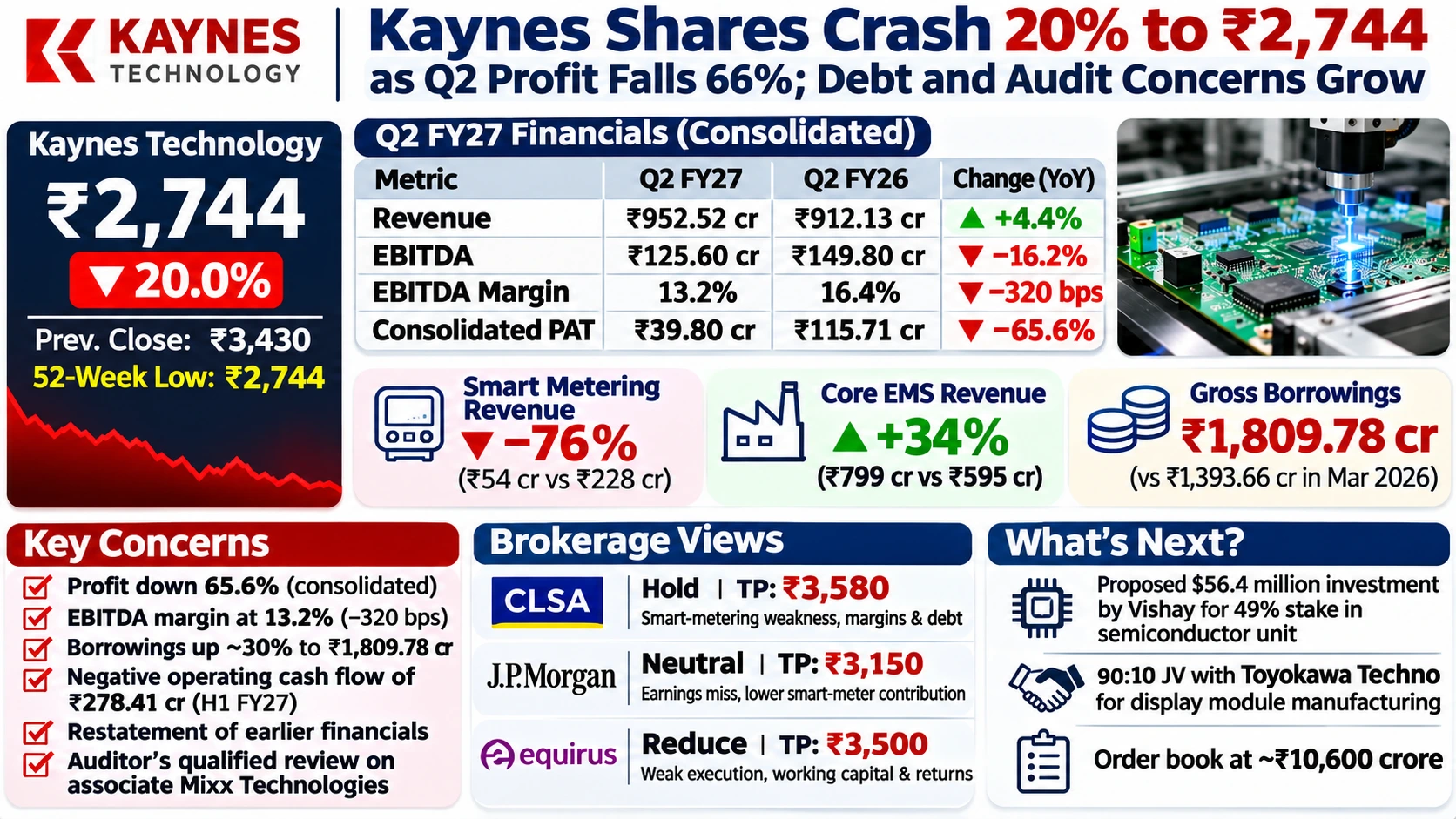
Kaynes Technology shares hit a fresh 52-week low of ₹2,744 on Monday, November 16, falling 20% from their previous close after the electronics manufacturing company reported a 65.6% decline in consolidated Q2 FY27 profit. Revenue increased just 4.4%, while EBITDA margin contracted to 13.2%.
A sharp fall in smart-metering revenue, higher gross borrowings, negative operating cash flow and restatements of previous financial statements have added to investor concerns. CLSA, JPMorgan and Equirus Securities also highlighted weaknesses in the company’s financial performance and reporting.
Shares of Kaynes Technology India plunged on Monday, November 16, after the company’s September-quarter results exposed a sharp deterioration in consolidated profitability and raised fresh questions about cash generation, borrowings and historical financial reporting.
The stock opened 10% lower at ₹3,087 on the NSE against Friday’s closing price of ₹3,430. Selling pressure intensified after trading resumed following the circuit breaker, taking shares to an intraday low of ₹2,744, representing a fall of as much as 20% and marking a fresh 52-week low.
At 10:51 a.m., an NSE market snapshot showed the shares at ₹2,948, down 14.05%. Business Today’s subsequent 11:46 a.m. update quoted the stock at ₹2,780, down approximately 19%. These are time-specific intraday observations; ₹2,744 remained the reported session low, not the closing price.
The selloff followed a disappointing Q2 FY27 performance, with lower smart-metering activity, contracting operating margins and a substantial increase in reported borrowings adding to investor concerns. The restatement of earlier financial statements and a qualified conclusion in the consolidated auditor’s limited-review report have created another layer of scrutiny.
Track Live: KAYNES TECHNOLOGY INDIA Options Chart | Nifty Trader
Kaynes Technology Q2 Results: Revenue Rises 4.4%, Profit Falls 65.6%
Kaynes Technology reported consolidated revenue from operations of ₹952.52 crore in Q2 FY27, compared with ₹912.13 crore in the corresponding quarter last year.
However, profitability weakened considerably as operating expenses and finance costs increased.
| Financial metric | Q2 FY27 | Q2 FY26 | YoY change |
|---|---|---|---|
| Revenue | ₹952.52 cr | ₹912.13 cr | +4.4% |
| EBITDA | ₹125.60 cr | ₹149.80 cr | -16.2% |
| EBITDA margin | 13.2% | 16.4% | -320 bps |
| Consolidated PAT | ₹39.80 cr | ₹115.71 cr | -65.6% |
| PAT margin | 4.2% | 12.7% | -850 bps |
An important distinction exists between total consolidated profit and profit attributable to shareholders. Total consolidated PAT declined 65.6% to ₹39.80 crore, while profit attributable to owners of the parent stood at ₹45.42 crore, against ₹118.23 crore a year earlier, a decline of approximately 61.6%.
The difference arises from losses attributable to non-controlling interests. Both figures are valid, but they represent different reporting measures.
Another concern was the movement in finance costs, which increased approximately 191% to ₹38.7 crore from ₹13.3 crore. Other income declined 45.5% to ₹18.62 crore from ₹34.08 crore.
For H1 FY27, consolidated revenue increased 17.9% to ₹1,898.7 crore, but EBITDA grew only 3.4% to ₹268.1 crore. Consolidated PAT declined 53.3% to ₹85.2 crore, while the EBITDA margin contracted to 14.1% from 16.1%.
The results highlight a growing gap between revenue expansion and earnings generation.
Smart Metering Revenue Falls 76% Despite 34% Core EMS Growth
The contrasting performance of Kaynes’ core electronics manufacturing services (EMS) and smart-metering businesses has emerged as a major factor behind the consolidated earnings disappointment.
According to management’s November earnings-call commentary, core EMS revenue, excluding smart metering, increased 34% to ₹799 crore in Q2 FY27 from ₹595 crore a year earlier.
In comparison, smart-metering revenue declined to ₹54 crore from ₹228 crore, a fall of approximately 76%.
Management said the reduction in smart-metering activity was deliberate, as the company prioritised collections, receivables management and balance-sheet discipline over near-term revenue growth.
There has been some progress in collections. Smart-metering receivables declined to ₹1,091 crore from ₹1,402 crore in the previous quarter.
Management indicated that it was targeting a further reduction in smart-metering receivables before restoring higher production levels.
The strategy presents a trade-off. Reducing exposure to a working-capital-intensive business could improve cash conversion, but lower smart-metering revenue also affects consolidated growth and the revenue mix.
The decline in a business that previously contributed meaningfully to consolidated profitability has therefore become an important concern for brokerages assessing Kaynes’ near-term earnings prospects.
Kaynes Technology Borrowings Rise to ₹1,810 Crore; ET Reports Net Debt of ₹1,728 Crore
The company’s restated consolidated balance sheet provides a clearer basis for assessing its borrowing position.
At September 30, 2026, non-current borrowings stood at ₹570.88 crore, while short-term borrowings amounted to ₹1,238.90 crore. Together, gross borrowings reached approximately ₹1,809.78 crore.
At March 31, 2026, non-current borrowings were ₹388.81 crore and short-term borrowings stood at ₹1,004.85 crore, taking total gross borrowings to approximately ₹1,393.66 crore.
Kaynes Technology’s restated consolidated balance sheet shows gross borrowings rising to approximately ₹1,810 crore at September-end from ₹1,394 crore in March 2026, an increase of approximately ₹416 crore. This comparison uses the restated March figures. It should not be confused with the much larger change in net debt reported by The Economic Times, which uses a different measure that has not been independently reconciled to the filing.
The company also reclassified certain bill-discounting and supplier-financing arrangements with borrowing-like obligations from trade-related balances into borrowings. This accounting change should be considered when interpreting its debt position.
The investor presentation also showed the consolidated net-debt-to-equity ratio at 0.3 times in H1 FY27, compared with 0.2 times in FY26.
Cash generation remains another concern. Consolidated net cash used in operating activities stood at ₹278.41 crore during H1 FY27, compared with an outflow of ₹404.18 crore in the corresponding period last year.
Although the operating cash outflow narrowed year-on-year, the business continued to consume cash from operations.
The company’s net working-capital days increased to 169 in H1 FY27 from 137 in FY26. This is a rolling 12-month measure adjusted for unutilised IPO and QIP proceeds, as specified in the investor presentation.
Also Check: KAYNES TECHNOLOGY INDIA Option Chain (NSE) — Live OI, PCR & Greeks
Financial Restatements: Earlier Accounting Errors Come Under Scrutiny
One of the most important disclosures in Kaynes Technology’s latest results package concerns the restatement of previous financial statements under Ind AS 8 following the identification of material prior-period errors.
The company corrected several accounting and reporting issues, including:
- Revenue recognised in certain earlier transactions before control of the goods had transferred to customers.
- Excess overhead costs incorrectly capitalised into inventory.
- Inadequate provisions for slow-moving and non-moving inventory.
- Corrections involving doubtful trade receivables and expected credit-loss provisions.
- Reclassification of certain bill-discounting and supplier-finance arrangements as borrowings where their nature represented financing obligations.
- Corrections involving employee incentives, interest income, tax-related entries and other financial-statement classifications.
These adjustments affected the presentation of historical revenue, expenses, inventory, borrowings, assets and earnings.
The impact differed between standalone and consolidated financial statements.
According to the company’s restated financial results, FY26 standalone PAT was revised down to approximately ₹182 crore from ₹254 crore.
In contrast, FY26 consolidated PAT was revised upwards to approximately ₹391.5 crore from ₹363.9 crore.
These figures are not contradictory. The first represents the standalone company, while the second includes its subsidiaries and associate-related accounting.
The restatements do not, by themselves, establish fraud or intentional wrongdoing. However, the nature and extent of the corrections make the consistency of historical financial reporting an important issue for investors.
Auditor’s Qualified Conclusion: Mixx Technologies Investment Under Scrutiny
Another significant disclosure appears in the independent auditor’s limited-review report on Kaynes’ consolidated financial results.
Walker Chandiok & Co LLP issued a qualified conclusion concerning the group’s investment in associate Mixx Technologies Inc.
The associate’s financial information had not been independently reviewed or audited by its auditors and had instead been furnished to Kaynes’ auditor by the holding company’s management.
The auditor stated that it could not perform alternative review procedures to support its conclusion on this information.
Consequently, it was unable to comment on possible adjustments relating to the group’s share of associate losses, the impact of a dilution gain, the carrying value of the investment as of September 30, 2026, and any consequential effect on the consolidated financial statements.
Kaynes recognised its share of Mixx Technologies’ net losses at ₹6.00 crore for Q2 FY27 and ₹10.44 crore for H1 FY27, based on the information available.
Importantly, the auditor’s standalone limited-review conclusion was unmodified. The qualification relates specifically to the uncertainty surrounding the associate’s financial information in the consolidated results.
The auditor also referred to the historical restatements but explicitly stated that its conclusion was not modified in respect of that matter.
The distinction is important: the qualified conclusion should not be presented as an adverse audit opinion on the entire company.
What CLSA, JPMorgan and Equirus Say on Kaynes Technology
The earnings disappointment, reported borrowing increase and accounting disclosures have attracted attention from multiple brokerages.
| Brokerage | Rating | Reported target price | Key concern |
|---|---|---|---|
| CLSA | Hold | ₹3,580 | EBITDA miss and smart-metering slowdown |
| JPMorgan | Neutral | ₹3,150 | Lower smart-metering contribution and working-capital pressure |
| Equirus Securities | Reduce | ₹3,500, under review | Financial restatements and auditor observations |
CLSA maintained its Hold rating, highlighting weaker-than-expected consolidated EBITDA and the reduced contribution from the smart-metering division.
The brokerage also noted stronger standalone performance, with revenue and EBITDA growth of approximately 43% and 46%, respectively, ahead of its estimates.
JPMorgan retained its Neutral rating, attributing the earnings disappointment primarily to lower smart-metering contributions as management focused on reducing net working-capital requirements.
The brokerage also highlighted uneven performance across business verticals. Automotive and railways showed stronger growth, while industrial, medical and IoT businesses faced weaker performance.
Equirus Securities retained its Reduce recommendation, with its ₹3,500 target price under review. Its concerns included the extent of prior-period accounting corrections and the implications of the consolidated auditor’s qualified conclusion.
These recommendations and targets are brokerage assessments reported by financial media, not company guidance or guaranteed future share-price outcomes.
Vishay and Toyokawa Joint Ventures Provide Longer-Term Growth Opportunities
Despite the immediate earnings concerns, Kaynes is continuing to expand its semiconductor and display-module manufacturing capabilities.
On November 12, Kaynes and Vishay Intertechnology entered into a binding term sheet for a proposed semiconductor back-end manufacturing joint venture in India.
Under the proposed arrangement, Vishay would invest $56.4 million for a 49% stake in an existing Kaynes subsidiary, while Kaynes would retain a 51% interest.
The venture is intended to establish semiconductor back-end manufacturing capabilities, including post-fabrication wafer processing, assembly, testing and packaging.
The transaction remains subject to definitive agreements, regulatory approvals and other customary closing conditions.
Separately, Kaynes approved the execution of a joint venture agreement with Toyokawa Techno Private Limited for TFT display-module manufacturing in India. Kaynes will hold 90% of the proposed venture, while Toyokawa will hold the remaining 10%.
These initiatives offer opportunities to expand the company’s manufacturing capabilities and move further up the electronics value chain. However, their eventual contribution to revenue and profitability will depend on investment, customer validation, execution and commercial ramp-up.
What Investors Will Watch Next
The immediate focus will be on whether Kaynes can improve consolidated profitability while reducing receivables and working-capital requirements.
Investors will also monitor the recovery of smart-metering activity, the conversion of its order book into revenue, operating cash generation and the management of its borrowing position.
The company’s Q2 press release reported an order book of ₹10,625.2 crore as of September 30, 2026. Its November investor-presentation chart displayed ₹10,563.5 crore for Q2 FY27. Both figures indicate an order pipeline of approximately ₹10,600 crore, although the difference between the two official disclosures warrants clarification.
Further management commentary on Mixx Technologies and the impact of historical accounting corrections will also remain important.
Bottom line: Kaynes Technology’s sharp share-price correction reflects more than a weak quarterly earnings report. Lower smart-metering revenue, contracting margins, negative operating cash flow, higher gross borrowings and material historical restatements have created several challenges for investors. Growth in the core EMS business, a sizeable order book and proposed semiconductor partnerships offer longer-term opportunities, but stronger cash conversion, profitability and financial-reporting clarity will be essential for rebuilding investor confidence.
Read Next: Stocks to Watch Today, Nov 16: Tata Motors PV, Kaynes, Eicher Motors and Paytm
Disclaimer: This article is for information and market awareness only and does not constitute investment advice or a recommendation to buy or sell any security. Brokerage ratings and target prices reflect analysts’ opinions and may change. Investors should independently review company disclosures and assess their individual risk tolerance before making investment decisions.