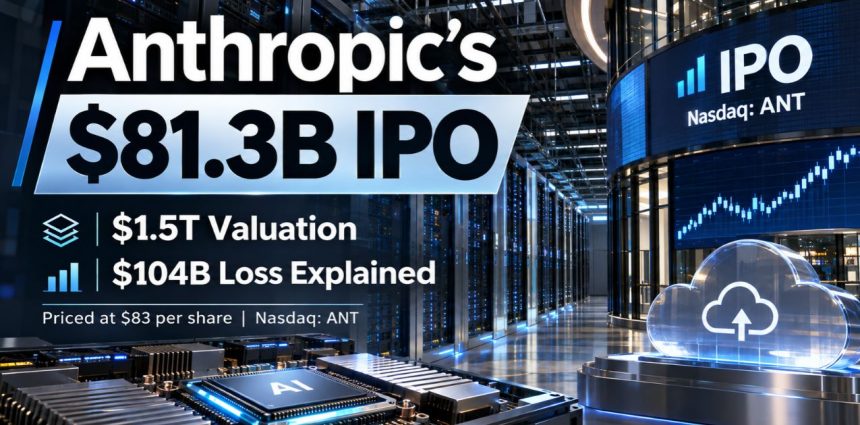
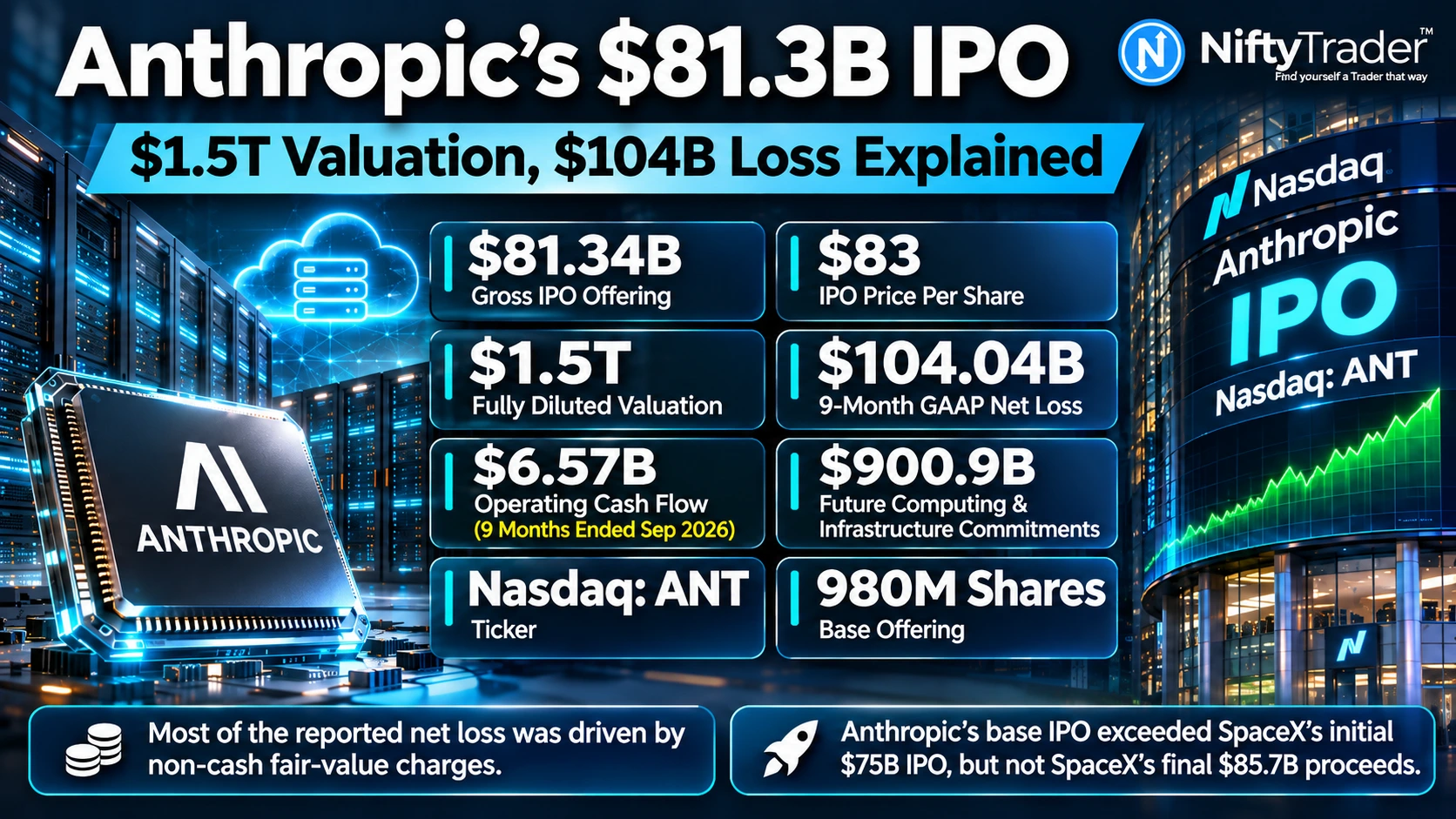
Anthropic has priced its IPO at $83 per share, giving its 980-million-share offering a gross value of $81.34 billion and valuing the Claude AI developer at approximately $1.5 trillion. However, its SEC prospectus reveals a $104.04-billion nine-month net loss, largely influenced by financing-related fair-value charges. The company also reported $6.57 billion in positive operating cash flow and disclosed nearly $901 billion in aggregate computing and infrastructure commitments.
November 19, 2026: Anthropic, the US artificial intelligence company behind Claude, has priced its initial public offering (IPO) at $83 per share, giving its 980-million-share base offering a gross value of approximately $81.34 billion. The transaction values the company at around $1.5 trillion on a fully diluted basis, setting up one of the most closely watched stock-market debuts of 2026.
The IPO price was above the company’s earlier proposed range of $70–$78 per share, signalling strong investor demand despite concerns about expensive AI infrastructure and the profitability of companies developing advanced artificial intelligence models.
Anthropic shares are scheduled to begin trading on the Nasdaq Global Select Market on Thursday, November 19, under the ticker symbol ANT, according to the company’s official IPO pricing announcement. The offering is expected to close on November 20, subject to customary conditions.
The enormous offering also brings an important financial question into focus: how should investors assess a company valued at $1.5 trillion when it reported a net loss exceeding $104 billion in the first nine months of 2026, despite generating positive operating cash flow?
Anthropic IPO: $81.34 Billion Offering Priced at $83 Per Share
Anthropic confirmed its final IPO pricing on November 18, expanding the offering from an earlier proposed 825 million shares to 980 million shares.
According to Anthropic’s official announcement and its November 17 amended SEC prospectus, the offering comprises:
| IPO detail | Confirmed information |
|---|---|
| IPO price | $83 per share |
| Shares offered | 980 million |
| Total gross offering value | $81.34 billion |
| Shares sold by Anthropic | 956.35 million |
| Shares sold by existing shareholders | 23.65 million |
| Fully diluted valuation | Approximately $1.5 trillion |
| Stock exchange | Nasdaq Global Select Market |
| Trading symbol | ANT |
| Expected trading debut | November 19, 2026 |
| Expected offering closing | November 20, 2026 |
| Additional underwriters’ option | 147 million shares |
The distinction between the shares sold by Anthropic and those sold by existing shareholders matters.
At the offer price, approximately $79.38 billion of gross proceeds relates to shares issued by Anthropic itself. The remaining approximately $1.96 billion represents shares sold by existing shareholders, including its seven co-founders.
Anthropic will not receive proceeds from these secondary share sales.
The company has also granted underwriters a 30-day option to purchase up to an additional 147 million shares. At $83 per share, full exercise could add approximately $12.2 billion to the public offering, taking its potential gross size to around $93.5 billion.
Did Anthropic’s IPO Really Surpass SpaceX?
Anthropic’s $81.34-billion offering exceeds the approximately $75 billion raised by Elon Musk’s SpaceX when it originally priced its IPO in June 2026.
However, there is an important qualification.
SpaceX subsequently raised approximately $85.7 billion after its underwriters exercised their overallotment option in full, according to the company’s official IPO closing announcement.
That means Anthropic has surpassed SpaceX’s original IPO offering, but its announced base proceeds remain below SpaceX’s final total following the additional share sale.
If Anthropic’s own 147-million-share overallotment option is fully exercised, the comparison could change, potentially taking its public offering above SpaceX’s completed proceeds.
The distinction matters because the size of an IPO at initial pricing and its final proceeds after additional share sales are not necessarily the same.
Anthropic Revenue Surges to $33.24 Billion, but Net Loss Crosses $104 Billion
Behind the extraordinary valuation is one of the fastest-growing businesses in the AI industry.
According to Anthropic’s SEC prospectus, revenue reached $33.24 billion during the nine months ended September 30, 2026, compared with $2.545 billion in the corresponding period in 2025.
That represents year-on-year growth of approximately 1,206%, as disclosed by the company.
However, Anthropic also reported a net loss of $104.039 billion for the nine-month period, compared with $25.107 billion a year earlier.
| Financial metric | Nine months ended Sep 30, 2025 | Nine months ended Sep 30, 2026 |
|---|---|---|
| Revenue | $2.545 billion | $33.242 billion |
| Operating loss | $5.224 billion | $1.260 billion |
| GAAP net loss | $25.107 billion | $104.039 billion |
| Net cash from operating activities | -$2.024 billion | +$6.569 billion |
Why the $104 Billion Loss Does Not Mean an Equivalent Cash Outflow
Anthropic’s SEC filing shows that approximately $94.324 billion of expenses during the nine-month period came from changes in the fair value of convertible notes, derivative liabilities and simple agreements for future equity (SAFEs).
The valuation-related charge increased substantially as the company’s estimated enterprise value rose. The company attributed much of the change to increases in the fair value of its outstanding convertible promissory notes.
This is a non-cash accounting adjustment and is not equivalent to Anthropic spending $94.324 billion in cash on everyday business operations.
The distinction is material because headline net losses can include accounting adjustments that do not represent immediate operating cash outflows.
Nevertheless, Anthropic still faces substantial expenses in developing, training and operating advanced AI models. The company reported a nine-month operating loss of approximately $1.26 billion, while its third-quarter operating loss was $567 million, reversing an operating profit of $974 million in the preceding quarter.
Positive Operating Cash Flow Offers a Different Financial Picture
The company’s cash-flow position presents a different picture from its headline net loss.
Anthropic reported $6.569 billion in net cash provided by operating activities for the nine months ended September 30, 2026, compared with approximately $2.024 billion used in operating activities during the corresponding period of 2025.
Anthropic attributed the improvement primarily to better earnings after adjusting for non-cash items, partly offset by a reduced contribution from working-capital movements. The large fair-value charges were excluded when reconciling reported net loss to operating cash flow.
However, positive operating cash flow does not mean the company is generating equivalent free cash flow. Anthropic continues to invest heavily in computing infrastructure, data centres and other long-term capacity requirements.
Investors should therefore assess the company’s operating cash generation alongside its infrastructure spending, investment requirements and future contractual commitments.
Claude Code and Enterprise AI Fuel Anthropic’s Growth
Anthropic’s expansion has been supported by growing demand for its Claude AI models and Claude Code, which helps developers perform software-engineering tasks using artificial intelligence.
Its SEC filing shows that more than 11,900 customers generated at least $100,000 each in trailing 12-month revenue as of September 30, 2026.
More than 1,900 customers generated at least $1 million each, while approximately 250 customers reached the $10-million level.
The company also disclosed that its annualised revenue run rate reached approximately $81 billion as of October 31, an increase of $10 billion from September 30.
An annualised revenue run rate is an estimate based on the pace of business at a particular point. It should not be confused with actual revenue earned over a full financial year or a guaranteed future revenue forecast.
The figures suggest expanding enterprise adoption, but continued growth will depend on customer demand, pricing, competition and Anthropic’s ability to deliver AI services economically.
Google, Microsoft, Nvidia and Other Technology Giants Back Anthropic
Anthropic’s IPO is also significant because of the financial connections between leading AI developers, semiconductor manufacturers and cloud-computing companies.
The SEC prospectus outlines a separate $26-billion private placement involving Google, Nvidia, AMD, Broadcom, Micron Technology, Microsoft and TSMC Partners.
The companies have agreed to purchase Anthropic’s Class N common stock at the IPO price, subject to the relevant closing conditions.
This private placement is separate from the $81.34-billion public offering and should not be counted as part of the IPO’s base proceeds.
At the $83 IPO price, the $81.34 billion public offering and the separately agreed $26 billion private placement represent approximately $107.34 billion in combined gross transaction value. This is not the same as the amount Anthropic will receive: the public offering includes secondary share sales, and the private placement remains subject to closing conditions.
The strategic relationship between Anthropic and major technology companies extends beyond equity investment. Cloud infrastructure, processors and computing capacity are central to developing and delivering its AI products.
The participation of major technology suppliers also highlights how closely connected AI model developers are becoming with the companies supplying the infrastructure needed to operate them.
Nearly $901 Billion in Computing Commitments Raise Questions
Anthropic’s expansion requires enormous computing capacity to train and operate increasingly capable AI models.
Its November 17 SEC prospectus disclosed approximately $900.9 billion in aggregate committed spending across purchase commitments and lease agreements as of and subsequent to September 30, 2026. Substantially all of the amount relates to computing and infrastructure.
The filing provides a breakdown of these commitments:
| Commitment schedule | Amount |
|---|---|
| Total aggregate committed spending | $900.9 billion |
| Expected before December 31, 2030 | $451.6 billion |
| Due in the 12 months following September 30, 2026 | $70.7 billion |
| Remaining commitments | Substantially all expected between 2031 and 2045 |
The $70.7 billion due within 12 months is already included in the $451.6 billion expected before the end of 2030. These figures are components of the $900.9 billion total, not additional commitments.
These commitments include short-term arrangements and leases that have not yet commenced. They should not be interpreted as an immediate cash payment or as expenditure that has already been incurred.
Anthropic also reported that computing and infrastructure expenses reached $18.808 billion during the first nine months of 2026, up 329% from $4.381 billion in the corresponding period of 2025.
The company said the increase was driven by the delivery of committed computing capacity, while $6.5 billion of computing during the nine-month period came from short-term commitments that currently cost significantly more than comparable capacity secured through multi-year arrangements.
The company also disclosed that, before accounting for proceeds from the IPO and concurrent private placement, it had approximately $146.6 billion in liquidity as of September 30, 2026. This included $95.6 billion in cash and cash equivalents, $36.3 billion in short-term investments and $14.8 billion in available credit-facility capacity.
However, the scale of future infrastructure commitments creates an important risk.
Anthropic’s revenue is primarily consumption-based, with much of it not covered by long-term customer commitments, while its computing and infrastructure obligations generally extend over multiple years.
If customer demand or revenue growth fails to keep pace with these commitments, the company could face higher financing requirements, underutilised infrastructure or pressure on future cash flows.
Why the Anthropic IPO Matters for Indian IT Stocks
Although Anthropic is listing in the United States, its IPO has a direct business connection to India’s technology-services industry, particularly Tata Consultancy Services (TCS).
Anthropic announced a global strategic partnership with TCS on June 12, 2026, to expand enterprise adoption of Claude.
Under the agreement, TCS will provide Claude to 50,000 of its employees across 56 countries, build Claude-powered products for clients and join the Claude Partner Network.
The partnership also involves creating solutions for financial services, healthcare, the public sector and other regulated industries. TCS is developing a dedicated practice involving consultants, engineers and industry specialists to design and operate Claude-based systems for enterprise customers.
Anthropic also identified India as its second-largest market for Claude.ai in its February 2026 announcement about opening its Bengaluru office.
For Indian IT companies, Anthropic’s listing could renew investor attention on enterprise AI spending, software-development automation and demand for AI integration services.
These developments may create opportunities for companies such as TCS, Infosys, HCL Technologies and Wipro, while also putting pressure on traditional software-development pricing and delivery models.
However, TCS has not disclosed a specific revenue contribution from its Anthropic partnership. The IPO should therefore not be interpreted as a direct or guaranteed earnings catalyst for Indian IT stocks.
Investors tracking the sector can monitor Nifty IT performance and constituent stocks alongside company earnings, management commentary and order announcements.
What Investors Should Watch When ANT Begins Trading
The first trading session will provide a clearer indication of how public-market investors value Anthropic after its large-scale fundraising.
One immediate factor will be the opening share price relative to the $83 IPO price. Investors will also monitor trading volumes, the company’s valuation after listing and whether demand for AI-related equities remains strong amid concerns about heavy capital expenditure.
Beyond the initial listing reaction, the more important financial measures will include revenue growth, operating margins, computing costs, operating cash flows and the company’s ability to convert enterprise demand into sustainable profits.
Anthropic’s IPO demonstrates the enormous amounts of capital investors are willing to commit to frontier AI development. But its financial disclosures also underline the scale of investment required to remain competitive.
The larger question is whether Anthropic can convert exceptional revenue growth and positive operating cash flow into lasting profitability while meeting its extensive computing commitments. The Nasdaq debut will test market appetite for that prospect, but it will not settle the question on its own.
Read Next: Anthropic’s $81.3B IPO: $1.5T Valuation, $104B Loss Explained
Disclaimer: This article is for informational and educational purposes only and does not constitute investment advice or a recommendation to buy, sell or hold any securities. Investors should independently verify financial disclosures, assess market risks and consult a SEBI-registered investment adviser before making investment decisions.