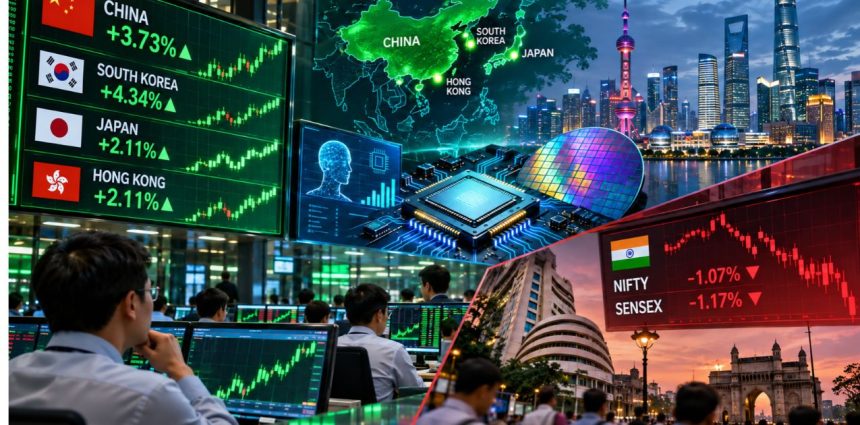
China’s semiconductor-led rally and Wall Street’s strong recovery provide positive global cues for Nifty, but elevated crude oil prices, a weakening rupee and upcoming monetary policy decisions remain key risks.
Asian stock markets staged a powerful recovery on Friday, November 27, as Beijing pledged stronger capital market support, semiconductor shares rebounded and investors returned to technology stocks following weeks of valuation-driven selling.
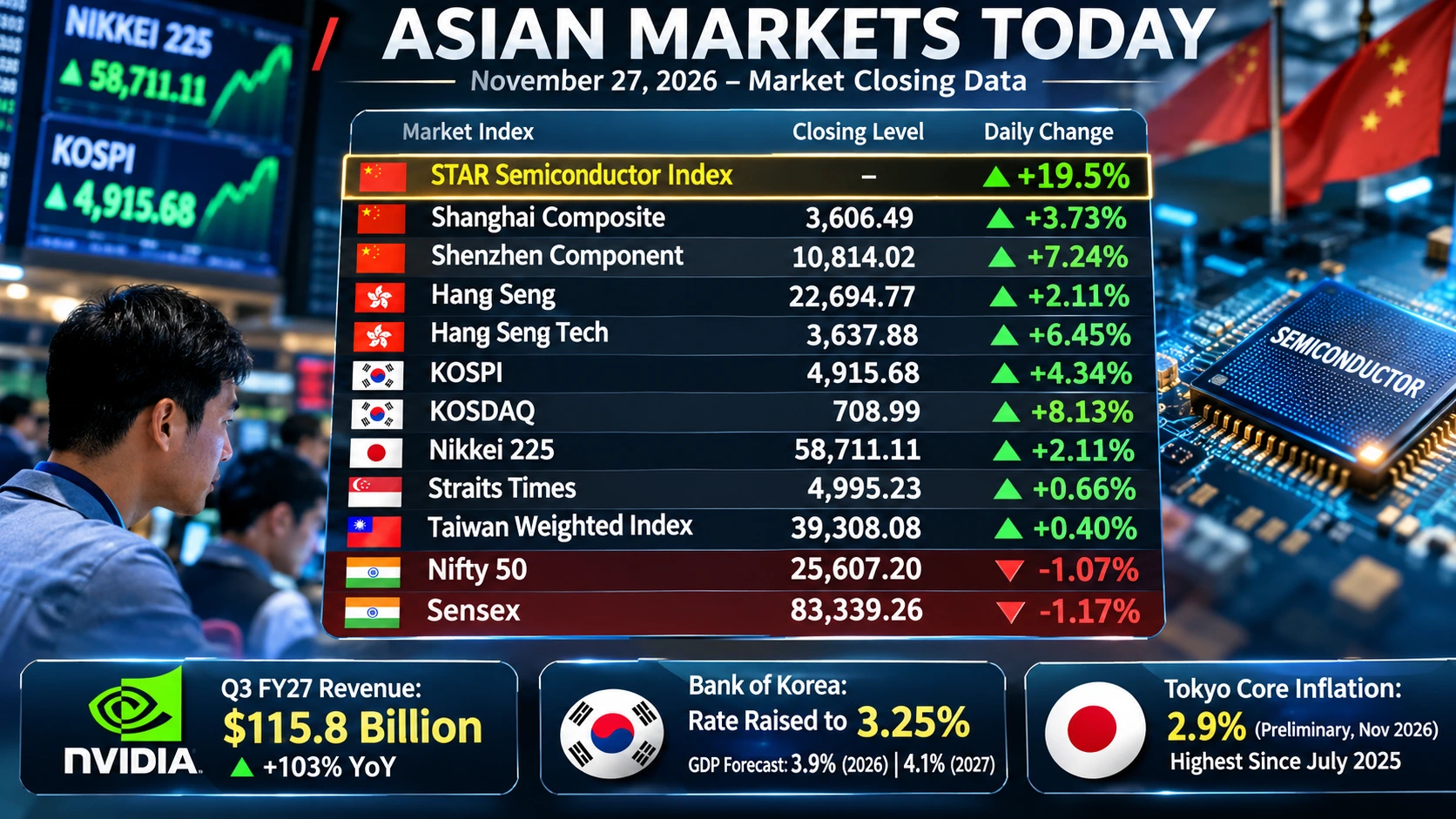
China’s STAR Semiconductor Index surged 19.5%, South Korea’s KOSPI jumped 4.34%, while the Shanghai Composite rallied 3.73%. Japan’s Nikkei 225 and Hong Kong’s Hang Seng advanced 2.11% each.
The recovery subsequently extended to Wall Street, where the Nasdaq Composite climbed 2.31% and the Dow Jones gained nearly 592 points.
Indian equities, however, moved against the global trend. The Sensex plunged 989.33 points, while the Nifty 50 declined 277.30 points to 25,607.20.
With major stock exchanges closed on Saturday, investors are assessing whether the international recovery can support Indian equities when trading resumes on Monday, November 30.
Track Live: NiftyTrader: Live Options Analytics & F&O Trading Tools
Asian Markets Today: Latest Market Closing Data
Asian equities recorded widespread gains on Friday, with Chinese technology shares and South Korean growth stocks leading the recovery.
| Benchmark Index | Closing Level | Daily Change |
|---|---|---|
| South Korea KOSDAQ | 708.99 | +8.13% |
| Shenzhen Component | 10,814.02 | +7.24% |
| Hang Seng Tech | 3,637.88 | +6.45% |
| South Korea KOSPI | 4,915.68 | +4.34% |
| Shanghai Composite | 3,606.49 | +3.73% |
| Japan Nikkei 225 | 58,711.11 | +2.11% |
| Hong Kong Hang Seng | 22,694.77 | +2.11% |
| Singapore Straits Times | 4,995.23 | +0.66% |
| Taiwan Weighted Index | 39,308.08 | +0.40% |
| India Nifty 50 | 25,607.20 | -1.07% |
| India Sensex | 83,339.26 | -1.17% |
Source: BNR Securities, Morningstar, StockQ, Korean market reports and Indian financial media. Data as of November 27, 2026.
The divergence between Indian and other Asian equities highlights the growing influence of semiconductor investment, domestic policy developments and energy prices on regional capital flows.
China’s STAR Semiconductor Index Surges 19.5% After Beijing’s Policy Support
China emerged as the biggest catalyst behind Friday’s regional market rebound after authorities signalled stronger intervention to stabilise domestic equities.
In its official November 27 announcement, China’s State Council confirmed that Premier Li Qiang chaired a meeting addressing capital market reforms and measures to improve financial market stability.
The government emphasised strengthening the role of state-backed investment institutions, encouraging listed companies to increase dividends and share buybacks, and attracting long-term capital from insurance and social security funds.
The announcement triggered aggressive buying across technology shares.
| Chinese Market Indicator | Daily Gain |
|---|---|
| STAR Semiconductor Index | 19.5% |
| STAR 50 Index | Approximately 15% |
| Shenzhen Component | 7.24% |
| Hang Seng Tech | 6.45% |
| CSI 300 | Approximately 4.2% |
| Shanghai Composite | 3.73% |
According to Reuters, the semiconductor index recorded a near-record daily advance, while the broader mainland benchmarks posted their strongest gains in over two years.
For Indian investors, a Chinese equity recovery presents a mixed opportunity. Improving Chinese demand could benefit commodity producers, while renewed foreign interest in Chinese technology shares could increase competition for international portfolio capital.
China’s Industrial Profits Rise 16% as Electronics Earnings Double
Fresh economic data provided additional support to China’s technology-led recovery.
According to official government statistics released on November 27, profits at Chinese industrial enterprises above the designated size increased 16% year-on-year during January–October 2026.
| Economic Indicator | YoY Growth |
|---|---|
| January–October industrial profits | 16.0% |
| January–September industrial profits | 15.5% |
| October industrial profits | 20.1% |
| September industrial profits | 14.4% |
| January–October electronics profits | 100% |
The electronics industry contributed 9.7 percentage points to overall industrial profit growth, supported by demand for AI computing infrastructure, memory chips and related manufacturing activities.
Although the figures indicate strengthening profitability in advanced manufacturing, they do not necessarily signal an equally strong recovery across China’s property, construction and consumer sectors.
For Indian metal companies, sustained improvement in Chinese industrial activity could become a positive demand catalyst.
South Korea’s KOSPI Jumps 4.34%, KOSDAQ Surges 8.13% Despite Rate Hike
South Korean equities recorded substantial gains amid renewed semiconductor buying and expectations of additional market-stabilisation measures.
Samsung Electronics and SK Hynix were among the major contributors to the recovery.
| South Korean Stock | Friday’s Closing Price | Daily Gain |
|---|---|---|
| Samsung Electronics | ₩179,100 | +4.55% |
| SK Hynix | ₩1,110,000 | +5.41% |
The rally followed the Bank of Korea’s decision on November 26 to raise its benchmark interest rate by 25 basis points to 3.25%.
The central bank also substantially upgraded its economic growth forecasts.
| Economic Indicator | Previous Forecast | Revised Forecast |
|---|---|---|
| 2026 GDP growth | 3.3% | 3.9% |
| 2027 GDP growth | 2.9% | 4.1% |
| Benchmark interest rate | 3.00% | 3.25% |
Source: Bank of Korea’s official monetary policy announcement and Aju Press.
South Korea’s performance reflects how improving semiconductor demand and stronger economic expectations can support equity markets despite rising borrowing costs.
Japan’s Nikkei Gains 1,212 Points as Tokyo Core Inflation Hits 16-Month High
Japan’s Nikkei 225 climbed 1,211.95 points to 58,711.11, despite fresh inflation figures strengthening expectations of further monetary tightening.
According to the official preliminary Tokyo CPI report, released on November 27:
| Tokyo Inflation Indicator | November 2026 |
|---|---|
| Headline CPI | 2.8% |
| CPI excluding fresh food | 2.9% |
| CPI excluding fresh food and energy | 2.5% |
Tokyo’s core inflation accelerated from 2.6% in October to its highest level since July 2025, remaining above the Bank of Japan’s 2% inflation target for the third consecutive month.
Investors will closely monitor BOJ Governor Kazuo Ueda’s scheduled address to business leaders in Nagoya on November 30.
Further monetary tightening could strengthen the Japanese yen and influence global carry trades, potentially affecting liquidity and risk appetite across emerging markets, including India.
NVIDIA’s $115.8 Billion Revenue Keeps AI Investment in Focus
The recovery in Asian semiconductor shares comes amid significant corporate developments at NVIDIA, whose financial performance remains an important indicator of global AI infrastructure demand.
According to NVIDIA’s official third-quarter FY2027 results, announced on November 17:
| NVIDIA Financial Indicator | Reported Figure |
|---|---|
| Quarterly revenue | $115.8 billion |
| Year-on-year revenue growth | 103% |
| Quarter-on-quarter revenue growth | 20% |
| GAAP operating income | $77.5 billion |
Separately, NVIDIA confirmed through its SEC Form 8-K filing that its board reinstated Jensen Huang as president, CEO and board member on November 22.
These developments remain significant for Asian semiconductor manufacturers supplying the global AI ecosystem. Nevertheless, investors continue to assess whether future profitability can justify elevated technology-sector valuations.
Asian Markets Rebound, but November’s Technology Sell-Off Remains a Concern
Friday’s substantial recovery should be viewed against the broader market correction experienced during November.
According to Reuters’ November 27 global market report, South Korea’s KOSPI was approximately 14% lower for the month, Japan’s Nikkei around 9% lower and the MSCI All-World Index down approximately 5% at the time of reporting.
These figures represent reporting-time estimates rather than final November returns.
US monetary policy also remains a concern. The US 10-year Treasury yield was trading around 4.90%, while interest rate futures indicated a 99% probability of a December Federal Reserve rate increase at the time of Reuters’ report.
The combination of higher bond yields and expensive technology valuations could limit the sustainability of the current recovery.
Wall Street Rally Strengthens Global Cues for Monday
US equities finished Friday’s holiday-shortened trading session with strong gains, completing their best week in more than a year.
| US Benchmark | Closing Level | Daily Change | Weekly Change* |
|---|---|---|---|
| Dow Jones | 50,774.94 | +1.18% | +5.5% |
| S&P 500 | 7,297.49 | +1.60% | +5.6% |
| Nasdaq Composite | 24,129.50 | +2.31% | +6.7% |
Weekly returns rounded. Source: Associated Press.
The strong US market finish provides encouraging international cues for Monday. However, investors will need to assess whether the buying momentum continues when normal trading volumes resume following the Thanksgiving holiday.
Brent Crude at $95.44, Rupee Weakens to 92.99 Against US Dollar
Despite improving global equity sentiment, elevated energy prices and currency depreciation remain important risks for Indian markets.
| Global Market Indicator | Latest Value |
|---|---|
| Brent crude futures | $95.44/barrel |
| WTI crude futures | $83.08/barrel |
| Brent weekly change | Approximately +3% |
| USD/INR | 92.99 |
| Rupee’s daily change | -0.60% |
Brent crude recorded its first weekly gain in November amid concerns over Middle East supply disruptions. Meanwhile, the rupee weakened on Friday despite substantial foreign equity inflows during the month.
Persistent crude oil strength could increase India’s import expenditure, while currency depreciation may raise operating costs for import-dependent companies.
Investors are now monitoring Sunday’s OPEC+ ministerial meeting for indications regarding future production and supply policy.
Why Did Nifty and Sensex Fall Despite the Asian Market Rally?
Indian equities ended Friday sharply lower, snapping a four-week winning streak as IT, automobile and realty stocks came under pressure.
However, metals and broader-market indices demonstrated relative resilience.
| Indian Market Indicator | Friday’s Performance |
|---|---|
| Sensex | -1.17% |
| Nifty 50 | -1.07% |
| Nifty IT | -1.88% |
| Nifty Auto | -1.48% |
| Nifty Realty | -1.43% |
| Nifty Metal | +1.40% |
| Nifty Midcap 100 | Approximately +0.1% |
| Nifty Smallcap 100 | +0.57% |
Meanwhile, provisional combined cash-market data across NSE, BSE and MSEI showed that foreign institutional investors remained net buyers.
| Institutional Activity | November 27 |
|---|---|
| FII/FPI net buying | ₹1,634.33 crore |
| DII net selling | ₹556.42 crore |
| Combined net buying | ₹1,077.91 crore |
Sources: Upstox, India Today, Moneycontrol, Economic Times and NSE institutional trading activity.
The divergence between falling benchmarks and improving broader-market breadth suggests that selling pressure was concentrated in heavyweight stocks rather than distributed uniformly across the market. However, this does not establish a broad-based bullish trend.
5 Key Market Triggers Investors Should Watch Next Week
| Market Trigger | Date | Potential Impact |
|---|---|---|
| OPEC+ ministerial meeting | November 29 | Crude oil and energy stocks |
| BOJ Governor Ueda’s address | November 30 | Yen and global liquidity |
| Global technology momentum | November 30 | IT and semiconductor sentiment |
| India’s Q2 FY27 GDP and IIP release event | November 30 | Domestic growth outlook |
| RBI monetary policy meeting | December 2–4 | Banking stocks and liquidity |
India’s Ministry of Statistics and Programme Implementation has scheduled a press conference covering second-quarter GDP estimates and October industrial production for November 30 at 4:30 PM IST.
Since the event is scheduled after regular market hours, Monday’s trading session could largely reflect investor expectations ahead of the announcement.
Asian Market Outlook: Can Nifty Recover on Monday?
China’s semiconductor rally, South Korea’s strong recovery and Wall Street’s positive finish offer encouraging global cues ahead of Monday’s session.
For the Nifty 50, 25,600 remains an immediate psychological reference point, while 26,000 represents a potential upside milestone. Neither should be interpreted as confirmed technical support or resistance.
The sustainability of any recovery will depend on crude oil prices, currency movements, institutional participation and upcoming economic releases.
The biggest question for investors is whether Friday’s global technology rally marks the beginning of a sustainable recovery or merely a temporary rebound following November’s sharp correction.
Read Next: F&O Buildup Report Nov 27: 101 Short Signals as Nifty Falls 277 Points
Disclaimer: This article is for informational and educational purposes only and does not constitute investment advice. Market data reflects the latest available figures as of November 27, 2026, and is subject to revision. Investors should conduct independent research or consult a SEBI-registered investment adviser before making investment decisions.