HFCL’s profit jumped 448% year-on-year as revenue, margins and its order book climbed. But the next test is whether its telecom-led growth can translate into sustained earnings and cash generation.
October 19, 2026
HFCL’s September-quarter results point to more than a sharp recovery in earnings. They show a business increasingly driven by telecom products, optical-fibre cables and connectivity infrastructure, including equipment used in data-centre networks.
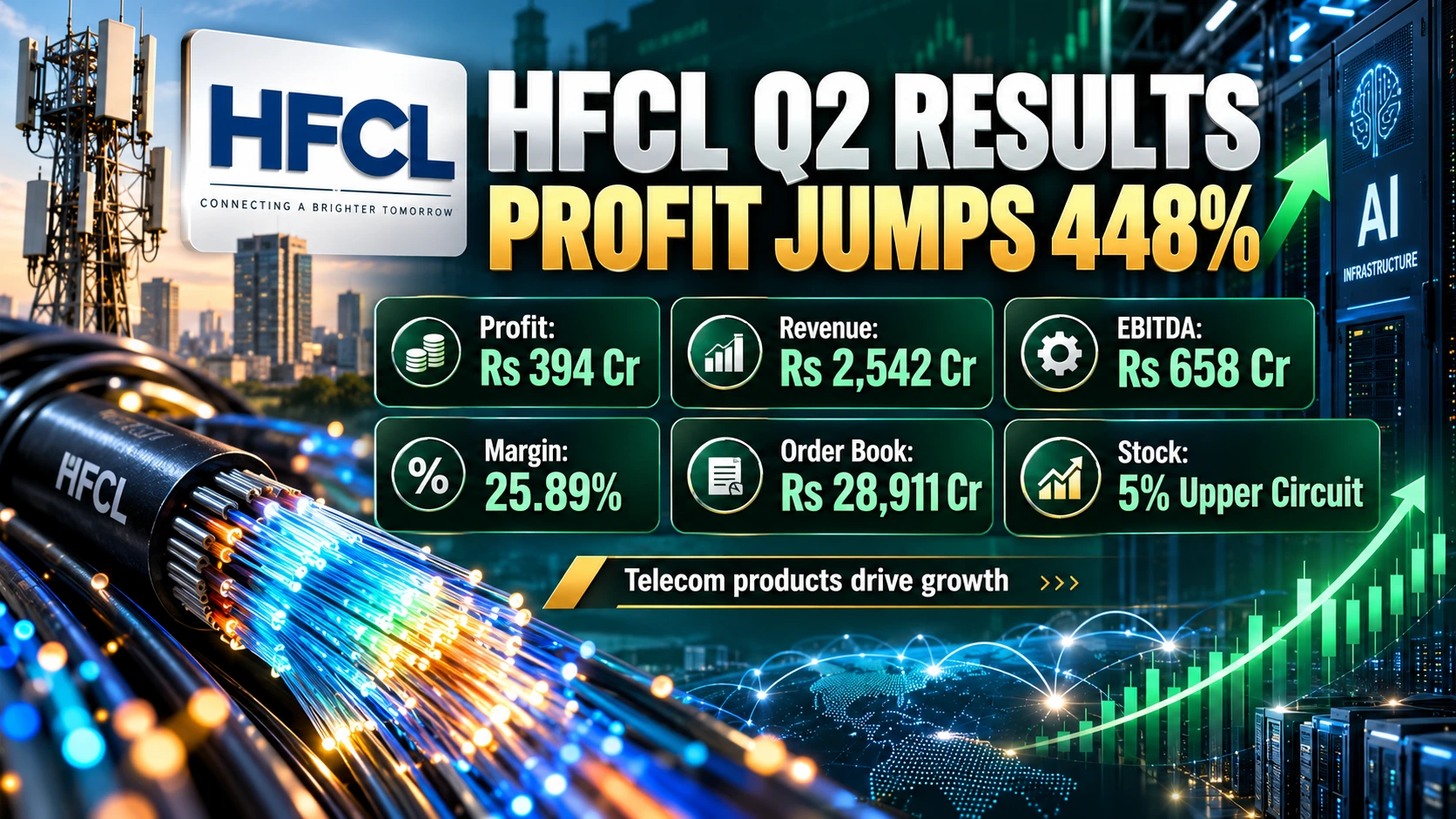
The company reported consolidated profit after tax (PAT) of ₹394.22 crore in Q2 FY27, up 448.14% from ₹71.92 crore a year earlier. Revenue from operations rose 143.62% to ₹2,541.79 crore, while EBITDA climbed 223.55% to ₹658 crore. The EBITDA margin expanded to 25.89% from 19.49% a year ago.
The sequential performance was also strong: revenue increased 32.73% from Q1 FY27, while PAT rose 60.49%. That matters because it suggests the latest quarter’s momentum was not driven only by comparison with a weaker year-ago period.
Yet the more important question for investors is what sits behind the numbers. Telecom Products generated most of the quarter’s revenue, while Turnkey Contracts and Services remained loss-making at the segment level. HFCL’s record order book and planned capacity expansion provide a potential growth runway, but execution, working capital and the sustainability of margins will determine how much of that opportunity reaches the bottom line.
Track Live: HFCL Ltd Futures — Live Price, OI & Basis
HFCL Q2 FY27 results: Key numbers
| Consolidated metric | Q2 FY27 | Change |
|---|---|---|
| Revenue from operations | ₹2,541.79 crore | +143.62% YoY |
| Profit after tax | ₹394.22 crore | +448.14% YoY |
| EBITDA | ₹658 crore | +223.55% YoY |
| EBITDA margin | 25.89% | Up 640 bps YoY |
| Revenue from operations in Q1 FY27 | ₹1,914.98 crore | +32.73% QoQ |
| PAT in Q1 FY27 | ₹245.64 crore | +60.49% QoQ |
| Order book at quarter-end | ₹28,911 crore | Up from ₹26,665 crore in Q1 |
YoY: year-on-year; QoQ: quarter-on-quarter. Figures are consolidated unless stated otherwise.
1. Sequential growth strengthens the earnings story
HFCL’s Q2 numbers were materially higher than its Q1 FY27 performance. Revenue rose from ₹1,914.98 crore to ₹2,541.79 crore, while PAT increased from ₹245.64 crore to ₹394.22 crore. 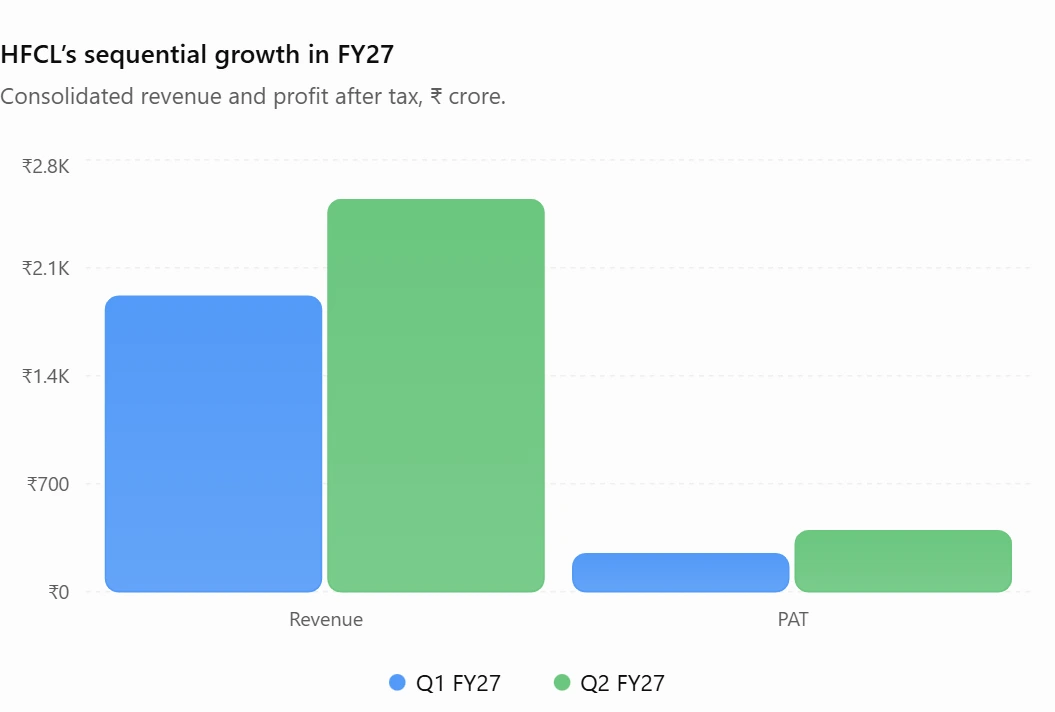
HFCL’s sequential growth in FY27 Revenue grew 32.73% sequentially, but profit grew faster at 60.49%. EBITDA also increased from ₹445.27 crore in Q1 to ₹658 crore in Q2, lifting the margin from 23.25% to 25.89%.
That combination—higher sales and stronger margins—helps explain why earnings grew faster than revenue. It is a more useful signal than the year-on-year profit jump alone, although one quarter cannot establish that the improved margin level will persist.
The comparison also needs context. Q2 FY26 revenue was ₹1,043.34 crore, and PAT was ₹71.92 crore, making the year-on-year growth rates particularly large. The sequential improvement shows that the quarter was strong against both the year-ago base and the immediately preceding quarter.
2. Telecom Products now drive the business
The clearest change in HFCL’s Q2 performance is the weight of its Telecom Products segment.
| Segment | Q2 FY27 revenue | Q2 FY26 revenue |
|---|---|---|
| Telecom Products | ₹2,321.98 crore | ₹490.10 crore |
| Turnkey Contracts and Services | ₹136.07 crore | ₹506.77 crore |
| Defence Products and Services | ₹54.94 crore | ₹29.73 crore |
Telecom Products contributed roughly 91% of consolidated revenue in Q2 FY27. Revenue in the segment rose nearly 374% year-on-year, while segment profit before interest and tax increased to ₹716.24 crore from ₹122.54 crore.
Turnkey Contracts and Services moved in the opposite direction. Revenue fell to ₹136.07 crore from ₹506.77 crore, and the segment reported a loss before interest and tax of ₹122.58 crore.
This divergence is important. HFCL’s consolidated results reflect a much larger contribution from telecom products, but the performance of its other activities remains uneven. The improvement in the overall margin should therefore be assessed alongside the segment mix, not treated as proof that every part of the business has strengthened.
For investors, the key questions are whether telecom-product demand remains strong, whether the company can deliver orders on schedule, and whether losses in turnkey contracts can be contained.
3. Why AI infrastructure matters—but is not the whole story
HFCL is positioned to benefit from the physical connectivity required by expanding telecom networks, hyperscale data centres and AI computing infrastructure. Its exposure is through products such as optical-fibre cables and high-density connectivity equipment—not through AI software or semiconductor design.
As AI workloads expand, data centres need faster connections between servers, racks and facilities. Fibre infrastructure and high-capacity optical links are part of that network. This creates a potential demand opportunity for suppliers with suitable products, manufacturing capacity and customer relationships.
HFCL has also developed its connectivity portfolio for higher-speed data-centre environments, including 400G and 800G applications and future 1.6T networks. However, the company has not disclosed a separate AI-revenue figure in the Q2 results. It would therefore be misleading to attribute the entire rise in revenue or profit directly to AI demand.
A previously announced international optical-fibre cable agreement adds to the growth opportunity. The five-year arrangement, announced in March 2026, carried a potential value of about US$1.1 billion, or roughly ₹10,159 crore, with supply quantities expected across 2026–2028 and possible extensions into 2029–2030.
That figure needs careful interpretation. It represents potential contract value, not revenue already earned or a single unconditional purchase order. Orders are released periodically according to customer projects and specifications. The revenue actually recognised will depend on purchase orders, deliveries and execution over time.
The agreement strengthens HFCL’s international opportunity pipeline, but investors should track confirmed orders, exports and actual revenue conversion rather than treating the headline contract value as assured sales.
4. The ₹28,911 crore order book provides visibility—with conditions
HFCL’s order book stood at ₹28,911 crore at the end of Q2 FY27, up from ₹26,665 crore at the end of Q1 FY27 and ₹21,206 crore at the end of FY26. That represents growth of around 8.4% sequentially and 36% since the end of the previous financial year. The company has described its order book as providing six to seven years or more of revenue visibility.
The composition is as important as the headline number:
-
64% relates to optical-fibre cable and data-centre interconnectivity (OFC/DCI), linking the order book to the company’s fibre and connectivity opportunity.
-
57% is export-related, highlighting the importance of international customers and overseas demand.
-
Product orders account for approximately ₹19,751 crore, while operations and maintenance contribute around ₹5,070 crore and network orders about ₹4,090 crore.
The export share creates an opportunity to diversify beyond domestic demand, but it also makes delivery schedules, customer spending plans, competition and international market conditions relevant to future performance.
An order book is not the same as booked revenue. Its value becomes earnings only as orders progress through customer call-offs, production, delivery, acceptance and revenue recognition. Delays, changes in project requirements or cancellations can affect the timing and value of that conversion.
The more meaningful measure over the next few quarters will be how consistently HFCL turns this backlog into sales, operating profit and cash.
5. FY27 growth guidance and planned capacity expansion
HFCL expects revenue growth of at least 80% in FY27 over FY26, according to the company’s stated outlook. FY26 consolidated revenue was ₹4,949.27 crore, implying FY27 revenue of approximately ₹8,909 crore or more if the guidance is achieved.
H1 FY27 revenue was ₹4,456.77 crore, up 132.81% year-on-year. That is already about half of the revenue level implied by the full-year guidance, but the second half still needs to deliver substantial sales. H1 performance alone does not guarantee that the target will be met.
The company has also outlined investment of approximately ₹1,800 crore across optical-fibre, cable and preform manufacturing. Planned capacity expansion includes:
-
Optical-fibre capacity rising from 28 million fibre-kilometres a year to 43.1 million.
-
Optical-fibre cable capacity increasing from 39 million to 62 million fibre-kilometres.
-
Preform manufacturing capacity of 600 tonnes annually.
The targeted completion dates extend into 2028. The expansion could help HFCL serve larger orders and deepen manufacturing integration, but it also requires capital and timely execution. Investors should monitor capex spending, capacity utilisation, borrowing levels and the demand available to absorb the added capacity.
HFCL’s ambition to reach ₹10,000 crore in revenue by FY29 may be achieved earlier, according to management commentary, but that remains an ambition rather than a guaranteed outcome.
6. Cash flow and working capital: the test behind the profit
A sharp rise in reported earnings is more reassuring when it is accompanied by cash generation. For HFCL, this is an area that deserves close monitoring as the business scales.
The consolidated cash-flow statement reports net cash from operating activities of ₹139.77 crore for H1 FY27, compared with ₹81.60 crore in H1 FY26. These figures should be used rather than the ₹455.27 crore figure appearing in the supplied draft: that larger number does not reconcile with the reported H1 operating cash-flow total.
The distinction matters because accounting profit and operating cash flow measure different things. Profit includes recognised earnings, while operating cash flow also reflects movements in receivables, inventory, payables and other operating balances.
HFCL’s receivables rose to ₹2,630.03 crore at September 30, 2026, from ₹2,212.18 crore at March 31, 2026. Inventory increased to ₹1,543.98 crore from ₹1,415.99 crore over the same period.
These increases are not automatically signs of stress in a rapidly expanding business: higher sales and production can require more working capital. But they do make collections, inventory movement and payment cycles important indicators to track.
The right question is whether operating cash flow strengthens as revenue and profit expand. If receivables and inventory grow faster than sales for a sustained period, more capital may remain tied up in the business. That could limit financial flexibility while HFCL invests in additional capacity.
7. Defence remains an additional opportunity, not the main earnings driver
HFCL’s Defence Products and Services segment reported Q2 FY27 revenue of ₹54.94 crore, up from ₹29.73 crore a year earlier. The company has indicated an aspiration of around ₹500 crore in defence and aerospace revenue for FY27, supported in part by its defence business pipeline.
However, the segment remains a small contributor to the quarter’s reported revenue. Its future contribution will depend on order execution and the progress of related business plans. It should be viewed as a potential source of diversification rather than the primary explanation for the current earnings surge.
8. HFCL shares hit the upper circuit: what the rally reflects
HFCL shares hit the 5% upper circuit at around ₹268.70 on the BSE after the results, extending a substantial year-to-date rally. The market reaction reflects investors’ focus on the sharp earnings improvement, expanding margins, AI-linked connectivity demand and the record order book.
But a strong results-day reaction does not, by itself, establish that the stock is attractively valued. After a substantial rally, expectations may already reflect a large part of the company’s growth opportunity. Future returns will depend not only on whether earnings rise, but also on whether they meet the expectations embedded in the share price.
Investors should therefore distinguish between business momentum and stock valuation. The results strengthen the operating-growth story; they do not remove the risks associated with a sharp rerating.
What investors should watch next
Four indicators will help test whether HFCL’s Q2 performance can be sustained:
-
Telecom Products growth: Can the company maintain strong demand and deliveries after the sharp increase in Q2?
-
Margins: Does the EBITDA margin remain near current levels as the product mix and project activity change?
-
Order conversion and cash flow: Are new orders translating into revenue, collections and operating cash—not just a larger backlog?
-
Capex and execution: Can HFCL expand capacity without putting excessive pressure on borrowing, working capital or project delivery?
The risk is not that the Q2 numbers were weak; they were strong. The risk is that the market may extrapolate an exceptional quarter too far ahead of the company’s ability to deliver.
The takeaway for HFCL investors
HFCL’s Q2 FY27 results show a material improvement in scale and profitability, supported by a sharp rise in Telecom Products revenue and a record ₹28,911 crore order book. Sequential growth adds credibility to the earnings momentum, while its optical-fibre and data-centre connectivity exposure provides a potential route to participate in expanding digital infrastructure demand.
The other side of the story is execution. Turnkey Contracts and Services remains loss-making, the order book still has to convert into recognised revenue, and higher receivables and inventory make cash generation an important test. The planned ₹1,800 crore capacity expansion adds another execution and capital-allocation challenge.
HFCL’s next milestone is not simply another large profit increase. It is proving that the current growth can be sustained while converting earnings and orders into cash. That will help determine whether the Q2 performance marks a durable shift in the business or an unusually strong phase in its growth cycle.
Read Next: Stocks to Watch Today, Oct 19: YES Bank’s ₹5,217-Crore AT1 Risk, HDFC Bank and More
Disclaimer: This article is for information and education only and is not investment advice. Company guidance, order-book figures and potential contract values are not guarantees of future revenue or returns. Investors should review official filings, valuation and their own risk tolerance before making investment decisions.