Need to Know
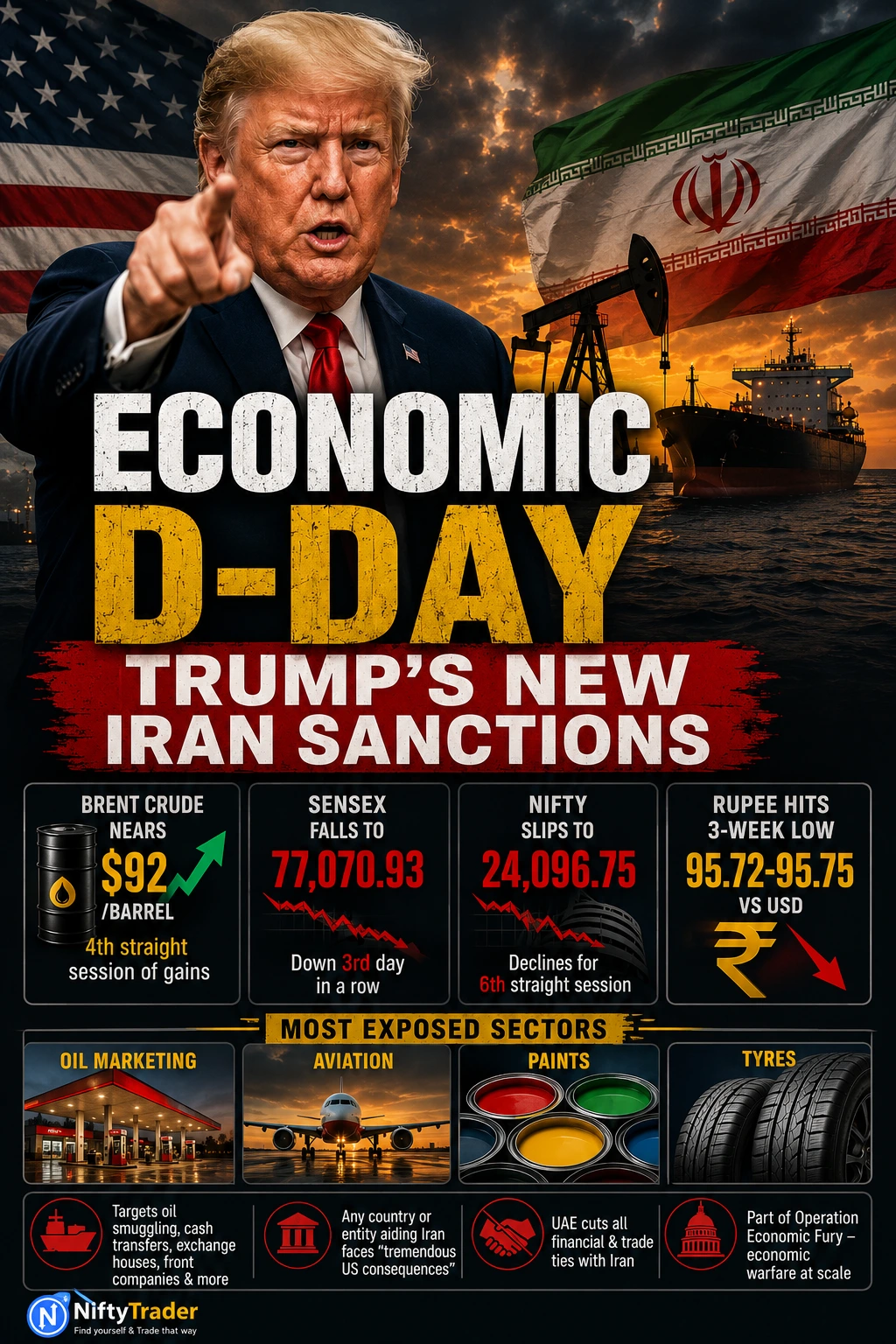
- Trump announced fresh Iran sanctions Wednesday evening via Truth Social, calling it “Economic D-Day” and the “most crushing economic operation ever taken against any country.”
- Any nation, bank, business or government entity offering Iran a financial lifeline — oil smuggling, currency swaps, cash transfers, exchange houses, ship registries, front companies — faces “tremendous” US consequences.
- The move follows Monday’s expiry of a 60-day US-Iran negotiating window and a UAE decision to sever all financial and trade ties with Tehran.
- Brent crude extended its fourth straight session of gains to trade near $92/barrel; WTI held near $86.
- Sensex fell for a third straight session to 77,235.46 (Tuesday) before slipping to 77,070.93 in early Wednesday trade; Nifty declined for a sixth straight session to 24,154.90, then 24,096.75.
- The rupee hit a three-week low near 95.72–95.75/USD.
- OMCs, aviation, paint and tyre stocks are the most directly exposed to sustained high crude.
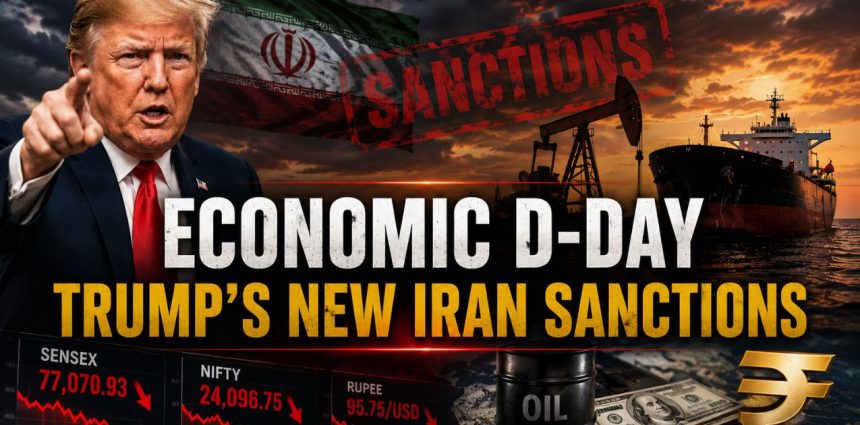
President Donald Trump on Wednesday announced fresh Iran sanctions under what he called an “Economic D-Day,” warning any nation, bank, business or government entity that offers Tehran a financial lifeline will face severe consequences of its own.
The escalation lands as the US-Israel conflict with Iran nears six months with no ceasefire in sight, and it hit Indian markets at an awkward moment, with Brent crude already at three-week highs and the rupee sliding.
For NiftyTrader readers, the real story behind this round of Iran sanctions isn’t geopolitics, it’s arithmetic. India imports the overwhelming majority of its crude oil, and a meaningful share of it moves through the Strait of Hormuz, the same waterway at the center of this standoff.
Every dollar Brent adds shows up later in the current account deficit, the fuel basket, and the margins of oil marketing, aviation, paint and tyre companies.
Source: Moneycontrol, Economic Times
What Trump Announced
In a lengthy Truth Social post Wednesday evening, Trump said he was launching the “MOST CRUSHING ECONOMIC OPERATION EVER TAKEN AGAINST ANY COUNTRY,” describing the new Iran sanctions push as economic warfare and isolation on an unprecedented scale. He said any country that allows its financial institutions, businesses, airports or government entities to give Iran any kind of lifeline will itself face tremendous economic consequences.
He named the specific channels this round of Iran sanctions is meant to shut down: oil smuggling, currency swap lines, cash transfers, exchange houses, ship registries and front companies. Trump called on US allies to join the effort and repeated his longstanding position that Tehran will never be allowed a nuclear weapon. Asked about further options, he said Washington still has “very draconian sanctions” in reserve, while maintaining that the existing naval blockade in the Strait of Hormuz has held even as vessel traffic continues.
Why Now: Ceasefire Window Lapses, UAE Cuts Ties
The timing isn’t incidental. A 60-day US-Iran negotiating window lapsed on Monday without a breakthrough, and Trump said this week that no talks are currently scheduled with Tehran. That came a day after the UAE announced an indefinite suspension of financial and trade ties with Iran, accusing Iranian forces of firing two ballistic missiles toward its territory; Iran denied the claim and called it a false-flag operation.
The UAE move matters because Iran has long relied on Dubai’s financial system and exchange houses to move money despite existing curbs. Treasury Secretary Scott Bessent had previewed Wednesday’s Iran sanctions escalation last week, calling it a combination of economic isolation the world hasn’t seen before, layered on a continued blockade of Iranian ports. The order effectively extends Operation Economic Fury, the campaign Trump’s administration launched in April to target foreign banks and firms doing business with Tehran.
Six Months Since the First Strikes
The standoff traces back to February 28, when the US and Israel launched joint strikes on Iranian targets, a conflict that has run for nearly six months through intermittent ceasefires that keep breaking down.
Iran has repeatedly tried to assert control over the Strait of Hormuz, including attacks on commercial shipping, prompting Washington’s own naval blockade of Iranian ports. An interim US-Iran memorandum reached earlier this summer briefly eased tensions before it unravelled, a pattern that’s now repeating with this fresh round of Iran sanctions.
Crude Oil, Sensex, Nifty and Rupee: The Immediate Fallout
Oil moved first. Brent crude extended its advance for a fourth straight session, trading near $92 a barrel on Wednesday, while US benchmark crude held close to $86, both near multi-week highs as the market priced in the new Iran sanctions and the stalled talks.
Indian equities felt it through the week. The Sensex closed down 492.70 points, or 0.63%, at 77,235.46 on Tuesday, its third straight day of losses, while the Nifty fell for a sixth consecutive session to 24,154.90. Wednesday’s early trade extended the slide, Sensex down a further 166.19 points to 77,070.93, Nifty off 59 points at 24,096.75, as elevated crude and the unresolved Iran sanctions standoff weighed on sentiment.
The rupee has been the more direct casualty, slipping to around 95.72–95.75 against the dollar on Wednesday, a three-week low and its third straight session of losses, pressured by costlier oil, elevated US Treasury yields and a broader risk-off mood. The RBI has been intervening through near-daily dollar sales to cap volatility without reversing the trend outright.
Market Snapshot (Wednesday, August 19)
| Indicator | Level | Move |
|---|---|---|
| Brent Crude | ~$92/barrel | 4th straight session of gains |
| WTI Crude | ~$86/barrel | Near multi-week high |
| Sensex | 77,070.93 (early trade) | Down 166.19 pts; 3rd straight losing session |
| Nifty 50 | 24,096.75 (early trade) | Down 59 pts; 6th straight losing session |
| USD/INR | ~95.72–95.75 | 3-week low; 3rd straight session of losses |
| FII (cash segment) | Net buyers, ₹408.00 crore | August 19 |
| DII (cash segment) | Net buyers, ₹3,973.70 crore | August 19 |
Sectors Most Exposed
India imports roughly 85–90% of its crude oil needs, and a large share of that transits the Strait of Hormuz, so any prolonged crude spike tied to these Iran sanctions flows quickly into specific NSE and BSE-listed names.
Oil marketing companies, Indian Oil, BPCL, HPCL, are the most direct casualties, since a sharp rise in crude widens under-recoveries if retail fuel prices stay capped. Aviation names like IndiGo and SpiceJet are similarly exposed, with ATF running 30–40% of an airline’s operating costs.
Paint makers, Asian Paints, Berger Paints, Kansai Nerolac, rely on crude-linked petrochemicals for close to a quarter of input costs, while tyre makers like MRF, Ceat and Apollo Tyres face similar pressure. Upstream producers such as ONGC and Oil India tend to benefit from higher realised crude.
Sector Impact Snapshot
| Sector | Key Names | Sensitivity |
|---|---|---|
| Oil Marketing (OMCs) | IOC, BPCL, HPCL | High — margin/under-recovery risk |
| Aviation | IndiGo, SpiceJet | High — ATF is 30–40% of costs |
| Paints | Asian Paints, Berger, Kansai Nerolac | Moderate — ~20–25% input cost link |
| Tyres | MRF, Ceat, Apollo Tyres | Moderate — petroleum-based inputs |
| Upstream Oil & Gas | ONGC, Oil India | Positive — benefits from higher realisations |
FII-DII Activity in Focus
Institutional flows told a more nuanced story than the headline index moves. FIIs were marginal net buyers in the cash segment at ₹408.00 crore even as global risk sentiment soured on the fresh Iran sanctions news, while DIIs stepped in more decisively with net buying of ₹3,973.70 crore, cushioning some of the crude-led selling.
Track the day-by-day breakdown on NiftyTrader’s FII-DII Tracker.
What Happens Next: The Trade Now Hinges on One Number
For D-Street, everything from here narrows down to whether Brent holds above $90. That single number decides which trade plays out.
If crude stays elevated: OMC margins keep getting squeezed, aviation and paint stocks stay under pressure, and the rupee’s slide toward 96 continues, pulling headline CPI higher just as the RBI was hoping to hold rates steady into FY27.
If Trump escalates further — say, secondary sanctions actually hit a major Iranian trading partner, Brent could push toward $100, a level that would force OMCs to choose between eating losses or hiking pump prices, either way a headline risk for the market.
If talks reopen instead — and Trump has cancelled strikes and revived negotiations more than once in this six-month conflict, Brent could unwind its recent gains just as fast as it built them, handing OMCs, aviation and paint stocks a sharp relief rally.
Nobody on D-Street is betting which way Washington moves next. But the number to watch through Thursday’s session is simple: Brent above $90 keeps this an OMC-and-rupee story; Brent above $100 makes it an inflation story the RBI can no longer ignore.
Read Next: Stocks to Watch Today: 7-Day Nifty Streak, 9.99% HDFC Bank Cap & More
Frequently Asked Questions
What did Trump announce against Iran on August 19?
Trump announced fresh Iran sanctions he called “Economic D-Day,” describing it as the most crushing economic operation ever taken against any country, and warned that any nation providing Iran a financial lifeline would face tremendous economic consequences.
How much did crude oil prices rise after the announcement?
Brent crude extended its advance to trade near $92 a barrel on Wednesday, its fourth consecutive session of gains, while WTI held close to $86 a barrel.
How did the Sensex and Nifty react?
The Sensex fell for a third straight session to 77,235.46 on Tuesday and slipped further to 77,070.93 in early Wednesday trade; the Nifty declined for a sixth straight session to 24,154.90 before easing to 24,096.75.
Why does the Strait of Hormuz matter this much for Indian markets?
India imports roughly 85–90% of its crude oil needs, and a significant share of those imports transit the Strait of Hormuz, so disruptions there flow directly into India’s import bill, the rupee and fuel-linked stocks.
Which Indian sectors are most at risk if crude stays above $90?
Oil marketing companies, aviation stocks, and paint and tyre makers face the most direct margin pressure, while upstream producers such as ONGC and Oil India tend to benefit.
Disclaimer: This article is for informational purposes only and does not constitute investment advice. Stock market investments are subject to market risks. Readers are advised to consult a registered financial advisor before making any investment decisions. NiftyTrader Desk has compiled this report based on publicly available information, Truth Social statements, and market data as of Wednesday, August 19, 2026; figures are subject to change as the situation develops.