
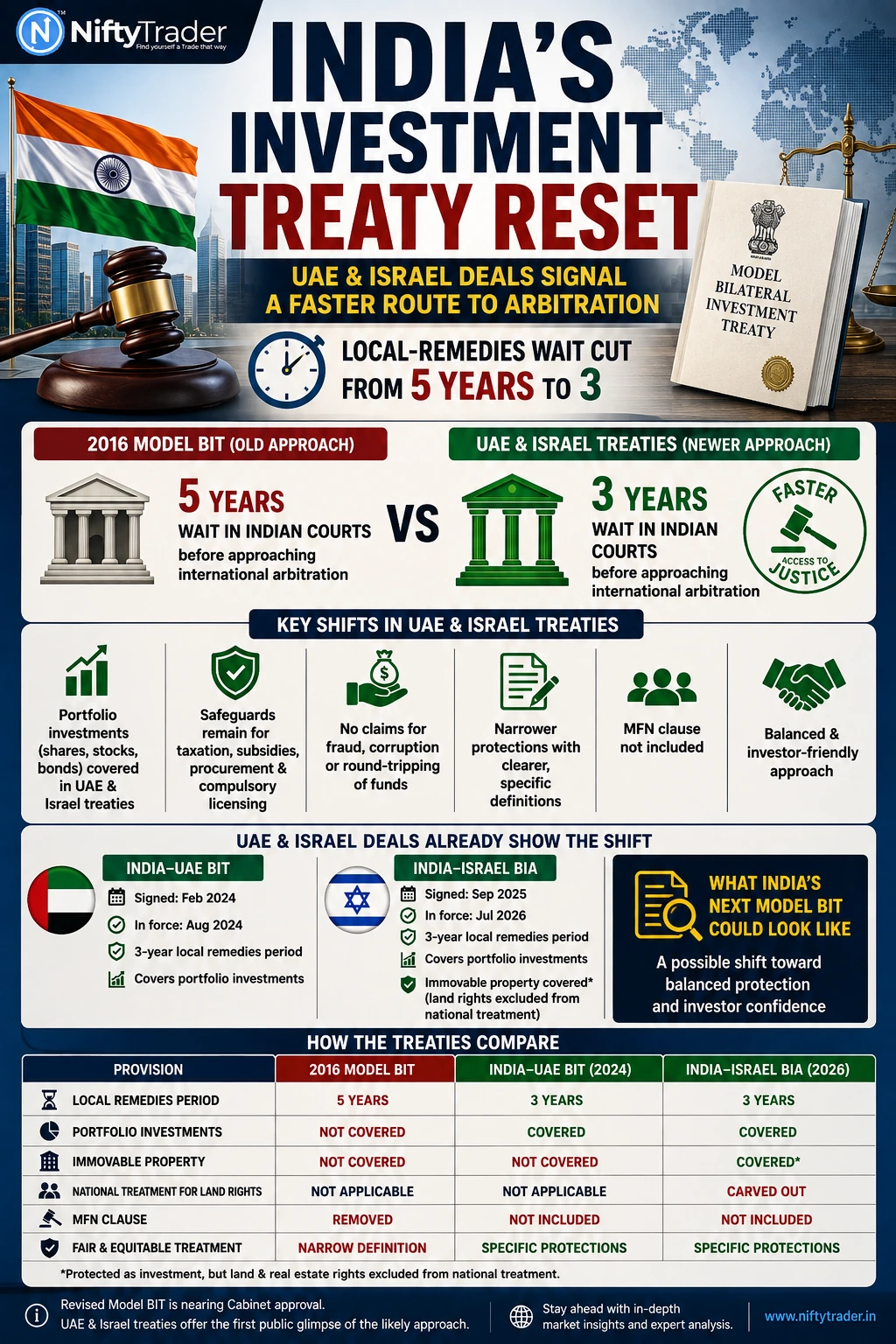
A revised Model Bilateral Investment Treaty is nearing Cabinet approval, and its likely shape is already visible in two treaties India signed in the past two years, both of which cut the wait time for foreign investors seeking justice almost in half.
For nearly a decade, foreign companies with a grievance against the Indian government faced a brutal timeline: fight it out in Indian courts for five years before they could even approach an international arbitration tribunal. That single clause, buried in India’s 2016 Model Bilateral Investment Treaty (BIT), became one of the most-cited reasons foreign capital cooled on India even as the economy kept growing.
That wall has already come down for two countries, and a version of it could soon come down for everyone else. Economic Affairs Secretary Anuradha Thakur confirmed earlier this month that the government’s long-pending review of the Model BIT is nearly complete and could reach the Union Cabinet soon.
What makes this moment different from years of on-again, off-again reform talk is that India has already put elements of the new approach into practice, first with the United Arab Emirates in 2024, then with Israel in 2025. Both treaties offer the clearest public signal yet of what that template could look like.
Why the five-year rule existed in the first place
India’s caution wasn’t accidental. It traces back to a single ruling. In 2011, Australian mining company White Industries won an international arbitration award against the Indian government, the first such loss New Delhi had suffered. The verdict opened the door to a wave of further investor claims over the following years, and New Delhi grew wary of an investment treaty regime it felt exposed the country to open-ended legal risk.
The response was drastic: starting in 2016, India began unilaterally terminating its older bilateral investment treaties, a process that had reached 77 countries, including the European Union, by 2024, and replaced them with a single, far more restrictive Model BIT.
The new template narrowed the definition of a protected “investment,” dropped the Most Favoured Nation clause that guaranteed one treaty partner the same terms as another, swapped out the broad “fair and equitable treatment” standard for a much shorter list of specific protections, and added the five-year local-remedies requirement.
The strategy worked in one sense, it insulated the government from a repeat of the White Industries-style claims, which had also included high-profile disputes with Vodafone and Cairn. But it came at a cost.
Trade negotiators from the European Union and Australia reportedly told Indian officials the terms were too restrictive to accept, and only a handful of countries, Belarus, Kyrgyzstan, Brazil, Taiwan and Uzbekistan among them, ended up signing fresh treaties under the strict new template.
A study by researchers Sarah Hartmann and Rok Spruk found that India’s treaty terminations were followed by a more than 30% drop in FDI from the affected countries relative to countries whose treaties stayed intact, with some of that investment simply rerouted through jurisdictions where treaty protection still applied.
Check Live to explore: NiftyTrader: Live Options Analytics & F&O Trading Tools
The blueprint: what changed in the UAE and Israel deals
Rather than rewrite the Model BIT in one sweeping move, India appears to have used its two most recent bilateral treaties as pilot versions of the new approach.
The India-UAE BIT, signed in February 2024 and in force since August that year, cut the local-remedies waiting period from five years to three. It also expanded the definition of a protected investment to cover portfolio holdings, shares, stocks and similar instruments, which the 2016 Model BIT had excluded. Certain safeguards stayed firmly in place: taxation decisions, government procurement, subsidies and compulsory licensing remain outside the treaty’s reach, and no investor can bring a claim if the underlying investment involved fraud, corruption or round-tripping of funds.
The India-Israel Bilateral Investment Agreement, signed in September 2025 and effective from July 2026, followed the same script almost exactly: the local-remedies window was trimmed to three years, and portfolio investments — shares and bonds among them — were brought under protection for the first time.
The Israel deal adds a wrinkle of its own: it treats immovable property as a protected investment, but specifically carves land and real-estate rights out of the treaty’s “national treatment” guarantee, so an Israeli investor gets protection for a property investment, but can’t use the treaty to claim the same land-ownership rights an Indian investor holds.
Israel became the first OECD member country to sign this newer style of Indian investment treaty, and the deal covers a bilateral investment relationship the two governments have valued at roughly $800 million, modest today, but one both sides are betting will grow as an India-Israel free trade agreement advances in parallel.
How the treaties compare
| Provision | 2016 Model BIT | India-UAE BIT (2024) | India-Israel BIA (2026) |
|---|---|---|---|
| Local remedies exhaustion before arbitration | 5 years | 3 years | 3 years |
| Portfolio investments covered | No | Yes | Yes |
| Taxation, subsidies, procurement | Excluded from treaty scope | Excluded | Excluded |
| Claims involving fraud/corruption | Generally barred | Explicitly barred | Explicitly barred |
| Outbound (Indian) investor protection emphasis | Limited | Growing | Growing |
| Notable treaty-specific quirk | — | Portfolio investment added | Land/real-estate rights excluded from “national treatment” |
The real trigger: India’s investment math has flipped
The timing of this overhaul is not a coincidence. It tracks a sharp shift in India’s capital flows that has alarmed policymakers.
Net FDI inflows, which capture the balance after outflows like repatriation and Indian firms’ own overseas investment, fell from an annual average of roughly $40 billion between FY20 and FY22 to just $7.65 billion in FY26, according to Reserve Bank of India data cited by Secretary Thakur. Separate government data placed net FDI even lower in the two years before that: from $27.99 billion in FY23 down to a low of $960 million in FY25, before partially recovering to $6.95 billion in FY26, according to figures the finance ministry gave Parliament in July. Gross inflows, by contrast, hit a record $94.84 billion in FY26 — meaning money is still arriving, but a much larger share of it is leaving again through repatriation and disinvestment.
At the same time, the opposite trend has been building on India’s outbound side. Net overseas direct investment by Indian companies has nearly tripled, climbing from about $11 billion to $33.29 billion over the same stretch, as Indian firms expand into new markets, diversify supply chains and hedge currency risk. That reversal has quietly changed what a Model BIT is actually for. It is no longer purely a tool to reassure incoming foreign capital — it increasingly needs to protect Indian companies operating abroad, too.
The trade-off nobody is glossing over
Not everyone views the shift as an unambiguous win. The Global Trade Research Initiative (GTRI), a New Delhi-based think tank, has argued that shortening the local-remedies window makes treaties more attractive to investors precisely because it weakens India’s ability to resolve disputes domestically before they escalate into costly international arbitration. Fewer years of mandatory local litigation means more disputes reach arbitration tribunals faster, tribunals that can, in theory, second-guess India’s regulatory decisions.
Legal experts tracking the review describe it in similarly two-sided terms. Prabhash Ranjan, a professor at Jindal Global Law School, sees the UAE and Israel treaties as real but partial movement, India easing its stance on dispute timelines while holding firm on excluding the Most Favoured Nation clause and taxation disputes from treaty coverage. Atul Pandey, a partner at law firm Khaitan & Co, cautions against reading the shift as a wholesale reversal of the restrictive 2016 approach, describing the direction of travel as calibrated liberalisation rather than a complete reversal of policy.
That tension, between making India’s treaty regime credible enough to unlock capital, and retaining enough legal room to regulate freely, is exactly what officials say the new Model BIT is trying to resolve. Thakur has signalled that some of the more protective 2016-era clauses may survive the rewrite for that reason, even as others are loosened.
What else could be in the new Model BIT
Beyond mirroring the UAE and Israel templates, officials have hinted at further changes still under discussion:
- An even shorter waiting period. Government officials have suggested the mandatory local-remedies window could be cut further, to as little as two years, in the final Model BIT text — a full year less than what UAE and Israeli investors currently get. Ranjan has publicly recommended exactly that figure as one of the changes he’d like to see in the final draft.
- A “negative list” approach. Rather than spelling out every protection in exhaustive detail, negotiators are reportedly working from a list of specific red-flag clauses to avoid, giving future treaty talks more flexibility.
- Explicit protection for Indian companies abroad, formalising what the UAE and Israel treaties only gestured toward.
- A workable middle ground on MFN and taxation. Rather than excluding these areas entirely, as the 2016 Model BIT does, legal experts have called for a balanced Most Favoured Nation clause and at least some room for taxation-related disputes, alongside a dispute-resolution mechanism that functions more smoothly in practice.
- Unblocking stalled talks with developed economies. Both the UK and the EU have recently concluded free trade agreements with India, but — notably, per a 2026 analysis by law firm Freshfields — those FTAs exclude investor-state arbitration altogether, routing disputes elsewhere. A more workable Model BIT is seen as key to finally closing standalone investment treaties with these partners.
A parallel reform: raising the bar for automatic FDI clearance
The Model BIT isn’t the only investment-approval process getting a rethink this month. Separately, the government is weighing a change to how large foreign investment proposals get cleared in the first place.
Under rules unchanged since November 2015, any FDI proposal involving foreign equity above ₹5,000 crore must be referred to the Cabinet Committee on Economic Affairs (CCEA) rather than being cleared by the relevant ministry alone.
A draft Cabinet note reportedly being worked on jointly by the Finance Ministry, the Department for Promotion of Industry and Internal Trade (DPIIT) and NITI Aayog would raise that threshold threefold, to ₹15,000 crore — letting ministries sign off on far larger deals without a CCEA referral. A related, separate proposal under discussion would also ease rules for downstream foreign investment, the indirect flow of capital into Indian companies through an upstream entity that has already secured approval.
Neither change is finalised. But taken alongside the Model BIT rewrite, they point to the same underlying goal: shrinking the gap between a foreign investor deciding to commit capital and that capital actually clearing India’s approval pipeline.
Also Read: New FDI Rules: India Plans Faster Foreign Investment
What happens next
No draft text of the revised Model BIT has been made public, and the timeline for Cabinet approval remains officially “soon” rather than fixed. But the direction of travel is no longer in doubt: India has already shown investors, in black and white, what its next-generation treaties look like. The UAE and Israel got the preview. The rest of the world is next in line.
Key numbers to remember
- 5 → 3 years: cut in the mandatory local-remedies window under both the India-UAE and India-Israel treaties, versus the 2016 Model BIT
- 77: older bilateral investment treaties India has unilaterally terminated since 2016, replaced under its more restrictive Model BIT
- $40B → $7.65B: decline in India’s average annual net FDI inflows, FY20–22 to FY26 (RBI data)
- $11B → $33.29B: near-tripling of outbound investment by Indian companies over the same period
- 2 years: the even-shorter local-remedies window officials have floated for the final revised Model BIT
- ₹5,000cr → ₹15,000cr: proposed threefold rise in the FDI value that requires CCEA sign-off, under separate discussion alongside the BIT rewrite