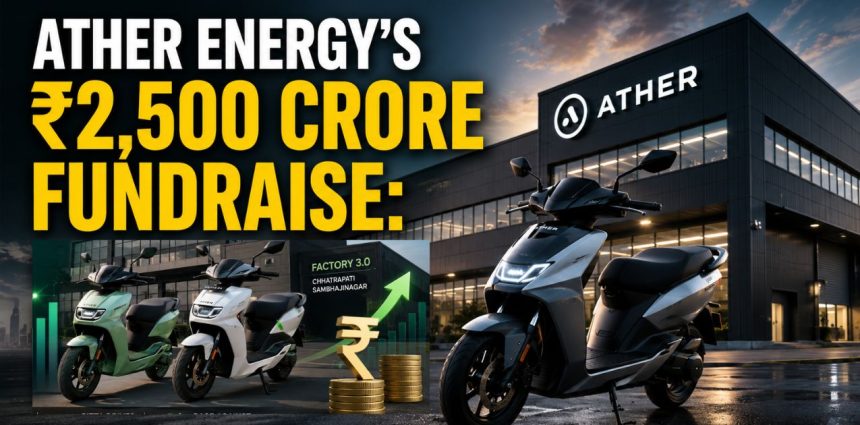
Thirteen months after its IPO, Ather Energy is back at the capital markets. The board-approved fundraise is an aggressive capacity play, but the clock is ticking against two well-funded legacy rivals.
Key Takeaways
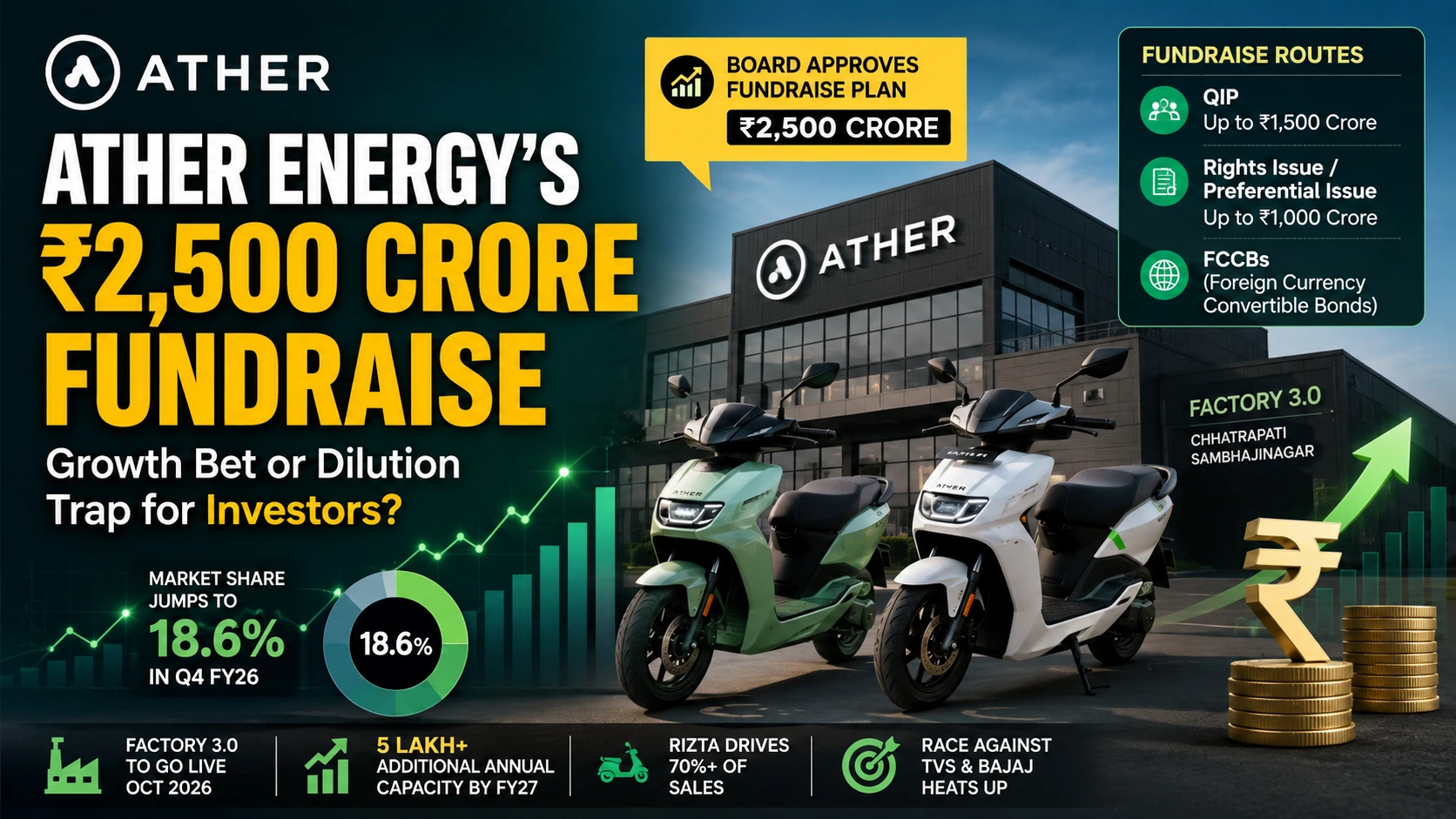
- Ather Energy board approved raising up to ₹2,500 crore on June 12, ₹1,500 crore via QIP and ₹1,000 crore via a preferential issue, rights issue, or FCCBs.
- This is the company’s first post-IPO fundraise, just 13 months after its ₹2,981-crore listing.
- Factory 3.0 in Chhatrapati Sambhajinagar is targeting commercial operations by October 2026; when fully built out, it will take total annual capacity to 1.42 million units.
- Ather’s market share surged from ~8% to 18.6% in Q4 FY26 on the back of the Rizta family scooter.
- The central investor tension: will Factory 3.0 come online before TVS and Bajaj further entrench their combined 45%+ market hold?
The Decision That Defines Ather’s Next Chapter
Ather Energy Ltd’s board approved a fresh capital raise of up to ₹2,500 crore at its meeting on June 12, 2026, the company’s first significant fundraise since it went public in April 2025.
The approval came with a two-part structure: up to ₹1,500 crore via a Qualified Institutions Placement (QIP) in one or more tranches, and up to ₹1,000 crore via a flexible window covering preferential allotment, rights issue, or Foreign Currency Convertible Bonds (FCCBs).
A dedicated Fundraising Committee has been constituted by the board. A postal ballot notice will be dispatched to shareholders for e-voting approval of the QIP component via special resolution. Pricing, investor selection, and security counts will be determined at the appropriate time per SEBI regulations.
CEO Tarun Mehta’s post on X on the same day gave the clearest signal of what is driving all of this: “We have crossed 90% utilisation, and will have to try and find ways to go above 100% in the coming weeks.”
That one line is the entire thesis behind the fundraise. Ather is not raising capital because it is struggling, it is raising capital because it is running out of room to grow.
Where Every Rupee Is Going: The Fundraise Structure
| Component | Amount | Instrument | Status |
|---|---|---|---|
| QIP Tranche | Up to ₹1,500 crore | Equity shares to QIBs | Pending shareholder e-vote |
| Flexible Tranche | Up to ₹1,000 crore | Equity / Rights / FCCBs | Board approved |
| Total Raise | Up to ₹2,500 crore | Multiple routes | Fundraising Committee formed |
Securities may be denominated in Indian rupees or foreign currencies, giving Ather access to both domestic institutional capital and cheaper global pools via FCCBs. The FCCB route is particularly notable, it allows Ather to raise debt that converts to equity at a future date, avoiding immediate dilution if the stock trades at a premium to conversion price.
The Factory Problem: Why Ather Cannot Wait
Ather currently operates two facilities in Hosur, Tamil Nadu, with a combined annual capacity of 4.20 lakh units. In FY26, the company sold 2,39,178 units, already running at roughly 57% of installed capacity across the full year, but with Q4 FY26 alone clocking approximately 83,000 units (an annualised run rate of ~3.3 lakh units), the existing footprint is effectively maxed out.
Factory 3.0, a 98-acre facility in the Bidkin AURIC industrial zone, Chhatrapati Sambhajinagar, is the solution. Here is what the numbers look like when it comes online:
| Metric | Current (Hosur Only) | Post Factory 3.0 (Full Build) |
|---|---|---|
| Annual Capacity | 4.20 lakh units | 14.20 lakh units |
| Phases | 2 operational | 2 additional phases planned |
| Commercial Ops Start | — | October 2026 (Phase 1) |
| Phase 1 Complete | — | March 2027 |
| IPO Proceeds Deployed | ₹927 crore already spent | Balance from fresh raise |
The original IPO had earmarked ₹927.2 crore specifically for this factory. That capital is already deployed. The ₹2,500-crore raise is what funds the remainder of construction, working capital for the ramp-up, and the EL platform launch.
Ather vs. the Field: Where It Stands in India’s EV Race
India’s electric two-wheeler market sold 14.01 lakh units in FY26, up 21.81% from FY25. The competitive picture has shifted dramatically from two years ago, and it is not flattering for pure-play EV startups.
India E2W Market — FY26 Final Rankings
| Rank | Brand | FY26 Units | YoY Growth | Market Share |
|---|---|---|---|---|
| 1 | TVS Motor (iQube) | 3,41,513 | +43.54% | ~24.4% |
| 2 | Bajaj Auto (Chetak) | 2,89,349 | +25.71% | ~20.6% |
| 3 | Ather Energy | 2,39,178 | +82.34% | ~17.1% |
| 4 | Hero Vida | 1,44,330 | +196.13% | ~10.3% |
| 5 | Ola Electric | 1,64,295 | -52.28% | ~11.7% |
Source: FADA / Vahan portal / RushLane; FY26 ended March 2026
Ather’s 82.34% volume growth is the strongest among the top three, but TVS and Bajaj together control nearly 45% of the market. More critically, their EV operations sit inside profitable, cash-generative legacy businesses.
TVS posted an operating EBITDA margin of 13.1% and its highest-ever quarterly revenue of ₹12,808 crore in Q4 FY26. They can sustain an EV price war indefinitely. Ather cannot, at least not until Factory 3.0 gives it the cost economics of true scale.
The Rizta Effect: How Ather Doubled Its Market Share in One Year
Ather’s market share expanded from approximately 8% to 18.6% during FY26, arguably the most impressive single-year repositioning in Indian EV history. The driver was a deliberate strategic pivot: the launch of the family-oriented Rizta scooter, which now accounts for over 70% of Ather’s total sales.
Ather significantly expanded its retail presence during FY26, growing its store network from 351 outlets to 700 while more than doubling the number of service centres.
That distribution expansion, alongside the Rizta’s appeal in states like Gujarat and Maharashtra, is what unlocked volumes well beyond Ather’s traditional urban strongholds.
The Rizta’s success is also what makes the upcoming EL platform launch so consequential. Designed as a mass-market architecture that can underpin multiple scooter variants, the EL platform is Ather’s bid to move further down the price ladder and compete directly in sub-₹1 lakh segments currently dominated by Bajaj’s Chetak.
Read Next: Diesel at ₹100 Forces India’s Biggest Companies Into Electric Trucks — But Barriers Remain
Ather vs. Ola: A Tale of Two Fundraises
The contrast with Ola Electric is instructive and worth holding in mind.
| Parameter | Ather Energy | Ola Electric |
|---|---|---|
| FY26 Volume Growth | +82.34% | -52.28% |
| Recent Fundraise | ₹2,500 crore (post-strength) | ₹780 crore (amid distress) |
| Market Share Trend | 8% → 18.6% (FY26) | Fell to ~11.7% |
| Factory Status | Building 3.0 (capacity expansion) | Existing capacity underutilised |
| Fundraise Signal | Growth capital | Survival capital |
Unlike rival Ola Electric, which recently raised ₹780 crore through a QIP amid concerns over market share and profitability, Ather is approaching investors after reporting strong operational growth and improving market position. That distinction is not cosmetic; it determines the valuation at which new shares will be issued and, therefore, how much dilution existing shareholders absorb.
The Central Investor Tension: Growth Bet or Dilution Drag?
This is the question the market did not fully answer: on June 12, the stock moved just +0.029% on the announcement day.
Ather Energy — Stock & Financials Snapshot
| Metric | Data |
|---|---|
| BSE Close (June 12, 2026) | ₹1,028.15 |
| Day’s Change | +₹0.30 (+0.029%) |
| IPO Price (April 2025) | ₹321 |
| 1-Year Return | ~220%+ |
| Market Cap (approx.) | ~₹38,400 crore |
| FY26 Revenue | ₹3,672 crore (+63% YoY) |
| FY26 Net Loss | ₹517 crore (narrowed 57% YoY) |
| Q4 FY26 Revenue | ₹1,174.66 crore (+73.75% YoY) |
| Q4 FY26 Net Loss | ₹100.23 crore |
The bull case is straightforward: Factory 3.0 comes online in October 2026, Ather hits 5-lakh-plus annual capacity by FY27, the EL platform drives a new volume cycle, and losses narrow toward breakeven, all before competitors entrench further.
At that point, the ₹2,500 crore raised today looks like exactly the right bet at exactly the right time.
The bear case is harder to dismiss: TVS and Bajaj are not standing still. Both are investing heavily in EV capacity and distribution, have structural cost advantages from their ICE businesses, and are already approaching Ather’s price points.
If Factory 3.0 faces delays, commercial ops are expected in October 2026, but regulatory and environmental approvals are still pending; every quarter of lost capacity is a quarter where TVS and Bajaj sell 80,000+ units each.
Meanwhile, the QIP will dilute existing shareholders, and FCCB conversion pressure could weigh on the stock if Ather’s share price corrects.
The battery cost environment adds another layer of risk. Lithium prices remain more than twice historical levels, while battery cell costs have risen between 30% and 50% in recent quarters due to commodity inflation and supply-chain challenges.
Despite ongoing cost optimisation efforts and selective price hikes, EV manufacturers expect margin pressures to persist in the near term.
Bottom Line
Ather Energy’s ₹2,500-crore fundraise is a capacity bet on India’s EV growth story, and the company has earned the right to make it, given 82% volume growth, market share that more than doubled in a year, and a Q4 FY26 net loss that has narrowed to ₹100 crore.
The Rizta turned Ather from a premium niche brand into a genuine mass-market contender. Factory 3.0 is what converts that momentum into defensible scale.
But the window is not open indefinitely. TVS and Bajaj are profitable, expanding, and hungry. October 2026 is when Factory 3.0 needs to deliver.
Whether this fundraise accelerates Ather’s march to leadership or simply finances a prolonged war of attrition against rivals with deeper pockets will define the stock’s trajectory through FY27 and beyond. Investors would do well to watch the factory commissioning timeline more closely than the QIP pricing.
Data as of June 12–13, 2026. Sources: BSE/NSE exchange filings, FADA, Vahan portal, company investor presentations, GreentechLead, RushLane. This article is for informational purposes only and does not constitute investment advice.