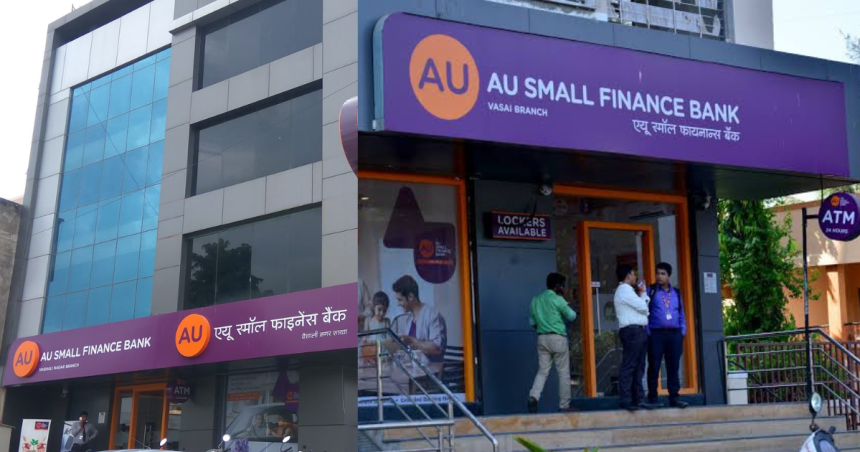
AU Small Finance Bank Q1: Profit Up 37%, Yogesh Jain Named Deputy CEO
AU Small Finance Bank delivered a stronger-than-expected start to FY27, reporting robust growth in profit, net interest income (NII), and loan disbursements despite a marginal sequential rise in bad loans. The lender’s Q1 FY27 earnings highlighted healthy business momentum, improved profitability, and continued investments in technology, reinforcing investor confidence.
The AU Small Finance Bank Q1 Results also reflected broad-based growth across deposits, advances, and secured lending. While higher operating expenses and a slight increase in gross NPAs remained areas to watch, lower credit costs and strong capital buffers helped offset concerns.
AU Small Finance Bank posts 37% jump in Q1 profit on strong lending growth
The bank reported a 37% year-on-year (YoY) increase in net profit to ₹796 crore for the quarter ended June 30, 2026, compared with ₹581 crore in the same period last year.
Net Interest Income (NII), a key measure of banking performance, climbed 32% YoY to ₹2,695 crore from ₹2,045 crore a year earlier. Operating profit also improved 9.4% YoY to ₹1,435 crore, reflecting healthy growth in the bank’s core business.
Net Interest Margin (NIM) expanded 47 basis points to 5.9%, indicating better profitability from lending operations.
Track Live : NSE Option Chain — Live
Key Financial Highlights
| Particulars | Q1 FY27 | YoY Growth |
|---|---|---|
| Net Interest Income (NII) | ₹2,695 crore | +32% |
| Net Interest Margin (NIM) | 5.9% | +47 bps |
| Core Other Income | ₹680 crore | +33% |
| Operating Expenses | ₹1,949 crore | +26% |
| Core PPoP | ₹1,426 crore | +41% |
| Total PPoP | ₹1,435 crore | +9% |
| Provisions | ₹371 crore | -30% |
| Profit After Tax (PAT) | ₹796 crore | +37% |
| Annualised ROA | 1.7% | |
| Annualised ROE | 15.6% |
Read More : SpaceX’s Starship Faces Crucial Test as IPO Pressure Builds Around Elon Musk’s Biggest Bet
Deposits and loan book continue to grow at a healthy pace
The AU Small Finance Bank Q1 Results showed strong traction in both deposits and lending.
Total deposits rose 24% YoY and 3% sequentially to ₹1.58 lakh crore, while CASA deposits increased 22% YoY to ₹45,399 crore. The CASA ratio remained healthy at 29%, supporting lower funding costs.
The bank’s gross loan portfolio expanded 23% YoY to ₹1.44 lakh crore, backed by an impressive 42% increase in loan disbursements.
Secured retail and commercial lending grew 25% YoY, while unsecured lending increased 11%, highlighting balanced credit growth across segments.
Deposit Growth
| Metric | Q1 FY27 | Growth/Ratio |
|---|---|---|
| Total Deposits | ₹1.58 lakh crore | 24% YoY, 3% QoQ |
| CASA Deposits | ₹45,399 crore | 22% YoY |
| CASA Ratio | 29% | — |
| Current Account Deposits | ₹8,498 crore | 34% YoY |
| Savings Account Deposits | ₹36,902 crore | 19% YoY |
| Stable Deposit Ratio | 79% | — |
| Cost of Funds | 6.48% | ↓ 60 bps YoY |
Asset quality remains stable despite a slight sequential rise in NPAs
Asset quality remained broadly stable during the quarter.
Gross Non-Performing Assets (GNPA) stood at 2.10%, slightly higher than 2.03% in the March quarter but significantly lower than 2.47% reported a year ago.
Net NPA improved to 0.76% from 0.88% in the corresponding quarter last year, although it was marginally above 0.74% recorded in Q4 FY26.
Slippages declined 22% YoY to ₹798 crore, while annualised credit cost improved sharply to 0.8% from 1.4% a year earlier.
The bank also reduced provisions by 30% YoY to ₹371 crore, despite creating an additional one-time provision of ₹23 crore to strengthen coverage for select retail loan portfolios.
Loan Book
| Metric | Q1 FY27 | Growth |
|---|---|---|
| Gross Loan Portfolio | ₹1.44 lakh crore | 23% YoY, 3% QoQ |
| Secured Loan Growth | — | 25% YoY |
| Unsecured Loan Growth | — | 11% YoY |
| Disbursement Growth | — | 42% YoY |
Asset Quality
| Metric | Q1 FY27 | Previous / Change |
|---|---|---|
| Gross NPA (GNPA) | 2.10% | 2.47% (previous year) |
| Net NPA (NNPA) | 0.76% | 0.88% (previous year) |
| Slippages | ₹798 crore | ↓ 22% YoY |
| Credit Cost | 0.8% | Improved from 1.4% |
| Additional Provision | ₹23 crore | One-time provision |
| Provision Coverage Ratio (PCR) | 85% | Stable |
| CGFMU Coverage | 96% | — |
Liquidity & Capital
| Metric | Q1 FY27 |
|---|---|
| Capital Adequacy Ratio (CAR) | 18.9% |
| Tier-I Capital Ratio | 17.1% |
| Liquidity Coverage Ratio (LCR) | 119% |
| Credit-Deposit (CD) Ratio | 80% |
Income Analysis
| Metric | Q1 FY27 | YoY Growth |
|---|---|---|
| Interest Income | ₹5,303 crore | 21% |
| Interest Expense | ₹2,607 crore | 12% |
| Net Interest Income (NII) | ₹2,695 crore | 32% |
Expense Analysis
| Metric | Q1 FY27 | YoY Growth |
|---|---|---|
| Employee Cost | ₹1,064 crore | 23% |
| Other Operating Expenses | ₹885 crore | 31% |
| Total Operating Expenses | ₹1,949 crore | 26% |
Profitability
| Metric | Q1 FY27 | YoY Growth |
|---|---|---|
| Profit Before Tax (PBT) | ₹1,064 crore | 37% |
| Profit After Tax (PAT) | ₹796 crore | 37% |
| Earnings Per Share (EPS) | ₹11 | — |
| Book Value Per Share (BVPS) | ₹279 | — |
Management highlights technology, AI and long-term growth strategy
Commenting on the performance, Founder, MD & CEO Sanjay Agarwal said the Indian economy remained resilient despite geopolitical uncertainties.
“Our performance is increasingly being driven by the underlying strength of the franchise and disciplined execution, rather than cyclical or one-off factors,” Agarwal said.
He added that investments in technology, distribution, product capabilities and talent continue to strengthen the bank’s long-term growth prospects.
The lender also announced the elevation of Yogesh Jain from Chief Operating Officer to Deputy CEO, effective July 25, 2026, to strengthen its leadership team as operations continue to expand.
AI investments and digital banking remain key growth drivers
One of the biggest highlights of the AU Small Finance Bank Q1 Results was the bank’s continued investment in artificial intelligence and digital transformation.
The bank is expanding AI-led capabilities across gold loans, mortgage origination, vehicle finance, personal loans and credit cards. It has also established an AI Centre of Excellence with more than 50 AI use cases under development.
More than 90% of customer transactions are now processed digitally through the AU 0101 platform, while the lender recently introduced an upgraded UPI interface and enhanced investment features.
These initiatives are expected to improve customer experience while driving operational efficiency over the long term.
Here’s what happened today and why traders reacted
The market responded positively to the AU Small Finance Bank Q1 Results as the lender reported stronger earnings growth than many investors had anticipated.
A 37% increase in net profit, 32% growth in NII, expanding margins, robust deposit mobilisation and lower credit costs reinforced confidence in the bank’s business model.
Although the sequential increase in GNPA and higher operating expenses remained watch points, the overall earnings quality, healthy capital adequacy of 18.9%, liquidity coverage ratio of 119%, and sustained loan growth outweighed near-term concerns.
What impact could this have on investors?
The latest AU Small Finance Bank Q1 Results strengthen the bank’s investment case by demonstrating consistent earnings growth, improving operating efficiency and strong balance sheet quality.
For traders, the strong quarterly numbers and positive management commentary could support near-term sentiment, particularly if management maintains its growth outlook during upcoming investor interactions.
Long-term investors are likely to take comfort from the bank’s expanding secured loan portfolio, improving credit costs, strong deposit franchise and aggressive investments in AI-driven banking.
However, investors should continue monitoring operating expenses, treasury income, yield on advances and the trajectory of NPAs over the coming quarters, as these factors will remain key determinants of future profitability and valuation.