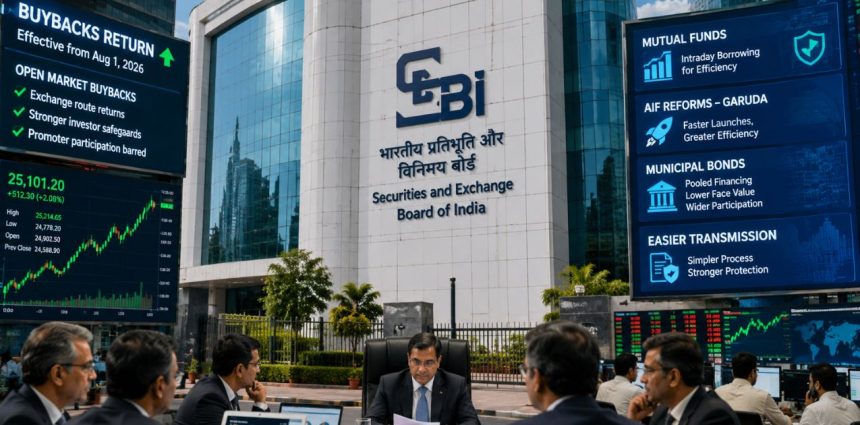
SEBI’s 214th board meeting brings back exchange-route buybacks, gives mutual funds intraday borrowing flexibility, fast-tracks AIF launches, and revives agri-commodity derivatives, a broad set of reforms aimed at easing compliance and protecting investors.
Key Takeaways
- Open-market share buybacks via stock exchanges return from August 1, 2026, roughly a year after the route was phased out in April 2025; promoters stay barred from participating.
- Mutual funds can now borrow intraday to bridge settlement and forex mismatches — a facility separate from, and outside, the existing 20% redemption-borrowing limit.
- The new GARUDA mechanism cuts regular AIF scheme launches to 10 working days, down from 30; angel and accredited-investor funds can launch immediately on filing.
- SEBI moved to revive agri-commodity derivatives, with higher position limits and select contracts allowed to start as cash-settled.
- Securities transmission to legal heirs gets simpler, QR-coded death certificates and a combined affidavit-cum-NOC replace some older paperwork.
The Securities and Exchange Board of India (SEBI), meeting in Mumbai on June 19, pushed through a wide set of reforms in a single sitting, touching companies, mutual funds, alternative investment funds, commodity traders, and city bodies. The clear theme was ease of doing business: most decisions cut friction rather than add new rules.
For traders and investors, three calls stand out: the comeback of exchange-route buybacks, a new daytime borrowing window for mutual funds, and a push to revive agri-commodity derivatives.
Here’s a quick map of the headline decisions, followed by what each means in practice.
| # | Decision | What changes | Effective |
|---|---|---|---|
| 1 | Open-market buyback | Exchange route returns alongside tender-offer/book-building | Aug 1, 2026 |
| 2 | MF intraday borrowing | Borrow within the day for settlement, forex and MTM gaps | On notification |
| 3 | GARUDA (AIF) | Regular scheme launch cut to 10 working days (from 30) | On notification |
| 4 | Agri-commodity derivatives | Revival; higher position limits; cash-settled-first contracts | On notification |
| 5 | Municipal bonds | Refinancing + pooled financing; ₹10,000 face value | On notification |
| 6 | Securities transmission | No mandatory probate; QR-code death certificates accepted | On notification |
Buybacks return to the exchange route, with tighter guardrails
The board approved amendments to the SEBI (Buy-back of Securities) Regulations, 2018, reviving open-market buybacks through stock exchanges from August 1, 2026.
The route had been fully phased out in April 2025, after a tax change made it unattractive: from October 1, 2024, buyback proceeds shifted from being taxed at the company level to being taxed in shareholders’ hands, and from April 1, 2026, those proceeds are taxed as capital gains.
With the tax-inequity problem addressed, SEBI is bringing the route back.
Companies regain the exchange route alongside the tender-offer and book-building routes that stayed available.
SEBI has tied the comeback to firmer safeguards: at least 40% of the earmarked buyback amount must be utilised in the first half of the buyback period, and the entire exercise must close within 66 working days.
Promoters and their associates cannot participate, and their shareholding stays frozen for the duration. Appointing a merchant banker is now optional, trimming compliance cost for issuers.
| Buyback parameter | Rule |
|---|---|
| Effective from | August 1, 2026 |
| Routes available | Tender offer, book-building and open-market (exchange) |
| Completion window | 66 working days |
| Minimum utilisation (first half) | 40% of earmarked funds |
| Promoter participation | Not allowed; holdings frozen |
| Merchant banker | Optional |
For shareholders, the exchange route has historically meant faster, more flexible buybacks than the drawn-out tender process, and for traders, an active buyback can support a stock’s price and shift its volumes, worth tracking once the rules go live in August.
(New to the mechanics? See our explainer on what a share buyback is and how it works.)
Mutual funds get intraday borrowing room
A separate amendment to the SEBI (Mutual Funds) Regulations, 2026 lets AMCs borrow intraday to cover timing gaps, pay-in/pay-out mismatches within asset classes, forex settlements, and mark-to-market obligations on derivative positions.
This is distinct from the borrowing mutual funds already use: schemes can currently borrow up to 20% of net assets for unit-holder payouts like redemptions for a limited period.
Intraday borrowing sits outside that limit and cannot be used as leverage, AMCs must repay it by end of day, and anything carried overnight falls back under the existing 20% cap. In short, it smooths daily cash mismatches; it does not let funds take bigger bets.
GARUDA: a green channel for AIF launches
SEBI introduced GARUDA (Green-Channel: AIF Rollout Upon Document Acknowledgement) to speed up fund launches. Regular AIF schemes can now go live in 10 working days, down from the roughly 30-day wait under the earlier process. Angel Funds and accredited-investor-only schemes can launch immediately after registration or filing their placement memorandum, skipping merchant-banker review entirely.
| AIF launch type | Earlier timeline | Under GARUDA |
|---|---|---|
| Regular AIF schemes | ~30 working days | 10 working days |
| Angel / AI-only schemes | Subject to review | Immediate, on filing |
The push reflects how fast this corner of the market has grown: registered AIFs have climbed from 732 in March 2021 to 1,849 by March 2026, with cumulative commitments of about ₹15.74 lakh crore. SEBI says it will still run post-facto checks on a sample basis.
(Background: what AIFs are and who they’re for.)
Agri-commodity derivatives get a revival push
In a decision that flew under the radar of most coverage, the board approved measures to revive agricultural commodity derivatives, a segment that has been heavily restricted in recent years.
SEBI is set to allow select agri-commodity contracts to launch as financially (cash) settled instruments first, transitioning to compulsory physical settlement only after they cross specified liquidity thresholds.
To deepen participation, the regulator is also moving to roughly double client-level position limits across categories and revise the penalties for breaches.
For commodity and F&O traders, this is the meeting’s most concrete derivatives signal, a sign the regulator wants to rebuild liquidity in a segment it had largely frozen.
Municipal bonds and easier transmission of securities
Municipalities can now raise funds to refinance existing project debt, and SEBI has laid out a framework for pooled financing across multiple municipal bodies, useful for smaller urban bodies that struggle to issue alone.
To widen retail participation, issuers can offer sweeteners such as extra interest or price discounts to retail investors, senior citizens and women, while the face value for privately placed municipal bonds drops to as low as ₹10,000 under specified conditions.
On the investor-protection side, SEBI scrapped the mandatory probate-of-will requirement wherever succession law already permits transfer, introduced a combined affidavit-cum-NOC, and will now accept QR-coded death certificates, with added verification steps for certificates issued overseas.
The aim is a quicker, cheaper, less stressful process for claimants.
Also on the table: SLB review, code of conduct and more
Beyond the headline calls, the board set up a working group to review the securities lending and borrowing (SLB) framework, cleared a new SEBI 2026 Code of Conduct for its own officials addressing conflict-of-interest concerns, approved aligning securitised-debt-instrument norms with the RBI’s securitisation framework, and picked SME capital-raising as the theme for an independent regulatory review in FY27.
The signal F&O traders should watch
One line from the press conference matters most for derivatives traders: SEBI flagged an analytical study on the impact of derivatives trading, which the chairman said would be released in June.
Given the regulator’s recent tightening of the F&O segment, that report, alongside the agri-derivatives revival, could shape position limits and product rules in the months ahead.
It is the development most likely to affect how options traders actually operate.
📊 Track it live: Watch the Nifty Option Chain for any positioning shift once the derivatives study lands, and keep an eye on FII-DII activity to see how institutions react to the buyback and AIF changes.
Bottom line
This board meeting reads less like a single headline and more like a broad reset of market plumbing, buybacks, mutual fund liquidity tools, AIF onboarding speed, agri-derivatives, municipal financing, and succession paperwork all got touched in one sitting.
For listed companies, the return of exchange-route buybacks from August 1 is the one to watch, given the tighter 66-day, 40%-utilisation conditions.
For traders, the agri-derivatives revival and the pending derivatives study are the two threads with the most direct read-through to how the market trades next.
Also Read: What Is SEBI Planning for Brokers? New Leverage Rules May Surprise You
Quick questions answered
When do open-market buybacks restart?
From August 1, 2026, through the stock-exchange route, alongside the existing tender-offer and book-building options.
Can mutual funds now use borrowed money to take bigger bets?
No. SEBI explicitly barred intraday borrowing from being used as leverage; it must be repaid the same day, and overnight amounts fall under the existing 20% cap.
What is GARUDA?
SEBI’s new green-channel mechanism that lets regular AIFs launch schemes in 10 working days instead of 30.
What does the agri-derivatives decision change?
It revives a restricted segment, letting select contracts start as cash-settled and raising position limits, to rebuild liquidity in agri-commodity futures.
Sources: SEBI (214th board meeting outcomes), ANI, Business Standard, Business Today, Outlook Money, Kotak Securities.