Reliance Industries shares rose as much as 2.8% to ₹1,345 on June 22 after Jio’s DRHP filing, indicating investors welcomed progress toward India’s potentially largest IPO.
Key Takeaways
Jio Platforms filed its DRHP with SEBI on June 19, 2026, confirmed by ANI and SEBI’s own filing portal, a 100% fresh issue of 27 crore equity shares with no OFS component.
Estimated issue size: Rs 35,000–40,000 crore; valuation range: $130–$170 billion per Bloomberg; Dolat Capital’s internal estimate stands at ~$110 billion.
Rs 27,500 crore of IPO proceeds earmarked for Reliance Jio Infocomm (RJIL) debt repayment; balance for general corporate purposes, per DRHP.
RIL’s pre-IPO stake in Jio stands at 66.43% per DRHP. Meta (9.98%), Google (7.73%), and sovereign/PE funds collectively hold the rest.
Nuvama applies a 20% holding company discount to RIL’s digital business, a structural ceiling on how much Jio’s listing premium flows back to Reliance shareholders.
RIL stock closed at Rs 1,309.50 on AGM day, down 1.45% — after a ~6% run-up in the five prior sessions, per NSE data.
Jio’s IPO, if completed at the upper end of estimates, would surpass the current Indian record of Rs 27,870 crore set by Hyundai Motor India in October 2024.
Track the Jio IPO subscription window on NiftyTrader’s IPO Calendar and monitor RELIANCE live options positioning on the Option Chain tool.
Jio Platforms Files With SEBI: Why Rs 35,000 Crore IPO May Not Deliver Windfall for Reliance Shareholders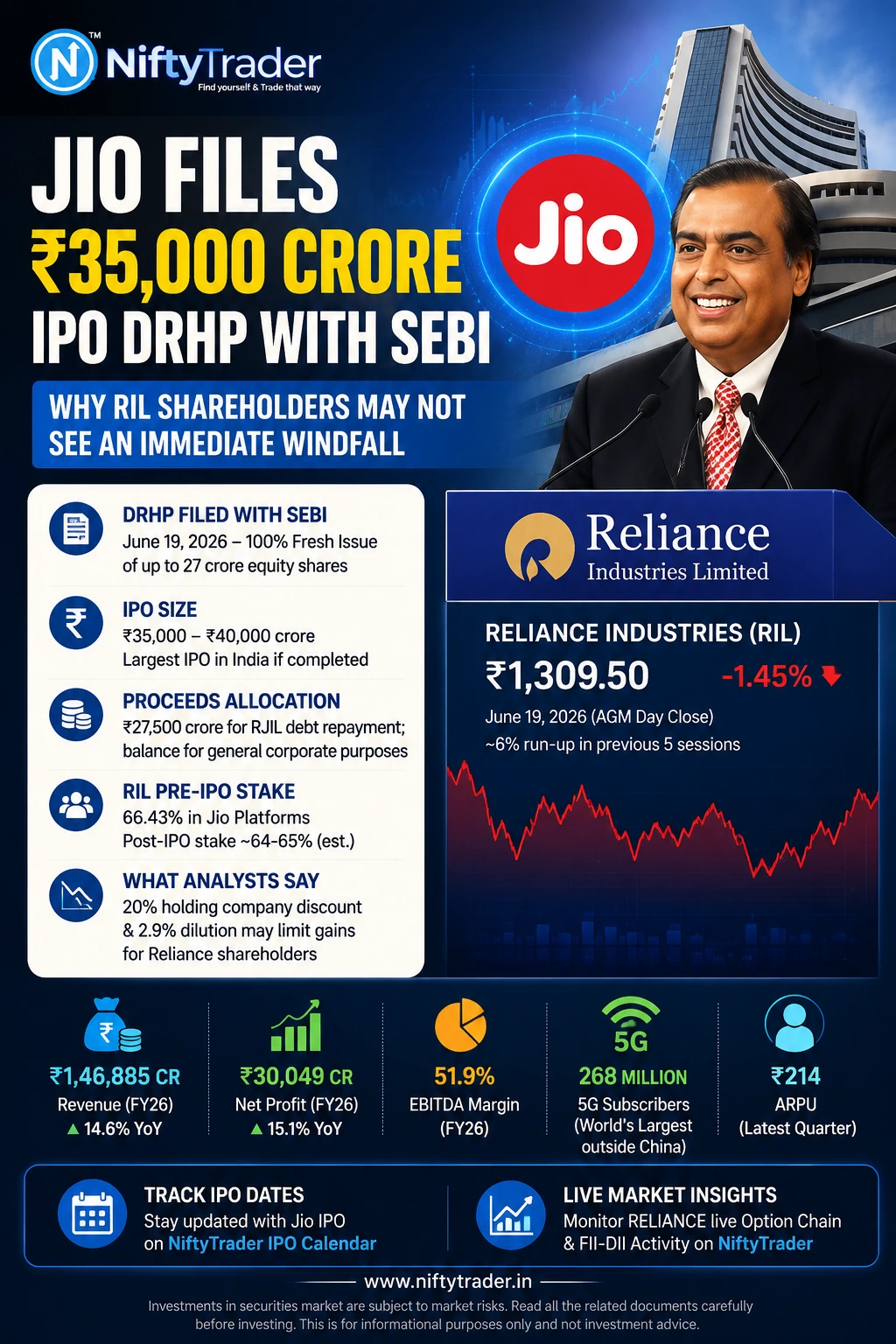
Jio Platforms officially filed its Draft Red Herring Prospectus (DRHP) with SEBI on June 19, 2026, confirmed by the national wire agency ANI and visible on SEBI’s own filings portal. Mukesh Ambani announced the development the same day at Reliance Industries’ 49th Annual General Meeting in Mumbai.
The DRHP, dated June 19, 2026, was filed just hours after the Jio Platforms board approved the draft offer document. The IPO is a 100% book-built fresh issue of up to 27 crore equity shares at a face value of Rs 10 each, with no Offer for Sale component, shares proposed for listing on NSE and BSE.
The company plans to use up to Rs 27,500 crore of IPO proceeds to repay debt at Reliance Jio Infocomm, with the balance earmarked for general corporate purposes.
At the anticipated issue size of Rs 35,000–40,000 crore, this would comfortably surpass the current Indian record of Rs 27,870 crore set by Hyundai Motor India in October 2024, making it the largest IPO in Indian market history, if completed at that level.
And yet, RIL stock closed at Rs 1,309.50 on AGM day, down 1.45%, after having already gained approximately 6% in the five trading sessions prior to the announcement, per NSE exchange data. The muted AGM-day reaction suggested investors may have already anticipated much of the announcement.
Market Reaction: RIL Shares Rebound After Filing
Reliance Industries shares climbed as much as 2.8% to ₹1,345 on the BSE after Jio Platforms filed its DRHP with SEBI for what could become India’s largest-ever IPO. The move partially reversed the muted reaction seen on AGM day, when investors appeared focused on valuation and holding-company discount concerns. The rebound suggests the market is beginning to assign value to the visibility and transparency that a separately listed Jio could bring.
Despite the positive reaction, analysts continue to caution that any long-term rerating of Reliance Industries will depend not only on Jio’s eventual valuation but also on execution across AI infrastructure, new energy projects, and future monetisation initiatives.
The One-Line Verdict Investors Need
Nuvama Institutional Equities noted that a holding company discount, where the parent entity trades at a lower valuation than the sum of its individual parts, could temper the direct financial uplift for RIL shareholders in the near term.
Combine that 20% structural discount with 2.9% equity dilution shared across 11 global investors, and a ~6% pre-AGM stock run-up, and the conclusion is clear: much of the value from the Jio IPO was priced into RIL shares before the DRHP was ever filed.
What the DRHP Confirms: Shareholding, Structure, and Scale
The promoter RIL holds 66.43% stake in Jio Platforms, with Google and Meta among the other significant shareholders, as confirmed in the DRHP filed with SEBI.
Meta Platforms (via Jaadhu Holdings) holds 9.98%, followed by Google International LLC at 7.73%. Saudi Arabia’s Public Investment Fund, along with KKR and Vista Equity Partners, each own 2.3%. Silver Lake and Mubadala Investment Company hold 1.88% and 1.85% respectively, while General Atlantic has a 1.34% stake and Abu Dhabi Investment Authority holds 1.16%.
This ownership structure has a direct implication: any valuation uplift from the listing is distributed across all these stakeholders, not channelled exclusively to Reliance Industries.
Post-IPO, RIL’s stake could decline to approximately 64–65%, depending on final issuance and capital structure, while Ambani family control of the board remains intact.
Jio’s Financials: The Numbers Are Not in Dispute
For FY26, Jio Platforms reported revenue of Rs 1,46,885 crore, up 14.6% YoY from Rs 1,28,218 crore in FY25. Net profit climbed 15.1% to Rs 30,049 crore. EBITDA grew 18.8% to Rs 76,255 crore, with margins expanding to 51.9% from 50.1% a year earlier.
Jio’s total user base crossed 524 million, including 268 million 5G subscribers, the world’s largest 5G footprint outside China. Net additions were 9.1 million in Q4 FY26, with churn steady at 1.7%. Average revenue per user rose 3.8% YoY to Rs 214, reflecting the residual benefit of the July 2024 tariff hike.
The one structural gap versus Airtel is ARPU. Airtel’s ARPU climbed to Rs 257 in Q4 FY26 from Rs 245 a year earlier. Jio’s Rs 214 versus Airtel’s Rs 257 is a 17% gap, the single most-watched monetisation metric ahead of the IPO and a key variable in how analysts disagree on valuation.
Jio vs. Airtel: Head-to-Head FY26 Comparison
| Metric | Jio Platforms (FY26) | Bharti Airtel (FY26) | Source |
|---|---|---|---|
| Revenue from Operations | Rs 1,46,885 crore | Rs 2,10,972 crore | Jio DRHP; Airtel FY26 results |
| Net Profit (PAT) | Rs 30,049 crore | Rs 33,823 crore | Jio DRHP; ICICI Direct FY26 analysis |
| EBITDA | Rs 76,255 crore | Rs 1,21,267 crore | Jio DRHP; Airtel FY26 results |
| EBITDA Margin | 51.9% | 57.5% | Jio DRHP; Airtel FY26 results |
| Total Subscribers | 524 million | 650 million+ | Jio DRHP; Airtel Q4 FY26 commentary |
| ARPU (Latest Quarter) | Rs 214 | Rs 257 | Jio DRHP; Airtel Q4 FY26 results |
| 5G Subscribers | 268 million | Not separately disclosed | Jio DRHP |
Jio leads on 5G scale and profit growth trajectory. Airtel commands the ARPU premium and higher absolute revenue, which is why analysts disagree sharply on whether Jio deserves the same or a higher per-subscriber valuation multiple.
The Holding Company Discount: The Structural Problem No One Is Fixing
Even at a $160–$170 billion Jio listing valuation, the gains for RIL shareholders are not a straight pass-through, and here is the arithmetic. Nuvama continues applying a 20% holding company discount to RIL’s digital business, at a $160 billion Jio valuation, that is a $32 billion discount baked structurally into how markets price RIL’s stake, before any dilution adjustment.
The valuation debate compounds this. Dolat Capital’s internal model pegs Jio closer to $110 billion, against the $130–$170 billion range per Bloomberg.
That gap translates to a Rs 50,000 crore-plus difference in the implied value of RIL’s stake. If the final issue price settles at the lower end of estimates, the “value unlocking” narrative loses substantial force.
Jio IPO: Complete Data Reference
| Parameter | Detail | Source |
|---|---|---|
| Issue Type | 100% Fresh Issue — No OFS | Jio DRHP, SEBI filing June 19, 2026 |
| Number of Shares | Up to 27 crore equity shares | Jio DRHP |
| Face Value | Rs 10 per share | Jio DRHP |
| Estimated Issue Size | Rs 35,000–40,000 crore | Industry estimates |
| Banker Valuation Range | $130–$170 billion | Bloomberg |
| Dolat Capital Estimate | ~$110 billion | Economic Times |
| Debt Repayment Allocation | Rs 27,500 crore (RJIL) | Jio DRHP |
| RIL Pre-IPO Stake | 66.43% | Jio DRHP (via ANI) |
| RIL Post-IPO Stake (est.) | ~64–65% | Analyst estimate; subject to final structure |
| Listing Exchange | NSE + BSE | Jio DRHP |
| SEBI Review Timeline | 30–75 days from filing | SEBI ICDR Regulations |
| Earliest Listing Window | August–October 2026 (analyst estimate) | IPOwiz, EasyFinance analysis |
| Current Indian IPO Record | Rs 27,870 crore — Hyundai Motor India (Oct 2024) | Business Standard, JP Morgan |
| Lead Managers | Morgan Stanley, Goldman Sachs, BofA, Axis Capital, HDFC Bank, JP Morgan, SBI Capital | Jio DRHP |
What the Market Has Already Said
Of 29 analysts tracked, 17 carry Strong Buy ratings on RIL, with 11 on Buy, a firmly bullish tilt despite the muted post-AGM share reaction. Nuvama’s Buy-rated target stands at Rs 1,765, against the June 19 closing price of approximately Rs 1,309, implying approximately 35% potential upside from that level.
YES Securities also carries a Buy with a target price of Rs 1,651 per share, noting that RIL’s capital deployment has prioritised expansion in digital, retail, and clean energy funded by strong operating cash flow.
Both brokerages are bullish, but their upside cases rest on new energy commissioning, AI infrastructure revenues, and a potential Reliance Retail listing, not the Jio IPO listing event itself.
The Shareholder Quota: What RIL Retail Investors Should Know Now
The DRHP includes a shareholder reservation category for eligible Reliance Industries shareholders, subject to the final offer terms and record date announcement. Existing RIL shareholders who hold shares in their demat account on the official record date, yet to be announced, will be eligible to apply through this separate reservation pool.
This quota is a separate reservation pool that typically faces lower competition than the general retail category in large, heavily subscribed IPOs, improving allotment probability compared to applying only through the retail category.
The record date has not been announced. Eligibility requirements and maximum application limits per category will be confirmed in the final Red Herring Prospectus after SEBI review.
Check NiftyTrader’s IPO Calendar for the Jio record date announcement and track FII-DII Activity for institutional positioning ahead of the listing.
Reliance Intelligence: The Real Rerating Catalyst
The AGM was not just about the DRHP. Reliance Intelligence will commission the first 120 megawatts of its AI infrastructure in Jamnagar by end of 2026, using an initial fleet of NVIDIA GB300 GPUs.
Akash Ambani said this capacity could scale to over 200,000 H100-equivalent GPUs, positioning the company among the world’s largest AI compute platforms. The facility will provide sovereign AI hosting within India, offering full model transparency and portability for enterprises.
Mukesh Ambani outlined five strategic pillars guiding Jio’s post-listing roadmap: JioTrue5G expansion, JioAirFiber proliferation, enterprise digitisation via JioPC, AI infrastructure development, and global technology exports.
Most brokerages attending the AGM concluded that these five pillars, and particularly the 120 MW Jamnagar commissioning timeline in H2 2026, represent a more direct near-term rerating trigger for RIL than the IPO DRHP filing.
Bottom Line
The Jio DRHP filing is confirmed, primary-source verified, and historically significant. The current Indian IPO record holder is Hyundai Motor India at Rs 27,870 crore, Jio’s estimated Rs 35,000–40,000 crore would decisively surpass that.
But for RIL shareholders watching for an immediate portfolio uplift: the 20% holding company discount Nuvama applies, a 2.9% dilution shared across 11 global investors ranging from Meta to sovereign wealth funds, a $60 billion valuation range disagreement between bankers and analysts, and a ~6% pre-AGM stock move that front-ran the announcement together mean the listing event itself is not where the rerating happens.
The rerating comes from execution, 120 MW of Jamnagar AI infrastructure commissioned by end-2026, new energy revenues appearing on the balance sheet in FY27, and a Reliance Retail listing timeline that remains unannounced. The Jio IPO opens a chapter. It does not close the valuation gap on its own.
Based on the June 19 DRHP filing and standard SEBI timelines of 30–75 days, the earliest realistic listing window is August–October 2026, price band and anchor investor dates to follow after SEBI observations are received.
Monitor RELIANCE derivatives positioning live on NiftyTrader’s Option Chain and track IPO subscription dates on the NiftyTrader IPO Calendar.
Disclaimer: This article is for informational and educational purposes only and does not constitute investment advice or a solicitation to subscribe to any securities offering. Investment in securities markets is subject to market risk. Please read all offer documents carefully before investing and consult a SEBI-registered investment adviser before making any financial decisions.